Directing in Management –
Principles and Techniques
1
Objectives
2
• Haveknowledge about Direction andits
principles.
• Learnabout issuingorders &characteristicsof
good order.
• Knowabout the importance andfunctions
characteristicsofgood order.
• Understand techniques of direction.
Introduction
3
• Direction ismanagementfunction performed
bythe top levelofficersof management.
• Direction ismanagement function performed
bythe top levelofficersof management.
• Everymanagergivesdirection to his
subordinates.
Definition
4
• Haimann: Thedirection isthe process&
techniques involvedin issuing instructions.
• KoontzandO’Donnel: Thedirection isthe
Interpersonal aspectof managing
• J.LMassie:Thedirection ismanageris
influencedthe actions to his subordinates
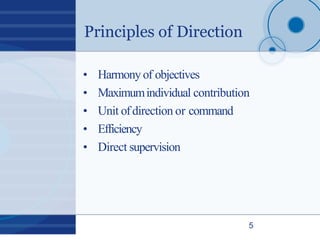
Principles of Direction
5
• Harmony of objectives
• Maximumindividual contribution
• Unit ofdirection or command
• Efficiency
• Direct supervision
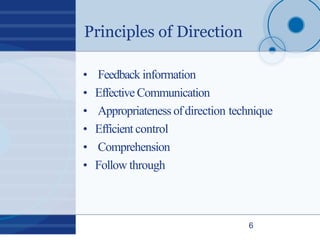
Principles of Direction
6
• Feedback information
• Effective Communication
• Appropriateness ofdirection technique
• Efficient control
• Comprehension
• Follow through
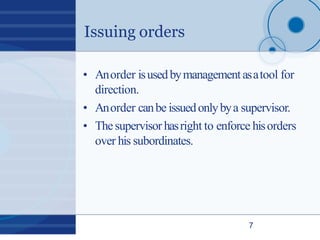
Issuing orders
7
• Anorder isusedbymanagementasatool for
direction.
• Anorder canbe issuedonlybya supervisor.
• Thesupervisorhasright to enforce hisorders
over his subordinates.
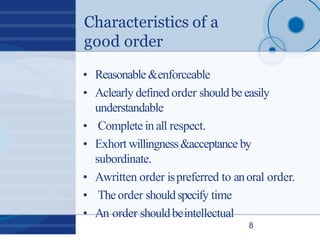
Characteristics of a
good order
8
• Reasonable&enforceable
• Aclearly definedorder shouldbe easily
understandable
• Complete in all respect.
• Exhort willingness&acceptance by
subordinate.
• Awritten order ispreferred to anoral order.
• Theorder shouldspecify time
• An order shouldbeintellectual
Techniques of
Direction
9
• Consultative
• Free rein
• Autocratic
Importance of
Direction
10
• Thedirection initiates action.
• Co-ordinates group effort
• Ensuresmaximumindividual contribution
• Reducesreluctance to put up with changesin
organization
• Providesstability and balance.
• Helpsto achieve objectives
Characteristics of
Direction
11
• One ofmanagerial function
• Managementinitiates actionthrough direction.
• Direction iscontinuousthroughout lifecycleof
organization .
• Thesubordinates directed by superiors.
• Subordinates do the thingsasper original plan.
• Direction creates linkbetween preparatory &
control functions.
Summary
12
• Direction ismanagementfunction performed
bythe top levelofficersof management.
• Direction istelling people what to do and
seeingthat they do it.
• Theprinciplesofdirections isUnit of
direction, Feedbackinformation &harmonyof
objectives

Directing in Management - Principles and Techniques

  • 1.
    Directing in Management– Principles and Techniques 1
  • 2.
    Objectives 2 • Haveknowledge aboutDirection andits principles. • Learnabout issuingorders &characteristicsof good order. • Knowabout the importance andfunctions characteristicsofgood order. • Understand techniques of direction.
  • 3.
    Introduction 3 • Direction ismanagementfunctionperformed bythe top levelofficersof management. • Direction ismanagement function performed bythe top levelofficersof management. • Everymanagergivesdirection to his subordinates.
  • 4.
    Definition 4 • Haimann: Thedirectionisthe process& techniques involvedin issuing instructions. • KoontzandO’Donnel: Thedirection isthe Interpersonal aspectof managing • J.LMassie:Thedirection ismanageris influencedthe actions to his subordinates
  • 5.
    Principles of Direction 5 •Harmony of objectives • Maximumindividual contribution • Unit ofdirection or command • Efficiency • Direct supervision
  • 6.
    Principles of Direction 6 •Feedback information • Effective Communication • Appropriateness ofdirection technique • Efficient control • Comprehension • Follow through
  • 7.
    Issuing orders 7 • Anorderisusedbymanagementasatool for direction. • Anorder canbe issuedonlybya supervisor. • Thesupervisorhasright to enforce hisorders over his subordinates.
  • 8.
    Characteristics of a goodorder 8 • Reasonable&enforceable • Aclearly definedorder shouldbe easily understandable • Complete in all respect. • Exhort willingness&acceptance by subordinate. • Awritten order ispreferred to anoral order. • Theorder shouldspecify time • An order shouldbeintellectual
  • 9.
  • 10.
    Importance of Direction 10 • Thedirectioninitiates action. • Co-ordinates group effort • Ensuresmaximumindividual contribution • Reducesreluctance to put up with changesin organization • Providesstability and balance. • Helpsto achieve objectives
  • 11.
    Characteristics of Direction 11 • Oneofmanagerial function • Managementinitiates actionthrough direction. • Direction iscontinuousthroughout lifecycleof organization . • Thesubordinates directed by superiors. • Subordinates do the thingsasper original plan. • Direction creates linkbetween preparatory & control functions.
  • 12.
    Summary 12 • Direction ismanagementfunctionperformed bythe top levelofficersof management. • Direction istelling people what to do and seeingthat they do it. • Theprinciplesofdirections isUnit of direction, Feedbackinformation &harmonyof objectives