1
Planning Process
Dr. S K Maheshwari
Ph D (INC Consortium), M Sc Nursing (AIIMS, Delhi), M A (Public Adm.)
Associate Professor
University College of Nursing, BFUHS,
Faridkot, Punjab- 151203 (India)
PLANNING IS PART AND
PARCEL OF LIFE
Introduction
 Planning is necessary in Health care system
because it is in stage of restructuring:
 Patient empowerment
 Efficient and effective use of sources (MMMTT).
 Emphasis on health promotion and prevention.
 Establishment of professional training centers.
Planning
 Deciding in advance (what, who, when,
where and how ) about something is to be
done.
Planning
 A continuous process,
 beginning with the setting of goals and objectives
and then
 laying out a plan of action to accomplish them,
 put them into play,
 review the process and the outcomes,
 provide feedback to personnel and
 modify as needed.
Planning
 The process of coping with uncertainty by
formulating courses of action to achieve
specified results.
 The determination of what is to be
accomplished. (Bernard and walsh)
The management process
Organizing
StaffingDirecting
Controlling
Planning
A Plan
 A specific documented
intention consisting of an
objective and an action
statement.
 Written document, which
serves as a blue print as
a for the future action.
Planning in Nursing Management
 A basic function of nursing management.
 This plan of action must have unity,
continuity, flexibility and precision”. (Fayol)
Purpose for planning in nursing
1. To increase the chance of success
2. Best use of resources- Cost effective
3. To forces analytical thinking and improves
decisions
4. To orients people to action
5. To avoid crisis in nursing management
6. To increases employee involvement and
improves communication
Area of Planning in Nursing
 Budgets and fund raising
 Recruitment, rotation and staffing
 Workshop/ conference/CNE organizing planning
 Examination
 Day to day patient care planning
 Community services planning
 Curriculum planning, students rotation
 Planning for establishment of hospital nursing
services /SON/ CON
Planning modes
1. Reactive planning –
• Done in response to crisis, no integration in whole organization.
• Can lead to hasty decisions and mistakes.
1. Inactivism –
• Spend a great energy to prevent change and conformity.
• When changes occur, slowly and incrementally.
1. Preactivism –
• Use technology to accelerate change and future oriented.
• Unsatisfied with past & present, do not value experience
1. Interactive or proactive planning-
• Present, past and future is considered, key element is adaptation,
• minimize risk and uncertainty, encourage the best use of
resources.
• provides the leaders with means of control, dynamic
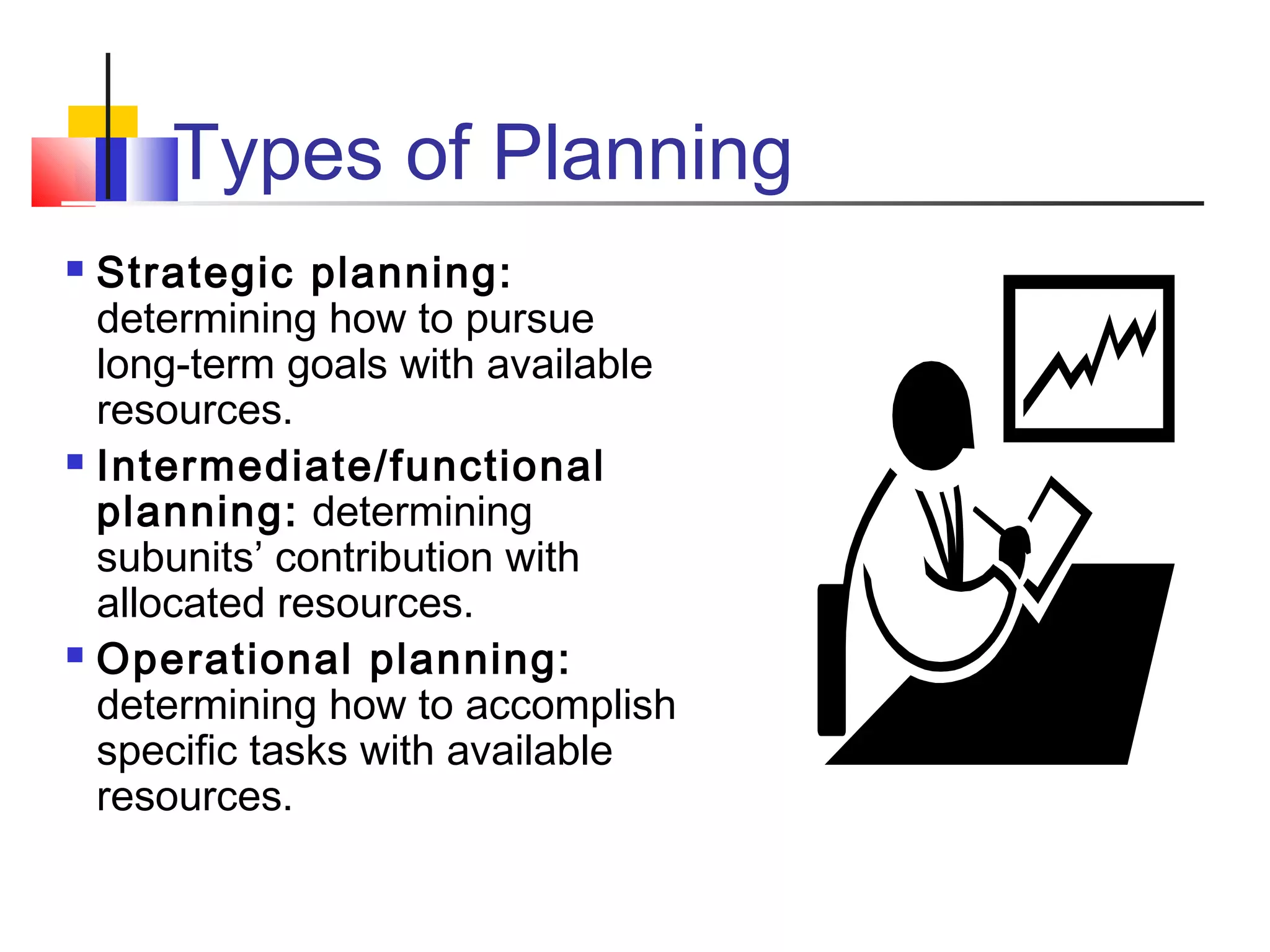
Types of Planning
 Strategic planning:
determining how to pursue
long-term goals with available
resources.
 Intermediate/functional
planning: determining
subunits’ contribution with
allocated resources.
 Operational planning:
determining how to accomplish
specific tasks with available
resources.
Types of Planning contd…
Strategic planning
 “An ongoing, future-oriented, values-based
process that empowers an organization and its
members to identify action strategically necessary
to accomplish its mission in an ever-changing and
diverse environment. (Safrit, 1998)
The Planning Hierarchy
Mission
Philosophy
Goals
Objectives
Policies
Procedures
Rules
General
Specific
planning
component
Mission or purpose
 It describes the purpose for which that
organization exists
 1st
step in strategic planning process
 It moves, guides and delivers the organization to
its perceived goal and provide vision
Vision
 It is an image of the future
the organization seeks to
create
Values
 These are concepts of perceived worth or
importance
 Eg. creativity, honesty, courtesy, caring
 These are morale rationale for business/work.
 Value statements make employees feel proud and
managers feel committed
 Values bond people and set behavioral standards
Philosophy
 The philosophy flows from the mission statement
and delineates the set of values and beliefs that
guides all actions of the organization
 It is the basic foundation that directs all further
planning toward achievement of mission.
 Philosophy which cannot be implemented is
useless
Philosophy.. example
 “We believe that our hospital is dedicated to
excellence in the fields of patient care,
teaching and research and
 We are dedicated to providing most effective
and efficient patient care”
Goals
 Goals setting is the process of developing,
negotiating and formalizing the objectives
that an employee is responsible
accomplishment.
 Help nurse administrator to focus attention
on what is relevant and important.
 Help to develop strategies and action to
achieve the goals.
Objectives
 Concrete and specific statements of the
goals that nurse managers seek to
accomplish.
 They are action commitments through which
the key elements of the mission will be
achieved and the philosophy sustained.
 Objectives are usually "milestones" along
the way when implementing the strategies.
Procedures
 These are plans that have been reduced to
a sequence of steps of required action
 They identify steps needed to implement a
policy
 Generally found in manuals at unit level
 They establish an acceptable way of
accomplishing a task with rationales for
each activities
Tasks
 Particularly in small organizations, people
are assigned various tasks required to
implement the plan.
 If the scope of the plan is very small, tasks
and activities are often essentially the same.
Rules and Regulation
 These are plans that define specific action
or non action
 They describe situations that allow only one
choice of action
 Least flexible, so there should be few rules
in the organization.
Action Strategies
 Specific work plans leading the organization
toward positive and desired future
Stakeholders
 A person who is involved in particular
organization/project. Because he has
invested money.
 Current users of the organization
 Potential users of the organization
 People affected by the work of the
organization
Resources and Budgets
 Resources include the man, materials,
technologies, money, etc., required to
implement the strategies or processes.
 The costs of these resources are often
depicted in the form of a budget.
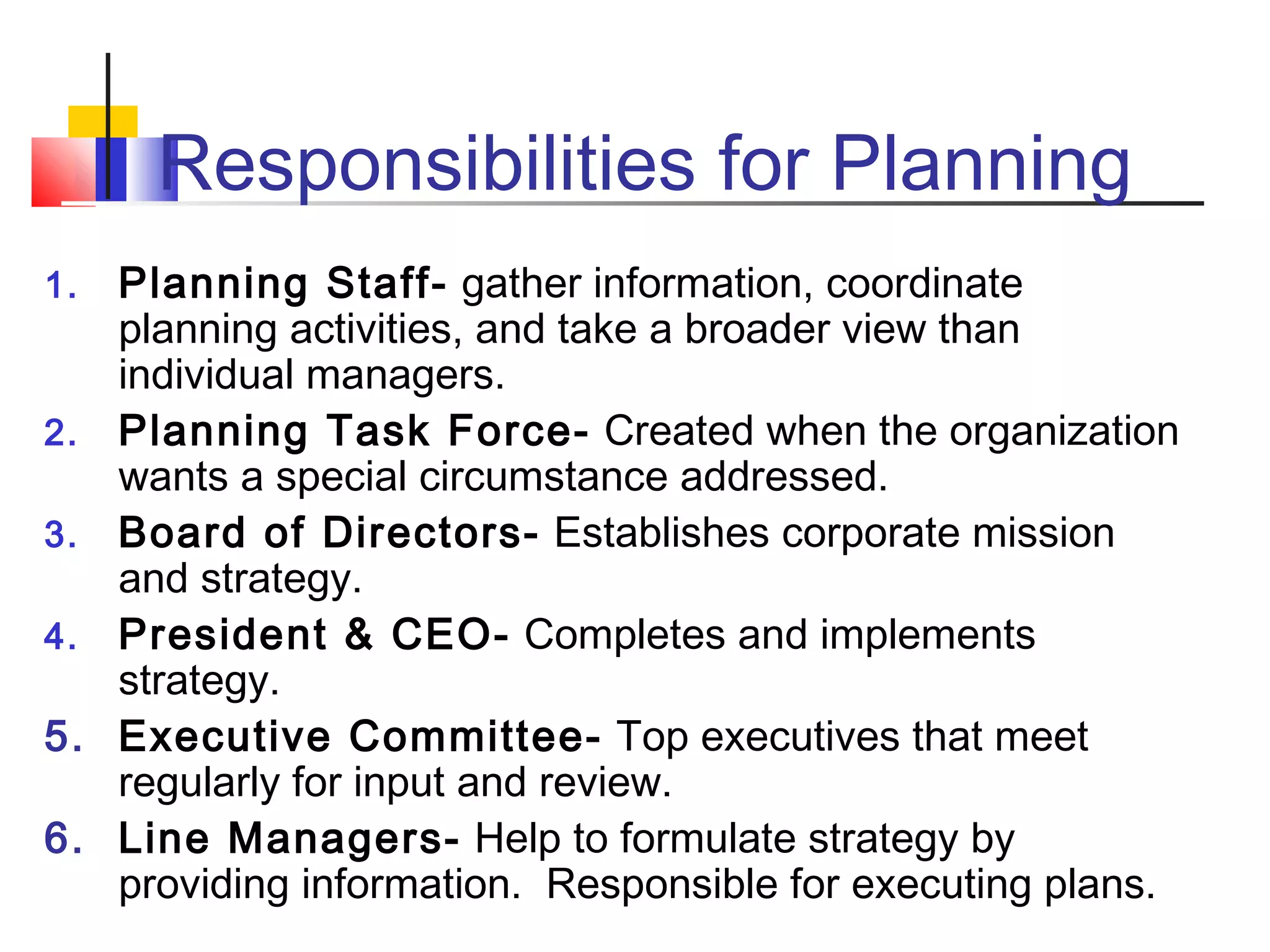
Responsibilities for Planning
1. Planning Staff- gather information, coordinate
planning activities, and take a broader view than
individual managers.
2. Planning Task Force- Created when the organization
wants a special circumstance addressed.
3. Board of Directors- Establishes corporate mission
and strategy.
4. President & CEO- Completes and implements
strategy.
5. Executive Committee- Top executives that meet
regularly for input and review.
6. Line Managers- Help to formulate strategy by
providing information. Responsible for executing plans.
Barriers to planning in nursing
 Lack of knowledge regarding philosophy, goals.
 Lack of skill about how to plan
 Focus on day to day operations rather than short
term and long term plans
 Consistent use of reactive rather than proactive
planning
 Lack of understanding about the external
environment’s impact on planning
 Inadequate intra organizational support
 Inappropriate use of plans
Barriers to planning in nursing contd…
 No Time
 Staff resistance to change.
 Board members or stakeholders
 Planning is non-productive use of time
 Previous bad planning experience
 Poor management
 Plans used to control rather than inspire or lead.
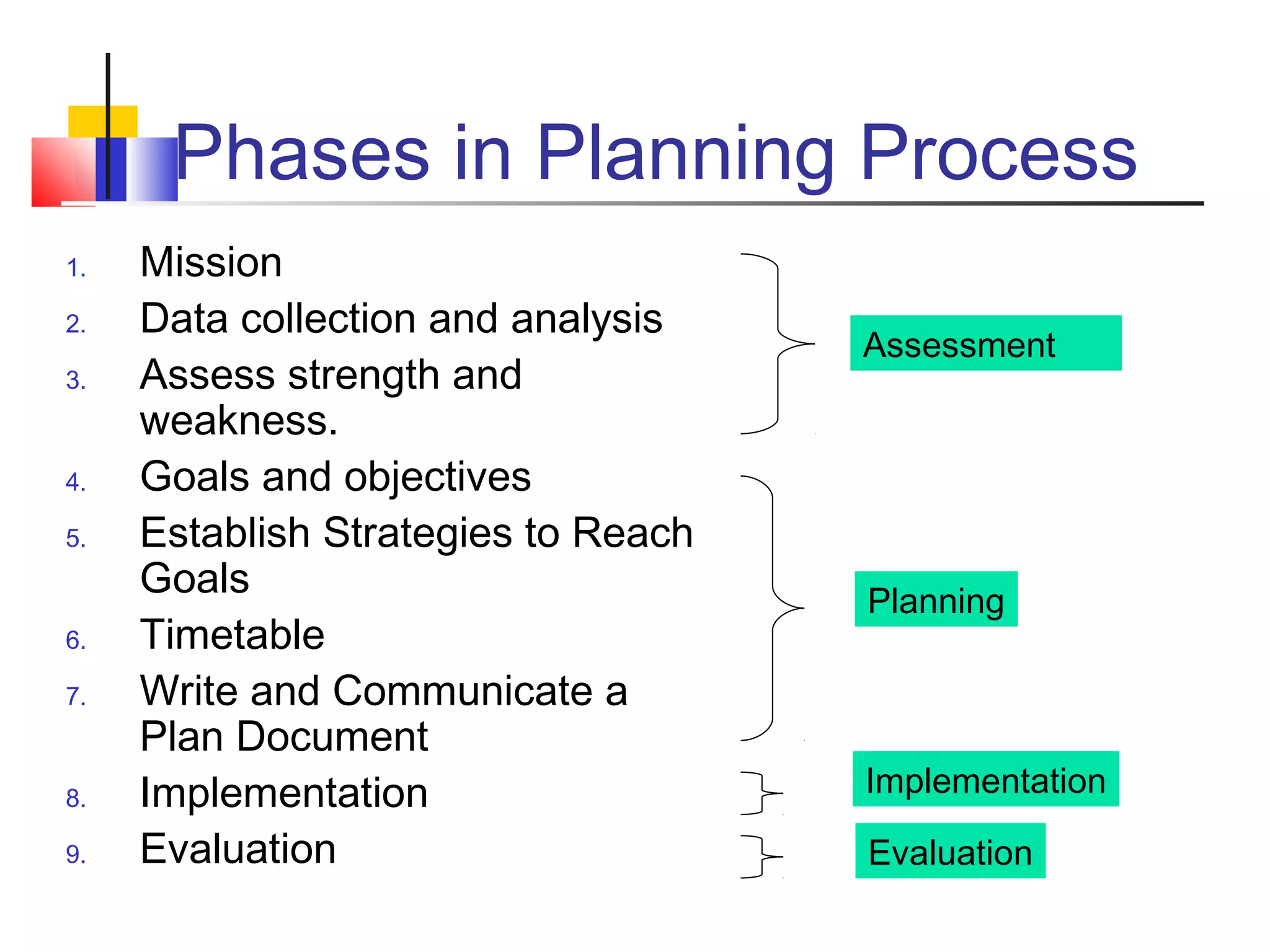
Phases in Planning Process
1. Mission
2. Data collection and analysis
3. Assess strength and
weakness.
4. Goals and objectives
5. Establish Strategies to Reach
Goals
6. Timetable
7. Write and Communicate a
Plan Document
8. Implementation
9. Evaluation
Assessment
Planning
Implementation
Evaluation
Phases in Planning Process contd…
1. Mission
 During planning, planners have in mind
(consciously or unconsciously) some overall
purpose or result that the plan is to achieve.
 For example, during strategic planning, it's
critical to reference the mission, or overall
purpose, of the organization.
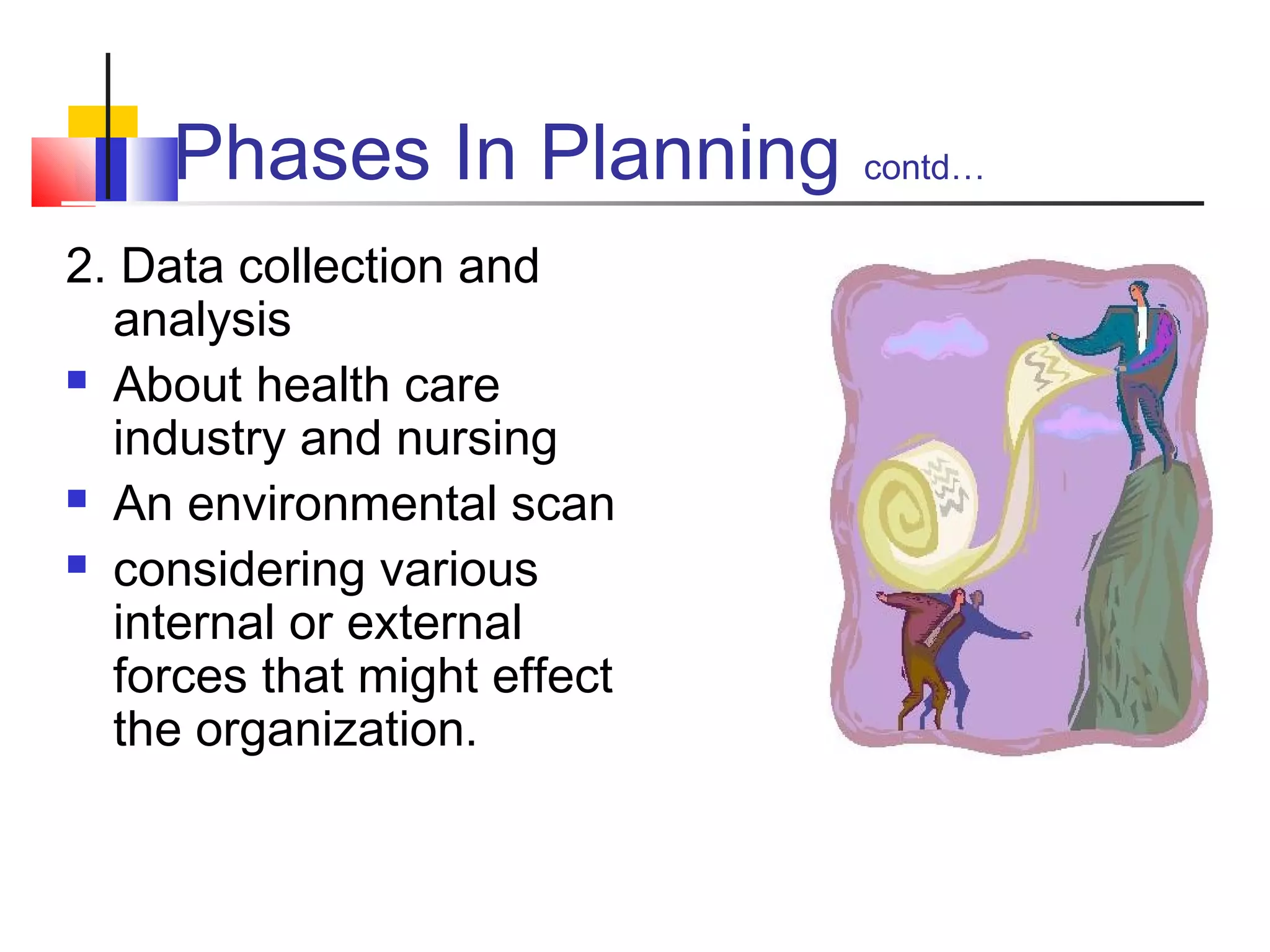
Phases In Planning contd…
2. Data collection and
analysis
 About health care
industry and nursing
 An environmental scan
 considering various
internal or external
forces that might effect
the organization.
Phases In Planning contd…
Assessment of external
environment
 Markets
 Competition
 Health care trends
 Economic factors
 Technology
 Social factors
 Educational factors
Assessment of internal
environment
 Patient care
 Financial resources
 Human resources
 Information system
 Research and
development capabilities
 Educational system
Phases In Planning contd…
3. Assess strength and weakness. For exa.
During strategic planning, planners often
conduct a "SWOT analysis".
 Define the current position and strength of the
unit
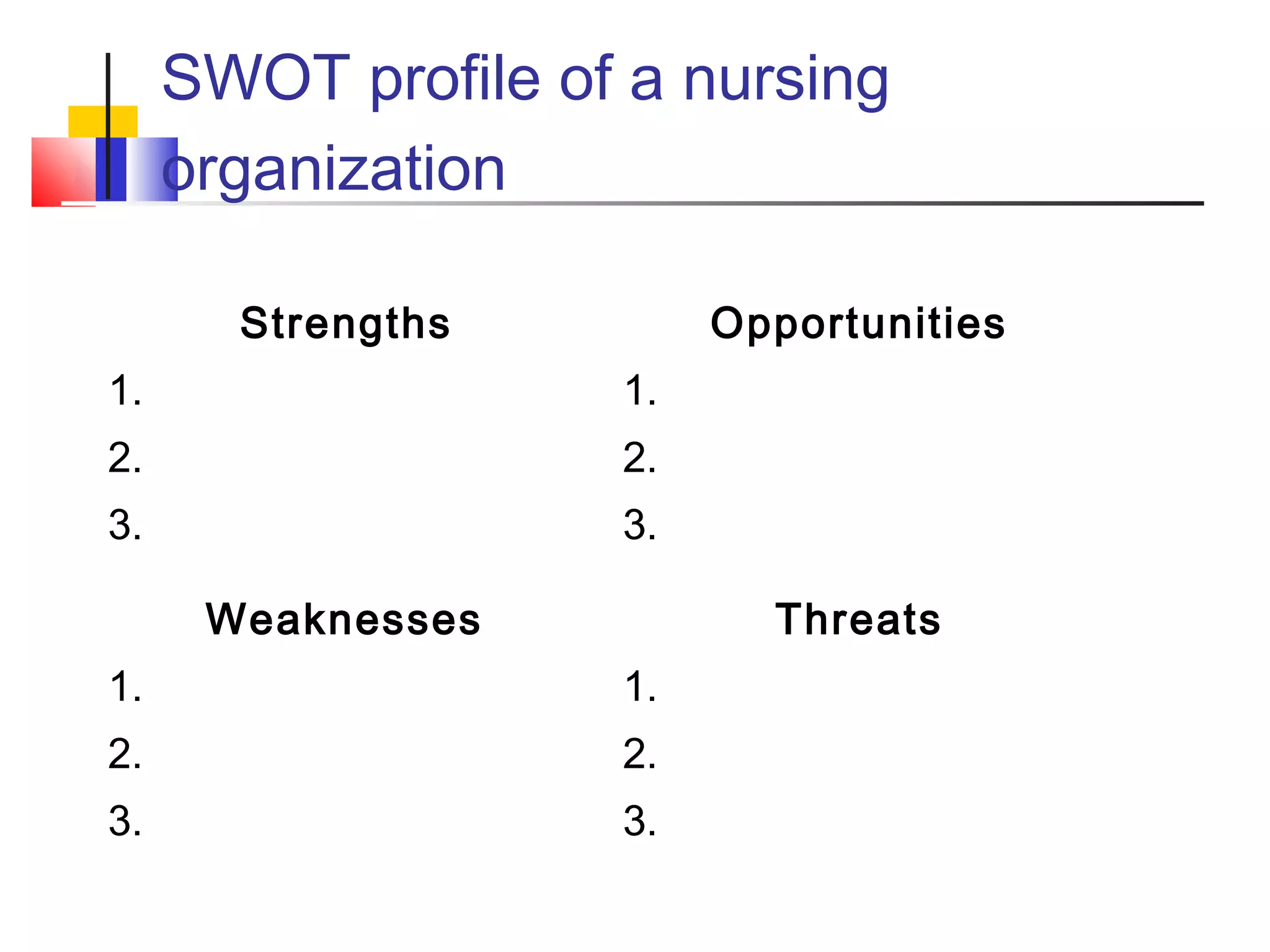
SWOT profile of a nursing
organization
Strengths
1.
2.
3.
Opportunities
1.
2.
3.
Weaknesses
1.
2.
3.
Threats
1.
2.
3.
Phases In Planning contd…
4. Goals and objectives
 Based on the analysis and alignment to the overall
mission of the system, planners establish a set of
goals that build on strengths to take advantage of
opportunities, while binding up weaknesses and
warding off threats.
 Goals are broken to objectives to be accomplished
in next 1-5 years
Phases In Planning contd…
5. Establish strategies to reach goals
 The particular strategies (or methods to
reach the goals) chosen depend on matters
of affordability, practicality and efficiency.
Phases In Planning contd…
6. Timetable
 Attach responsibilities and time lines with
each objective
 Responsibilities are assigned for
implementation of the plan, and for
achieving various goals and objectives.
 Deadlines are set for meeting each
responsibility.
Phases In Planning contd…
7. Write and Communicate a Plan Document
 Operational and functional plans
 The information is organized and written in a
document which is distributed around the system.
 Plan includes detailed action, policies, practices,
communication and feedback, controlling and
evaluation plans, budgets and persons to be held
accountable
Operational plan
 These are everyday working management plans
developed from both long range objectives and the
strategic planning process and short range or
tactical plans
 It is the written blueprint for achieving objectives
 It specifies the activities and procedures that will be
used
 Sets timetables for achieving objectives
 It tells who is responsible for what activity or
procedure
 It specifies the records to be kept and policies
needed
Objective
Actions Target
Dates
Accomplishments
Operational plan contd…
Functional plan contd…
 Functional plan- nursing planning
performed at a service or departmental level
 It relates to a specialty service within a
nursing division
Phases In Planning contd…
8. Implementation
 Put plan to work
9. Evaluation
 Formative and summative evaluation
 Feedback is provided to modify and update the
plan
Guidelines for Successful
Organizational Planning
 The movement within organization should
be directed at specified goals and objectives
 Plan must be flexible
 Involve people that could be affected by the
course of action
 Plan should be simple, specific and realistic
 Know when to plan and when not to plan
Guidelines for Successful Planning
and Implementation
 Must be written and communicated widely
 Goals and objectives should be SMARTER
 Build in accountability (Regularly Review Who's
Doing What and By When?)
 Note deviations from the plan and re-plan
accordingly
 Evaluate the plan and planning process
Summary
 Planning is primary and essential element of
management.
 Strategic planning sets objectives for 1-10 years.
 Intermediate planning is short range planning.
 Operational planning is daily, weekly and monthly
planning and provide data for strategic and
tactical planning to keep in motion.
Plan Today
for a
Successful Tomorrow
References
 www.managementhelp.org/plan
 www.nursing/adminsitration.com
 Marquis and Huston, Leadership roles and management
functions in nursing, Lippincott 2nd
edition, 55-73
 Wise Y, Leading and managing in nursing, Mosby, 1st
edition, 66-87
 Swansburg and Swansburg, Introductory management and
leadership for nurses, 2nd
edition
 Russal Linda, Management and leadership for nurse
administrators,Jones and Bartlett Publishers, 1st
editon,
215-247

Planning process nursing

  • 1.
    1 Planning Process Dr. SK Maheshwari Ph D (INC Consortium), M Sc Nursing (AIIMS, Delhi), M A (Public Adm.) Associate Professor University College of Nursing, BFUHS, Faridkot, Punjab- 151203 (India)
  • 4.
    PLANNING IS PARTAND PARCEL OF LIFE
  • 5.
    Introduction  Planning isnecessary in Health care system because it is in stage of restructuring:  Patient empowerment  Efficient and effective use of sources (MMMTT).  Emphasis on health promotion and prevention.  Establishment of professional training centers.
  • 6.
    Planning  Deciding inadvance (what, who, when, where and how ) about something is to be done.
  • 7.
    Planning  A continuousprocess,  beginning with the setting of goals and objectives and then  laying out a plan of action to accomplish them,  put them into play,  review the process and the outcomes,  provide feedback to personnel and  modify as needed.
  • 8.
    Planning  The processof coping with uncertainty by formulating courses of action to achieve specified results.  The determination of what is to be accomplished. (Bernard and walsh)
  • 9.
  • 10.
    A Plan  Aspecific documented intention consisting of an objective and an action statement.  Written document, which serves as a blue print as a for the future action.
  • 11.
    Planning in NursingManagement  A basic function of nursing management.  This plan of action must have unity, continuity, flexibility and precision”. (Fayol)
  • 12.
    Purpose for planningin nursing 1. To increase the chance of success 2. Best use of resources- Cost effective 3. To forces analytical thinking and improves decisions 4. To orients people to action 5. To avoid crisis in nursing management 6. To increases employee involvement and improves communication
  • 13.
    Area of Planningin Nursing  Budgets and fund raising  Recruitment, rotation and staffing  Workshop/ conference/CNE organizing planning  Examination  Day to day patient care planning  Community services planning  Curriculum planning, students rotation  Planning for establishment of hospital nursing services /SON/ CON
  • 14.
    Planning modes 1. Reactiveplanning – • Done in response to crisis, no integration in whole organization. • Can lead to hasty decisions and mistakes. 1. Inactivism – • Spend a great energy to prevent change and conformity. • When changes occur, slowly and incrementally. 1. Preactivism – • Use technology to accelerate change and future oriented. • Unsatisfied with past & present, do not value experience 1. Interactive or proactive planning- • Present, past and future is considered, key element is adaptation, • minimize risk and uncertainty, encourage the best use of resources. • provides the leaders with means of control, dynamic
  • 15.
    Types of Planning Strategic planning: determining how to pursue long-term goals with available resources.  Intermediate/functional planning: determining subunits’ contribution with allocated resources.  Operational planning: determining how to accomplish specific tasks with available resources.
  • 16.
  • 17.
    Strategic planning  “Anongoing, future-oriented, values-based process that empowers an organization and its members to identify action strategically necessary to accomplish its mission in an ever-changing and diverse environment. (Safrit, 1998)
  • 18.
  • 19.
    Mission or purpose It describes the purpose for which that organization exists  1st step in strategic planning process  It moves, guides and delivers the organization to its perceived goal and provide vision
  • 20.
    Vision  It isan image of the future the organization seeks to create
  • 21.
    Values  These areconcepts of perceived worth or importance  Eg. creativity, honesty, courtesy, caring  These are morale rationale for business/work.  Value statements make employees feel proud and managers feel committed  Values bond people and set behavioral standards
  • 22.
    Philosophy  The philosophyflows from the mission statement and delineates the set of values and beliefs that guides all actions of the organization  It is the basic foundation that directs all further planning toward achievement of mission.  Philosophy which cannot be implemented is useless
  • 23.
    Philosophy.. example  “Webelieve that our hospital is dedicated to excellence in the fields of patient care, teaching and research and  We are dedicated to providing most effective and efficient patient care”
  • 24.
    Goals  Goals settingis the process of developing, negotiating and formalizing the objectives that an employee is responsible accomplishment.  Help nurse administrator to focus attention on what is relevant and important.  Help to develop strategies and action to achieve the goals.
  • 25.
    Objectives  Concrete andspecific statements of the goals that nurse managers seek to accomplish.  They are action commitments through which the key elements of the mission will be achieved and the philosophy sustained.  Objectives are usually "milestones" along the way when implementing the strategies.
  • 26.
    Procedures  These areplans that have been reduced to a sequence of steps of required action  They identify steps needed to implement a policy  Generally found in manuals at unit level  They establish an acceptable way of accomplishing a task with rationales for each activities
  • 27.
    Tasks  Particularly insmall organizations, people are assigned various tasks required to implement the plan.  If the scope of the plan is very small, tasks and activities are often essentially the same.
  • 28.
    Rules and Regulation These are plans that define specific action or non action  They describe situations that allow only one choice of action  Least flexible, so there should be few rules in the organization.
  • 29.
    Action Strategies  Specificwork plans leading the organization toward positive and desired future
  • 30.
    Stakeholders  A personwho is involved in particular organization/project. Because he has invested money.  Current users of the organization  Potential users of the organization  People affected by the work of the organization
  • 31.
    Resources and Budgets Resources include the man, materials, technologies, money, etc., required to implement the strategies or processes.  The costs of these resources are often depicted in the form of a budget.
  • 32.
    Responsibilities for Planning 1.Planning Staff- gather information, coordinate planning activities, and take a broader view than individual managers. 2. Planning Task Force- Created when the organization wants a special circumstance addressed. 3. Board of Directors- Establishes corporate mission and strategy. 4. President & CEO- Completes and implements strategy. 5. Executive Committee- Top executives that meet regularly for input and review. 6. Line Managers- Help to formulate strategy by providing information. Responsible for executing plans.
  • 33.
    Barriers to planningin nursing  Lack of knowledge regarding philosophy, goals.  Lack of skill about how to plan  Focus on day to day operations rather than short term and long term plans  Consistent use of reactive rather than proactive planning  Lack of understanding about the external environment’s impact on planning  Inadequate intra organizational support  Inappropriate use of plans
  • 34.
    Barriers to planningin nursing contd…  No Time  Staff resistance to change.  Board members or stakeholders  Planning is non-productive use of time  Previous bad planning experience  Poor management  Plans used to control rather than inspire or lead.
  • 35.
    Phases in PlanningProcess 1. Mission 2. Data collection and analysis 3. Assess strength and weakness. 4. Goals and objectives 5. Establish Strategies to Reach Goals 6. Timetable 7. Write and Communicate a Plan Document 8. Implementation 9. Evaluation Assessment Planning Implementation Evaluation
  • 36.
    Phases in PlanningProcess contd… 1. Mission  During planning, planners have in mind (consciously or unconsciously) some overall purpose or result that the plan is to achieve.  For example, during strategic planning, it's critical to reference the mission, or overall purpose, of the organization.
  • 37.
    Phases In Planningcontd… 2. Data collection and analysis  About health care industry and nursing  An environmental scan  considering various internal or external forces that might effect the organization.
  • 38.
    Phases In Planningcontd… Assessment of external environment  Markets  Competition  Health care trends  Economic factors  Technology  Social factors  Educational factors Assessment of internal environment  Patient care  Financial resources  Human resources  Information system  Research and development capabilities  Educational system
  • 39.
    Phases In Planningcontd… 3. Assess strength and weakness. For exa. During strategic planning, planners often conduct a "SWOT analysis".  Define the current position and strength of the unit
  • 40.
    SWOT profile ofa nursing organization Strengths 1. 2. 3. Opportunities 1. 2. 3. Weaknesses 1. 2. 3. Threats 1. 2. 3.
  • 41.
    Phases In Planningcontd… 4. Goals and objectives  Based on the analysis and alignment to the overall mission of the system, planners establish a set of goals that build on strengths to take advantage of opportunities, while binding up weaknesses and warding off threats.  Goals are broken to objectives to be accomplished in next 1-5 years
  • 42.
    Phases In Planningcontd… 5. Establish strategies to reach goals  The particular strategies (or methods to reach the goals) chosen depend on matters of affordability, practicality and efficiency.
  • 43.
    Phases In Planningcontd… 6. Timetable  Attach responsibilities and time lines with each objective  Responsibilities are assigned for implementation of the plan, and for achieving various goals and objectives.  Deadlines are set for meeting each responsibility.
  • 44.
    Phases In Planningcontd… 7. Write and Communicate a Plan Document  Operational and functional plans  The information is organized and written in a document which is distributed around the system.  Plan includes detailed action, policies, practices, communication and feedback, controlling and evaluation plans, budgets and persons to be held accountable
  • 45.
    Operational plan  Theseare everyday working management plans developed from both long range objectives and the strategic planning process and short range or tactical plans  It is the written blueprint for achieving objectives  It specifies the activities and procedures that will be used  Sets timetables for achieving objectives  It tells who is responsible for what activity or procedure  It specifies the records to be kept and policies needed
  • 46.
  • 47.
    Functional plan contd… Functional plan- nursing planning performed at a service or departmental level  It relates to a specialty service within a nursing division
  • 48.
    Phases In Planningcontd… 8. Implementation  Put plan to work 9. Evaluation  Formative and summative evaluation  Feedback is provided to modify and update the plan
  • 49.
    Guidelines for Successful OrganizationalPlanning  The movement within organization should be directed at specified goals and objectives  Plan must be flexible  Involve people that could be affected by the course of action  Plan should be simple, specific and realistic  Know when to plan and when not to plan
  • 50.
    Guidelines for SuccessfulPlanning and Implementation  Must be written and communicated widely  Goals and objectives should be SMARTER  Build in accountability (Regularly Review Who's Doing What and By When?)  Note deviations from the plan and re-plan accordingly  Evaluate the plan and planning process
  • 51.
    Summary  Planning isprimary and essential element of management.  Strategic planning sets objectives for 1-10 years.  Intermediate planning is short range planning.  Operational planning is daily, weekly and monthly planning and provide data for strategic and tactical planning to keep in motion.
  • 52.
  • 53.
    References  www.managementhelp.org/plan  www.nursing/adminsitration.com Marquis and Huston, Leadership roles and management functions in nursing, Lippincott 2nd edition, 55-73  Wise Y, Leading and managing in nursing, Mosby, 1st edition, 66-87  Swansburg and Swansburg, Introductory management and leadership for nurses, 2nd edition  Russal Linda, Management and leadership for nurse administrators,Jones and Bartlett Publishers, 1st editon, 215-247