MANAGEMENT PROCESS:
PLANNING
Mr.Visanth V S
Asso. Professor
Dept. of Mental Health Nursing
Indira Gandhi College of Nursing, Amethi
MANAGEMENT
• Management is the attainment of
organizational goals in an effective and
efficient manner through planning,
organizing, staffing, directing and
controlling organizational resources.
• A process is a series of steps or actions
which lead to achieve a goal and it is
dynamic.
Definitions
• Louis E Boone & David L Kurtz- The use of
people and other resources to accomplish
objectives.
• Mary Parker Follet- the act of getting things done
through people.
• Frederick Taylor defines Management as the art
of knowing what you want to do in the best and
cheapest way.
• Able to do something.
• Able to complete some task as instructed or
self-directed.
Manage
• A person who is in charge of getting something done
• A person who is in charge of an area of the work
force
• Carries out managerial roles.
Manag
er
• The art of getting things done.
• The technique of getting goal achieved.
• The way a person runs the organization.
Management
Concepts
FUNCTIONS OF
MANAGEMENT
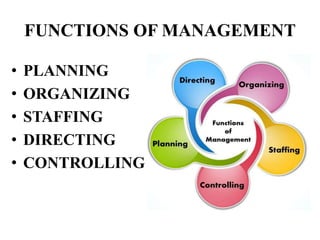
FUNCTIONS OF MANAGEMENT
• PLANNING
• ORGANIZING
• STAFFING
• DIRECTING
• CONTROLLING
PLANNING
• Planning is the first and fundamental function of
management because all other management
functions are dependent on it.
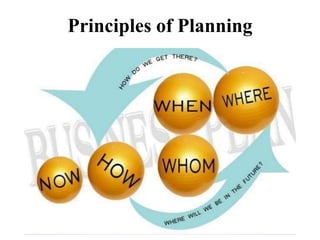
• Planning is deciding what is to be done, when it
is to be done, how it is to be done and who is to
do it.
• It is an orderly process that gives organizational
direction.
Definition
•
• According to Willet, “Planning is the process
of determining the objectives of administrative
effort and of devising the means calculated to
achieve them”.
Purposes of Planning
• It gives direction to the organization. ™
• It improves efficiency and meaning to work.
• It eliminates duplication of efforts. ™
• It concentrates resources on important services. ™
• It reduces guess work.
• It improves communication and coordination of
activities.
• It is based on the past and future thus helping to
reduce the element of change and discover need
for change.
Nature & Characteristics of Planning
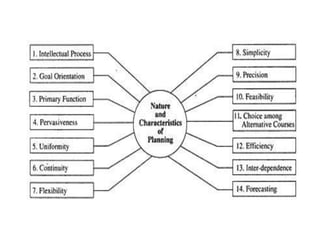
1. Intellectual Process: Planning is a mental exercise
involving imagination, foresight and sound judgment.
2. Goal-orientation: All planning is linked up with certain
goals and objectives. It follows, therefore, that every
plan must contribute in some positive way to the
accomplishment of group objectives.
3. Primary function: Planning is the first of the
managerial functions. It precedes all other management
functions.
4. Pervasiveness: It is the job of all managers in all types of
organization. It is undertaken at all segments and levels of the
organization.
5. Uniformity: There may be separate plans prepared in
different levels in the organization, but all the sub-plans must
be united with the general plan so as to make up a
comprehensive plan for operation at a time.
6. Continuity: It is essential that planning must be a
continuous process.
7. Flexibility: Plans should not be made rigid. It should be as
flexible as possible to accommodate all possible changes.
8. Simplicity: The planning should be simple so that each and
every part of it may easily be understood by the employees at
different levels,
9. Precision: This gives the planning exact,
definite, and accurate meaning in its scope and
content.
10. Feasibility: It is based on facts and experience,
and thereby realistic in nature.
11. Choice among Alternative Courses: Planning
involves selection of suitable course of action from
several alternatives.
12. Efficiency: A plan is a course of action that
shows promise of optimizing return at the minimum
expense of inputs.
13. Inter dependency: The different
departments may formulate different plans
and are inter-dependent and inter-related.
14. Forecasting: Forecasting means
assessing the future and making provision for
it.
Importance of Planning
• Planning Provides the Basis of Decision
• Planning concentrates attention on the objectives of
an enterprise.
• It minimizes Uncertainty and Risk
• Adapting with Changes
• Planning focuses on efficiency and economy in
operation.
• Planning leads to achieve a coordinated structure of
operations
• Making Control Effective
• Planning ensures organizational effectiveness.
Principles of Planning
1.Principle of Commitment: This means that
certain resources must be committed or pledged for
the purpose
2. Principle of the Limiting Factor: This principle
implies that more emphasis has to be put on that
factor which is scarce or limited in supply or
extremely costly. of planning.
3. Principle of Reflective Thinking: Planning,
being an intellectual activity is based on rational
considerations.
4. Principle of Flexibility:
5. Principle of Contribution to Organizational
Objectives
6. Principle of Efficiency
7. Principle of Selection of Alternatives
8. Principle of Planning Premises: A plan is
prepared against some foundations or backgrounds
known as ‘Planning Premises’.
9. Principle of Timing and Sequence of
Operations
10. Principle of Securing Participation
11. Principle of Pervasiveness
12. Principle of Strategic Planning
13. Principle of Innovation
14. Principle of Follow-up
Elements/Components of Planning
1. Objectives: Objectives are basic plans
which determine goals or end results of the
projected action of an enterprise. By setting
goals, objectives provide the foundation
upon which structure of plan can be built.
2. Policies: Policies are written statements or
oral understanding. Policies provide
standing solutions to problem.
3. Procedures: Procedures indicate the specific
manner in which a certain activity is to be
performed.
4. Programme: Programmes are necessary for both
repetitive (routine planning)and non-repetitive
(creative planning) course of action.
5. Budget: Budgets are plans continuing statements
of expected results in numerical items.
6. Rules: A rule specifies necessary course of action
in a particular situation. It acts as a guide and is
essentially in the nature of a decision made by the
management authority.
Steps in Planning
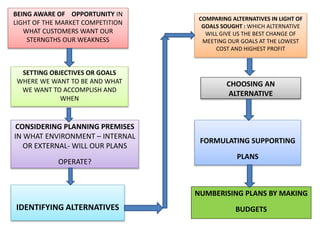
BEING AWARE OF OPPORTUNITY IN
LIGHT OF THE MARKET COMPETITION
WHAT CUSTOMERS WANT OUR
STERNGTHS OUR WEAKNESS
SETTING OBJECTIVES OR GOALS
WHERE WE WANT TO BE AND WHAT
WE WANT TO ACCOMPLISH AND
WHEN
CONSIDERING PLANNING PREMISES
IN WHAT ENVIRONMENT – INTERNAL
OR EXTERNAL- WILL OUR PLANS
OPERATE?
IDENTIFYING ALTERNATIVES
COMPARING ALTERNATIVES IN LIGHT OF
GOALS SOUGHT : WHICH ALTERNATIVE
WILL GIVE US THE BEST CHANGE OF
MEETING OUR GOALS AT THE LOWEST
COST AND HIGHEST PROFIT
CHOOSING AN
ALTERNATIVE
FORMULATING SUPPORTING
PLANS
NUMBERISING PLANS BY MAKING
BUDGETS
1. Being aware of opportunities
It provide actual planning and is there for
not strictly a part of planning process, an
awareness of opportunities in the external
environment as well as within the
organizations is the real starting point for
planning. All managers should know where
they stand in the light of their strengths and
weakness.
2. Establishing objectives
Establish objective for the entire
enterprise and then for each subordinate
work unit. This is to done for long term as
well as short term range. Objectives specify
the expected results and indicate the end
points of what is to be done.
3. Developing premises
Certain assumptions about the future on the
basis of which the plan will be ultimately
formulated. Planning premises can be classified as
Internal and external premises.
Internal premises are skill of the labor force,
other resources and abilities of the organization in
the form of machines, money and methods. External
premises include population growth, political
stability, sociological factors and government
policies.
4. Identify alternative courses
There is seldom a plan for which reasonable
alternatives do not exist and quite often an
alternative that is not obvious proves to be the best.
The planner must usually make a preliminary
examination to discover the most fruitful
possibilities.
5. Comparing Alternatives
After seeking out alternative course and
examining their strong and weak points. The
next step is evaluating the alternatives by
weighing them in the light of premises and
goals.
6. Choosing an Alternative
This is the point at which the plan is
adopted the real point of decision making.
An analysis and evaluation of alternative
course will disclose that two or more are
advisable and the manager may decide to
follow several courses rather the one best
course.
7. Formulating Supporting Plans
Once the plan has been formulated its
broad goals must be translated into day to
day operations of the organization. Middle
and lower level managers must draw - up
the appropriate plans, programmes and
budgets for their subunits. There are
described as Supporting/ derivative plan.
8. Numberizing plans by budgeting
After decisions are made and plans are
set, the final step in giving them meaning and
to numberize them by converting them to
budget. If done well, budget become a means
of adding together the various plans and also
set important standards against which
planning progress can be measured.
Types of Planning
1. Directional Planning: It is often called policy
planning and is concerned with the broad general
direction of the programme.
Eg: State level planning at directorate or secretarial of
states or union(centre).
2. Administrative planning: It is concerned with the
overall implementation of the policies developed and
with the mobilization and coordination of the personnel
and material available in the administrative unit.
Eg: Medical superintendent of major hospital are
responsible for administrative planning
3. Operational planning : It is concerned with
the actual delivery of the service to the
community. Operational or short range
planning is undertaken by middle or supervisory
level personnel.
Eg: Nursing personnel of all level are planning to
deliver proper service either in hospital or
community.
4. Strategic Planning: Usually strategic and long
range planning is undertaken by the top level, which
involves.
 Detail analysis of strength, weakness, opportunities and
threats (SWOT)of organization both internal or external
environment.
 Developing philosophy and formulation of policies and
objectives.
 Allocation of resources on the basis of priority
 Evaluation of activities to increase efficiency.
 Providing proper direction to avoid duplication of
services.
Levels Of Planning
• Top level planning
Also known as overall or strategic
planning. Top level planning is done by the
top management that is board of direction or
governing body. It encompasses the long
range objectives and policies or results rather
than sectional objectives.
• Second Level Planning
Also known as tactical planning. It is done
by middle level managers or departmental heads. It
is concerned with ‘how ‘of planning. It deals with
deployment of resources to the best advantage. It
concerned mainly but not exclusively with long
range planning, but time plan are usually shorter
than those of strategic planning.
• Third level Planning
Also known as operational or activity planning.
It is the concern of departmental managers and
supervisors. It is confined to putting into effect the
departmental plans. It is usually short terms may be
revised quiet often.
• Corporate planning:
It is the new concept which has gain popularity
these days. It is specifically strategic in nature as it
takes the overall view of the organization. Its time
span is usually over a minimum period five years.
ADVANTAGES OF PLANNING
• Planning leads to more effective and faster
achievements of any organization.
• Planning gives strength to the business or service for
its continuous growth and steady prosperity.
• Planning avoids duplication of services.
• Planning has unique contribution towards the
efficiency of other managerial functions.
• Planning provides the basis for control in an
organization.
• Planning serves as an integral part of other
administrative functions.
DISADVANTAGES OF PLANNING
• It depends up on facts and information
,reliable information is not possible.
• Planning may lead to internal inflexibilities
and procedural rigidities.
• It is a time consuming and expensive
process.
Thank You

Planning- Management Process

  • 1.
    MANAGEMENT PROCESS: PLANNING Mr.Visanth VS Asso. Professor Dept. of Mental Health Nursing Indira Gandhi College of Nursing, Amethi
  • 2.
    MANAGEMENT • Management isthe attainment of organizational goals in an effective and efficient manner through planning, organizing, staffing, directing and controlling organizational resources. • A process is a series of steps or actions which lead to achieve a goal and it is dynamic.
  • 3.
    Definitions • Louis EBoone & David L Kurtz- The use of people and other resources to accomplish objectives. • Mary Parker Follet- the act of getting things done through people. • Frederick Taylor defines Management as the art of knowing what you want to do in the best and cheapest way.
  • 4.
    • Able todo something. • Able to complete some task as instructed or self-directed. Manage • A person who is in charge of getting something done • A person who is in charge of an area of the work force • Carries out managerial roles. Manag er • The art of getting things done. • The technique of getting goal achieved. • The way a person runs the organization. Management Concepts
  • 5.
  • 6.
    FUNCTIONS OF MANAGEMENT •PLANNING • ORGANIZING • STAFFING • DIRECTING • CONTROLLING
  • 7.
    PLANNING • Planning isthe first and fundamental function of management because all other management functions are dependent on it. • Planning is deciding what is to be done, when it is to be done, how it is to be done and who is to do it. • It is an orderly process that gives organizational direction.
  • 8.
    Definition • • According toWillet, “Planning is the process of determining the objectives of administrative effort and of devising the means calculated to achieve them”.
  • 9.
    Purposes of Planning •It gives direction to the organization. ™ • It improves efficiency and meaning to work. • It eliminates duplication of efforts. ™ • It concentrates resources on important services. ™ • It reduces guess work. • It improves communication and coordination of activities. • It is based on the past and future thus helping to reduce the element of change and discover need for change.
  • 10.
  • 12.
    Nature & Characteristicsof Planning 1. Intellectual Process: Planning is a mental exercise involving imagination, foresight and sound judgment. 2. Goal-orientation: All planning is linked up with certain goals and objectives. It follows, therefore, that every plan must contribute in some positive way to the accomplishment of group objectives. 3. Primary function: Planning is the first of the managerial functions. It precedes all other management functions.
  • 13.
    4. Pervasiveness: Itis the job of all managers in all types of organization. It is undertaken at all segments and levels of the organization. 5. Uniformity: There may be separate plans prepared in different levels in the organization, but all the sub-plans must be united with the general plan so as to make up a comprehensive plan for operation at a time. 6. Continuity: It is essential that planning must be a continuous process. 7. Flexibility: Plans should not be made rigid. It should be as flexible as possible to accommodate all possible changes. 8. Simplicity: The planning should be simple so that each and every part of it may easily be understood by the employees at different levels,
  • 14.
    9. Precision: Thisgives the planning exact, definite, and accurate meaning in its scope and content. 10. Feasibility: It is based on facts and experience, and thereby realistic in nature. 11. Choice among Alternative Courses: Planning involves selection of suitable course of action from several alternatives. 12. Efficiency: A plan is a course of action that shows promise of optimizing return at the minimum expense of inputs.
  • 15.
    13. Inter dependency:The different departments may formulate different plans and are inter-dependent and inter-related. 14. Forecasting: Forecasting means assessing the future and making provision for it.
  • 16.
    Importance of Planning •Planning Provides the Basis of Decision • Planning concentrates attention on the objectives of an enterprise. • It minimizes Uncertainty and Risk • Adapting with Changes • Planning focuses on efficiency and economy in operation. • Planning leads to achieve a coordinated structure of operations • Making Control Effective • Planning ensures organizational effectiveness.
  • 17.
  • 18.
    1.Principle of Commitment:This means that certain resources must be committed or pledged for the purpose 2. Principle of the Limiting Factor: This principle implies that more emphasis has to be put on that factor which is scarce or limited in supply or extremely costly. of planning. 3. Principle of Reflective Thinking: Planning, being an intellectual activity is based on rational considerations. 4. Principle of Flexibility:
  • 19.
    5. Principle ofContribution to Organizational Objectives 6. Principle of Efficiency 7. Principle of Selection of Alternatives 8. Principle of Planning Premises: A plan is prepared against some foundations or backgrounds known as ‘Planning Premises’. 9. Principle of Timing and Sequence of Operations 10. Principle of Securing Participation
  • 20.
    11. Principle ofPervasiveness 12. Principle of Strategic Planning 13. Principle of Innovation 14. Principle of Follow-up
  • 21.
    Elements/Components of Planning 1.Objectives: Objectives are basic plans which determine goals or end results of the projected action of an enterprise. By setting goals, objectives provide the foundation upon which structure of plan can be built. 2. Policies: Policies are written statements or oral understanding. Policies provide standing solutions to problem.
  • 22.
    3. Procedures: Proceduresindicate the specific manner in which a certain activity is to be performed. 4. Programme: Programmes are necessary for both repetitive (routine planning)and non-repetitive (creative planning) course of action. 5. Budget: Budgets are plans continuing statements of expected results in numerical items. 6. Rules: A rule specifies necessary course of action in a particular situation. It acts as a guide and is essentially in the nature of a decision made by the management authority.
  • 23.
  • 24.
    BEING AWARE OFOPPORTUNITY IN LIGHT OF THE MARKET COMPETITION WHAT CUSTOMERS WANT OUR STERNGTHS OUR WEAKNESS SETTING OBJECTIVES OR GOALS WHERE WE WANT TO BE AND WHAT WE WANT TO ACCOMPLISH AND WHEN CONSIDERING PLANNING PREMISES IN WHAT ENVIRONMENT – INTERNAL OR EXTERNAL- WILL OUR PLANS OPERATE? IDENTIFYING ALTERNATIVES COMPARING ALTERNATIVES IN LIGHT OF GOALS SOUGHT : WHICH ALTERNATIVE WILL GIVE US THE BEST CHANGE OF MEETING OUR GOALS AT THE LOWEST COST AND HIGHEST PROFIT CHOOSING AN ALTERNATIVE FORMULATING SUPPORTING PLANS NUMBERISING PLANS BY MAKING BUDGETS
  • 25.
    1. Being awareof opportunities It provide actual planning and is there for not strictly a part of planning process, an awareness of opportunities in the external environment as well as within the organizations is the real starting point for planning. All managers should know where they stand in the light of their strengths and weakness.
  • 26.
    2. Establishing objectives Establishobjective for the entire enterprise and then for each subordinate work unit. This is to done for long term as well as short term range. Objectives specify the expected results and indicate the end points of what is to be done.
  • 27.
    3. Developing premises Certainassumptions about the future on the basis of which the plan will be ultimately formulated. Planning premises can be classified as Internal and external premises. Internal premises are skill of the labor force, other resources and abilities of the organization in the form of machines, money and methods. External premises include population growth, political stability, sociological factors and government policies.
  • 28.
    4. Identify alternativecourses There is seldom a plan for which reasonable alternatives do not exist and quite often an alternative that is not obvious proves to be the best. The planner must usually make a preliminary examination to discover the most fruitful possibilities.
  • 29.
    5. Comparing Alternatives Afterseeking out alternative course and examining their strong and weak points. The next step is evaluating the alternatives by weighing them in the light of premises and goals.
  • 30.
    6. Choosing anAlternative This is the point at which the plan is adopted the real point of decision making. An analysis and evaluation of alternative course will disclose that two or more are advisable and the manager may decide to follow several courses rather the one best course.
  • 31.
    7. Formulating SupportingPlans Once the plan has been formulated its broad goals must be translated into day to day operations of the organization. Middle and lower level managers must draw - up the appropriate plans, programmes and budgets for their subunits. There are described as Supporting/ derivative plan.
  • 32.
    8. Numberizing plansby budgeting After decisions are made and plans are set, the final step in giving them meaning and to numberize them by converting them to budget. If done well, budget become a means of adding together the various plans and also set important standards against which planning progress can be measured.
  • 33.
    Types of Planning 1.Directional Planning: It is often called policy planning and is concerned with the broad general direction of the programme. Eg: State level planning at directorate or secretarial of states or union(centre). 2. Administrative planning: It is concerned with the overall implementation of the policies developed and with the mobilization and coordination of the personnel and material available in the administrative unit. Eg: Medical superintendent of major hospital are responsible for administrative planning
  • 34.
    3. Operational planning: It is concerned with the actual delivery of the service to the community. Operational or short range planning is undertaken by middle or supervisory level personnel. Eg: Nursing personnel of all level are planning to deliver proper service either in hospital or community.
  • 35.
    4. Strategic Planning:Usually strategic and long range planning is undertaken by the top level, which involves.  Detail analysis of strength, weakness, opportunities and threats (SWOT)of organization both internal or external environment.  Developing philosophy and formulation of policies and objectives.  Allocation of resources on the basis of priority  Evaluation of activities to increase efficiency.  Providing proper direction to avoid duplication of services.
  • 36.
    Levels Of Planning •Top level planning Also known as overall or strategic planning. Top level planning is done by the top management that is board of direction or governing body. It encompasses the long range objectives and policies or results rather than sectional objectives.
  • 37.
    • Second LevelPlanning Also known as tactical planning. It is done by middle level managers or departmental heads. It is concerned with ‘how ‘of planning. It deals with deployment of resources to the best advantage. It concerned mainly but not exclusively with long range planning, but time plan are usually shorter than those of strategic planning.
  • 38.
    • Third levelPlanning Also known as operational or activity planning. It is the concern of departmental managers and supervisors. It is confined to putting into effect the departmental plans. It is usually short terms may be revised quiet often. • Corporate planning: It is the new concept which has gain popularity these days. It is specifically strategic in nature as it takes the overall view of the organization. Its time span is usually over a minimum period five years.
  • 39.
    ADVANTAGES OF PLANNING •Planning leads to more effective and faster achievements of any organization. • Planning gives strength to the business or service for its continuous growth and steady prosperity. • Planning avoids duplication of services. • Planning has unique contribution towards the efficiency of other managerial functions. • Planning provides the basis for control in an organization. • Planning serves as an integral part of other administrative functions.
  • 40.
    DISADVANTAGES OF PLANNING •It depends up on facts and information ,reliable information is not possible. • Planning may lead to internal inflexibilities and procedural rigidities. • It is a time consuming and expensive process.
  • 41.