Importance of Leadership
Deepa Makhija
Manisha Kunwar
Juanita Kasbe
Rahul Chaudhary
L – Leading
E – Efficiently in
A – All
D – Departments wit
E – Effective
R – Representation
“To an extent, leadership is like beauty:
it’s hard to define, but you know it when
you see it.” Warren Bennis
What is Leadership?
•

John Newstrom and Keith Davis have described
leadership as “the process of influencing and
supporting others to work enthusiastically toward
achieving objectives.” It is a process whereby one
individual influences other group members toward the
attainment of defined group or organizational goals.”
• Leadership is not the same as management. Although
leaders need management skills, they possess many
other important qualities and have many other
functions to perform.
Concept of Leadership
• Leadership is defined as the relationship in which
one person influences others to work together to
reach a desired level of achievement. If there is no
follower, there is no leader.
• “Leadership is the process by which an executive
or a manager imaginatively directs, guides and
influences the work of others in choosing and
attaining specified goals by mediation between the
individual and organization in such a manner that
both will obtain the maximum satisfaction.”
SMU Learning Centre, Alwar LC
Code 03034

4
Leadership involves:
• Establishing a clear vision,
• Sharing that vision with others so that they
will follow willingly,
• Providing the information, knowledge and
methods to realize that vision, and
• Coordinating and balancing the conflicting
interests of all members and stakeholders.
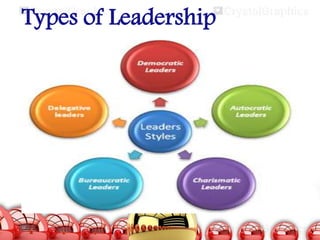
Types of Leadership
Autocratic Leaders:
Autocratic leaders are an excessive form
of transactional leadership, where a
leader makes use of high levels of power
over his team members. People within
the team are given few opportunities for
making suggestions, even if these would
be in the team's or organizations
interest.
Bureaucratic Leaders:
Bureaucratic leaders work by the book,
ensuring that their staffs follow
procedures accurately. This is a very
right approach for work involving
serious safety risks (such as working
with machinery, with toxic substances
or at heights) or where large sums of
money are involved (such as cashprocess).
Charismatic Leaders:
A charismatic leaders style can appear
similar to a transformational leadership
style, in that the leader bring in huge
doses of enthusiasm into his team, and is
very energetic in driving others
forward. Charismatic leadership carries
great responsibility, and needs longterm commitment from the leader.
Democratic Leaders:
A democratic leader makes the final
decision but he invites other members to
contribute to the decision-making
process, which increases job satisfaction
by involving team members and also
helps to develop people’s skills. Team
members feel in control of their own
destiny, and are motivated to work
smart.
Laissez-Faire Leaders:
They known as “Delegate leader” offer
little or no guidance to group members
and leave decision-making up to group
members. While this style can be
effective in situations where group
members are highly qualified in an area
of expertise, it often leads to poorly
defined roles and a lack of motivation.
As the perfect leader had the most known
3 styles as he play the role of each type in
situation he face as below
Characteristics of Leadership
 Drive
 Intelligence
 Energy levels and stress tolerance
 Optimistic: Most leaders are highly optimistic
 Emotional maturity
 Honesty and integrity
 Leadership motivation
 Self-confidence
 Cognitive ability
 Knowledge of the business
Functions of a Leader











Policy Maker
Planner
Executive
External Group Representative
Controller of Internal Group Relationship
Controller of Reward and Punishment
Arbitrator and Mediator
Exemplar
Father Figure
Spacegoat
Importance of Leadership
A clear vision
Effective Planning
Inspiration and Motivation
New Ideas
Employee Relation
Crisis Management
Warren Bennis (1989) has given twelve differences
between leaders and managers. They are:

1.
2.
3.
4.
5.
6.
7.

Managers administer, leaders innovate.
Managers ask how and when, leaders ask what and why.
Managers focus on systems, leaders focus on people.
Managers do things right, leaders do the right things.
Managers maintain, leaders develop.
Managers depend on control, leaders inspire trust.
Managers have a short-term perspective, leaders have a
long-term perspective.
8. Managers accept the situation as it is (status quo),
leaders challenge the status quo.
9. Managers have an eye on the bottom line, leaders
have an eye on the horizon.
10. Managers imitate (copy), leaders originate (have
original ideas)
11. Managers follow the classic good soldier
(examples set or methods used by other people),
leaders are their own person.
12. Managers copy, leaders show originality.
Leadership

Leadership

  • 1.
    Importance of Leadership DeepaMakhija Manisha Kunwar Juanita Kasbe Rahul Chaudhary
  • 2.
    L – Leading E– Efficiently in A – All D – Departments wit E – Effective R – Representation “To an extent, leadership is like beauty: it’s hard to define, but you know it when you see it.” Warren Bennis
  • 3.
    What is Leadership? • JohnNewstrom and Keith Davis have described leadership as “the process of influencing and supporting others to work enthusiastically toward achieving objectives.” It is a process whereby one individual influences other group members toward the attainment of defined group or organizational goals.” • Leadership is not the same as management. Although leaders need management skills, they possess many other important qualities and have many other functions to perform.
  • 4.
    Concept of Leadership •Leadership is defined as the relationship in which one person influences others to work together to reach a desired level of achievement. If there is no follower, there is no leader. • “Leadership is the process by which an executive or a manager imaginatively directs, guides and influences the work of others in choosing and attaining specified goals by mediation between the individual and organization in such a manner that both will obtain the maximum satisfaction.” SMU Learning Centre, Alwar LC Code 03034 4
  • 5.
    Leadership involves: • Establishinga clear vision, • Sharing that vision with others so that they will follow willingly, • Providing the information, knowledge and methods to realize that vision, and • Coordinating and balancing the conflicting interests of all members and stakeholders.
  • 6.
  • 7.
    Autocratic Leaders: Autocratic leadersare an excessive form of transactional leadership, where a leader makes use of high levels of power over his team members. People within the team are given few opportunities for making suggestions, even if these would be in the team's or organizations interest.
  • 8.
    Bureaucratic Leaders: Bureaucratic leaderswork by the book, ensuring that their staffs follow procedures accurately. This is a very right approach for work involving serious safety risks (such as working with machinery, with toxic substances or at heights) or where large sums of money are involved (such as cashprocess).
  • 9.
    Charismatic Leaders: A charismaticleaders style can appear similar to a transformational leadership style, in that the leader bring in huge doses of enthusiasm into his team, and is very energetic in driving others forward. Charismatic leadership carries great responsibility, and needs longterm commitment from the leader.
  • 10.
    Democratic Leaders: A democraticleader makes the final decision but he invites other members to contribute to the decision-making process, which increases job satisfaction by involving team members and also helps to develop people’s skills. Team members feel in control of their own destiny, and are motivated to work smart.
  • 11.
    Laissez-Faire Leaders: They knownas “Delegate leader” offer little or no guidance to group members and leave decision-making up to group members. While this style can be effective in situations where group members are highly qualified in an area of expertise, it often leads to poorly defined roles and a lack of motivation.
  • 12.
    As the perfectleader had the most known 3 styles as he play the role of each type in situation he face as below
  • 13.
    Characteristics of Leadership Drive  Intelligence  Energy levels and stress tolerance  Optimistic: Most leaders are highly optimistic  Emotional maturity  Honesty and integrity  Leadership motivation  Self-confidence  Cognitive ability  Knowledge of the business
  • 14.
    Functions of aLeader           Policy Maker Planner Executive External Group Representative Controller of Internal Group Relationship Controller of Reward and Punishment Arbitrator and Mediator Exemplar Father Figure Spacegoat
  • 15.
    Importance of Leadership Aclear vision Effective Planning Inspiration and Motivation New Ideas Employee Relation Crisis Management
  • 16.
    Warren Bennis (1989)has given twelve differences between leaders and managers. They are: 1. 2. 3. 4. 5. 6. 7. Managers administer, leaders innovate. Managers ask how and when, leaders ask what and why. Managers focus on systems, leaders focus on people. Managers do things right, leaders do the right things. Managers maintain, leaders develop. Managers depend on control, leaders inspire trust. Managers have a short-term perspective, leaders have a long-term perspective.
  • 17.
    8. Managers acceptthe situation as it is (status quo), leaders challenge the status quo. 9. Managers have an eye on the bottom line, leaders have an eye on the horizon. 10. Managers imitate (copy), leaders originate (have original ideas) 11. Managers follow the classic good soldier (examples set or methods used by other people), leaders are their own person. 12. Managers copy, leaders show originality.