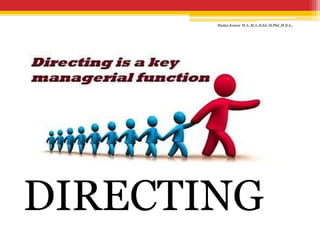
DIRECTING
Madan Kumar M.A.,M.A.,B.Ed.,M.Phil.,M.B.A.,
Meaning of Directing
• Directing means giving instructions and guiding
people in doing some work
• Directing refers to the process of instructing,
guiding , leading , counselling and motivating
people in an organization to achieve
predetermined objectives.
Madan Kumar M.A.,M.A.,B.Ed.,M.Phil.,M.B.A.,
Features or Characteristics of
Directing
• Initiates action
• Takes place at every level
• A continuous process
• Flows from top to bottom
Madan Kumar M.A.,M.A.,B.Ed.,M.Phil.,M.B.A.,
Importance of Directing
• Initiates action
• Integrates employees efforts
• Provides leadership
• Introduces changes
Madan Kumar M.A.,M.A.,B.Ed.,M.Phil.,M.B.A.,
Elements of Directing
Elements of
Directing
Supervision
Motivation
Communication
leadership
Madan Kumar M.A.,M.A.,B.Ed.,M.Phil.,M.B.A.,
Supervision
• The word supervision consists of two terms
Super and Vision
• The super means to over and above , and the
word vision means to see.
1. Supervision as an elements of directing
2. Supervision as a function of supervisor
Madan Kumar M.A.,M.A.,B.Ed.,M.Phil.,M.B.A.,
Importance / function of Supervision
• Maintains contact
• Acts as a link
• Maintains group unity
• Ensures performance
• Provides on-the-job training
• Builds morale
• Provides feedback
Madan Kumar M.A.,M.A.,B.Ed.,M.Phil.,M.B.A.,
Motivation
• Motive :- it is an inner state that activates and
energizes behavior towards goals, realization of a
motive causes restlessness to individuals .
• Motivator :- it is the technique used to motivate
people in the organization
Madan Kumar M.A.,M.A.,B.Ed.,M.Phil.,M.B.A.,
Definitions
• Motivation means a process of stimulating
people to action to accomplish desired goals –
William G scout
• Motivation is a process which begins with a
physiological or psychological need or deficiency
which triggers behavior or a drive that is aimed
at a goal or incentive.—Fred luthans
Madan Kumar M.A.,M.A.,B.Ed.,M.Phil.,M.B.A.,
Features of Motivation
• Motivation is a psychological phenomenon
• Goal directed behavior
• Motivation may be positive or negative
• Motivation is a complex process.
Madan Kumar M.A.,M.A.,B.Ed.,M.Phil.,M.B.A.,
Motivation process
• An unsatisfied need of an individual creates
tension, which stimulates his drives
• These drives generates a search behavior to
satisfy such need
• When the need is satisfied, the individual is
relieved of tension
Madan Kumar M.A.,M.A.,B.Ed.,M.Phil.,M.B.A.,
Unsatisfied
needs
tension
Drives
Search
behavior
Satisfied
needs
Reduction
of tension
Madan Kumar M.A.,M.A.,B.Ed.,M.Phil.,M.B.A.,
Importance of Motivation
• Improves performance
• Builds positive attitude
• Reduces employee turnover
• Introduces changes
• Reduces absenteeism
Madan Kumar M.A.,M.A.,B.Ed.,M.Phil.,M.B.A.,
Maslow’s need hierarchy theory of
motivation
Madan Kumar M.A.,M.A.,B.Ed.,M.Phil.,M.B.A.,
Assumption of Maslow’s need hierarchy
theory
• People’s behavior is based on their needs.
Satisfaction of such needs influences their behavior
• People’s needs are hierarchical in order. They start
from basic physiological needs and reach to high
level needs.
• A satisfied need can no longer motivate a person,
only next higher level need can motivate a person
• A person moves to the next higher level needs, only
when the lower level need is satisfied.
Madan Kumar M.A.,M.A.,B.Ed.,M.Phil.,M.B.A.,
Basic physiological needs
• These are the basic needs, which a person is
required to satisfy in order to survive.
• Hunger , thirst, shelter….
• In an organization basic salary helps to satisfy
these needs.
Madan Kumar M.A.,M.A.,B.Ed.,M.Phil.,M.B.A.,
Safety/security needs
• These needs are concerned with physical,
economic and social security, in the form of job
security, stability of income , etc.,
Madan Kumar M.A.,M.A.,B.Ed.,M.Phil.,M.B.A.,
Affiliation / belongingness/social needs
• These needs are concerned with affection, sense
of belongingness , acceptance and friendship.
• It is fulfilled when employees have cordial
relations with colleagues.
Madan Kumar M.A.,M.A.,B.Ed.,M.Phil.,M.B.A.,
Esteem needs
• These needs include factors such as self-respect ,
status and recognition.
• When these needs are fulfilled through job title,
it enhances self-confidence and prestige of
employees.
Madan Kumar M.A.,M.A.,B.Ed.,M.Phil.,M.B.A.,
Self – actualization needs
• It is the highest level of need in the hierarchy
• It arises after the satisfaction of all previously
discussed needs
• These needs include growth, self-fulfillment and
achievement of goals.
Madan Kumar M.A.,M.A.,B.Ed.,M.Phil.,M.B.A.,
Financial and non-financial incentives
• Financial incentives
i. Pay and allowances
ii. Productivity linked wage incentives
iii. Bonus
iv. Profit sharing
v. Co-partnership/stock option
vi. Retirement benefits
vii. perquisites
Madan Kumar M.A.,M.A.,B.Ed.,M.Phil.,M.B.A.,
• Non financial incentives
I. Status
II. Organizational climate
III. Career advancement opportunity
IV. Job enrichment
V. Employee recognition programmes
VI. Job security
VII.Employee participation
VIII.Employee empowerment
Madan Kumar M.A.,M.A.,B.Ed.,M.Phil.,M.B.A.,
Leadership
• The process of influencing the behavior of
people by making them strive voluntarily
towards the achievement of goals.
Madan Kumar M.A.,M.A.,B.Ed.,M.Phil.,M.B.A.,
definition
• Leadership is the art or process of influencing
people, so that they will strive willingly and
enthusiastically towards the achievement of
group goals. --harold koontz and heinz weihrich
Madan Kumar M.A.,M.A.,B.Ed.,M.Phil.,M.B.A.,
Features of leadership
• It is the ability of an individual to influence
people.
• It tries to bring change in the behavior of others
• It is exercised to achieve common goals of the
organization
• It explains the interpersonal relationship
between leaders and followers
• It is a continuous process
Madan Kumar M.A.,M.A.,B.Ed.,M.Phil.,M.B.A.,
Importance of leadership
• Influences the behavior of people
• Provides confidence
• Introduces changes
• Handles conflicts
• Provides training
Madan Kumar M.A.,M.A.,B.Ed.,M.Phil.,M.B.A.,
Qualities of a good leader
• Physical qualities
• Knowledge
• Integrity
• Initiative
• Communication skills
• Motivation skills
• Self-confidence
• Decisiveness
• Social skills
Madan Kumar M.A.,M.A.,B.Ed.,M.Phil.,M.B.A.,
Leadership styles
1. Authoritarian or Autocratic leadership
Madan Kumar M.A.,M.A.,B.Ed.,M.Phil.,M.B.A.,
2. Democratic or Participative leadership
Madan Kumar M.A.,M.A.,B.Ed.,M.Phil.,M.B.A.,
3. Free – rein or laissez faire leadership
Madan Kumar M.A.,M.A.,B.Ed.,M.Phil.,M.B.A.,
Difference between leader and manager
Basis leader Manager
Formal rights No formal rights Has certain formal rights
Followers subordinates Has followers Has subordinates
Functions To guide and motivate
his followers
A manager is to plan,
organize, staff, direct,
motivate and control
Necessity Leadership is not a
necessity for an
organization
Manager ship is a
necessity for an
organization
Scope Leadership is a part of
managerial functions.
Thus, its scope is limited
Manager ship is a wider
term and includes
leadership
Mutual relationship All leaders are not
managers
All managers are leaders
Madan Kumar M.A.,M.A.,B.Ed.,M.Phil.,M.B.A.,
Communication
• Process of exchange of ideas, facts, feelings,
views, etc., between two or more people to create
common understanding
Madan Kumar M.A.,M.A.,B.Ed.,M.Phil.,M.B.A.,
Definition
• Communication is the sum of all things, one
person does when he wants to create
understanding in the mind of another. It
involves systematic and continuous process of
telling, listening and understanding – Louis
Allen
Madan Kumar M.A.,M.A.,B.Ed.,M.Phil.,M.B.A.,
Elements of communication process
1. Sender
2. Message
3. Encoding
4. Channel or Media
5. Decoding
6. Receiver
7. Feedback
8. Noise
Madan Kumar M.A.,M.A.,B.Ed.,M.Phil.,M.B.A.,
Communication process
Madan Kumar M.A.,M.A.,B.Ed.,M.Phil.,M.B.A.,
Importance of communication
• Act as basis of coordination
• Helps in smooth working of an enterprise
• Acts as basis of decision making
• Increase managerial efficiency
• Promotes cooperation ad industrial peace
• Establishes effective leadership
• Boosts morale and provide motivation
Madan Kumar M.A.,M.A.,B.Ed.,M.Phil.,M.B.A.,
Formal and informal communication
• Formal communication
1. Vertical communication
a. Upward communication
b. Downward communication
2. Horizontal lateral communication
Madan Kumar M.A.,M.A.,B.Ed.,M.Phil.,M.B.A.,
Network of formal communication
1. Single chain
2. Wheel network
3. Circular network
4. Free flow
5. Inverted V
Madan Kumar M.A.,M.A.,B.Ed.,M.Phil.,M.B.A.,
• Informal communication / grapevine
It takes in a organization without following the
formal lines of communication. Such type of
communication usually takes place among the
workers to exchange their views and to satisfy
their social needs
Madan Kumar M.A.,M.A.,B.Ed.,M.Phil.,M.B.A.,
Network of informal communication
1. Single strand network
2. Gossip network
3. Probability network
4. Cluster network
Madan Kumar M.A.,M.A.,B.Ed.,M.Phil.,M.B.A.,
Difference between formal and
informal communication
Basis Formal Informal
Mutual relationship
among members
Based on formal superior
–subordinate
relationship
Based on interpersonal
contracts
Nature Systematic and orderly Unsystematic and erratic
Speed of communication It is slow and time
consuming
it is fast and time saving
Authenticity Official and well planned
messages are authentic
Unofficial and
unplanned messages
may not authentic
Contents or subject
matter
Work related matters
e.g. orders and
instructions are
communicated
Personal matters are
discussed
Objectives To achieve
organizational
objectives.
To meet personal needs
and interests.
Madan Kumar
M.A.,M.A.,B.Ed.,M.Phil.,M.B.A.,
Barriers to communication
• Semantic barriers
1. Badly expressed message
2. Symbol with different meaning
3. Faulty translations
4. Unclarified assumption
5. Technical jargon
6. Body language and gesture decoding
Madan Kumar M.A.,M.A.,B.Ed.,M.Phil.,M.B.A.,
• Psychological barriers
1. Premature evaluation
2. Lack of attention
3. Loss by transmission and poor retention
4. Distrust
Madan Kumar M.A.,M.A.,B.Ed.,M.Phil.,M.B.A.,
• Organizational barriers
1. Organizational policy
2. Rules and regulations
3. Complexity in organization
4. Organizational facilities
5. Status
Madan Kumar M.A.,M.A.,B.Ed.,M.Phil.,M.B.A.,
• Personal barriers
1. Fear of challenge to authority
2. Lack of confidence of superior on his
subordinates
3. Unwillingness to communicate
4. Lack of proper incenties
Madan Kumar M.A.,M.A.,B.Ed.,M.Phil.,M.B.A.,
Improving communication
effectiveness
• Clarify the ideas before communicating
• Communicate according to the needs of recevier
• Conslut others before communicating
• Be aware of the language, tone and content of the
message
• Convey things of help and value to listeners
• Ensure proper feedback
• Communicate for present as well as for the future
• Follow-up communication
• Be a good listener
Madan Kumar M.A.,M.A.,B.Ed.,M.Phil.,M.B.A.,
Madan Kumar
M.A.,M.A.,B.Ed.,M.Phil.,M.B.A.,
Madan Kumar
M.A.,M.A.,B.Ed.,M.Phil.,M.B.A.,
Video presentation
• https://youtu.be/3IlbEB5ZLhE
• https://youtu.be/tjy0B-Q9WMU
Madan Kumar M.A.,M.A.,B.Ed.,M.Phil.,M.B.A.,

Directing

  • 1.
  • 2.
    Meaning of Directing •Directing means giving instructions and guiding people in doing some work • Directing refers to the process of instructing, guiding , leading , counselling and motivating people in an organization to achieve predetermined objectives. Madan Kumar M.A.,M.A.,B.Ed.,M.Phil.,M.B.A.,
  • 3.
    Features or Characteristicsof Directing • Initiates action • Takes place at every level • A continuous process • Flows from top to bottom Madan Kumar M.A.,M.A.,B.Ed.,M.Phil.,M.B.A.,
  • 4.
    Importance of Directing •Initiates action • Integrates employees efforts • Provides leadership • Introduces changes Madan Kumar M.A.,M.A.,B.Ed.,M.Phil.,M.B.A.,
  • 5.
    Elements of Directing Elementsof Directing Supervision Motivation Communication leadership Madan Kumar M.A.,M.A.,B.Ed.,M.Phil.,M.B.A.,
  • 6.
    Supervision • The wordsupervision consists of two terms Super and Vision • The super means to over and above , and the word vision means to see. 1. Supervision as an elements of directing 2. Supervision as a function of supervisor Madan Kumar M.A.,M.A.,B.Ed.,M.Phil.,M.B.A.,
  • 7.
  • 8.
    Importance / functionof Supervision • Maintains contact • Acts as a link • Maintains group unity • Ensures performance • Provides on-the-job training • Builds morale • Provides feedback Madan Kumar M.A.,M.A.,B.Ed.,M.Phil.,M.B.A.,
  • 9.
    Motivation • Motive :-it is an inner state that activates and energizes behavior towards goals, realization of a motive causes restlessness to individuals . • Motivator :- it is the technique used to motivate people in the organization Madan Kumar M.A.,M.A.,B.Ed.,M.Phil.,M.B.A.,
  • 10.
  • 11.
    Definitions • Motivation meansa process of stimulating people to action to accomplish desired goals – William G scout • Motivation is a process which begins with a physiological or psychological need or deficiency which triggers behavior or a drive that is aimed at a goal or incentive.—Fred luthans Madan Kumar M.A.,M.A.,B.Ed.,M.Phil.,M.B.A.,
  • 12.
    Features of Motivation •Motivation is a psychological phenomenon • Goal directed behavior • Motivation may be positive or negative • Motivation is a complex process. Madan Kumar M.A.,M.A.,B.Ed.,M.Phil.,M.B.A.,
  • 13.
    Motivation process • Anunsatisfied need of an individual creates tension, which stimulates his drives • These drives generates a search behavior to satisfy such need • When the need is satisfied, the individual is relieved of tension Madan Kumar M.A.,M.A.,B.Ed.,M.Phil.,M.B.A.,
  • 14.
  • 15.
    Importance of Motivation •Improves performance • Builds positive attitude • Reduces employee turnover • Introduces changes • Reduces absenteeism Madan Kumar M.A.,M.A.,B.Ed.,M.Phil.,M.B.A.,
  • 16.
    Maslow’s need hierarchytheory of motivation Madan Kumar M.A.,M.A.,B.Ed.,M.Phil.,M.B.A.,
  • 17.
    Assumption of Maslow’sneed hierarchy theory • People’s behavior is based on their needs. Satisfaction of such needs influences their behavior • People’s needs are hierarchical in order. They start from basic physiological needs and reach to high level needs. • A satisfied need can no longer motivate a person, only next higher level need can motivate a person • A person moves to the next higher level needs, only when the lower level need is satisfied. Madan Kumar M.A.,M.A.,B.Ed.,M.Phil.,M.B.A.,
  • 18.
    Basic physiological needs •These are the basic needs, which a person is required to satisfy in order to survive. • Hunger , thirst, shelter…. • In an organization basic salary helps to satisfy these needs. Madan Kumar M.A.,M.A.,B.Ed.,M.Phil.,M.B.A.,
  • 19.
    Safety/security needs • Theseneeds are concerned with physical, economic and social security, in the form of job security, stability of income , etc., Madan Kumar M.A.,M.A.,B.Ed.,M.Phil.,M.B.A.,
  • 20.
    Affiliation / belongingness/socialneeds • These needs are concerned with affection, sense of belongingness , acceptance and friendship. • It is fulfilled when employees have cordial relations with colleagues. Madan Kumar M.A.,M.A.,B.Ed.,M.Phil.,M.B.A.,
  • 21.
    Esteem needs • Theseneeds include factors such as self-respect , status and recognition. • When these needs are fulfilled through job title, it enhances self-confidence and prestige of employees. Madan Kumar M.A.,M.A.,B.Ed.,M.Phil.,M.B.A.,
  • 22.
    Self – actualizationneeds • It is the highest level of need in the hierarchy • It arises after the satisfaction of all previously discussed needs • These needs include growth, self-fulfillment and achievement of goals. Madan Kumar M.A.,M.A.,B.Ed.,M.Phil.,M.B.A.,
  • 23.
    Financial and non-financialincentives • Financial incentives i. Pay and allowances ii. Productivity linked wage incentives iii. Bonus iv. Profit sharing v. Co-partnership/stock option vi. Retirement benefits vii. perquisites Madan Kumar M.A.,M.A.,B.Ed.,M.Phil.,M.B.A.,
  • 24.
    • Non financialincentives I. Status II. Organizational climate III. Career advancement opportunity IV. Job enrichment V. Employee recognition programmes VI. Job security VII.Employee participation VIII.Employee empowerment Madan Kumar M.A.,M.A.,B.Ed.,M.Phil.,M.B.A.,
  • 25.
  • 26.
    Leadership • The processof influencing the behavior of people by making them strive voluntarily towards the achievement of goals. Madan Kumar M.A.,M.A.,B.Ed.,M.Phil.,M.B.A.,
  • 27.
    definition • Leadership isthe art or process of influencing people, so that they will strive willingly and enthusiastically towards the achievement of group goals. --harold koontz and heinz weihrich Madan Kumar M.A.,M.A.,B.Ed.,M.Phil.,M.B.A.,
  • 28.
    Features of leadership •It is the ability of an individual to influence people. • It tries to bring change in the behavior of others • It is exercised to achieve common goals of the organization • It explains the interpersonal relationship between leaders and followers • It is a continuous process Madan Kumar M.A.,M.A.,B.Ed.,M.Phil.,M.B.A.,
  • 29.
    Importance of leadership •Influences the behavior of people • Provides confidence • Introduces changes • Handles conflicts • Provides training Madan Kumar M.A.,M.A.,B.Ed.,M.Phil.,M.B.A.,
  • 30.
    Qualities of agood leader • Physical qualities • Knowledge • Integrity • Initiative • Communication skills • Motivation skills • Self-confidence • Decisiveness • Social skills Madan Kumar M.A.,M.A.,B.Ed.,M.Phil.,M.B.A.,
  • 31.
    Leadership styles 1. Authoritarianor Autocratic leadership Madan Kumar M.A.,M.A.,B.Ed.,M.Phil.,M.B.A.,
  • 32.
    2. Democratic orParticipative leadership Madan Kumar M.A.,M.A.,B.Ed.,M.Phil.,M.B.A.,
  • 33.
    3. Free –rein or laissez faire leadership Madan Kumar M.A.,M.A.,B.Ed.,M.Phil.,M.B.A.,
  • 34.
    Difference between leaderand manager Basis leader Manager Formal rights No formal rights Has certain formal rights Followers subordinates Has followers Has subordinates Functions To guide and motivate his followers A manager is to plan, organize, staff, direct, motivate and control Necessity Leadership is not a necessity for an organization Manager ship is a necessity for an organization Scope Leadership is a part of managerial functions. Thus, its scope is limited Manager ship is a wider term and includes leadership Mutual relationship All leaders are not managers All managers are leaders Madan Kumar M.A.,M.A.,B.Ed.,M.Phil.,M.B.A.,
  • 35.
  • 36.
    Communication • Process ofexchange of ideas, facts, feelings, views, etc., between two or more people to create common understanding Madan Kumar M.A.,M.A.,B.Ed.,M.Phil.,M.B.A.,
  • 37.
    Definition • Communication isthe sum of all things, one person does when he wants to create understanding in the mind of another. It involves systematic and continuous process of telling, listening and understanding – Louis Allen Madan Kumar M.A.,M.A.,B.Ed.,M.Phil.,M.B.A.,
  • 38.
    Elements of communicationprocess 1. Sender 2. Message 3. Encoding 4. Channel or Media 5. Decoding 6. Receiver 7. Feedback 8. Noise Madan Kumar M.A.,M.A.,B.Ed.,M.Phil.,M.B.A.,
  • 39.
    Communication process Madan KumarM.A.,M.A.,B.Ed.,M.Phil.,M.B.A.,
  • 40.
    Importance of communication •Act as basis of coordination • Helps in smooth working of an enterprise • Acts as basis of decision making • Increase managerial efficiency • Promotes cooperation ad industrial peace • Establishes effective leadership • Boosts morale and provide motivation Madan Kumar M.A.,M.A.,B.Ed.,M.Phil.,M.B.A.,
  • 41.
    Formal and informalcommunication • Formal communication 1. Vertical communication a. Upward communication b. Downward communication 2. Horizontal lateral communication Madan Kumar M.A.,M.A.,B.Ed.,M.Phil.,M.B.A.,
  • 42.
    Network of formalcommunication 1. Single chain 2. Wheel network 3. Circular network 4. Free flow 5. Inverted V Madan Kumar M.A.,M.A.,B.Ed.,M.Phil.,M.B.A.,
  • 43.
    • Informal communication/ grapevine It takes in a organization without following the formal lines of communication. Such type of communication usually takes place among the workers to exchange their views and to satisfy their social needs Madan Kumar M.A.,M.A.,B.Ed.,M.Phil.,M.B.A.,
  • 44.
    Network of informalcommunication 1. Single strand network 2. Gossip network 3. Probability network 4. Cluster network Madan Kumar M.A.,M.A.,B.Ed.,M.Phil.,M.B.A.,
  • 45.
    Difference between formaland informal communication Basis Formal Informal Mutual relationship among members Based on formal superior –subordinate relationship Based on interpersonal contracts Nature Systematic and orderly Unsystematic and erratic Speed of communication It is slow and time consuming it is fast and time saving Authenticity Official and well planned messages are authentic Unofficial and unplanned messages may not authentic Contents or subject matter Work related matters e.g. orders and instructions are communicated Personal matters are discussed Objectives To achieve organizational objectives. To meet personal needs and interests. Madan Kumar M.A.,M.A.,B.Ed.,M.Phil.,M.B.A.,
  • 46.
    Barriers to communication •Semantic barriers 1. Badly expressed message 2. Symbol with different meaning 3. Faulty translations 4. Unclarified assumption 5. Technical jargon 6. Body language and gesture decoding Madan Kumar M.A.,M.A.,B.Ed.,M.Phil.,M.B.A.,
  • 47.
    • Psychological barriers 1.Premature evaluation 2. Lack of attention 3. Loss by transmission and poor retention 4. Distrust Madan Kumar M.A.,M.A.,B.Ed.,M.Phil.,M.B.A.,
  • 48.
    • Organizational barriers 1.Organizational policy 2. Rules and regulations 3. Complexity in organization 4. Organizational facilities 5. Status Madan Kumar M.A.,M.A.,B.Ed.,M.Phil.,M.B.A.,
  • 49.
    • Personal barriers 1.Fear of challenge to authority 2. Lack of confidence of superior on his subordinates 3. Unwillingness to communicate 4. Lack of proper incenties Madan Kumar M.A.,M.A.,B.Ed.,M.Phil.,M.B.A.,
  • 50.
    Improving communication effectiveness • Clarifythe ideas before communicating • Communicate according to the needs of recevier • Conslut others before communicating • Be aware of the language, tone and content of the message • Convey things of help and value to listeners • Ensure proper feedback • Communicate for present as well as for the future • Follow-up communication • Be a good listener Madan Kumar M.A.,M.A.,B.Ed.,M.Phil.,M.B.A.,
  • 51.
  • 52.
  • 53.
    Video presentation • https://youtu.be/3IlbEB5ZLhE •https://youtu.be/tjy0B-Q9WMU Madan Kumar M.A.,M.A.,B.Ed.,M.Phil.,M.B.A.,
  • 54.