MANAGEMENT- DEFINITION,
OBJECTIVES,CHARACTERISTICS
AND FUNCTION
Objectives
• Understand the Meaning and the
definitions of Management
• Features of , Functions and
importance of management
• Know and Understand the relation
between Administration and
Management
Introduction
• With the increasing complexities,
managing the business concern
becomes difficult.
• Every business unit has objectives of
its own.
• The need of existence has
increased tremendously.
Meaning and
Definition Of
Management
• Meaning of Management:
– Management if the art of getting things
done by a group of people with the
effective utilization of available
resources
• Definitions of Management:
– According to various experts like Peter F.
Drucker, Ralph C. Davis etc.
Definition of
Management
• Joseph L. Massie: Management is the
process by which a cooperative group
directs actions towards common goal
• James D. Monny: Management is
the art of directing and inspiring
the people
Definition of
Management
• G.E. Millward: Management is the
process and the agency through
which execution of policy is planed
and supervised
• Management is the process
consisting the functions of:
– Planning
– Organizing
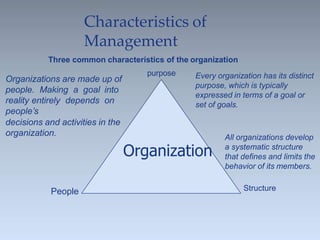
Characteristics of
Management
Organization
purpose
Structure
Organizations are made up of
people. Making a goal into
reality entirely depends on
people’s
decisions and activities in the
organization.
Every organization has its distinct
purpose, which is typically
expressed in terms of a goal or
set of goals.
All organizations develop
a systematic structure
that defines and limits the
behavior of its members.
Three common characteristics of the organization
People
Characteristics of
Management
• Art as well as Science
• Management is an activity
• A continuous Process
• Management achieving Pre-defined
objectives
Characteristics of
Management
• Organized Activities
• Management is a Factor of
Production
Characteristics of
Management
• Management as system of
activity
• Management is a discipline
Characteristics of
Management
• Management is a purposeful
activity
• Management is a distinct entity
• Management aims at
maximizing profit
• Decision making
• Management is a profession
Characteristics of
Management
• Universal Application
• Management is getting
things done
• Management as a class of a
team
• Management as a career
Characteristics of
Management
• Direction and control
• Dynamics
• Management is needed at
all levels
• Leadership activity
Functions of
Management
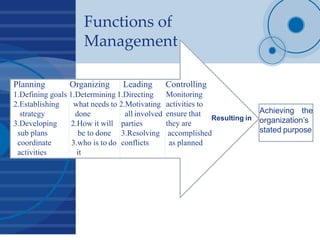
Planning Organizing Leading
1.Defining goals 1.Determining 1.Directing
what needs to 2.Motivating
Controlling
Monitoring
activities to
ensure that
they are
all involved
parties
3.Resolving
conflicts
accomplished
as planned
2.Establishing
strategy
3.Developing
sub plans
coordinate
activities
done
2.How it will
be to done
3.who is to do
it
Resulting in
Achieving the
organization’s
stated purpose
Functions of
Management
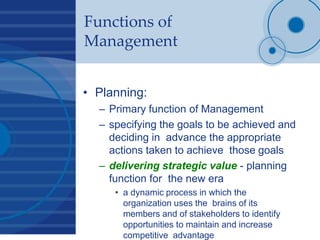
• Planning:
– Primary function of Management
– specifying the goals to be achieved and
deciding in advance the appropriate
actions taken to achieve those goals
– delivering strategic value - planning
function for the new era
• a dynamic process in which the
organization uses the brains of its
members and of stakeholders to identify
opportunities to maintain and increase
competitive advantage
Functions of
Management
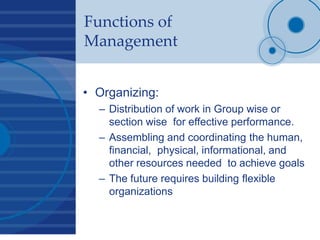
• Organizing:
– Distribution of work in Group wise or
section wise for effective performance.
– Assembling and coordinating the human,
financial, physical, informational, and
other resources needed to achieve goals
– The future requires building flexible
organizations
Functions of
Management
• Staffing:
– Activities of selection and placement of
competent personnel.
– Filling and keeping filled with qualified
people all positions in the business.
– Managers must be good at mobilizing
people to contribute their ideas
Functions of
Management
• Directing:
– The actual performance of a work starts
with this.
– Stimulating people to be high
performers.
– Influencing people's behavior through
motivation, communication, group
dynamics, leadership and discipline.
Functions of
Management
• Co-coordinating :
– All the activities are divided group wise
or section wise under organizing
function
– Such activities are co-ordinated towards
the accomplishment of objectives of the
organization.
– monitors progress and implements
necessary changes
– makes sure that goals are met
– new technology makes it possible to
Functions of
Management
• Motivating or actuating:
– All the goals are achieved
– Increasing the speed of
performance
Functions of
Management
• Controlling:
– Ensures the confirmation of the achieved
objectives to preplanned objectives
Functions of
Management
• Innovation:
– The presentation of personnel and
organization to face the changes made
in the business world
• Representation:
– Manager is the representative of the
company
• Decision-making:
Functions of
Management
• Communication:
– The transmission of human thoughts
• Classification of functions of
management according to Luther
Gullik
– POSDCORB
Importance of
Management
• Management meet the challenges
of change
• Accomplishment of group goals
• Effective utilization of business
Importance of
Management
• Effective functioning of
business
• Resource development
• Sound organization
structure
Importance of
Management
• Management directs the
organization
• Integrates the various
interests
• Stability
Importance of
Management
• Innovation
• Co-ordination and team-
spirit
• Tackling problems
• A tool for personality
development
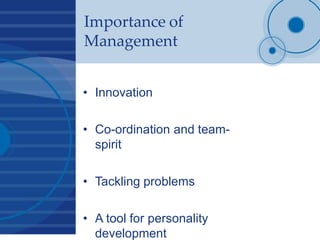
Administration &
Management
Board of Directors
General Managers
Supervisor
Workers
Administration
Department Manager
Management
Top Level
Difference between
Administration &
Management
• Oliver Sheldon: Administration is
concerned with the determination of
the corporate policy. Management is
concerned with the execution of policy
within the limits set up by
administration
• William R. Spiregal: Administration is
concerned with overall determination
of industrial objectives. Management
is concerned with carrying out of the
Difference between
Administration &
Management
• E.F.L. Brech: Management is a social
process entailing responsibilities for
the effective and economical
planning. Administration is a part of
management concerned with
installation and carrying out of he
procedures.
• Theo Heimann: each manager
performs both activities and spends
Difference between
Administration &
Management
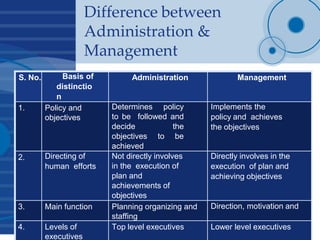
S. No. Basis of
distinctio
n
Administration Management
1. Policy and
objectives
Determines policy
to be followed and
decide the
objectives to be
achieved
Implements the
policy and achieves
the objectives
2. Directing of
human efforts
Not directly involves
in the execution of
plan and
achievements of
objectives
Directly involves in the
execution of plan and
achieving objectives
3. Main function Planning organizing and
staffing
Direction, motivation and
4. Levels of
executives
Top level executives Lower level executives
Summary
• A business develops in course of
time with complexity
• Management aims at maximizing
profit
• Many times the terms
administration and management
are used synonymously
End of Chapter 1
Nature Of Management

MANAGEMENT- DEFINITION, OBJECTIVES,CHARACTERISTICS AND FUNCTION

  • 1.
  • 2.
    Objectives • Understand theMeaning and the definitions of Management • Features of , Functions and importance of management • Know and Understand the relation between Administration and Management
  • 3.
    Introduction • With theincreasing complexities, managing the business concern becomes difficult. • Every business unit has objectives of its own. • The need of existence has increased tremendously.
  • 4.
    Meaning and Definition Of Management •Meaning of Management: – Management if the art of getting things done by a group of people with the effective utilization of available resources • Definitions of Management: – According to various experts like Peter F. Drucker, Ralph C. Davis etc.
  • 5.
    Definition of Management • JosephL. Massie: Management is the process by which a cooperative group directs actions towards common goal • James D. Monny: Management is the art of directing and inspiring the people
  • 6.
    Definition of Management • G.E.Millward: Management is the process and the agency through which execution of policy is planed and supervised • Management is the process consisting the functions of: – Planning – Organizing
  • 7.
    Characteristics of Management Organization purpose Structure Organizations aremade up of people. Making a goal into reality entirely depends on people’s decisions and activities in the organization. Every organization has its distinct purpose, which is typically expressed in terms of a goal or set of goals. All organizations develop a systematic structure that defines and limits the behavior of its members. Three common characteristics of the organization People
  • 8.
    Characteristics of Management • Artas well as Science • Management is an activity • A continuous Process • Management achieving Pre-defined objectives
  • 9.
    Characteristics of Management • OrganizedActivities • Management is a Factor of Production
  • 10.
    Characteristics of Management • Managementas system of activity • Management is a discipline
  • 11.
    Characteristics of Management • Managementis a purposeful activity • Management is a distinct entity • Management aims at maximizing profit • Decision making • Management is a profession
  • 12.
    Characteristics of Management • UniversalApplication • Management is getting things done • Management as a class of a team • Management as a career
  • 13.
    Characteristics of Management • Directionand control • Dynamics • Management is needed at all levels • Leadership activity
  • 14.
    Functions of Management Planning OrganizingLeading 1.Defining goals 1.Determining 1.Directing what needs to 2.Motivating Controlling Monitoring activities to ensure that they are all involved parties 3.Resolving conflicts accomplished as planned 2.Establishing strategy 3.Developing sub plans coordinate activities done 2.How it will be to done 3.who is to do it Resulting in Achieving the organization’s stated purpose
  • 15.
    Functions of Management • Planning: –Primary function of Management – specifying the goals to be achieved and deciding in advance the appropriate actions taken to achieve those goals – delivering strategic value - planning function for the new era • a dynamic process in which the organization uses the brains of its members and of stakeholders to identify opportunities to maintain and increase competitive advantage
  • 16.
    Functions of Management • Organizing: –Distribution of work in Group wise or section wise for effective performance. – Assembling and coordinating the human, financial, physical, informational, and other resources needed to achieve goals – The future requires building flexible organizations
  • 17.
    Functions of Management • Staffing: –Activities of selection and placement of competent personnel. – Filling and keeping filled with qualified people all positions in the business. – Managers must be good at mobilizing people to contribute their ideas
  • 18.
    Functions of Management • Directing: –The actual performance of a work starts with this. – Stimulating people to be high performers. – Influencing people's behavior through motivation, communication, group dynamics, leadership and discipline.
  • 19.
    Functions of Management • Co-coordinating: – All the activities are divided group wise or section wise under organizing function – Such activities are co-ordinated towards the accomplishment of objectives of the organization. – monitors progress and implements necessary changes – makes sure that goals are met – new technology makes it possible to
  • 20.
    Functions of Management • Motivatingor actuating: – All the goals are achieved – Increasing the speed of performance
  • 21.
    Functions of Management • Controlling: –Ensures the confirmation of the achieved objectives to preplanned objectives
  • 22.
    Functions of Management • Innovation: –The presentation of personnel and organization to face the changes made in the business world • Representation: – Manager is the representative of the company • Decision-making:
  • 23.
    Functions of Management • Communication: –The transmission of human thoughts • Classification of functions of management according to Luther Gullik – POSDCORB
  • 24.
    Importance of Management • Managementmeet the challenges of change • Accomplishment of group goals • Effective utilization of business
  • 25.
    Importance of Management • Effectivefunctioning of business • Resource development • Sound organization structure
  • 26.
    Importance of Management • Managementdirects the organization • Integrates the various interests • Stability
  • 27.
    Importance of Management • Innovation •Co-ordination and team- spirit • Tackling problems • A tool for personality development
  • 28.
    Administration & Management Board ofDirectors General Managers Supervisor Workers Administration Department Manager Management Top Level
  • 29.
    Difference between Administration & Management •Oliver Sheldon: Administration is concerned with the determination of the corporate policy. Management is concerned with the execution of policy within the limits set up by administration • William R. Spiregal: Administration is concerned with overall determination of industrial objectives. Management is concerned with carrying out of the
  • 30.
    Difference between Administration & Management •E.F.L. Brech: Management is a social process entailing responsibilities for the effective and economical planning. Administration is a part of management concerned with installation and carrying out of he procedures. • Theo Heimann: each manager performs both activities and spends
  • 31.
    Difference between Administration & Management S.No. Basis of distinctio n Administration Management 1. Policy and objectives Determines policy to be followed and decide the objectives to be achieved Implements the policy and achieves the objectives 2. Directing of human efforts Not directly involves in the execution of plan and achievements of objectives Directly involves in the execution of plan and achieving objectives 3. Main function Planning organizing and staffing Direction, motivation and 4. Levels of executives Top level executives Lower level executives
  • 32.
    Summary • A businessdevelops in course of time with complexity • Management aims at maximizing profit • Many times the terms administration and management are used synonymously
  • 33.
    End of Chapter1 Nature Of Management