Mr. Visanth V S
Asso.Professor
Dept. of Psychiatric Nursing
IGSCON
Meaning
The word organization may convey at least 3 meanings
• Firstly it may refer to the activity of management in
arranging people, tasks and resources in the most
orderly and efficient manner.
• Secondly it may also name the arrangement itself, the
outcome of the organizing activity.
• Thirdly, it may describe any number of businesses,
behavioral and humanistic concepts.
Definition
• Organisation is ‘a group of people
working together and with each other
towards the achievement of the common
goals’.
• Essentially as the creation and
maintenance of an intentional structure
of role’.
-Koontz and O’Donnell
Nature of Organization
1. As a Process
 Organisation is a process of defining,
arranging and grouping the activities
of an enterprise and establishing the
authority relationships among the
persons performing these activities.
2. Structure
 The function of organizing is the
creation of a structural framework of
duties and responsibilities to be
performed by a group of people for the
attainment of the objectives of the
concern.
3. Dividing and Grouping the Activities
• Activities of an enterprise are required
to be distributed between the
departments, units or sections as well
as between the persons for securing
the benefits of division of labor and
specialization.
4. Accomplishment of Goals or Objectives
• An organization structure has no
meaning or purpose unless it is built
around certain clear-cut goals or
objectives.
5. Human and Material Aspects:
• Organisation deals with the human and
material factors in business. Human element
is the most important element in an
organization.
Characteristics of an organization
• Group of people
• Common goals or objectives
• Division of work
• Vertical and horizontal relationship
• Chain of command
• Group dynamics
• Organisation is a Machine of Management
Principles of Organization
1. Principle of Objective
• The organization should set up certain aims
for the achievement of which various
departments should work. A common goal
so devised for the business as a whole and
the organization is set up to achieve that
goal.
2. Principles of Co-ordination
• The co-ordination of different activities is
an important principle of the organization.
There should be some agency to co-
ordinate the activities of various
departments. In the absence of co-
ordination there is a possibility of setting up
different goals by different departments.
3. Principle of Span of Control
• Span of control refers to the maximum number
of members effectively supervised by a single
individual.
• The span of control enables smooth functioning
of the organization.
• This is also called span of management or span
of supervision .
4. Principle Of Specialization Or Division Of Work
• Each person should perform a single leading
function.
• There is a division of labor: a differentiation
among kinds of duties.
• Specialization is the best way to use individuals
and groups.
• Division of work means that the entire activities
of the organization are suitably grouped into
departments and sections.
5. Hierarchy or scalar chain:
• It is the order of rank from top to
bottom in an organization.
• This is also called a chain of
command or line authority.
6. Centrality
It relates to the position or distance the
person has on the organizational chart from
other workers.
7. Principle of continuity
• Administration is a continuing or ongoing
process – recycling the structure of the
organization based on the economic,
environmental and socio-political changes.
8. Principle of Flexibility:
• To meet the challenges of the increasing
and changing demands of the environment,
an organization structure is subjected to
change.
• As such rigidity has to be avoided and
flexibility is essential in the organization
structure, so that changes can be brought
about without disrupting basic design of the
structure.
Types of Organization
Formal Organization
• Provides a framework for
defining responsibility,
authority, delegation and
accountability.
• Depending on the
organizational philosophy,
the formal structure may
be rigid or loose.
Informal Organization
Informal organization is an
organizational structure
which establishes the
relationship on the basis of
the likes and dislikes of
officers without
considering the rules,
regulations and
procedures.
Steps in Organization Process
Determination of Activities
Delegation of Authority
Grouping of Activities
Assignment of Duties
Establishment of Relationships
1. Determination of Activities
• The first step in organizing is to divide the
total job of an enterprise into several
essential activities such as—production,
financing, purchasing, sales, personnel, and
so on. Identification of work enables the
managers to concentrate attention on
important activities.
2. Grouping or Classification of Activities
The various activities identified are
classified into appropriate departments,
divisions, sections, sub-divisions etc. on
the basis of functions, products,
territories or customers. This will
facilitate specialization.
3. Assignment of Duties
• After the creation of departments the next
step will be to fix suitable and qualified
persons into the activities of each
department.
• Each person in the department will be
given a specific part of the job to do and
will be made responsible for it.
4. Establishment of Relationships
• Through the assignment of tasks to
individuals superior-subordinate
relationships between various positions
are established in the enterprise.
• Such relationships and channels of
communication should be clearly
defined.
5. Delegation of Authority
• Appropriate amount of authority is
delegated to people to enable them to
perform the assigned duties with
confidence.
• No one can discharge his respon-
sibilities regarding a particular work in
the absence of requisite authority to do
the same.
Levels of Organization
There are 3 levels of organization;
1. Line organization
2. Staff organization
3. Functional organization
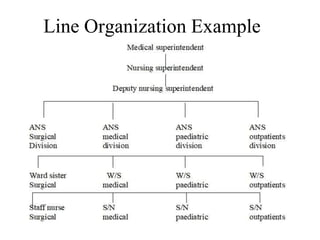
1. Line Organization
• It is the oldest and the simplest form of
organization.
• It is also known as the scalar organization.
• The line of authority is straight and vertical and
each person at the same level performs the same
functions.
• In an enterprise or institution, the chief executive
leads the entire organization. Here the maximum
authority rests on the top or highest levels of
management.
Line Organization Example
2. Staff Organization
• Managers of line as well as staff departments
have line authority over their subordinates. When
the work of line managers increases, staff
officers are appointed to help them. The job of
staff is to give advice, information, suggestion
and guidance.
• For example, personnel manager is appointed to
help the managers in hiring and training people.
He does not have the final authority to appoint
people.
Staff Organization
3. Functional Organization
• In functional organization, the organization is
divided into a number of functional areas.
• Each function is managed by a functional expert in
that area.
• Every functional area serves all other areas.
• For example, the personnel department recruits
employees, arranges for their training, and deals with
the people required for all the other departments.
• The purchasing department handles purchases for
the entire concern.
Functional Organization
Organisation Structure
• It is a process of creating a structure or
platform where various people can
work together to attain their common
objectives effectively.
The organization structure should indicate;
• Well defined relationships (vertical, horizontal and
lateral) of all categories of staff.
• Well defined duties and responsibilities of all categories
of personnel.
• Hierarchial relationship between the supervisors and the
subordinates within the establishment.
• Assignment of tasks to individuals, divisions and
department.
• Coordination of activities and tasks.
• Policies, rules, regulations, procedures and methods for
performance of activities.
Organizational Charts
“An organization chart is a diagrammatic
representation of the framework or structure
of an organization”.
- J.Batty
“An organization chart portrays managerial
positions and relationships in a company or
department unit.”
- Henry H. Albert
• Organisation charts are prepared for the
purpose of describing the organization
structure.
• These are used as tools of management
control.
• They give full information on a particular
organization.
• An executive finds out his exact place in the
organization structure.
• It shows the responsibility and authority of an
executive.
Types of Organization Chart
1. Horizontal chart: The lines of command flows
horizontally. In this, the supervisor is on the left side
of the chart and the subordinate on the right side or
vice versa. This is not followed in any organization.
2. Vertical : In this
chart major functions
are shown at the top
and subordinate
functions in
successive lower
positions. In this chart
scalar levels run
horizontally and
functions run
vertically.
3. Circular chart: Here the positions of the
persons are shown in a circle.
Advantages of Organization Chart
• They give a clear picture of the organization in a
simple way.
• They show the levels of authority and relationship
prevailing among employees at a glance.
• Dual reporting relationships and overlapping
positions come to light in the preparation of
organization chart.
• Newly hired personnel can understand their role in
the organization and behave accordingly.
• Strengths and weaknesses of an organization
are evaluated.
• It act as authoritative sources of information.
• The lines of authority shown are definite and
formal.
• The lines of promotion can be understood.
• Organisation charts help planning and improve
communication both inward and outward.
• Serves as training guides
Limitations of Organization Chart
• The organization charts create more rigidity of
relationship prevailing among the employees of the
organization.
• It is very difficult to maintain and ensure that the
organization charts up-to-date.
• If the charts are not correctly prepared, they will lead to
misleading inference.
• The organization charts produce a psychological
complex such as superiors, inferiors etc., in the minds of
the employees
44
Thank
You

Organization- Management Process

  • 1.
    Mr. Visanth VS Asso.Professor Dept. of Psychiatric Nursing IGSCON
  • 2.
    Meaning The word organizationmay convey at least 3 meanings • Firstly it may refer to the activity of management in arranging people, tasks and resources in the most orderly and efficient manner. • Secondly it may also name the arrangement itself, the outcome of the organizing activity. • Thirdly, it may describe any number of businesses, behavioral and humanistic concepts.
  • 3.
    Definition • Organisation is‘a group of people working together and with each other towards the achievement of the common goals’. • Essentially as the creation and maintenance of an intentional structure of role’. -Koontz and O’Donnell
  • 4.
  • 5.
    1. As aProcess  Organisation is a process of defining, arranging and grouping the activities of an enterprise and establishing the authority relationships among the persons performing these activities.
  • 6.
    2. Structure  Thefunction of organizing is the creation of a structural framework of duties and responsibilities to be performed by a group of people for the attainment of the objectives of the concern.
  • 7.
    3. Dividing andGrouping the Activities • Activities of an enterprise are required to be distributed between the departments, units or sections as well as between the persons for securing the benefits of division of labor and specialization.
  • 8.
    4. Accomplishment ofGoals or Objectives • An organization structure has no meaning or purpose unless it is built around certain clear-cut goals or objectives.
  • 9.
    5. Human andMaterial Aspects: • Organisation deals with the human and material factors in business. Human element is the most important element in an organization.
  • 10.
    Characteristics of anorganization • Group of people • Common goals or objectives • Division of work • Vertical and horizontal relationship • Chain of command • Group dynamics • Organisation is a Machine of Management
  • 11.
  • 12.
    1. Principle ofObjective • The organization should set up certain aims for the achievement of which various departments should work. A common goal so devised for the business as a whole and the organization is set up to achieve that goal.
  • 13.
    2. Principles ofCo-ordination • The co-ordination of different activities is an important principle of the organization. There should be some agency to co- ordinate the activities of various departments. In the absence of co- ordination there is a possibility of setting up different goals by different departments.
  • 14.
    3. Principle ofSpan of Control • Span of control refers to the maximum number of members effectively supervised by a single individual. • The span of control enables smooth functioning of the organization. • This is also called span of management or span of supervision .
  • 15.
    4. Principle OfSpecialization Or Division Of Work • Each person should perform a single leading function. • There is a division of labor: a differentiation among kinds of duties. • Specialization is the best way to use individuals and groups. • Division of work means that the entire activities of the organization are suitably grouped into departments and sections.
  • 16.
    5. Hierarchy orscalar chain: • It is the order of rank from top to bottom in an organization. • This is also called a chain of command or line authority.
  • 17.
    6. Centrality It relatesto the position or distance the person has on the organizational chart from other workers. 7. Principle of continuity • Administration is a continuing or ongoing process – recycling the structure of the organization based on the economic, environmental and socio-political changes.
  • 18.
    8. Principle ofFlexibility: • To meet the challenges of the increasing and changing demands of the environment, an organization structure is subjected to change. • As such rigidity has to be avoided and flexibility is essential in the organization structure, so that changes can be brought about without disrupting basic design of the structure.
  • 19.
    Types of Organization FormalOrganization • Provides a framework for defining responsibility, authority, delegation and accountability. • Depending on the organizational philosophy, the formal structure may be rigid or loose. Informal Organization Informal organization is an organizational structure which establishes the relationship on the basis of the likes and dislikes of officers without considering the rules, regulations and procedures.
  • 20.
  • 21.
    Determination of Activities Delegationof Authority Grouping of Activities Assignment of Duties Establishment of Relationships
  • 22.
    1. Determination ofActivities • The first step in organizing is to divide the total job of an enterprise into several essential activities such as—production, financing, purchasing, sales, personnel, and so on. Identification of work enables the managers to concentrate attention on important activities.
  • 23.
    2. Grouping orClassification of Activities The various activities identified are classified into appropriate departments, divisions, sections, sub-divisions etc. on the basis of functions, products, territories or customers. This will facilitate specialization.
  • 24.
    3. Assignment ofDuties • After the creation of departments the next step will be to fix suitable and qualified persons into the activities of each department. • Each person in the department will be given a specific part of the job to do and will be made responsible for it.
  • 25.
    4. Establishment ofRelationships • Through the assignment of tasks to individuals superior-subordinate relationships between various positions are established in the enterprise. • Such relationships and channels of communication should be clearly defined.
  • 26.
    5. Delegation ofAuthority • Appropriate amount of authority is delegated to people to enable them to perform the assigned duties with confidence. • No one can discharge his respon- sibilities regarding a particular work in the absence of requisite authority to do the same.
  • 27.
    Levels of Organization Thereare 3 levels of organization; 1. Line organization 2. Staff organization 3. Functional organization
  • 28.
    1. Line Organization •It is the oldest and the simplest form of organization. • It is also known as the scalar organization. • The line of authority is straight and vertical and each person at the same level performs the same functions. • In an enterprise or institution, the chief executive leads the entire organization. Here the maximum authority rests on the top or highest levels of management.
  • 29.
  • 30.
    2. Staff Organization •Managers of line as well as staff departments have line authority over their subordinates. When the work of line managers increases, staff officers are appointed to help them. The job of staff is to give advice, information, suggestion and guidance. • For example, personnel manager is appointed to help the managers in hiring and training people. He does not have the final authority to appoint people.
  • 31.
  • 32.
    3. Functional Organization •In functional organization, the organization is divided into a number of functional areas. • Each function is managed by a functional expert in that area. • Every functional area serves all other areas. • For example, the personnel department recruits employees, arranges for their training, and deals with the people required for all the other departments. • The purchasing department handles purchases for the entire concern.
  • 33.
  • 34.
    Organisation Structure • Itis a process of creating a structure or platform where various people can work together to attain their common objectives effectively.
  • 35.
    The organization structureshould indicate; • Well defined relationships (vertical, horizontal and lateral) of all categories of staff. • Well defined duties and responsibilities of all categories of personnel. • Hierarchial relationship between the supervisors and the subordinates within the establishment. • Assignment of tasks to individuals, divisions and department. • Coordination of activities and tasks. • Policies, rules, regulations, procedures and methods for performance of activities.
  • 36.
    Organizational Charts “An organizationchart is a diagrammatic representation of the framework or structure of an organization”. - J.Batty “An organization chart portrays managerial positions and relationships in a company or department unit.” - Henry H. Albert
  • 37.
    • Organisation chartsare prepared for the purpose of describing the organization structure. • These are used as tools of management control. • They give full information on a particular organization. • An executive finds out his exact place in the organization structure. • It shows the responsibility and authority of an executive.
  • 38.
    Types of OrganizationChart 1. Horizontal chart: The lines of command flows horizontally. In this, the supervisor is on the left side of the chart and the subordinate on the right side or vice versa. This is not followed in any organization.
  • 39.
    2. Vertical :In this chart major functions are shown at the top and subordinate functions in successive lower positions. In this chart scalar levels run horizontally and functions run vertically.
  • 40.
    3. Circular chart:Here the positions of the persons are shown in a circle.
  • 41.
    Advantages of OrganizationChart • They give a clear picture of the organization in a simple way. • They show the levels of authority and relationship prevailing among employees at a glance. • Dual reporting relationships and overlapping positions come to light in the preparation of organization chart. • Newly hired personnel can understand their role in the organization and behave accordingly.
  • 42.
    • Strengths andweaknesses of an organization are evaluated. • It act as authoritative sources of information. • The lines of authority shown are definite and formal. • The lines of promotion can be understood. • Organisation charts help planning and improve communication both inward and outward. • Serves as training guides
  • 43.
    Limitations of OrganizationChart • The organization charts create more rigidity of relationship prevailing among the employees of the organization. • It is very difficult to maintain and ensure that the organization charts up-to-date. • If the charts are not correctly prepared, they will lead to misleading inference. • The organization charts produce a psychological complex such as superiors, inferiors etc., in the minds of the employees
  • 44.