Chapter 2:
Transistor MOSFET
Assoc. Prof. Pham Nguyen
Thanh Loan
1
Chapter 3: MOSFET
 Introduction
 Classifications
 JFET
 D-MOSFET (Depletion MOS, DFET…)
 MOSFET (Enhancement E-MOSFET/ E-FET)
 DC biasing
 AC Analysis (Small signal analysis)
 Equivalent small signal circuit
2
FET Introduction
 High input impedance, nMΩ-n100MΩ
 Controlled by voltage (≠ BJT)
 Low power consumption
 Low noise, suitable for small signal
 Low impact of temperature
 Using as switch for low power application
 Small size and adapt for integrated circuit
3
Classification
 JFET-Junction Field Effect Transistor
🞑 N and P channels
 MOSFET-Metal Oxide Semiconductor FET
🞑 Depletion MOS
 N and P channels
🞑 Enhancement MOS
 N and P channels
4
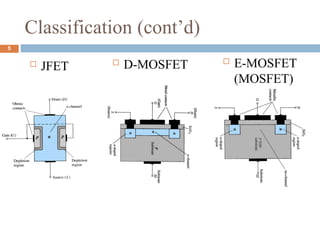
Classification (cont’d)
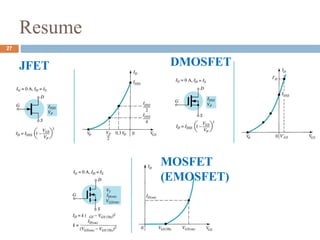
 JFET  D-MOSFET  E-MOSFET
(MOSFET)
5
JFET
 Structure and Operation
 Characteristic Curve
 Compare with BJT
 Examples, datasheets
6
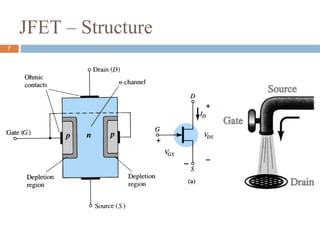
JFET – Structure
7
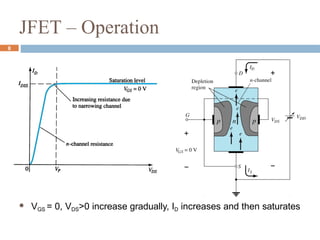
JFET – Operation
 VGS = 0, VDS>0 increase gradually, ID increases and then saturates
8
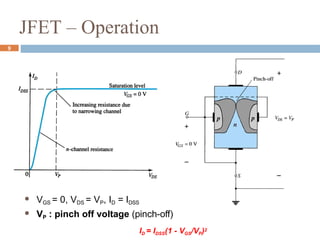
JFET – Operation
 VGS = 0, VDS = VP, ID = IDSS
 VP : pinch off voltage (pinch-off)
ID = IDSS(1 - VGS/VP)2
9
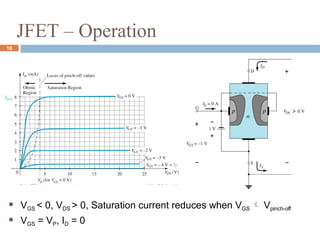
JFET – Operation
 VGS < 0, VDS > 0, Saturation current reduces when VGS  Vpinch-off
 VGS = VP, ID = 0
10
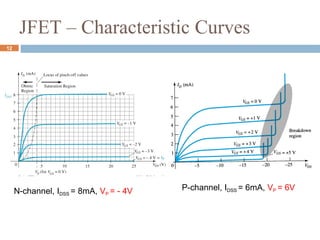
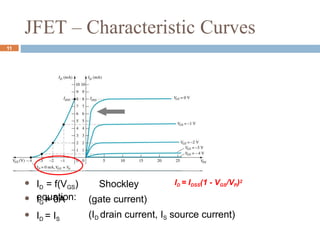
JFET – Characteristic Curves
 ID = f(VGS) Shockley
equation:
 IG ≈ 0A
 ID = IS
(gate current)
(ID drain current, IS source current)
11
ID = IDSS(1 - VGS/VP)2
JFET – Characteristic Curves
P-channel, IDSS = 6mA, VP = 6V
N-channel, IDSS = 8mA, VP = - 4V
12
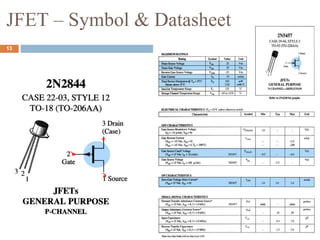
JFET – Symbol & Datasheet
13
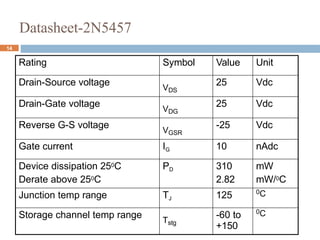
Datasheet-2N5457
Rating Symbol Value Unit
Drain-Source voltage
VDS
25 Vdc
Drain-Gate voltage
VDG
25 Vdc
Reverse G-S voltage
VGSR
-25 Vdc
Gate current IG 10 nAdc
Device dissipation 250C
Derate above 250C
PD 310
2.82
mW
mW/0C
Junction temp range TJ 125 0C
Storage channel temp range
Tstg
-60 to
+150
0C
14
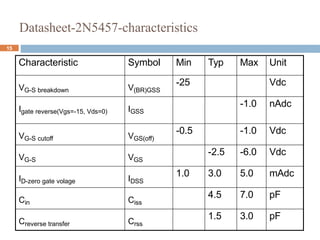
Datasheet-2N5457-characteristics
Characteristic Symbol Min Typ Max Unit
VG-S breakdown V(BR)GSS
-25 Vdc
Igate reverse(Vgs=-15, Vds=0) IGSS
-1.0 nAdc
VG-S cutoff VGS(off)
-0.5 -1.0 Vdc
VG-S VGS
-2.5 -6.0 Vdc
ID-zero gate volage IDSS
1.0 3.0 5.0 mAdc
Cin Ciss
4.5 7.0 pF
Creverse transfer Crss
1.5 3.0 pF
15
MOSFET
 Structures
 Operation
 Characteristic Curves
16
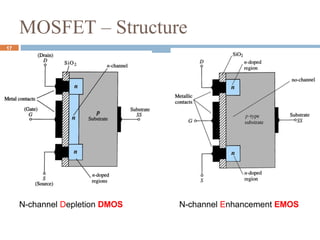
MOSFET – Structure
N-channel Enhancement EMOS
N-channel Depletion DMOS
17
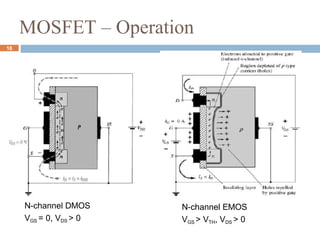
MOSFET – Operation
N-channel EMOS
VGS > VTH, VDS > 0
N-channel DMOS
VGS = 0, VDS > 0
18
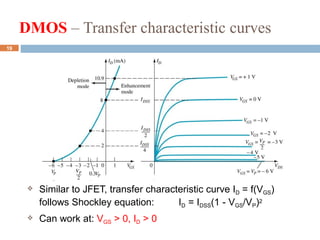
DMOS – Transfer characteristic curves
 Similar to JFET, transfer characteristic curve ID = f(VGS)
follows Shockley equation: ID = IDSS(1 - VGS/VP)2
 Can work at: VGS > 0, ID > 0
19
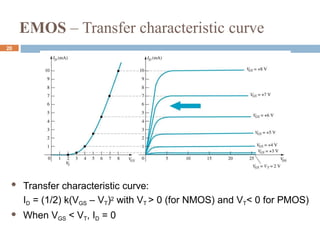
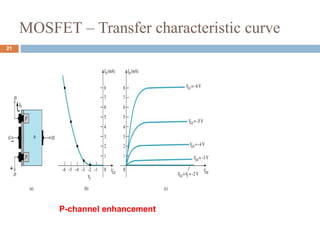
EMOS – Transfer characteristic curve
 Transfer characteristic curve:
ID = (1/2) k(VGS – VT)2 with VT > 0 (for NMOS) and VT< 0 for PMOS)
 When VGS < VT, ID = 0
20
MOSFET – Transfer characteristic curve
P-channel enhancement
21
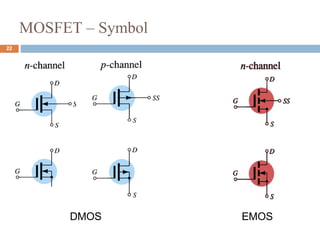
MOSFET – Symbol
EMOS
DMOS
22
23
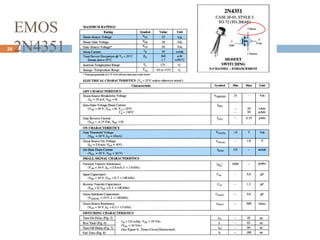
EMOS
24 2N4351
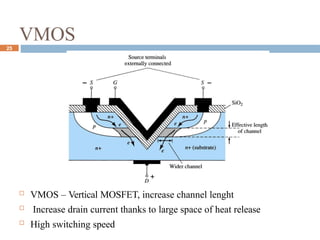
VMOS
 VMOS – Vertical MOSFET, increase channel lenght
 Increase drain current thanks to large space of heat release
 High switching speed
25
CMOS
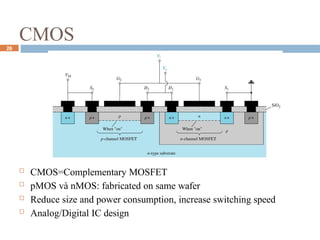
 CMOS=Complementary MOSFET
 pMOS và nMOS: fabricated on same wafer
 Reduce size and power consumption, increase switching speed
 Analog/Digital IC design
26
Resume
JFET DMOSFET
MOSFET
(EMOSFET)
27
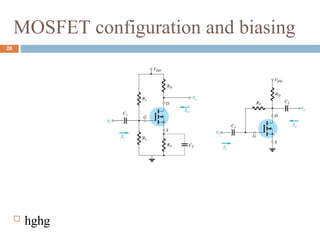
MOSFET configuration and biasing
 hghg
28
AC & DC analysis
29
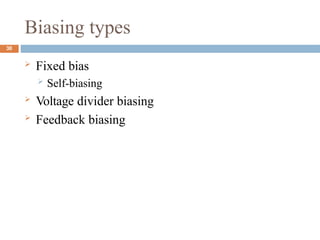
Biasing types
 Fixed bias
 Self-biasing
 Voltage divider biasing
 Feedback biasing
30
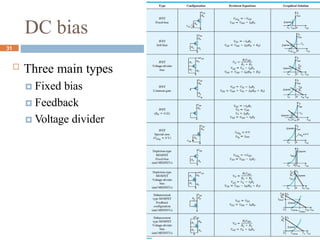
DC bias
 Three main types
🞑 Fixed bias
🞑 Feedback
🞑 Voltage divider
31
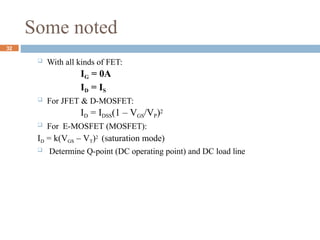
Some noted
 With all kinds of FET:
IG = 0A
ID = IS
 For JFET & D-MOSFET:
ID = IDSS(1 – VGS/VP)2
 For E-MOSFET (MOSFET):
ID = k(VGS – VT)2 (saturation mode)
 Determine Q-point (DC operating point) and DC load line
32
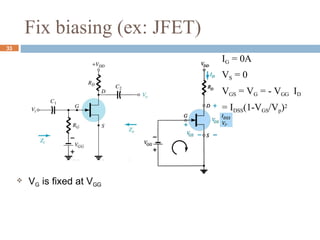
Fix biasing (ex: JFET)
IG = 0A
VS = 0
VGS = VG = - VGG ID
= IDSS(1-VGS/Vp)2
 VG is fixed at VGG
33
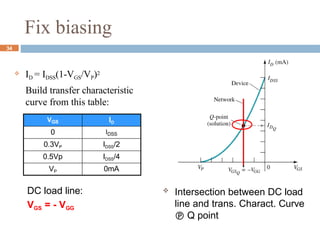
Fix biasing
 ID = IDSS(1-VGS/VP)2
Build transfer characteristic
curve from this table:
VGS ID
0 IDSS
0.3VP IDSS/2
0.5Vp IDSS/4
VP 0mA
DC load line:
VGS = - VGG
 Intersection between DC load
line and trans. Charact. Curve
 Q point
34
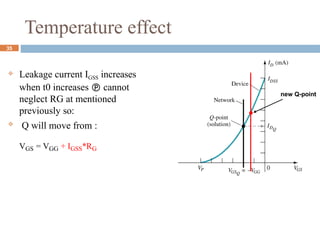
Temperature effect
 Leakage current IGSS increases
when t0 increases  cannot
neglect RG at mentioned
previously so:
 Q will move from :
VGS = VGG + IGSS*RG
new Q-point
35
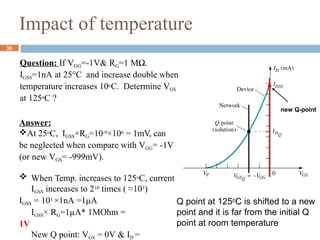
new Q-point
Answer:
At 25oC, IGSS×RG=10-9×106 = 1mV, can
be neglected when compare with VGG= -1V
(or new VGS= -999mV).
Q point at 1250C is shifted to a new
point and it is far from the initial Q
point at room temperature
36
Question: If VGG=-1V& RG=1 MΩ.
IGSS=1nA at 25°C and increase double when
temperature increases 10oC. Determine VGS
at 125oC ?
 When Temp. increases to 125oC, current
IGSS increases to 210 times ( ≈103)
IGSS = 103 ×1nA =1µA
IGSS× RG=1µA* 1MOhm =
1V
New Q point: VGS = 0V & ID =
Impact of temperature
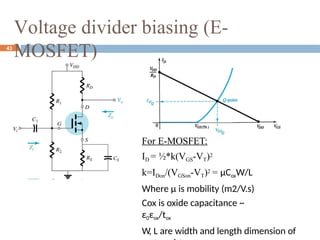
For E-MOSFET:
ID = ½*k(VGS-VT)2
k=IDon/(VGSon-VT)2 = μCoxW/L
Where μ is mobility (m2/V.s)
Cox is oxide capacitance ~
ε0εox/tox
W, L are width and length dimension of
43
Voltage divider biasing (E-
MOSFET)
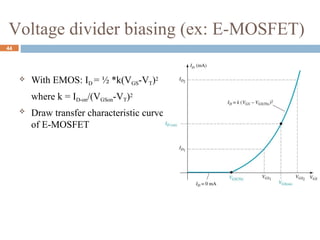
 With EMOS: ID = ½ *k(VGS-VT)2
where k = ID-on/(VGSon-VT)2
 Draw transfer characteristic curve
of E-MOSFET
44
Voltage divider biasing (ex: E-MOSFET)
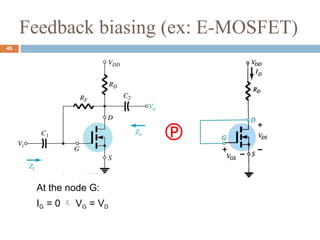
Feedback biasing (ex: E-MOSFET)
At the node G:
IG = 0  VG = VD
45

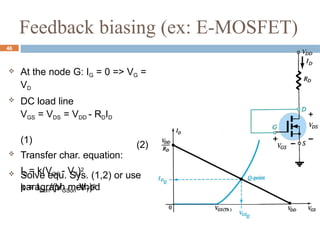
 At the node G: IG = 0 => VG =
VD
 DC load line
(2)
VGS = VDS = VDD - RDID
(1)
 Transfer char. equation:
ID = k(VGS - VT)2
,
k = IDon/(VGSon-VT)2
 Solve equ. Sys. (1,2) or use
paragraph method
46
Feedback biasing (ex: E-MOSFET)
Homework
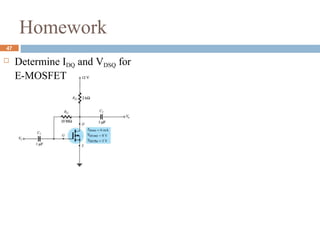
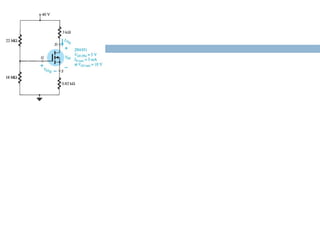
 Determine IDQ and VDSQ for
E-MOSFET
47
Homework
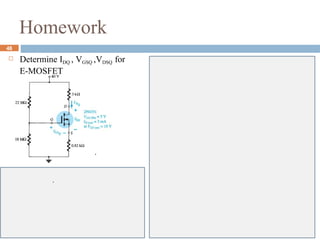
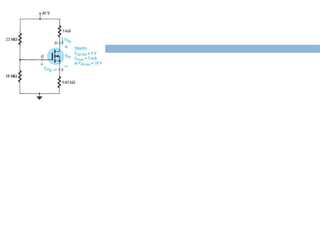
 Determine IDQ , VGSQ ,VDSQ for
E-MOSFET
48
49
50
Example
51
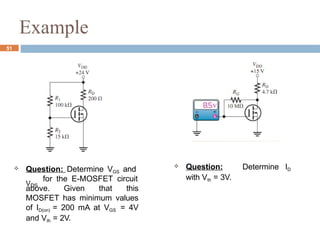
 Question: Determine VGS and
VDS
for the E-MOSFET circuit
above. Given that this
MOSFET has minimum values
of ID(on) = 200 mA at VGS = 4V
and Vth = 2V.
 Question: Determine ID
with Vth = 3V.
Analyze the circuit for AC
signal (small signal)
52
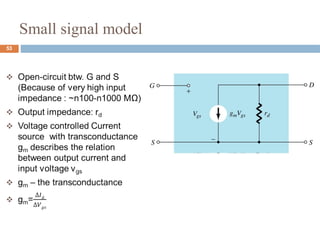
Small signal model
53
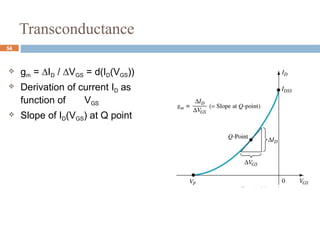
Transconductance
 gm = ∆ID / ∆VGS = d(ID(VGS))
 Derivation of current ID as
function of VGS
 Slope of ID(VGS) at Q point
54
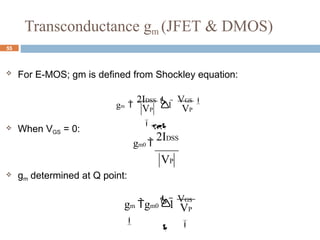
Transconductance gm (JFET & DMOS)


VP VP

 For E-MOS; gm is defined from Shockley equation:
gm 
2IDSS 
1 
VGS 
 When VGS = 0:
gm0 
2IDSS
VP
 gm determined at Q point:


VP

gm gm0

1
VGS

55
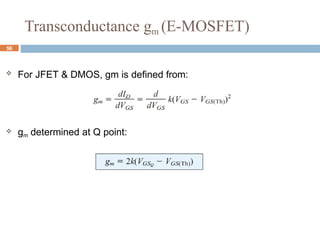
Transconductance gm (E-MOSFET)
 For JFET & DMOS, gm is defined from:
 gm determined at Q point:
56
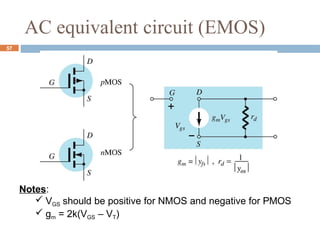
Notes:
 VGS should be positive for NMOS and negative for PMOS
 gm = 2k(VGS – VT)
AC equivalent circuit (EMOS)
57
3 types of MOSFET amplifier
58
 CS – CD - CG
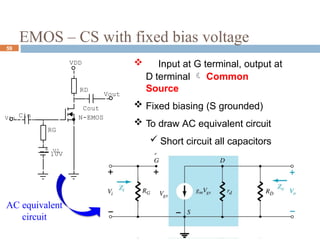
EMOS – CS with fixed bias voltage
59
Vout
Vin Cin
+ V1
10V
VDD
RG
RD
Cout
N-EMOS
 Input at G terminal, output at
D terminal  Common
Source
 Fixed biasing (S grounded)
 To draw AC equivalent circuit
 Short circuit all capacitors
Short circuit power supply
AC equivalent
circuit
60
61
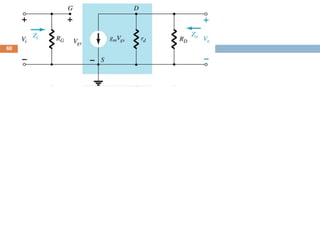
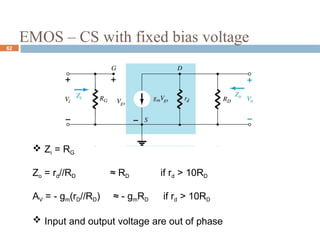
 Zi = RG
Zo = rd//RD ≈ RD if rd > 10RD
AV = - gm(rD//RD) ≈ - gmRD if rd > 10RD
 Input and output voltage are out of phase
EMOS – CS with fixed bias voltage
62
EMOS – CS with voltage divider
63
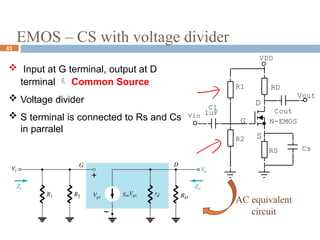
 Input at G terminal, output at D
terminal  Common Source
 Voltage divider
 S terminal is connected to Rs and Cs
in parralel
G
D
S
R1
Cs
RS
Cout
Vout
C1
Vin 1uF
VDD
R2
RD
N-EMOS
AC equivalent
circuit
64
65
EMOS – CS with voltage divider
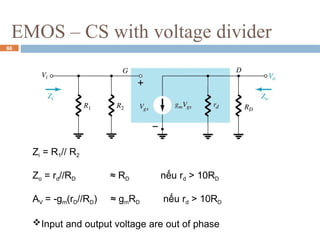
Zi = R1// R2
Zo = rd//RD ≈ RD nếu rd > 10RD
AV = -gm(rD//RD) ≈ gmRD nếu rd > 10RD
Input and output voltage are out of phase
66
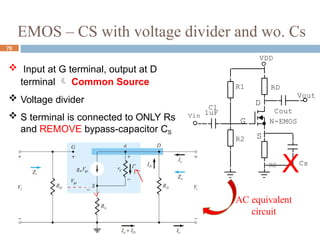
EMOS – CS with voltage divider and wo. Cs
67
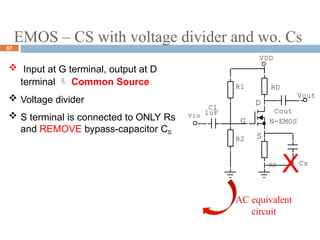
 Input at G terminal, output at D
terminal  Common Source
 Voltage divider
 S terminal is connected to ONLY Rs
and REMOVE bypass-capacitor CS
G
D
S
R1
Cout
Vout
C1
Vin 1uF
VDD
R2
RD
N-EMOS
RS
XCs
AC equivalent
circuit
68
69
EMOS – CS with voltage divider and wo. Cs
70
 Input at G terminal, output at D
terminal  Common Source
 Voltage divider
 S terminal is connected to ONLY Rs
and REMOVE bypass-capacitor CS
G
D
S
R1
Cout
Vout
C1
Vin 1uF
VDD
R2
RD
N-EMOS
RS
XCs
AC equivalent
circuit
71
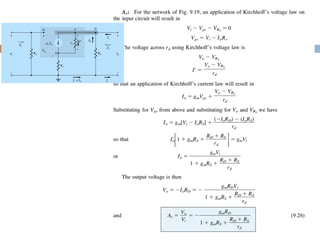
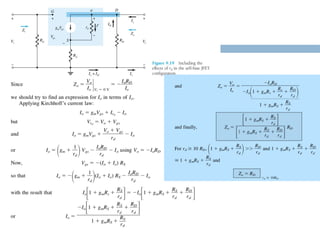
EMOS – CS with voltage divider and wo. Cs
 Zi = RG
Zo =
(or R1//R2)
AV = -gmRD/[1+gmRS+(RD+RS)/rd]
 Input and output voltage are out of phase
73
EMOS – CS with feedback bias
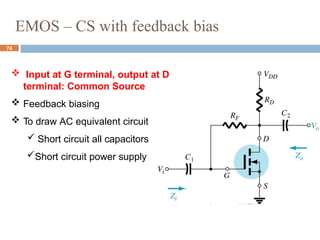
 Input at G terminal, output at D
terminal: Common Source
 Feedback biasing
 To draw AC equivalent circuit
 Short circuit all capacitors
Short circuit power supply
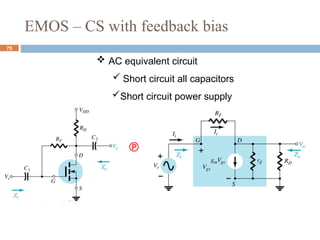
74
EMOS – CS with feedback bias
75
 AC equivalent circuit
 Short circuit all capacitors
Short circuit power supply

76
77
EMOS – CS with feedback bias
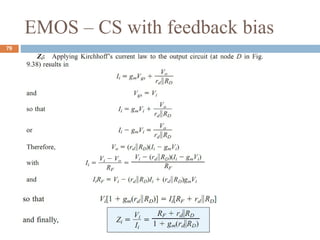
 Zi = (RF+rd//RD)/[1+gm(rd//RD)]
≈ RF/(1+gmRD) with rd >10RD, RF>>rd//RD
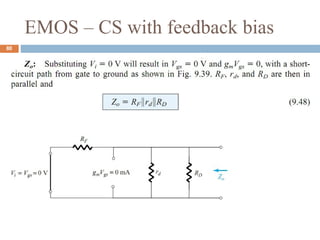
 Zo = RF//rd//RD ≈ RD with rd >10RD, RF>>rd//RD
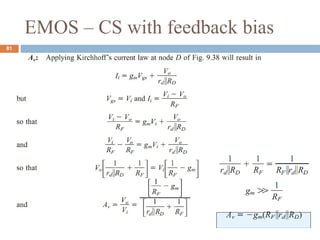
 AV = gm RF//rd//RD ≈ gmRD with rd >10RD,
RF>>rd//RD
 Output and input voltage are out of phase
78
EMOS – CS with feedback bias
79
80
EMOS – CS with feedback bias
81
EMOS – CS with feedback bias
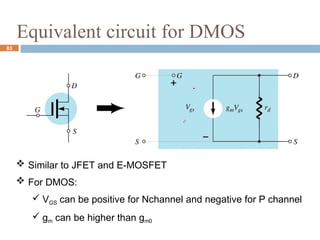
Equivalent circuit for DMOS
 Similar to JFET and E-MOSFET
 For DMOS:
 VGS can be positive for Nchannel and negative for P channel
 gm can be higher than gm0
83
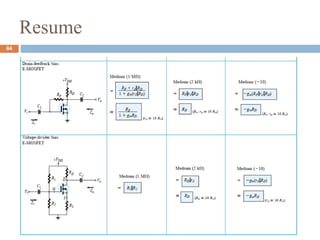
Resume
84
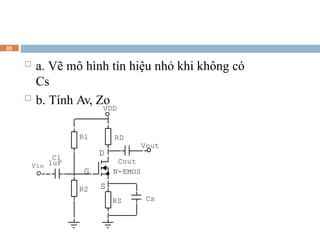
 a. Vẽ mô hình tín hiệu nhỏ khi không có
Cs
 b. Tính Av, Zo
85
G
D
S
R1
Cs
RS
Cout
Vout
C1
Vin 1uF
VDD
R2
RD
N-EMOS
86
87
88

20241_Chapter 2 _FEergergergergedfgdfT.pptx

  • 1.
    Chapter 2: Transistor MOSFET Assoc.Prof. Pham Nguyen Thanh Loan 1
  • 2.
    Chapter 3: MOSFET Introduction  Classifications  JFET  D-MOSFET (Depletion MOS, DFET…)  MOSFET (Enhancement E-MOSFET/ E-FET)  DC biasing  AC Analysis (Small signal analysis)  Equivalent small signal circuit 2
  • 3.
    FET Introduction  Highinput impedance, nMΩ-n100MΩ  Controlled by voltage (≠ BJT)  Low power consumption  Low noise, suitable for small signal  Low impact of temperature  Using as switch for low power application  Small size and adapt for integrated circuit 3
  • 4.
    Classification  JFET-Junction FieldEffect Transistor 🞑 N and P channels  MOSFET-Metal Oxide Semiconductor FET 🞑 Depletion MOS  N and P channels 🞑 Enhancement MOS  N and P channels 4
  • 5.
    Classification (cont’d)  JFET D-MOSFET  E-MOSFET (MOSFET) 5
  • 6.
    JFET  Structure andOperation  Characteristic Curve  Compare with BJT  Examples, datasheets 6
  • 7.
  • 8.
    JFET – Operation VGS = 0, VDS>0 increase gradually, ID increases and then saturates 8
  • 9.
    JFET – Operation VGS = 0, VDS = VP, ID = IDSS  VP : pinch off voltage (pinch-off) ID = IDSS(1 - VGS/VP)2 9
  • 10.
    JFET – Operation VGS < 0, VDS > 0, Saturation current reduces when VGS  Vpinch-off  VGS = VP, ID = 0 10
  • 11.
    JFET – CharacteristicCurves  ID = f(VGS) Shockley equation:  IG ≈ 0A  ID = IS (gate current) (ID drain current, IS source current) 11 ID = IDSS(1 - VGS/VP)2
  • 12.
    JFET – CharacteristicCurves P-channel, IDSS = 6mA, VP = 6V N-channel, IDSS = 8mA, VP = - 4V 12
  • 13.
    JFET – Symbol& Datasheet 13
  • 14.
    Datasheet-2N5457 Rating Symbol ValueUnit Drain-Source voltage VDS 25 Vdc Drain-Gate voltage VDG 25 Vdc Reverse G-S voltage VGSR -25 Vdc Gate current IG 10 nAdc Device dissipation 250C Derate above 250C PD 310 2.82 mW mW/0C Junction temp range TJ 125 0C Storage channel temp range Tstg -60 to +150 0C 14
  • 15.
    Datasheet-2N5457-characteristics Characteristic Symbol MinTyp Max Unit VG-S breakdown V(BR)GSS -25 Vdc Igate reverse(Vgs=-15, Vds=0) IGSS -1.0 nAdc VG-S cutoff VGS(off) -0.5 -1.0 Vdc VG-S VGS -2.5 -6.0 Vdc ID-zero gate volage IDSS 1.0 3.0 5.0 mAdc Cin Ciss 4.5 7.0 pF Creverse transfer Crss 1.5 3.0 pF 15
  • 16.
  • 17.
    MOSFET – Structure N-channelEnhancement EMOS N-channel Depletion DMOS 17
  • 18.
    MOSFET – Operation N-channelEMOS VGS > VTH, VDS > 0 N-channel DMOS VGS = 0, VDS > 0 18
  • 19.
    DMOS – Transfercharacteristic curves  Similar to JFET, transfer characteristic curve ID = f(VGS) follows Shockley equation: ID = IDSS(1 - VGS/VP)2  Can work at: VGS > 0, ID > 0 19
  • 20.
    EMOS – Transfercharacteristic curve  Transfer characteristic curve: ID = (1/2) k(VGS – VT)2 with VT > 0 (for NMOS) and VT< 0 for PMOS)  When VGS < VT, ID = 0 20
  • 21.
    MOSFET – Transfercharacteristic curve P-channel enhancement 21
  • 22.
  • 23.
  • 24.
  • 25.
    VMOS  VMOS –Vertical MOSFET, increase channel lenght  Increase drain current thanks to large space of heat release  High switching speed 25
  • 26.
    CMOS  CMOS=Complementary MOSFET pMOS và nMOS: fabricated on same wafer  Reduce size and power consumption, increase switching speed  Analog/Digital IC design 26
  • 27.
  • 28.
    MOSFET configuration andbiasing  hghg 28
  • 29.
    AC & DCanalysis 29
  • 30.
    Biasing types  Fixedbias  Self-biasing  Voltage divider biasing  Feedback biasing 30
  • 31.
    DC bias  Threemain types 🞑 Fixed bias 🞑 Feedback 🞑 Voltage divider 31
  • 32.
    Some noted  Withall kinds of FET: IG = 0A ID = IS  For JFET & D-MOSFET: ID = IDSS(1 – VGS/VP)2  For E-MOSFET (MOSFET): ID = k(VGS – VT)2 (saturation mode)  Determine Q-point (DC operating point) and DC load line 32
  • 33.
    Fix biasing (ex:JFET) IG = 0A VS = 0 VGS = VG = - VGG ID = IDSS(1-VGS/Vp)2  VG is fixed at VGG 33
  • 34.
    Fix biasing  ID= IDSS(1-VGS/VP)2 Build transfer characteristic curve from this table: VGS ID 0 IDSS 0.3VP IDSS/2 0.5Vp IDSS/4 VP 0mA DC load line: VGS = - VGG  Intersection between DC load line and trans. Charact. Curve  Q point 34
  • 35.
    Temperature effect  Leakagecurrent IGSS increases when t0 increases  cannot neglect RG at mentioned previously so:  Q will move from : VGS = VGG + IGSS*RG new Q-point 35
  • 36.
    new Q-point Answer: At 25oC,IGSS×RG=10-9×106 = 1mV, can be neglected when compare with VGG= -1V (or new VGS= -999mV). Q point at 1250C is shifted to a new point and it is far from the initial Q point at room temperature 36 Question: If VGG=-1V& RG=1 MΩ. IGSS=1nA at 25°C and increase double when temperature increases 10oC. Determine VGS at 125oC ?  When Temp. increases to 125oC, current IGSS increases to 210 times ( ≈103) IGSS = 103 ×1nA =1µA IGSS× RG=1µA* 1MOhm = 1V New Q point: VGS = 0V & ID = Impact of temperature
  • 37.
    For E-MOSFET: ID =½*k(VGS-VT)2 k=IDon/(VGSon-VT)2 = μCoxW/L Where μ is mobility (m2/V.s) Cox is oxide capacitance ~ ε0εox/tox W, L are width and length dimension of 43 Voltage divider biasing (E- MOSFET)
  • 38.
     With EMOS:ID = ½ *k(VGS-VT)2 where k = ID-on/(VGSon-VT)2  Draw transfer characteristic curve of E-MOSFET 44 Voltage divider biasing (ex: E-MOSFET)
  • 39.
    Feedback biasing (ex:E-MOSFET) At the node G: IG = 0  VG = VD 45 
  • 40.
     At thenode G: IG = 0 => VG = VD  DC load line (2) VGS = VDS = VDD - RDID (1)  Transfer char. equation: ID = k(VGS - VT)2 , k = IDon/(VGSon-VT)2  Solve equ. Sys. (1,2) or use paragraph method 46 Feedback biasing (ex: E-MOSFET)
  • 41.
    Homework  Determine IDQand VDSQ for E-MOSFET 47
  • 42.
    Homework  Determine IDQ, VGSQ ,VDSQ for E-MOSFET 48
  • 43.
  • 44.
  • 45.
    Example 51  Question: DetermineVGS and VDS for the E-MOSFET circuit above. Given that this MOSFET has minimum values of ID(on) = 200 mA at VGS = 4V and Vth = 2V.  Question: Determine ID with Vth = 3V.
  • 46.
    Analyze the circuitfor AC signal (small signal) 52
  • 47.
  • 48.
    Transconductance  gm =∆ID / ∆VGS = d(ID(VGS))  Derivation of current ID as function of VGS  Slope of ID(VGS) at Q point 54
  • 49.
    Transconductance gm (JFET& DMOS)   VP VP   For E-MOS; gm is defined from Shockley equation: gm  2IDSS  1  VGS   When VGS = 0: gm0  2IDSS VP  gm determined at Q point:   VP  gm gm0  1 VGS  55
  • 50.
    Transconductance gm (E-MOSFET) For JFET & DMOS, gm is defined from:  gm determined at Q point: 56
  • 51.
    Notes:  VGS shouldbe positive for NMOS and negative for PMOS  gm = 2k(VGS – VT) AC equivalent circuit (EMOS) 57
  • 52.
    3 types ofMOSFET amplifier 58  CS – CD - CG
  • 53.
    EMOS – CSwith fixed bias voltage 59 Vout Vin Cin + V1 10V VDD RG RD Cout N-EMOS  Input at G terminal, output at D terminal  Common Source  Fixed biasing (S grounded)  To draw AC equivalent circuit  Short circuit all capacitors Short circuit power supply AC equivalent circuit
  • 54.
  • 55.
  • 56.
     Zi =RG Zo = rd//RD ≈ RD if rd > 10RD AV = - gm(rD//RD) ≈ - gmRD if rd > 10RD  Input and output voltage are out of phase EMOS – CS with fixed bias voltage 62
  • 57.
    EMOS – CSwith voltage divider 63  Input at G terminal, output at D terminal  Common Source  Voltage divider  S terminal is connected to Rs and Cs in parralel G D S R1 Cs RS Cout Vout C1 Vin 1uF VDD R2 RD N-EMOS AC equivalent circuit
  • 58.
  • 59.
  • 60.
    EMOS – CSwith voltage divider Zi = R1// R2 Zo = rd//RD ≈ RD nếu rd > 10RD AV = -gm(rD//RD) ≈ gmRD nếu rd > 10RD Input and output voltage are out of phase 66
  • 61.
    EMOS – CSwith voltage divider and wo. Cs 67  Input at G terminal, output at D terminal  Common Source  Voltage divider  S terminal is connected to ONLY Rs and REMOVE bypass-capacitor CS G D S R1 Cout Vout C1 Vin 1uF VDD R2 RD N-EMOS RS XCs AC equivalent circuit
  • 62.
  • 63.
  • 64.
    EMOS – CSwith voltage divider and wo. Cs 70  Input at G terminal, output at D terminal  Common Source  Voltage divider  S terminal is connected to ONLY Rs and REMOVE bypass-capacitor CS G D S R1 Cout Vout C1 Vin 1uF VDD R2 RD N-EMOS RS XCs AC equivalent circuit
  • 65.
  • 67.
    EMOS – CSwith voltage divider and wo. Cs  Zi = RG Zo = (or R1//R2) AV = -gmRD/[1+gmRS+(RD+RS)/rd]  Input and output voltage are out of phase 73
  • 68.
    EMOS – CSwith feedback bias  Input at G terminal, output at D terminal: Common Source  Feedback biasing  To draw AC equivalent circuit  Short circuit all capacitors Short circuit power supply 74
  • 69.
    EMOS – CSwith feedback bias 75  AC equivalent circuit  Short circuit all capacitors Short circuit power supply 
  • 70.
  • 71.
  • 72.
    EMOS – CSwith feedback bias  Zi = (RF+rd//RD)/[1+gm(rd//RD)] ≈ RF/(1+gmRD) with rd >10RD, RF>>rd//RD  Zo = RF//rd//RD ≈ RD with rd >10RD, RF>>rd//RD  AV = gm RF//rd//RD ≈ gmRD with rd >10RD, RF>>rd//RD  Output and input voltage are out of phase 78
  • 73.
    EMOS – CSwith feedback bias 79
  • 74.
    80 EMOS – CSwith feedback bias
  • 75.
    81 EMOS – CSwith feedback bias
  • 76.
    Equivalent circuit forDMOS  Similar to JFET and E-MOSFET  For DMOS:  VGS can be positive for Nchannel and negative for P channel  gm can be higher than gm0 83
  • 77.
  • 78.
     a. Vẽmô hình tín hiệu nhỏ khi không có Cs  b. Tính Av, Zo 85 G D S R1 Cs RS Cout Vout C1 Vin 1uF VDD R2 RD N-EMOS
  • 79.
  • 80.
  • 81.