CMOS
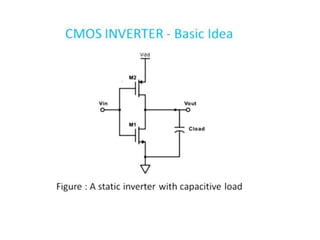
Digital Integrated
Circuits
Analysis and Design
1
Unit-2
MOS Inverters: Static Characteristics
Introduction
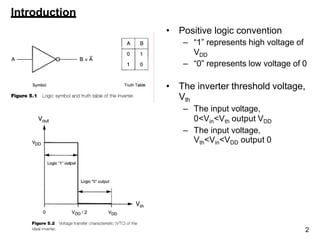
• Positive logic convention
– “1” represents high voltage of
VDD
– “0” represents low voltage of 0
• The inverter threshold voltage,
Vth
– The input voltage,
0<Vin<Vth output VDD
– The input voltage,
Vth<Vin<VDD output 0
2
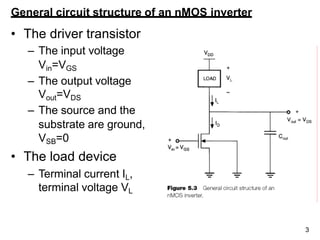
General circuit structure of an nMOS inverter
• The driver transistor
– The input voltage
Vin=VGS
– The output voltage
Vout=VDS
– The source and the
substrate are ground,
VSB=0
• The load device
– Terminal current IL,
terminal voltage VL
3
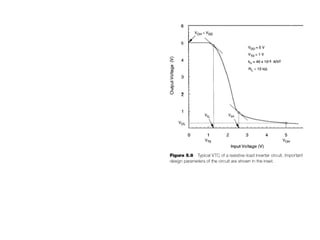
Voltage transfer characteristic (VTC)
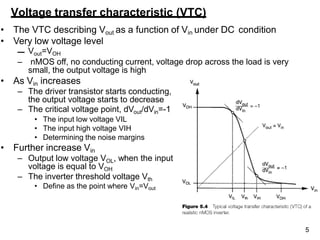
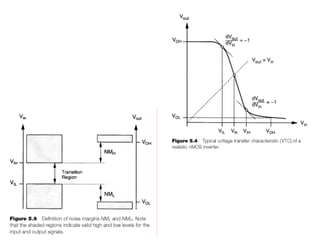
• The VTC describing Vout as a function of Vin under DC condition
• Very low voltage level
– Vout=VOH
– nMOS off, no conducting current, voltage drop across the load is very
small, the output voltage is high
• As Vin increases
– The driver transistor starts conducting,
the output voltage starts to decrease
– The critical voltage point, dVout/dVin=-1
• The input low voltage VIL
• The input high voltage VIH
• Determining the noise margins
• Further increase Vin
– Output low voltage VOL, when the input
voltage is equal to VOH
– The inverter threshold voltage Vth
• Define as the point where Vin=Vout
5
Noise immunity and noise margin
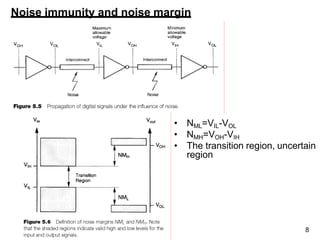
• NML=VIL-VOL
• NMH=VOH-VIH
• The transition region, uncertain
region
8
9
Power and area consideration
• The DC power dissipation
– The product of its power supply voltage and the
amount of current down from the power supply during
steady state or in standby mode
– PDC=VDDIDC=(VDD/2)[IDC(Vin=low)+IDC(Vin=high)]
– In deep submicron technologies
• Subthreshold current is high therefore more power
consumption
• The chip area
– To reduce the area of the MOS transistor
• The gate area of the MOS transistor
• The product of W and L
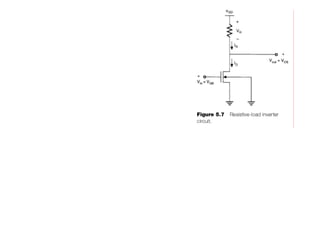
Resistive-load inverter
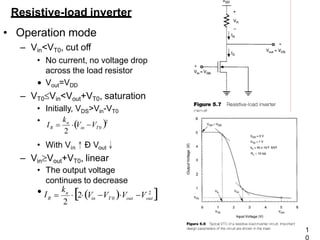
• Operation mode
– Vin<VT0, cut off
• No current, no voltage drop
across the load resistor
• Vout=VDD
– VT0Vin<Vout+VT0, saturation
• Initially, VDS>Vin-VT0
•
• With Vin↑Ð Vout↓
– VinVout+VT0, linear
• The output voltage
continues to decrease
2
2
in T0
n
R
k
V V
I  
2
out
in T 0 out
n
R
k
• I 2V V V V 2


1
0
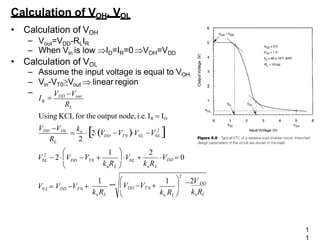
Calculation of VOH, VOL
• Calculation of VOH
– Vout=VDD-RLIR
– When Vin is low ID=IR=0 VOH=VDD
• Calculation of VOL
– Assume the input voltage is equal to VOH
– Vin-VT0≥Vout  linear region
–
n L
L
L
R
kn RL
k R
k R
R
R
I
2V
1
1
2
1
2
0L
DD T0
2
0L
2
0L
DD T 0 0L
 DD
knRL

kn RL 

2

 VDD VT 0 

V0 L  VDD VT 0 
VDD  0
V 

n L 





V  2 V V
V V

kn
 2V V 
VDD VOL
Using KCLfor the output node,i.e.IR  ID

VDD Vout
1
1
9
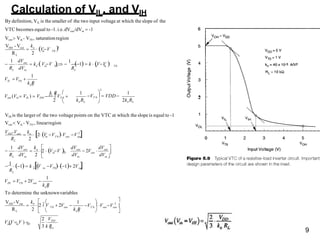
Calculation of VIL, and VIH
n L
out in IH
n L
n L
out
L
out
out
in
out
out n
L in
L
n L
L
out
L in
k R
k R
R
dV
dV
dV
dV
k R
R
R dV
3 k R
R 2
To determine the unknownvariables
1
R dV 2
1 dV k
R 2
2knRL
1
1
2 kn RL
1
1 dV
2
R
V - V k
T 0 out
L
VDD -Vout
IH T 0 out
n in T0
in T0
2
in T 0 out out
IL T0
n in T0
n in T0
2
in T0
L
DD out n
2

VDD
V (V  V ) 

2

  


kn
  1
VT 0
 Vout Vout 
 2V 
  2V
V  V  2V 
V  1 2V 

1
 1  k V

in 




 2V 
V V 
  2  
 
VDD-Vout

kn
 2 V V V V 
VIH is the larger of the two voltage points on the VTC at which the slope is equal to -1
Vout  Vin - VTO , linearregion

2

k R 
VT 0   VDD

Vout (Vin  VIL )  VDD  n L
VT 0 
V  V 
V V  
1
 1  k  VV 
 k 
 
  VV
By definition, VIL is the smaller of the two input voltage at which the slope of the
VTC becomes equal to -1.i.e.dVout/dVin  -1
Vout  Vin - VT0 , saturationregion
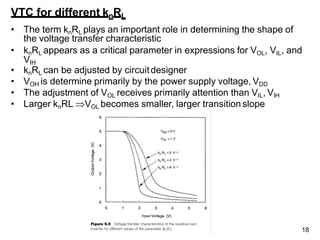
VTC for different knRL
• The term knRL plays an important role in determining the shape of
the voltage transfer characteristic
• knRL appears as a critical parameter in expressions for VOL, VIL, and
VIH
• knRL can be adjusted by circuitdesigner
• VOH is determine primarily by the power supply voltage, VDD
• The adjustment of VOL receives primarily attention than VIL, VIH
• Larger knRL VOL becomes smaller, larger transition slope
18
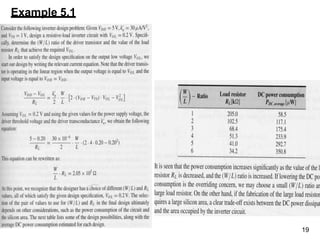
Example 5.1
19
L
20
Power consumption
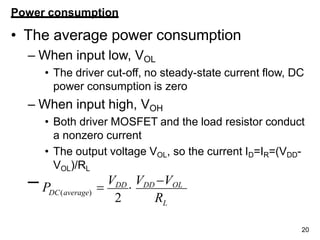
• The average power consumption
– When input low, VOL
• The driver cut-off, no steady-state current flow, DC
power consumption is zero
– When input high, VOH
• Both driver MOSFET and the load resistor conduct
a nonzero current
• The output voltage VOL, so the current ID=IR=(VDD-
VOL)/RL
– P 
VDD

VDD VOL
2 R
DC(average)
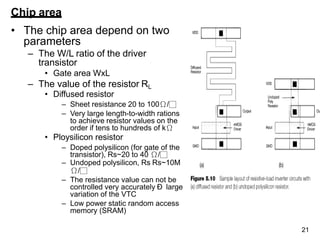
Chip area
• The chip area depend on two
parameters
– The W/L ratio of the driver
transistor
• Gate area WxL
– The value of the resistor RL
• Diffused resistor
– Sheet resistance 20 to 100Ω/□
– Very large length-to-width rations
to achieve resistor values on the
order if tens to hundreds of kΩ
• Ploysilicon resistor
– Doped polysilicon (for gate of the
transistor), Rs~20 to 40 Ω/□
– Undoped polysilicon, Rs Rs~10M
Ω/□
– The resistance value can not be
controlled very accurately Ð large
variation of the VTC
– Low power static random access
memory (SRAM)
21
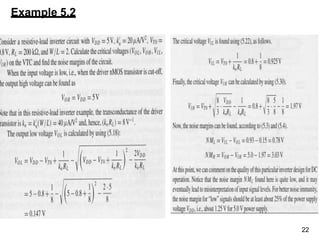
Example 5.2
22
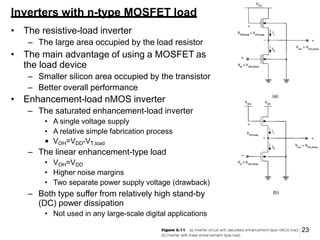
Inverters with n-type MOSFET load
• The resistive-load inverter
– The large area occupied by the load resistor
• The main advantage of using a MOSFET as
the load device
– Smaller silicon area occupied by the transistor
– Better overall performance
• Enhancement-load nMOS inverter
– The saturated enhancement-load inverter
• A single voltage supply
• A relative simple fabrication process
• VOH=VDD-VT,load
– The linear enhancement-type load
• VOH=VDD
• Higher noise margins
• Two separate power supply voltage (drawback)
– Both type suffer from relatively high stand-by
(DC) power dissipation
• Not used in any large-scale digital applications
23
– The linear enhancement-type load
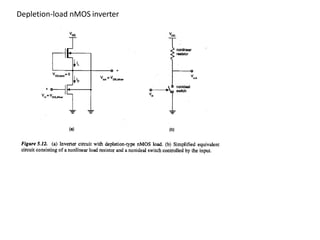
Depletion-load nMOS inverter
16
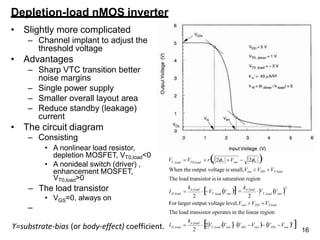
Depletion-load nMOS inverter
• Slightly more complicated
– Channel implant to adjust the
threshold voltage
• Advantages
– Sharp VTC transition better
noise margins
– Single power supply
– Smaller overall layout area
– Reduce standby (leakage)
current
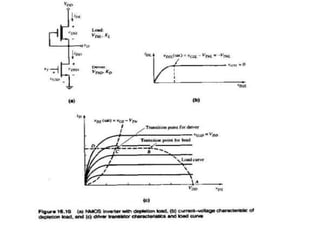
• The circuit diagram
– Consisting
• A nonlinear load resistor,
depletion MOSFET, VT0,load<0
• A nonideal switch (driver) ,
enhancement MOSFET,
VT0,load>0
– The load transistor
GS
• V =0, always on
–
2
The load transistor operates in the linear region
2 2
T ,load out
T ,load out
n,load
D,load
F out F
T ,load T 0,load
V
k
For larger output voltage level,Vout VDD VT,load
2

kn,load
 V
V V
I 
When the output voltage is small,Vout  VDD VT,load
The load transistor is in saturation region
V V  r 
2 V  2
ϒ=substrate-bias (or body-effect) coefficient. 2
out
DD
T ,load out DD out
n,load
D,load
k

2V V V V  V V 2

I 
17
2
2
2
2
2
2
T ,load OL
load
OL
OL
T0
OH
driver
OH DD OH
DD
T ,load OH
n,load
D,load
VOH
k
k
k
 VT ,load VOL 

 driver 
 kload

k
VT 0
VT 0 
VOL  VOH
 V

2V V V V
   V 2
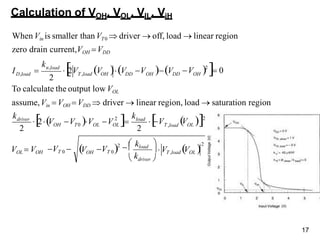
To calculate the output low VOL
assume,Vin  VOH  VDD  driver  linear region, load  saturation region
2V V V V V
 V 2
 0
I 
Calculation of VOH, VOL, VIL, ViH
When Vin is smaller thanVT0  driver  off, load  linear region
zero drain current,VOH VDD
18
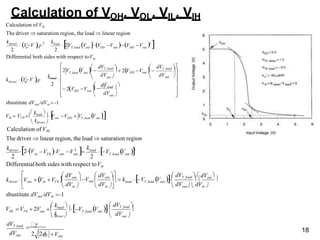
Calculation of VOH, VOL, VIL, VIH
DD out
out
DD out DD out
load
driver
dV
dV
dV
k
k k
out DD T ,load out
T ,load out
driver in T0
T ,load out
2
in T0
load
2
2 2

V V  V V 
 kload 
VIL  VT 0 
sbustitute dVout /dVin  -1







Differential both sides with respect toVin

out 

 dV 
T ,load

 2V V




dVT ,load 


  2VDD Vout 
out 
dVT ,load 

2V V 


k  VV 
2V V V V V
 V 2

 VV  
Calculation of VIL
The driver  saturation region, the load  linear region
load
dVout
dV
k
k
Vout

 out 
V 
V
 driver 
 kload 
 
 dVout   dVin 
 k V V 



 dVin 
 Vout  
 dVin 
 dVout   dVout 
V 
V V
2 2F
V V  2V 
sbustitute dVout /dVin -1
Differentialboth sides with respect toVin
kdriver
2V
2 2
 kdriver 
Calculation of VIH
The driver  linear region, the load  saturation region
dVT,load


 dVT ,load 
T ,load out
IH T 0 out
 dVT ,load   dVout 
T ,load out
kdriver Vout  Vin VT 0 
V V 2
T ,load out
2 load
in T 0 out out
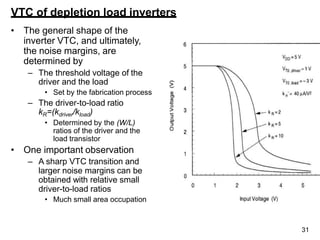
VTC of depletion load inverters
• The general shape of the
inverter VTC, and ultimately,
the noise margins, are
determined by
– The threshold voltage of the
driver and the load
• Set by the fabrication process
– The driver-to-load ratio
kR=(kdriver/kload)
• Determined by the (W/L)
ratios of the driver and the
load transistor
• One important observation
– A sharp VTC transition and
larger noise margins can be
obtained with relative small
driver-to-load ratios
• Much small area occupation
31
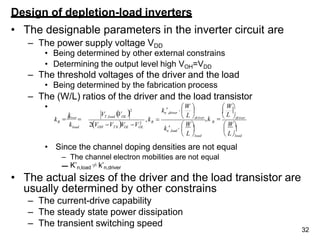
Design of depletion-load inverters
• The designable parameters in the inverter circuit are
– The power supply voltage VDD
• Being determined by other external constrains
• Determining the output level high VOH=VDD
– The threshold voltages of the driver and the load
• Being determined by the fabrication process
– The (W/L) ratios of the driver and the load transistor
•
• Since the channel doping densities are not equal
– The channel electron mobilities are not equal
– K’n,load≠k’n,driver
• The actual sizes of the driver and the load transistor are
usually determined by other constrains
– The current-drive capability
– The steady state power dissipation
– The transient switching speed
R
32
R
load
R
L
V V
k
k
k
 W
driver
 
   
 L load  Lload
 W
  
L


W   W
 driver
 driver
,k
,k 
kn,load 
kn,driver 
2V V V V 2
OH T 0 OL OL
2
T ,load OL
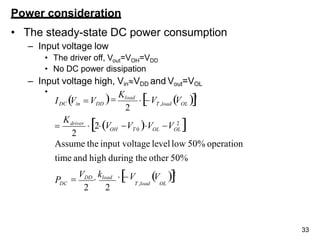
Power consideration
• The steady-state DC power consumption
– Input voltage low
• The driver off, Vout=VOH=VDD
• No DC power dissipation
– Input voltage high, VinVDD and Vout=VOL
•
Assume the input voltage levellow 50% operation
time and high during the other 50%
33
2
2
DC
OH T 0 OL OL
driver
T ,load OL
P
K
V V 2
T ,load OL

VDD

kload
2 2
2V V V V 2


V V 2

Kload
IDC Vin  VDD
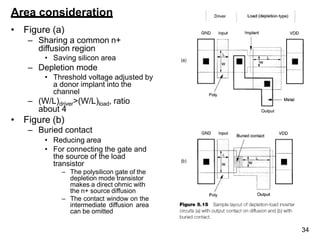
Area consideration
• Figure (a)
– Sharing a common n+
diffusion region
• Saving silicon area
– Depletion mode
• Threshold voltage adjusted by
a donor implant into the
channel
– (W/L)driver>(W/L)load, ratio
about 4
• Figure (b)
– Buried contact
• Reducing area
• For connecting the gate and
the source of the load
transistor
– The polysilicon gate of the
depletion mode transistor
makes a direct ohmic with
the n+ source diffusion
– The contact window on the
intermediate diffusion area
can be omitted
34
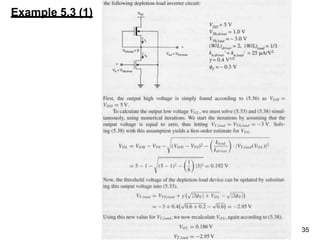
Example 5.3 (1)
35
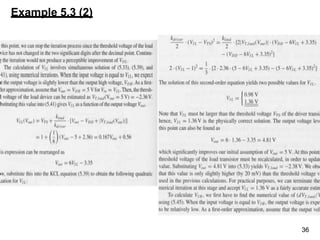
Example 5.3 (2)
36
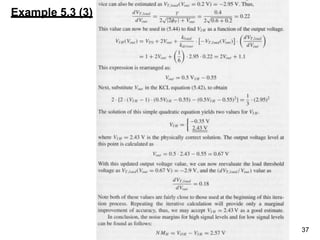
Example 5.3 (3)
37
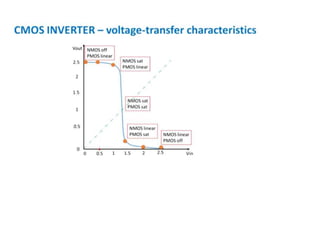
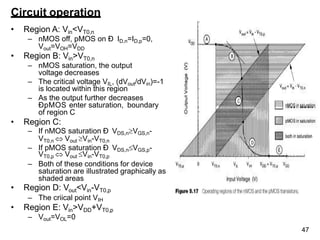
Circuit operation
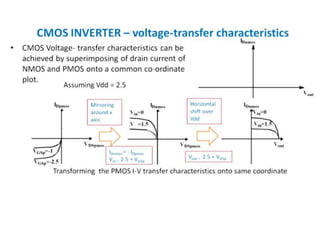
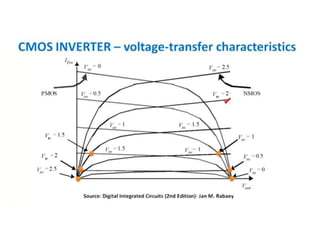
• Region A: Vin<VT0,n
– nMOS off, pMOS on Ð ID,n=ID,p=0,
Vout=VOH=VDD
• Region B: Vin>VT0,n
– nMOS saturation, the output
voltage decreases
– The critical voltage VIL, (dVout/dVin)=-1
is located within this region
– As the output further decreases
ÐpMOS enter saturation, boundary
of region C
• Region C:
– If nMOS saturation Ð VDS,nVGS,n-
VT0,n  Vout Vin-VT0,n
– If pMOS saturation Ð VDS,nVGS,p-
VT0,p  Vout Vin-VT0,p
– Both of these conditions for device
saturation are illustrated graphically as
shaded areas
• Region D: Vout<Vin-VT0,p
– The criical point VIH
• Region E: Vin>VDD+VT0,p
– Vout=VOL=0
47
48
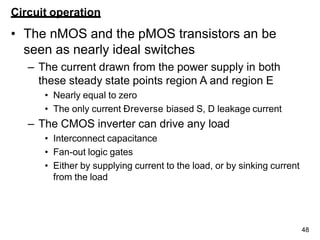
Circuit operation
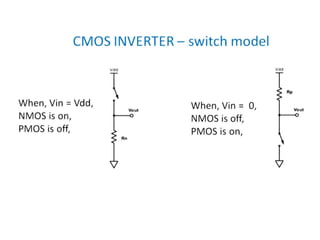
• The nMOS and the pMOS transistors an be
seen as nearly ideal switches
– The current drawn from the power supply in both
these steady state points region A and region E
• Nearly equal to zero
• The only current Ðreverse biased S, D leakage current
– The CMOS inverter can drive any load
• Interconnect capacitance
• Fan-out logic gates
• Either by supplying current to the load, or by sinking current
from the load
30
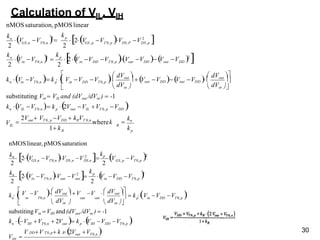
Calculation of VIL, VIH
p
R
R
IL
p
out DD
n
n
k
V
k
k
k

kn




 dVin 
 dVout 
  Vout VDD  Vout VDD 
 dVin 
 dVout 
V V V 
k V V  k  
V V V
V V 
1 k
k V V  k 2V V V V 
substituting Vin  VIL and (dVout /dVin )  -1
2
2
2
2
nMOSsaturation, pMOSlinear

2Vout  VT 0, p VDD  kRVT 0,n
wherek
n IL T 0.n p out IL T 0, p DD
in DD T 0, p
n in T0,n
V  V V 2

in DD T 0, p out DD

V V 2

kp

2
V
in T0,n
2V V V V 2

GS , p T 0, p DS,P DS,p
2 p
GS ,n T0,n
n
out
k
V 
V V V 
 k  



  dVout 
 dVin   dVin 
 dVout 
V V   V V  
out out
k  

V V V
V 
V V
V
V V
V V  k 2V V 
k V V  2V  k 
V V V 
substitingVin VIH and(dVout /dVin )  -1
2
kn
 2V
2
2 2
nMOSlinear, pMOSsaturation
out T0,n
DD T 0,p R
out p IH DD T0,p
IH T0,n
p in DD T0,p
n in T0,n
2
in DD T0,p
2 p
in T 0,n out
2
GS, p T0,p
kn
 2V V 2

kp
V
GS,n T 0,n DS,n DS,n
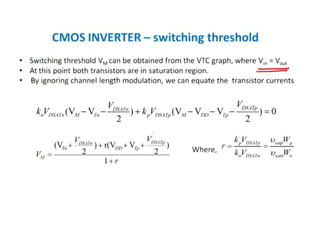
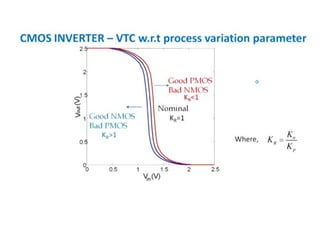
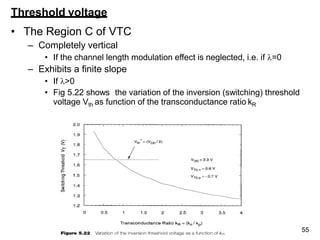
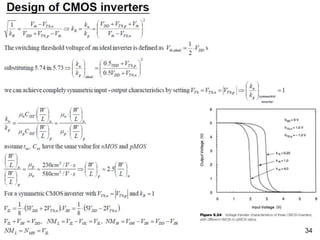
Threshold voltage
• The Region C of VTC
– Completely vertical
• If the channel length modulation effect is neglected, i.e. if =0
– Exhibits a finite slope
• If >0
• Fig 5.22 shows the variation of the inversion (switching) threshold
voltage Vth as function of the transconductance ratio kR
55
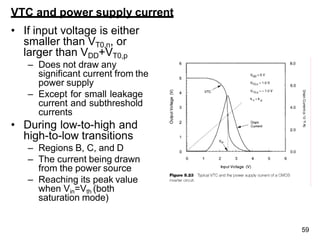
VTC and power supply current
• If input voltage is either
smaller than VT0,n, or
larger than VDD+VT0,p
– Does not draw any
significant current from the
power supply
– Except for small leakage
current and subthreshold
currents
• During low-to-high and
high-to-low transitions
– Regions B, C, and D
– The current being drawn
from the power source
– Reaching its peak value
when Vin=Vth (both
saturation mode)
59
35
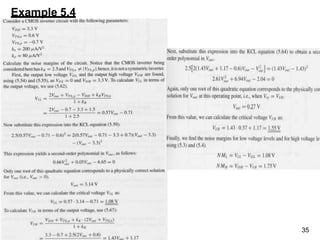
Example 5.4
36
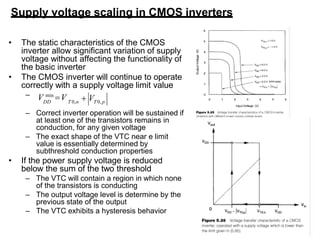
Supply voltage scaling in CMOS inverters
• The static characteristics of the CMOS
inverter allow significant variation of supply
voltage without affecting the functionality of
the basic inverter
• The CMOS inverter will continue to operate
correctly with a supply voltage limit value
– Correct inverter operation will be sustained if
at least one of the transistors remains in
conduction, for any given voltage
– The exact shape of the VTC near e limit
value is essentially determined by
subthreshold conduction properties
• If the power supply voltage is reduced
below the sum of the two threshold
– The VTC will contain a region in which none
of the transistors is conducting
– The output voltage level is determine by the
previous state of the output
– The VTC exhibits a hysteresis behavior
DD T 0,n T 0, p
 V
– V min
V
37
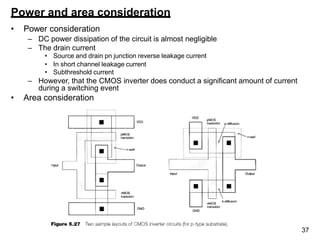
Power and area consideration
• Power consideration
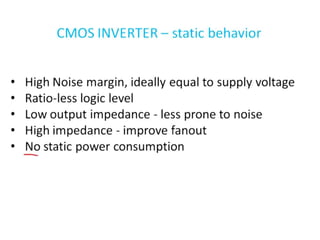
– DC power dissipation of the circuit is almost negligible
– The drain current
• Source and drain pn junction reverse leakage current
• In short channel leakage current
• Subthreshold current
– However, that the CMOS inverter does conduct a significant amount of current
during a switching event
• Area consideration

MOS Inverters Static Characteristics.pptx

  • 1.
    CMOS Digital Integrated Circuits Analysis andDesign 1 Unit-2 MOS Inverters: Static Characteristics
  • 2.
    Introduction • Positive logicconvention – “1” represents high voltage of VDD – “0” represents low voltage of 0 • The inverter threshold voltage, Vth – The input voltage, 0<Vin<Vth output VDD – The input voltage, Vth<Vin<VDD output 0 2
  • 3.
    General circuit structureof an nMOS inverter • The driver transistor – The input voltage Vin=VGS – The output voltage Vout=VDS – The source and the substrate are ground, VSB=0 • The load device – Terminal current IL, terminal voltage VL 3
  • 5.
    Voltage transfer characteristic(VTC) • The VTC describing Vout as a function of Vin under DC condition • Very low voltage level – Vout=VOH – nMOS off, no conducting current, voltage drop across the load is very small, the output voltage is high • As Vin increases – The driver transistor starts conducting, the output voltage starts to decrease – The critical voltage point, dVout/dVin=-1 • The input low voltage VIL • The input high voltage VIH • Determining the noise margins • Further increase Vin – Output low voltage VOL, when the input voltage is equal to VOH – The inverter threshold voltage Vth • Define as the point where Vin=Vout 5
  • 8.
    Noise immunity andnoise margin • NML=VIL-VOL • NMH=VOH-VIH • The transition region, uncertain region 8
  • 9.
    9 Power and areaconsideration • The DC power dissipation – The product of its power supply voltage and the amount of current down from the power supply during steady state or in standby mode – PDC=VDDIDC=(VDD/2)[IDC(Vin=low)+IDC(Vin=high)] – In deep submicron technologies • Subthreshold current is high therefore more power consumption • The chip area – To reduce the area of the MOS transistor • The gate area of the MOS transistor • The product of W and L
  • 10.
    Resistive-load inverter • Operationmode – Vin<VT0, cut off • No current, no voltage drop across the load resistor • Vout=VDD – VT0Vin<Vout+VT0, saturation • Initially, VDS>Vin-VT0 • • With Vin↑Ð Vout↓ – VinVout+VT0, linear • The output voltage continues to decrease 2 2 in T0 n R k V V I   2 out in T 0 out n R k • I 2V V V V 2   1 0
  • 11.
    Calculation of VOH,VOL • Calculation of VOH – Vout=VDD-RLIR – When Vin is low ID=IR=0 VOH=VDD • Calculation of VOL – Assume the input voltage is equal to VOH – Vin-VT0≥Vout  linear region – n L L L R kn RL k R k R R R I 2V 1 1 2 1 2 0L DD T0 2 0L 2 0L DD T 0 0L  DD knRL  kn RL   2   VDD VT 0   V0 L  VDD VT 0  VDD  0 V   n L       V  2 V V V V  kn  2V V  VDD VOL Using KCLfor the output node,i.e.IR  ID  VDD Vout 1 1
  • 14.
    9 Calculation of VIL,and VIH n L out in IH n L n L out L out out in out out n L in L n L L out L in k R k R R dV dV dV dV k R R R dV 3 k R R 2 To determine the unknownvariables 1 R dV 2 1 dV k R 2 2knRL 1 1 2 kn RL 1 1 dV 2 R V - V k T 0 out L VDD -Vout IH T 0 out n in T0 in T0 2 in T 0 out out IL T0 n in T0 n in T0 2 in T0 L DD out n 2  VDD V (V  V )   2       kn   1 VT 0  Vout Vout   2V    2V V  V  2V  V  1 2V   1  1  k V  in       2V  V V    2     VDD-Vout  kn  2 V V V V  VIH is the larger of the two voltage points on the VTC at which the slope is equal to -1 Vout  Vin - VTO , linearregion  2  k R  VT 0   VDD  Vout (Vin  VIL )  VDD  n L VT 0  V  V  V V   1  1  k  VV   k      VV By definition, VIL is the smaller of the two input voltage at which the slope of the VTC becomes equal to -1.i.e.dVout/dVin  -1 Vout  Vin - VT0 , saturationregion
  • 18.
    VTC for differentknRL • The term knRL plays an important role in determining the shape of the voltage transfer characteristic • knRL appears as a critical parameter in expressions for VOL, VIL, and VIH • knRL can be adjusted by circuitdesigner • VOH is determine primarily by the power supply voltage, VDD • The adjustment of VOL receives primarily attention than VIL, VIH • Larger knRL VOL becomes smaller, larger transition slope 18
  • 19.
  • 20.
    L 20 Power consumption • Theaverage power consumption – When input low, VOL • The driver cut-off, no steady-state current flow, DC power consumption is zero – When input high, VOH • Both driver MOSFET and the load resistor conduct a nonzero current • The output voltage VOL, so the current ID=IR=(VDD- VOL)/RL – P  VDD  VDD VOL 2 R DC(average)
  • 21.
    Chip area • Thechip area depend on two parameters – The W/L ratio of the driver transistor • Gate area WxL – The value of the resistor RL • Diffused resistor – Sheet resistance 20 to 100Ω/□ – Very large length-to-width rations to achieve resistor values on the order if tens to hundreds of kΩ • Ploysilicon resistor – Doped polysilicon (for gate of the transistor), Rs~20 to 40 Ω/□ – Undoped polysilicon, Rs Rs~10M Ω/□ – The resistance value can not be controlled very accurately Ð large variation of the VTC – Low power static random access memory (SRAM) 21
  • 22.
  • 23.
    Inverters with n-typeMOSFET load • The resistive-load inverter – The large area occupied by the load resistor • The main advantage of using a MOSFET as the load device – Smaller silicon area occupied by the transistor – Better overall performance • Enhancement-load nMOS inverter – The saturated enhancement-load inverter • A single voltage supply • A relative simple fabrication process • VOH=VDD-VT,load – The linear enhancement-type load • VOH=VDD • Higher noise margins • Two separate power supply voltage (drawback) – Both type suffer from relatively high stand-by (DC) power dissipation • Not used in any large-scale digital applications 23
  • 25.
    – The linearenhancement-type load
  • 26.
  • 27.
    16 Depletion-load nMOS inverter •Slightly more complicated – Channel implant to adjust the threshold voltage • Advantages – Sharp VTC transition better noise margins – Single power supply – Smaller overall layout area – Reduce standby (leakage) current • The circuit diagram – Consisting • A nonlinear load resistor, depletion MOSFET, VT0,load<0 • A nonideal switch (driver) , enhancement MOSFET, VT0,load>0 – The load transistor GS • V =0, always on – 2 The load transistor operates in the linear region 2 2 T ,load out T ,load out n,load D,load F out F T ,load T 0,load V k For larger output voltage level,Vout VDD VT,load 2  kn,load  V V V I  When the output voltage is small,Vout  VDD VT,load The load transistor is in saturation region V V  r  2 V  2 ϒ=substrate-bias (or body-effect) coefficient. 2 out DD T ,load out DD out n,load D,load k  2V V V V  V V 2  I 
  • 29.
    17 2 2 2 2 2 2 T ,load OL load OL OL T0 OH driver OHDD OH DD T ,load OH n,load D,load VOH k k k  VT ,load VOL    driver   kload  k VT 0 VT 0  VOL  VOH  V  2V V V V    V 2 To calculate the output low VOL assume,Vin  VOH  VDD  driver  linear region, load  saturation region 2V V V V V  V 2  0 I  Calculation of VOH, VOL, VIL, ViH When Vin is smaller thanVT0  driver  off, load  linear region zero drain current,VOH VDD
  • 30.
    18 Calculation of VOH,VOL, VIL, VIH DD out out DD out DD out load driver dV dV dV k k k out DD T ,load out T ,load out driver in T0 T ,load out 2 in T0 load 2 2 2  V V  V V   kload  VIL  VT 0  sbustitute dVout /dVin  -1        Differential both sides with respect toVin  out    dV  T ,load   2V V     dVT ,load      2VDD Vout  out  dVT ,load   2V V    k  VV  2V V V V V  V 2   VV   Calculation of VIL The driver  saturation region, the load  linear region load dVout dV k k Vout   out  V  V  driver   kload     dVout   dVin   k V V      dVin   Vout    dVin   dVout   dVout  V  V V 2 2F V V  2V  sbustitute dVout /dVin -1 Differentialboth sides with respect toVin kdriver 2V 2 2  kdriver  Calculation of VIH The driver  linear region, the load  saturation region dVT,load    dVT ,load  T ,load out IH T 0 out  dVT ,load   dVout  T ,load out kdriver Vout  Vin VT 0  V V 2 T ,load out 2 load in T 0 out out
  • 31.
    VTC of depletionload inverters • The general shape of the inverter VTC, and ultimately, the noise margins, are determined by – The threshold voltage of the driver and the load • Set by the fabrication process – The driver-to-load ratio kR=(kdriver/kload) • Determined by the (W/L) ratios of the driver and the load transistor • One important observation – A sharp VTC transition and larger noise margins can be obtained with relative small driver-to-load ratios • Much small area occupation 31
  • 32.
    Design of depletion-loadinverters • The designable parameters in the inverter circuit are – The power supply voltage VDD • Being determined by other external constrains • Determining the output level high VOH=VDD – The threshold voltages of the driver and the load • Being determined by the fabrication process – The (W/L) ratios of the driver and the load transistor • • Since the channel doping densities are not equal – The channel electron mobilities are not equal – K’n,load≠k’n,driver • The actual sizes of the driver and the load transistor are usually determined by other constrains – The current-drive capability – The steady state power dissipation – The transient switching speed R 32 R load R L V V k k k  W driver        L load  Lload  W    L   W   W  driver  driver ,k ,k  kn,load  kn,driver  2V V V V 2 OH T 0 OL OL 2 T ,load OL
  • 33.
    Power consideration • Thesteady-state DC power consumption – Input voltage low • The driver off, Vout=VOH=VDD • No DC power dissipation – Input voltage high, VinVDD and Vout=VOL • Assume the input voltage levellow 50% operation time and high during the other 50% 33 2 2 DC OH T 0 OL OL driver T ,load OL P K V V 2 T ,load OL  VDD  kload 2 2 2V V V V 2   V V 2  Kload IDC Vin  VDD
  • 34.
    Area consideration • Figure(a) – Sharing a common n+ diffusion region • Saving silicon area – Depletion mode • Threshold voltage adjusted by a donor implant into the channel – (W/L)driver>(W/L)load, ratio about 4 • Figure (b) – Buried contact • Reducing area • For connecting the gate and the source of the load transistor – The polysilicon gate of the depletion mode transistor makes a direct ohmic with the n+ source diffusion – The contact window on the intermediate diffusion area can be omitted 34
  • 35.
  • 36.
  • 37.
  • 47.
    Circuit operation • RegionA: Vin<VT0,n – nMOS off, pMOS on Ð ID,n=ID,p=0, Vout=VOH=VDD • Region B: Vin>VT0,n – nMOS saturation, the output voltage decreases – The critical voltage VIL, (dVout/dVin)=-1 is located within this region – As the output further decreases ÐpMOS enter saturation, boundary of region C • Region C: – If nMOS saturation Ð VDS,nVGS,n- VT0,n  Vout Vin-VT0,n – If pMOS saturation Ð VDS,nVGS,p- VT0,p  Vout Vin-VT0,p – Both of these conditions for device saturation are illustrated graphically as shaded areas • Region D: Vout<Vin-VT0,p – The criical point VIH • Region E: Vin>VDD+VT0,p – Vout=VOL=0 47
  • 48.
    48 Circuit operation • ThenMOS and the pMOS transistors an be seen as nearly ideal switches – The current drawn from the power supply in both these steady state points region A and region E • Nearly equal to zero • The only current Ðreverse biased S, D leakage current – The CMOS inverter can drive any load • Interconnect capacitance • Fan-out logic gates • Either by supplying current to the load, or by sinking current from the load
  • 51.
    30 Calculation of VIL,VIH p R R IL p out DD n n k V k k k  kn      dVin   dVout    Vout VDD  Vout VDD   dVin   dVout  V V V  k V V  k   V V V V V  1 k k V V  k 2V V V V  substituting Vin  VIL and (dVout /dVin )  -1 2 2 2 2 nMOSsaturation, pMOSlinear  2Vout  VT 0, p VDD  kRVT 0,n wherek n IL T 0.n p out IL T 0, p DD in DD T 0, p n in T0,n V  V V 2  in DD T 0, p out DD  V V 2  kp  2 V in T0,n 2V V V V 2  GS , p T 0, p DS,P DS,p 2 p GS ,n T0,n n out k V  V V V   k        dVout   dVin   dVin   dVout  V V   V V   out out k    V V V V  V V V V V V V  k 2V V  k V V  2V  k  V V V  substitingVin VIH and(dVout /dVin )  -1 2 kn  2V 2 2 2 nMOSlinear, pMOSsaturation out T0,n DD T 0,p R out p IH DD T0,p IH T0,n p in DD T0,p n in T0,n 2 in DD T0,p 2 p in T 0,n out 2 GS, p T0,p kn  2V V 2  kp V GS,n T 0,n DS,n DS,n
  • 55.
    Threshold voltage • TheRegion C of VTC – Completely vertical • If the channel length modulation effect is neglected, i.e. if =0 – Exhibits a finite slope • If >0 • Fig 5.22 shows the variation of the inversion (switching) threshold voltage Vth as function of the transconductance ratio kR 55
  • 59.
    VTC and powersupply current • If input voltage is either smaller than VT0,n, or larger than VDD+VT0,p – Does not draw any significant current from the power supply – Except for small leakage current and subthreshold currents • During low-to-high and high-to-low transitions – Regions B, C, and D – The current being drawn from the power source – Reaching its peak value when Vin=Vth (both saturation mode) 59
  • 61.
  • 62.
    36 Supply voltage scalingin CMOS inverters • The static characteristics of the CMOS inverter allow significant variation of supply voltage without affecting the functionality of the basic inverter • The CMOS inverter will continue to operate correctly with a supply voltage limit value – Correct inverter operation will be sustained if at least one of the transistors remains in conduction, for any given voltage – The exact shape of the VTC near e limit value is essentially determined by subthreshold conduction properties • If the power supply voltage is reduced below the sum of the two threshold – The VTC will contain a region in which none of the transistors is conducting – The output voltage level is determine by the previous state of the output – The VTC exhibits a hysteresis behavior DD T 0,n T 0, p  V – V min V
  • 63.
    37 Power and areaconsideration • Power consideration – DC power dissipation of the circuit is almost negligible – The drain current • Source and drain pn junction reverse leakage current • In short channel leakage current • Subthreshold current – However, that the CMOS inverter does conduct a significant amount of current during a switching event • Area consideration