Presented By:
Inchara R
1st Semester
Molecular Biology
30/10/2017
Guided By:
Dr. N. S. Devaki
Course Coordinator
Dept. of molecular
Biology
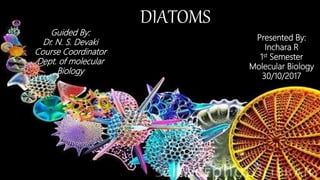
DIATOMS
CONTENTS Introduction
 Occurrence
 Classification
 Differences and Examples Of Diatoms
 Cell Structure
 Reproduction
 Economic Importance
 Conclusion
 References
 Acknowledgement
OCCURENCE
There are about 16,000 species grouped under 200
genera.
They occur in various habitats like fresh water, saline
water and also in terrestrial condition.
They occur as epiphytes.
There are epizoic also.
CLASSIFICATION
Class: Bacilloriophyceae
Order: Centrales Order: Pennales
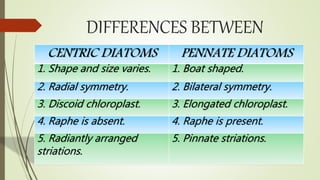
DIFFERENCES BETWEEN
CENTRIC DIATOMS PENNATE DIATOMS
1. Shape and size varies. 1. Boat shaped.
2. Radial symmetry. 2. Bilateral symmetry.
3. Discoid chloroplast. 3. Elongated chloroplast.
4. Raphe is absent. 4. Raphe is present.
5. Radiantly arranged
striations.
5. Pinnate striations.
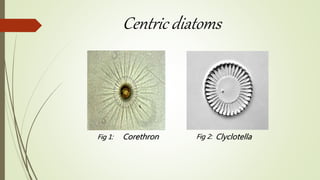
Corethron Clyclotella
Centric diatoms
Fig 1: Fig 2:
Fig 9: Tubellaria fenestrata
PennateDiatoms
5. 6.
Fig 7. Fig 8: Cocconies
placentula
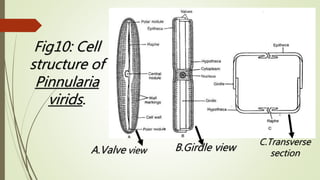
Structure of cell wall consists of two parts.
1.Cell Wall 2.Protoplast
1.Cell Wall
Cell wall is made up of pectic substances impregnated
with silica.
Cells are covered by siliceous wall, the frustule.
These consists of two overlapping halves, the theca.
CELL STRUCTURE
A.Valve view B.Girdle view
Fig10: Cell
structure of
Pinnularia
virids.
C.Transverse
section
STRAITIONS
Fig 11: Cyclotella
bodanica Fig 12: Navicula
acumtaina
2. Protoplast
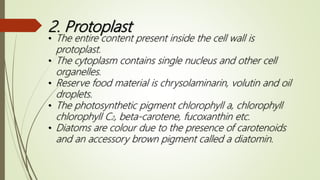
• The entire content present inside the cell wall is
protoplast.
• The cytoplasm contains single nucleus and other cell
organelles.
• Reserve food material is chrysolaminarin, volutin and oil
droplets.
• The photosynthetic pigment chlorophyll a, chlorophyll
chlorophyll C2, beta-carotene, fucoxanthin etc.
• Diatoms are colour due to the presence of carotenoids
and an accessory brown pigment called a diatomin.
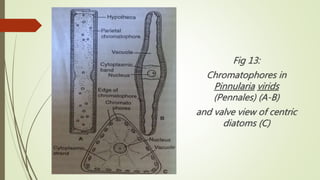
Fig 13:
Chromatophores in
Pinnularia virids
(Pennales) (A-B)
and valve view of centric
diatoms (C)
REPRODUCTION
There two types of reproduction.
Vegetative reproduction
Sexual reproduction
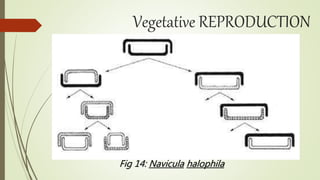
Vegetative REPRODUCTION
Fig 14: Navicula halophila
SEXUAL REPRODUCTION
Auxospore formation in Pennales are of
different types:
Production of one auxospore by two conjugating cells.
Production of two auxospore by one conjugating cells.
Production of one auxospore by a single cell.
Production of auxospore by autogamy.
Production of auxospore by parthenogenesis.
Production of auxospore by oogamy.
Production of two auxospore by two conjugating
cells
Cymbella lanceolataFig 15:
ECONOMIC IMPORTANCE
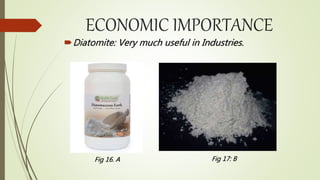
Diatomite: Very much useful in Industries.
Fig 16. A Fig 17: B
Testing of microscopic lenses.
Fig 18: Pinnularia dactylus Fig 19: Pictinfra
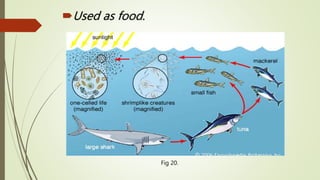
Used as food.
Fig 20.
 Petroleum is considered to be diatom origin.
 It is used as Pollution Indicators.
 Diatom is used in tooth paste.
REFERENCES B. R. Vashishta, A. K. Sinha, V. P. Singh. 1960. Botany For Degree
Students Algae. S. Chand $ company Ltd., Ram Nagar, New Delhi,
544pp.
 F. E. Fritsch. 1965. Structure $ Reproduction of Algae. Cambridge
University Press, New York, 791pp.
 www.biologydisscussion.com/algae/diatoms-charecteristics-
occurrence-and-reproduction/46940.
 Cals.Arizona.edu
ACKNOWLEDGEMENT
I would like to thank the dept. of Molecular Biology for
providing this opportunity to present this seminar.
I would also like to thank my guide DR. N.S. Devaki ma’am for
her valuable guidance.
Thank you one and all.
THANK YOU

Diatoms

  • 1.
    Presented By: Inchara R 1stSemester Molecular Biology 30/10/2017 Guided By: Dr. N. S. Devaki Course Coordinator Dept. of molecular Biology DIATOMS
  • 2.
    CONTENTS Introduction  Occurrence Classification  Differences and Examples Of Diatoms  Cell Structure  Reproduction  Economic Importance  Conclusion  References  Acknowledgement
  • 4.
    OCCURENCE There are about16,000 species grouped under 200 genera. They occur in various habitats like fresh water, saline water and also in terrestrial condition. They occur as epiphytes. There are epizoic also.
  • 5.
  • 6.
    DIFFERENCES BETWEEN CENTRIC DIATOMSPENNATE DIATOMS 1. Shape and size varies. 1. Boat shaped. 2. Radial symmetry. 2. Bilateral symmetry. 3. Discoid chloroplast. 3. Elongated chloroplast. 4. Raphe is absent. 4. Raphe is present. 5. Radiantly arranged striations. 5. Pinnate striations.
  • 7.
  • 8.
    Fig 9: Tubellariafenestrata PennateDiatoms 5. 6. Fig 7. Fig 8: Cocconies placentula
  • 9.
    Structure of cellwall consists of two parts. 1.Cell Wall 2.Protoplast 1.Cell Wall Cell wall is made up of pectic substances impregnated with silica. Cells are covered by siliceous wall, the frustule. These consists of two overlapping halves, the theca. CELL STRUCTURE
  • 10.
    A.Valve view B.Girdleview Fig10: Cell structure of Pinnularia virids. C.Transverse section
  • 11.
    STRAITIONS Fig 11: Cyclotella bodanicaFig 12: Navicula acumtaina
  • 12.
    2. Protoplast • Theentire content present inside the cell wall is protoplast. • The cytoplasm contains single nucleus and other cell organelles. • Reserve food material is chrysolaminarin, volutin and oil droplets. • The photosynthetic pigment chlorophyll a, chlorophyll chlorophyll C2, beta-carotene, fucoxanthin etc. • Diatoms are colour due to the presence of carotenoids and an accessory brown pigment called a diatomin.
  • 13.
    Fig 13: Chromatophores in Pinnulariavirids (Pennales) (A-B) and valve view of centric diatoms (C)
  • 14.
    REPRODUCTION There two typesof reproduction. Vegetative reproduction Sexual reproduction
  • 15.
  • 16.
    SEXUAL REPRODUCTION Auxospore formationin Pennales are of different types: Production of one auxospore by two conjugating cells. Production of two auxospore by one conjugating cells. Production of one auxospore by a single cell. Production of auxospore by autogamy. Production of auxospore by parthenogenesis. Production of auxospore by oogamy.
  • 17.
    Production of twoauxospore by two conjugating cells Cymbella lanceolataFig 15:
  • 18.
    ECONOMIC IMPORTANCE Diatomite: Verymuch useful in Industries. Fig 16. A Fig 17: B
  • 19.
    Testing of microscopiclenses. Fig 18: Pinnularia dactylus Fig 19: Pictinfra
  • 20.
  • 21.
     Petroleum isconsidered to be diatom origin.  It is used as Pollution Indicators.  Diatom is used in tooth paste.
  • 23.
    REFERENCES B. R.Vashishta, A. K. Sinha, V. P. Singh. 1960. Botany For Degree Students Algae. S. Chand $ company Ltd., Ram Nagar, New Delhi, 544pp.  F. E. Fritsch. 1965. Structure $ Reproduction of Algae. Cambridge University Press, New York, 791pp.  www.biologydisscussion.com/algae/diatoms-charecteristics- occurrence-and-reproduction/46940.  Cals.Arizona.edu
  • 24.
    ACKNOWLEDGEMENT I would liketo thank the dept. of Molecular Biology for providing this opportunity to present this seminar. I would also like to thank my guide DR. N.S. Devaki ma’am for her valuable guidance. Thank you one and all.
  • 25.