Prepared by:Prepared by:
NOE P. MENDEZNOE P. MENDEZ
CENTRAL MINDANAO UNIVERSITY (CMU)CENTRAL MINDANAO UNIVERSITY (CMU)
npolomendez@gmail.comnpolomendez@gmail.com
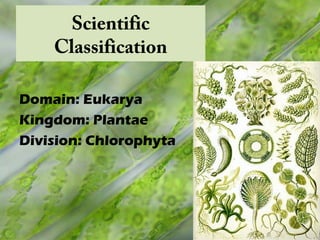
Scientific
Classification
Domain: Eukarya
Kingdom: Plantae
Division: Chlorophyta
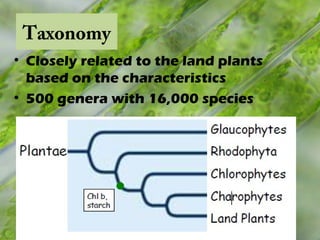
Taxonomy
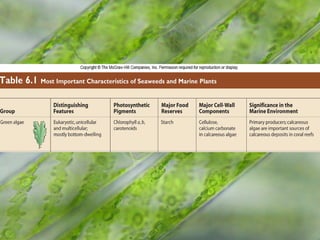
• Closely related to the land plants
based on the characteristics
• 500 genera with 16,000 species
• Mostly freshwater (90%)
• Marine (10%)
• Ulvophyceae – solely marine
Habitat
Distribution
Green Algae: Phylum Chlorophyta
• Chlorophyll in both green algae and plants
are not normally masked by other
pigments
• Land plants are believed to have evolved
from green algae; considered by many
taxonomists as belonging to Kingdom
Plantae!
Classes of Chlorophyta
1. Prasinophyceae
2. Ulvophyceae
3. Chlorophyceae
4. Charophyceae
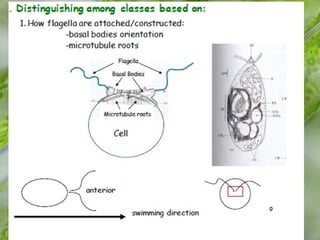
Distinguishing among classes
based on:
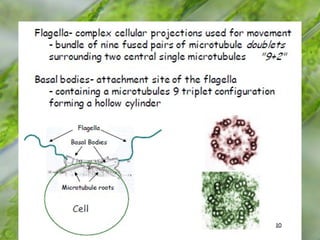
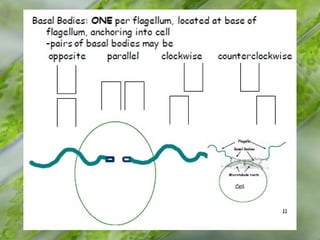
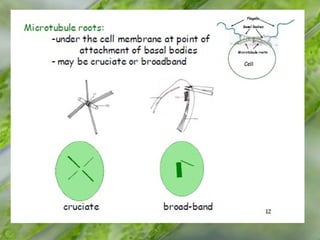
1.How flagella are
attached/constructed:
•basal bodies orientation
•microtubule roots
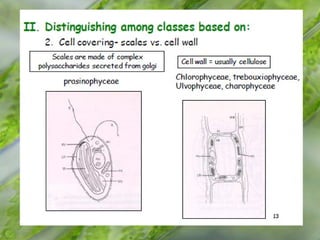
2.Cell covering:
•scales vs. cell wall
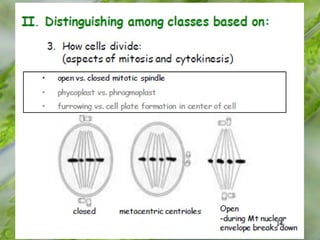
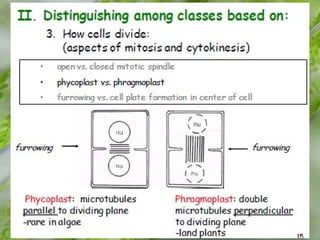
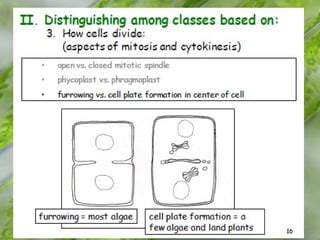
3.How cells divide:
•aspects of mitosis and cytokinesis
1. Prasinophyceae = primarily marine
flagellates, some freshwater; modern
representatives of earliest green algae
2. Ulvophyceae = marine macroalgae
3. Chlorophyceae = freshwater
4. Charophyceae = freshwater; all
terrestrial plants are derived from
Charophycean class
Prasinophyceae
Morphology:
- unicellular, free-living, primitive green
flagellates
- 1-8 flagella of varied morphology
- flagella usually inserted in a lateral or
apical depression
Habitat:
- marine and freshwater habitats
- important part of phytoplankton
(picoplankton)
Special features:
- organic scales on flagella and plasmalemma
- fossil findings ~ 1.2 billion years old
(Precambrium)
Cell division:
- open or closed mitosis
- persistent or non-persistent telophase
spindle
- cytokinesis by cleavage furrow or
phycoplast
Prominent species:
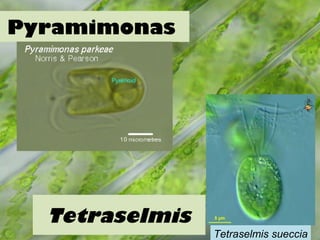
- Tetraselmis, Pyramimonas, Ostreococcus
Pyramimonas
Tetraselmis
Tetraselmis sueccia
Ulvophyceae
• Morphology:
- unicellular, multicellular, non-flagellates
- Molecular features:
- glycolate dehydrogenase, urease
- linear complexes of cellulose synthase
• Habitat:
- almost exclusively marine
• Cell division:
- closed mitosis
- persistent telophase spindle
- cytokinesis by cleavage furrow
• Reproduction:
- haplontic or isomorphic
diplohaplontic life cycle
- isogamous or anisogamous sexual
reproduction
Orders of Ulvophyceae
● Ulotrichales
● Ulvales
● Cladophorales
● Dasycladales
● Caulerpales
● Siphonocladales
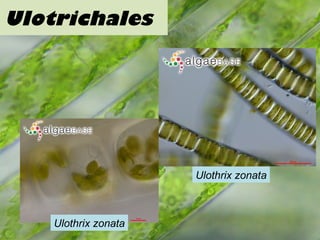
Ulotrichales
Ulothrix zonata
Ulothrix zonata
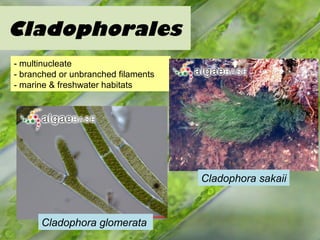
Cladophorales
- multinucleate
- branched or unbranched filaments
- marine & freshwater habitats
Cladophora sakaii
Cladophora glomerata
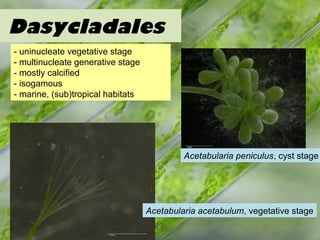
Dasycladales
- uninucleate vegetative stage
- multinucleate generative stage
- mostly calcified
- isogamous
- marine, (sub)tropical habitats
Acetabularia peniculus, cyst stage
Acetabularia acetabulum, vegetative stage
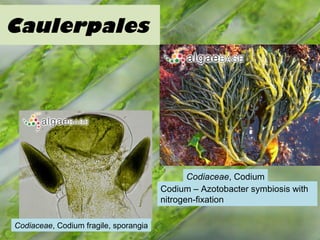
Caulerpales
Codiaceae, Codium
Codium – Azotobacter symbiosis with
nitrogen-fixation
Codiaceae, Codium fragile, sporangia
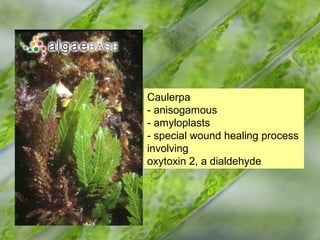
Caulerpa
- anisogamous
- amyloplasts
- special wound healing process
involving
oxytoxin 2, a dialdehyde
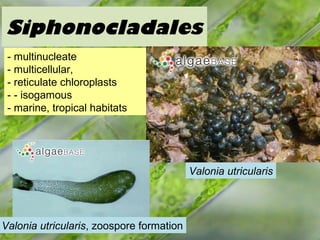
Siphonocladales
- multinucleate
- multicellular,
- reticulate chloroplasts
- - isogamous
- marine, tropical habitats
Valonia utricularis
Valonia utricularis, zoospore formation
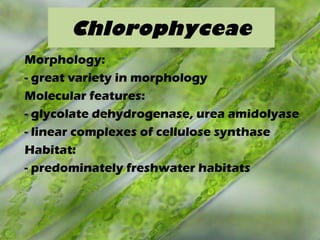
Chlorophyceae
Morphology:
- great variety in morphology
Molecular features:
- glycolate dehydrogenase, urea amidolyase
- linear complexes of cellulose synthase
Habitat:
- predominately freshwater habitats
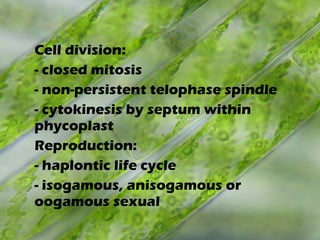
Cell division:
- closed mitosis
- non-persistent telophase spindle
- cytokinesis by septum within
phycoplast
Reproduction:
- haplontic life cycle
- isogamous, anisogamous or
oogamous sexual
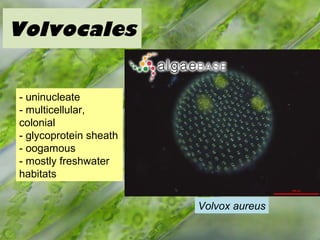
Volvocales
- uninucleate
- multicellular,
colonial
- glycoprotein sheath
- oogamous
- mostly freshwater
habitats
Volvox aureus
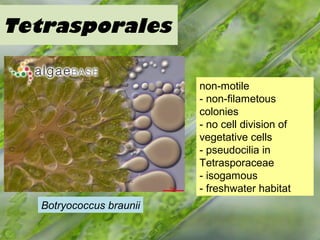
Tetrasporales
Botryococcus braunii
non-motile
- non-filametous
colonies
- no cell division of
vegetative cells
- pseudocilia in
Tetrasporaceae
- isogamous
- freshwater habitat
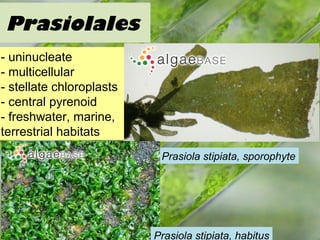
Prasiolales
- uninucleate
- multicellular
- stellate chloroplasts
- central pyrenoid
- freshwater, marine,
terrestrial habitats
Prasiola stipiata, sporophyte
Prasiola stipiata, habitus
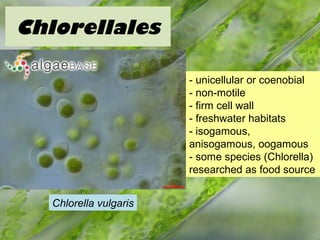
Chlorellales
Chlorella vulgaris
- unicellular or coenobial
- non-motile
- firm cell wall
- freshwater habitats
- isogamous,
anisogamous, oogamous
- some species (Chlorella)
researched as food source
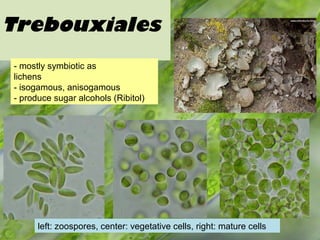
Trebouxiales
- mostly symbiotic as
lichens
- isogamous, anisogamous
- produce sugar alcohols (Ribitol)
left: zoospores, center: vegetative cells, right: mature cells
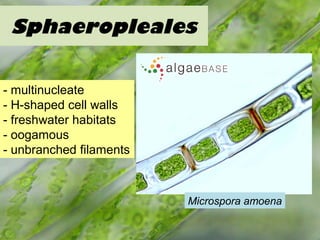
Sphaeropleales
- multinucleate
- H-shaped cell walls
- freshwater habitats
- oogamous
- unbranched filaments
Microspora amoena
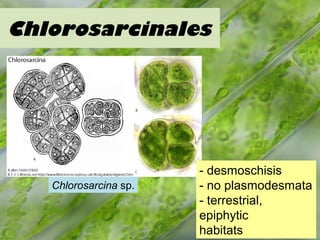
Chlorosarcinales
Chlorosarcina sp.
- desmoschisis
- no plasmodesmata
- terrestrial,
epiphytic
habitats
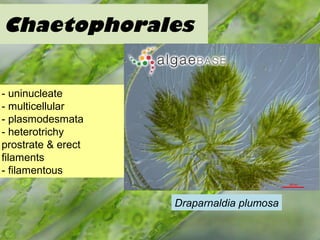
Chaetophorales
Draparnaldia plumosa
- uninucleate
- multicellular
- plasmodesmata
- heterotrichy
prostrate & erect
filaments
- filamentous
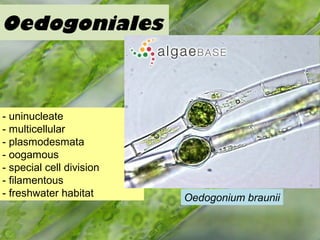
Oedogoniales
- uninucleate
- multicellular
- plasmodesmata
- oogamous
- special cell division
- filamentous
- freshwater habitat Oedogonium braunii
Charophyceae
Morphology:
- zoids with 2 lateral flagella of unilateral type
- no eyespots
Molecular features:
- glycolate oxidase, urease
- cellulose synthase rosette
Habitat:
- freshwater, marine
Cell division:
- open mitosis
- persistent telophase spindle
- cytokinesis by cleavage furrow or
phragmoplast
Reproduction:
- isogamous, anisogamous, oogamous
- formation of dormant zygotes
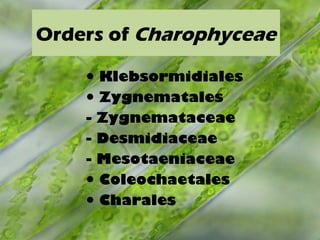
Orders of Charophyceae
● Klebsormidiales
● Zygnematales
- Zygnemataceae
- Desmidiaceae
- Mesotaeniaceae
● Coleochaetales
● Charales
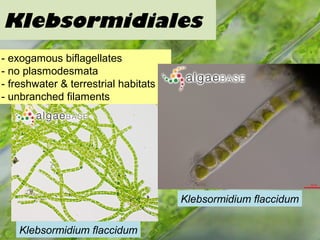
Klebsormidiales
Klebsormidium flaccidum
- exogamous biflagellates
- no plasmodesmata
- freshwater & terrestrial habitats
- unbranched filaments
Klebsormidium flaccidum
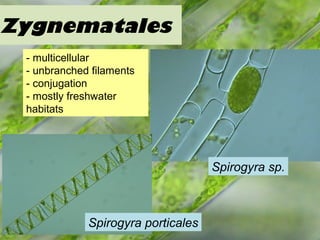
Zygnematales
Spirogyra sp.
- multicellular
- unbranched filaments
- conjugation
- mostly freshwater
habitats
Spirogyra porticales
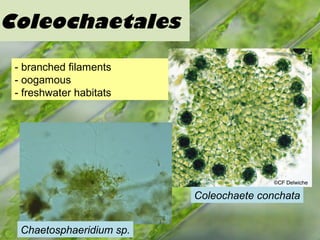
Coleochaetales
- branched filaments
- oogamous
- freshwater habitats
Coleochaete conchata
Chaetosphaeridium sp.
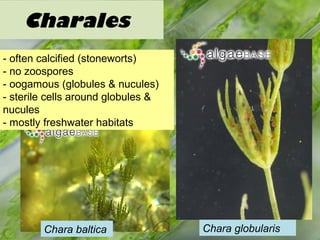
Charales
- often calcified (stoneworts)
- no zoospores
- oogamous (globules & nucules)
- sterile cells around globules &
nucules
- mostly freshwater habitats
Chara globularisChara baltica
END!

Chlorophyta

Editor's Notes

  • #4 e.g. bryophyte & trachaeophyta