BIODIVERSITY STUDY OF DIATOMS
FROM GANGA RIVER WATER AND
RESIDENTIAL POND WATER
Presented by: Camellia Roy
3rd year B.Sc Biotechnology (H)
Gurunanak Institute of Pharmaceutical
Science & Technology
Overview :
Introduction
Morphology
Classification
Collection and cleaning of diatoms
Results and discussions
Importance
Applications
Conclusion
References
INTRODUCTION:
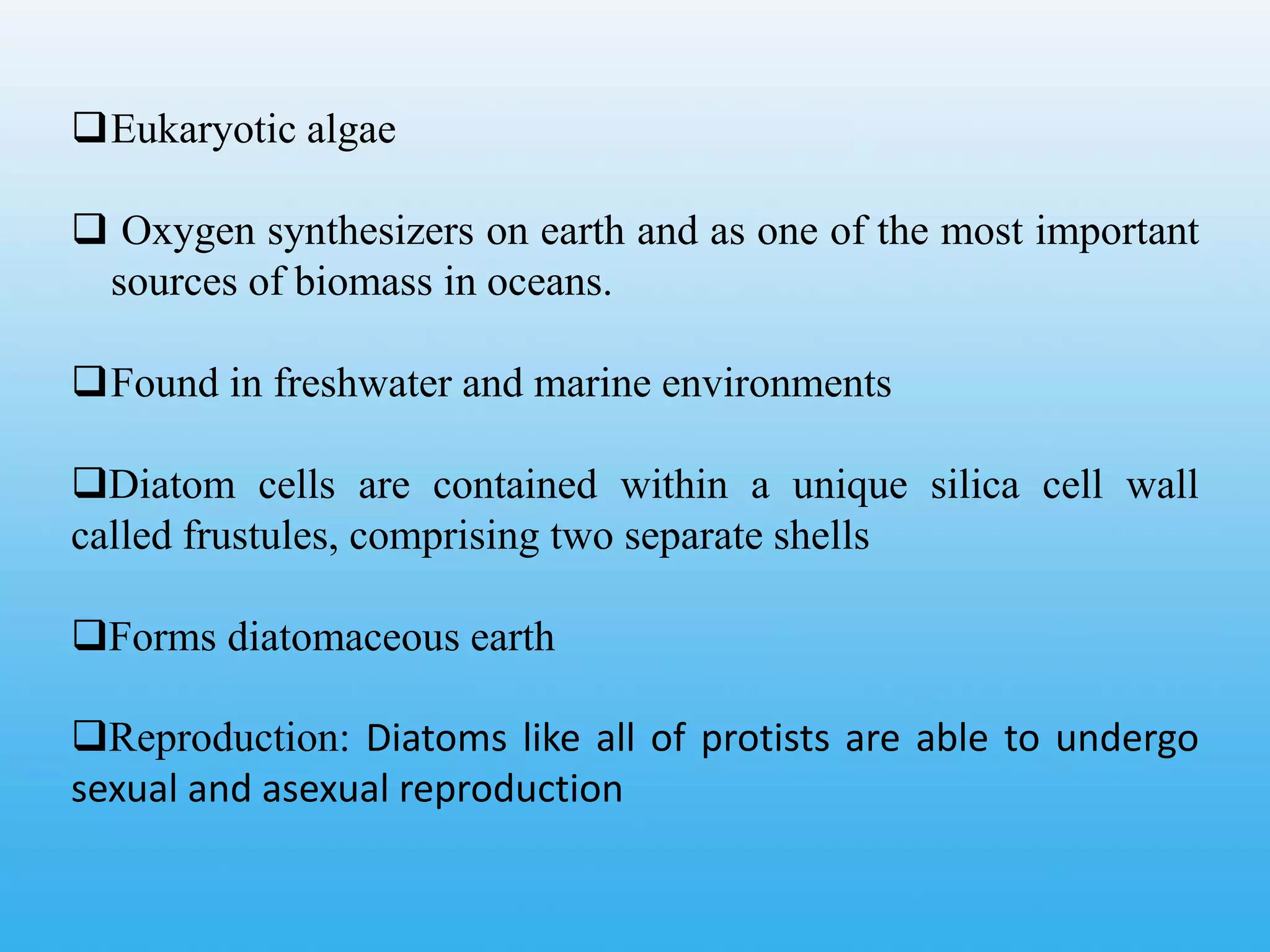
Diatoms are unicellular phototrophs that evolved some
180 million years ago and may consist of more than
100,000 species (Drum and Gordon 2003; Kroth 2007)
Figure 1: Various shapes of Diatoms
Eukaryotic algae
 Oxygen synthesizers on earth and as one of the most important
sources of biomass in oceans.
Found in freshwater and marine environments
Diatom cells are contained within a unique silica cell wall
called frustules, comprising two separate shells
Forms diatomaceous earth
Reproduction: Diatoms like all of protists are able to undergo
sexual and asexual reproduction
MORPHOLOGY
Figure 2 : Descriptive morphology of the diatoms
CLASSIFICATION
Domain: Eukaryota
Kingdom: Chromalveolata
Phylum: Heterokontophyta
Class: Bacillariophyceae
Orders :Centrales Figure 3
Pennales
Round & Crawford (1990) and Hoek et al. (1995) provided more
comprehensive coverage of diatom taxonomy.
COLLECTION OF DIATOMS
Figure 4: Diatoms collected from:
(a) Ganga river water (b) residential pond water
Continue.
CLEANING OF DIATOMS
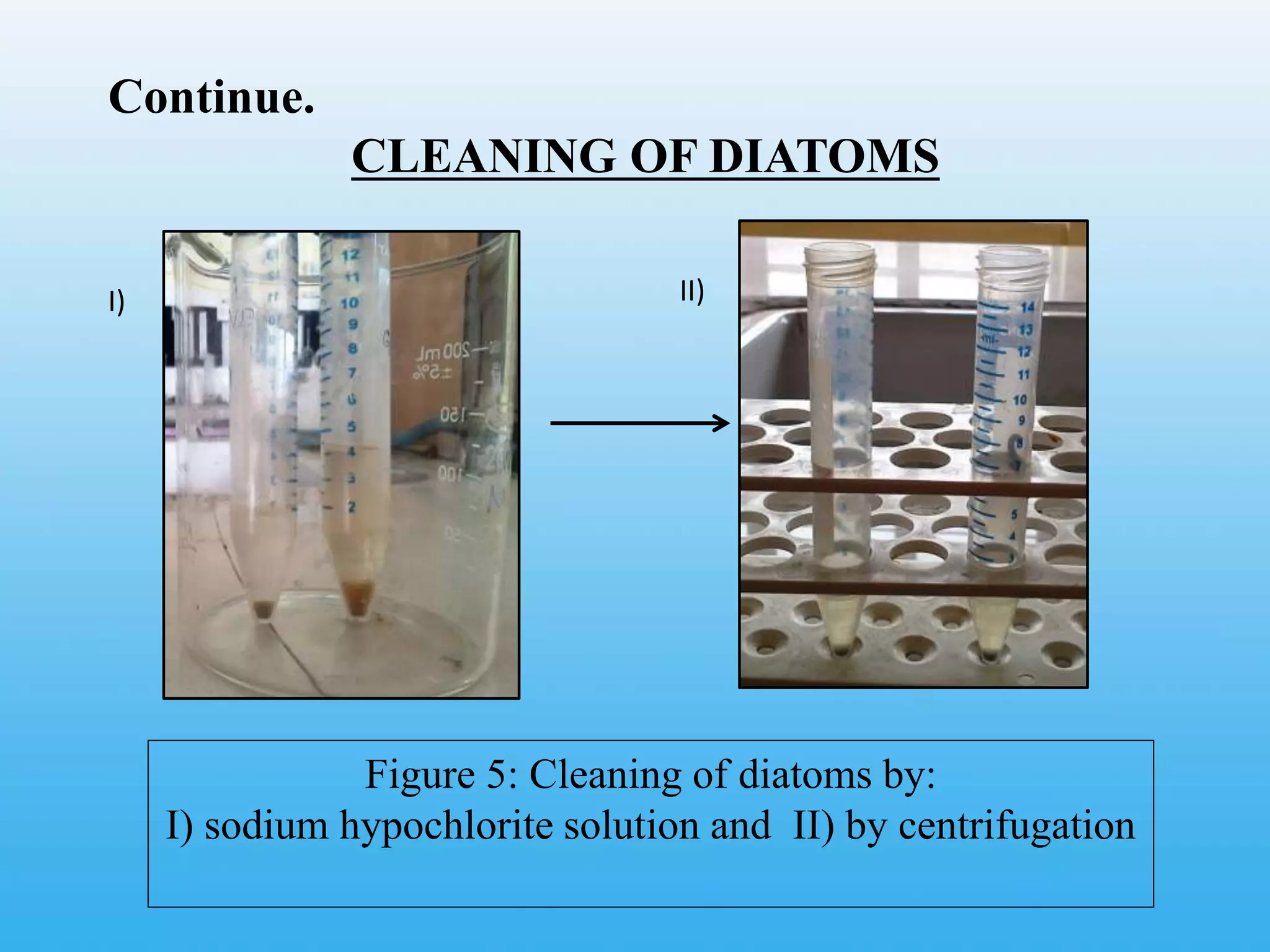
Figure 5: Cleaning of diatoms by:
I) sodium hypochlorite solution and II) by centrifugation
I) II)
Observations
Figure 6: Ganga river water
Figure 7 : View of residential pond water
Continue
IMPORTANCES OF DIATOMS
Responsible for 20%-25%of all carbon fixation (CO2 + H2O =
sugars)
Contribute to atmospheric oxygen
Major component of plankton (source of food for many
organisms
Age dating (many have short time ranges)
Dynamite, abrasive, filter, etc.
Grass of the Sea
APPLICATIONS OF DIATOMS
 Nutritional applications
• Unsaturated fatty acids like eicosapentaenoic acid, omega-3 fatty acids
 Industrial applications
• Carbohydrates for ethanol production via fermentation
• Proteins for methane production via anaerobic gasification
• Natural oils for biodiesel production
Conti….
 Nanotechnology
• Drug delivery
 Phytoremediation of heavy metals contamination
CONCLUSION :
Future optimization of resource production via genetic
manipulation is the method of choice for making diatom
biotechnology not just viable but lucrative.
Collection and studying of diatoms were performed successfully.
The diatom-based indexes are widely used and have proved to
work in many areas of the world. They are mainly used to detect
organic pollution and eutrophy. The sampling procedures to ensure
a good treatment and analysis of the samples are normalized.
REFERENCE
Karthik B, Jonathan Charles Taylor,Mahesh M K and Ramachandran T V, 2010.
 “Protocols for collection, preservation and enumeration of Diatoms from Aquatic
habitat for Water Quality in India, IUP Journal of Soil and Water Sciences, Vol III, No.1,
2010.
2009_Bozarth et al Diatoms in biotechnology, modern tools and applications
E. Virginia Armbrust. The life of diatoms in the world’s oceans. Nature, 459:185–192,
2009.
 Rebecca J. Bixby and Erik C. Zeek. A simple method for calculating valve curvature,
journal = Proceedings of the Academy of Natural Science of Philadelphia, volume = 160,
number = 1, page=73, year = 2010.
Tom Britton, Cajsa Lisa Anderson, David Jacquet, Samuel Lundqvist, and K˚are
Bremer. Estimating divergence times in large phylogenetic trees. Systematic Biology,
56:741–752, 2007.
C. Bowler et al. The phaeodactylum reveals the evolutionary history of diatom
genomes. Nature, 456:239–244, 2008.
Andrews, G. W. 1981. Revision of the diatom genus Delphineis and morphology of
Delphineis surirella a new marine diatom. In Proceedings of the Sixth Symposium on
Recent and Fossil Diatoms, ed. R. Ross, 81–92. Koenigstein: Otto Koeltz Science
Publishers.
THANK YOU

Study of diatoms

  • 1.
    BIODIVERSITY STUDY OFDIATOMS FROM GANGA RIVER WATER AND RESIDENTIAL POND WATER Presented by: Camellia Roy 3rd year B.Sc Biotechnology (H) Gurunanak Institute of Pharmaceutical Science & Technology
  • 2.
    Overview : Introduction Morphology Classification Collection andcleaning of diatoms Results and discussions Importance Applications Conclusion References
  • 3.
    INTRODUCTION: Diatoms are unicellularphototrophs that evolved some 180 million years ago and may consist of more than 100,000 species (Drum and Gordon 2003; Kroth 2007) Figure 1: Various shapes of Diatoms
  • 4.
    Eukaryotic algae  Oxygensynthesizers on earth and as one of the most important sources of biomass in oceans. Found in freshwater and marine environments Diatom cells are contained within a unique silica cell wall called frustules, comprising two separate shells Forms diatomaceous earth Reproduction: Diatoms like all of protists are able to undergo sexual and asexual reproduction
  • 5.
    MORPHOLOGY Figure 2 :Descriptive morphology of the diatoms
  • 6.
    CLASSIFICATION Domain: Eukaryota Kingdom: Chromalveolata Phylum:Heterokontophyta Class: Bacillariophyceae Orders :Centrales Figure 3 Pennales Round & Crawford (1990) and Hoek et al. (1995) provided more comprehensive coverage of diatom taxonomy.
  • 7.
    COLLECTION OF DIATOMS Figure4: Diatoms collected from: (a) Ganga river water (b) residential pond water
  • 8.
    Continue. CLEANING OF DIATOMS Figure5: Cleaning of diatoms by: I) sodium hypochlorite solution and II) by centrifugation I) II)
  • 9.
  • 10.
    Figure 7 :View of residential pond water Continue
  • 11.
    IMPORTANCES OF DIATOMS Responsiblefor 20%-25%of all carbon fixation (CO2 + H2O = sugars) Contribute to atmospheric oxygen Major component of plankton (source of food for many organisms Age dating (many have short time ranges) Dynamite, abrasive, filter, etc. Grass of the Sea
  • 12.
    APPLICATIONS OF DIATOMS Nutritional applications • Unsaturated fatty acids like eicosapentaenoic acid, omega-3 fatty acids  Industrial applications • Carbohydrates for ethanol production via fermentation • Proteins for methane production via anaerobic gasification • Natural oils for biodiesel production
  • 13.
    Conti….  Nanotechnology • Drugdelivery  Phytoremediation of heavy metals contamination
  • 14.
    CONCLUSION : Future optimizationof resource production via genetic manipulation is the method of choice for making diatom biotechnology not just viable but lucrative. Collection and studying of diatoms were performed successfully. The diatom-based indexes are widely used and have proved to work in many areas of the world. They are mainly used to detect organic pollution and eutrophy. The sampling procedures to ensure a good treatment and analysis of the samples are normalized.
  • 15.
    REFERENCE Karthik B, JonathanCharles Taylor,Mahesh M K and Ramachandran T V, 2010.  “Protocols for collection, preservation and enumeration of Diatoms from Aquatic habitat for Water Quality in India, IUP Journal of Soil and Water Sciences, Vol III, No.1, 2010. 2009_Bozarth et al Diatoms in biotechnology, modern tools and applications E. Virginia Armbrust. The life of diatoms in the world’s oceans. Nature, 459:185–192, 2009.  Rebecca J. Bixby and Erik C. Zeek. A simple method for calculating valve curvature, journal = Proceedings of the Academy of Natural Science of Philadelphia, volume = 160, number = 1, page=73, year = 2010. Tom Britton, Cajsa Lisa Anderson, David Jacquet, Samuel Lundqvist, and K˚are Bremer. Estimating divergence times in large phylogenetic trees. Systematic Biology, 56:741–752, 2007. C. Bowler et al. The phaeodactylum reveals the evolutionary history of diatom genomes. Nature, 456:239–244, 2008. Andrews, G. W. 1981. Revision of the diatom genus Delphineis and morphology of Delphineis surirella a new marine diatom. In Proceedings of the Sixth Symposium on Recent and Fossil Diatoms, ed. R. Ross, 81–92. Koenigstein: Otto Koeltz Science Publishers.
  • 16.