Marchantia
V.S.Patil
Associate Professor, Department of Botany
Shri Shivaji College of Arts, Commerce,& Science
Akola
Classification
Habitat- Family Marchantiaceae is represented by
about 65 species. All species are terrestrial and
cosmopolitan in distribution. The species prefer to
grow in moist and shady places like wet open
woodlands, banks of streams, wood rocks or on
shaded stub rocks.
Thallus-The plant body is gametophytic, thalloid, flat,
prostrate, plagiotropic, 2-10 cm.long & dichotomously
branched.
Dorsal surface: Dorsal surface is dark green. It has a
conspicuous midrib and a number of polygonal areas
called areolae. The midrib ends in a depression at the
apical region forming an apical notch in which
growing point is situated.
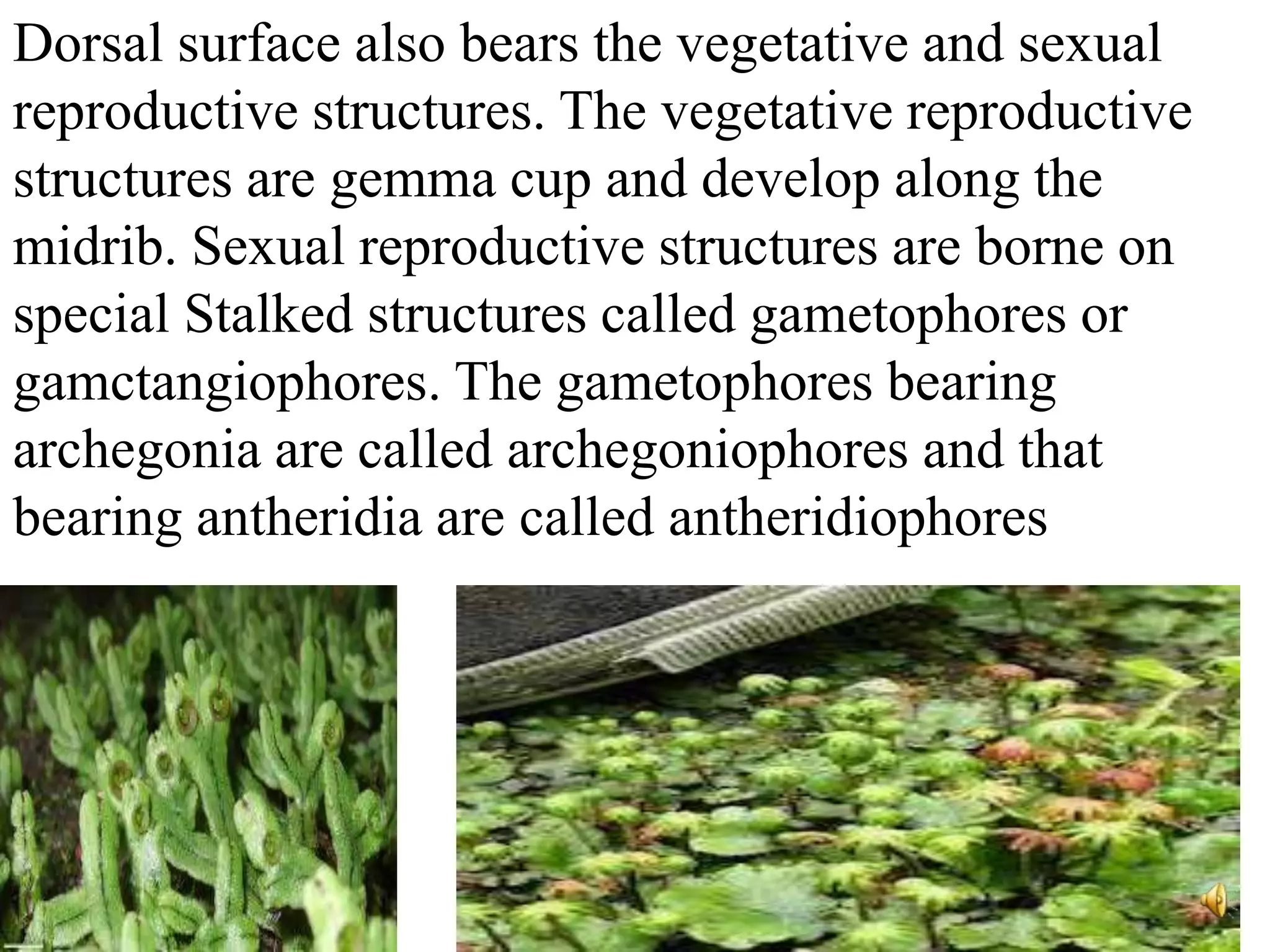
Dorsal surface also bears the vegetative and sexual
reproductive structures. The vegetative reproductive
structures are gemma cup and develop along the
midrib. Sexual reproductive structures are borne on
special Stalked structures called gametophores or
gamctangiophores. The gametophores bearing
archegonia are called archegoniophores and that
bearing antheridia are called antheridiophores
Ventral surface:
The ventral surface of the thallus bears scales and
rhizoids along the midrib. Scales are violet coloured,
multicellular, one cell thick and arranged in 2-4 rows.
Scales are of two types:
(i) Simple or ligulate
(ii) Appendiculate.
Appendiculate- scales form the inner row of the scales
close with midrib. Ligulate scales form the outer or
marginal row and are smaller than the appendiculate
scales.
Rhizoids are unicellular, branched and develop as
prolongation of the lower epidermal cells. They are of
two types:(i) Smooth-walled rhizoids,
(ii) Tuberculate rhizoids.
In smooth-walled rhizoids both the inner and
outer wall layers are fully stretched while in
tuber-culate rhizoids appear like circular dots in
surface view. The main functions of the rhizoids
are to anchor the thallus on the substratum and
to absorb water and mineral nutrients from the
soil.
Ventral view Dorsal view
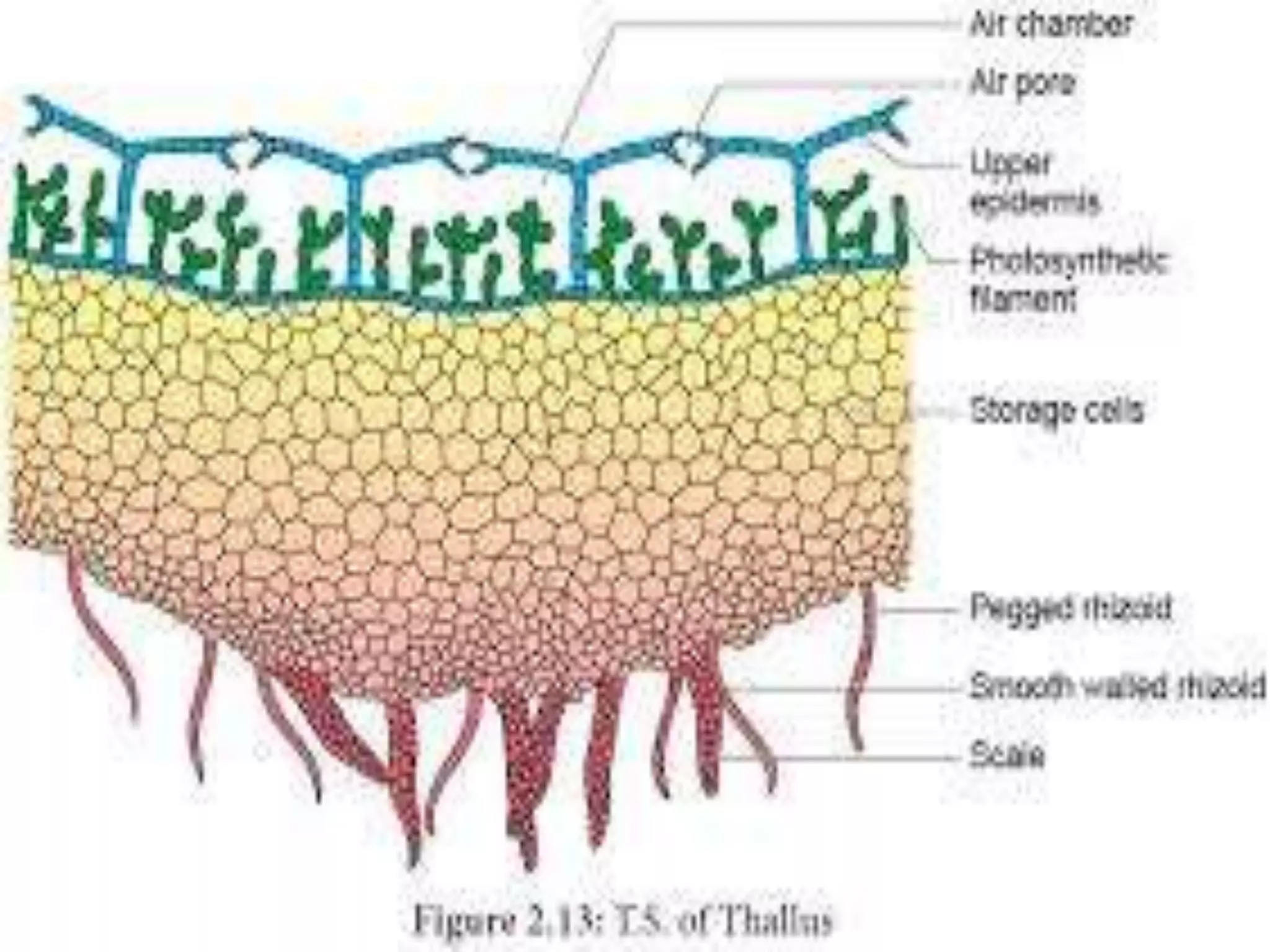
T.S.Thallus-A vertical cross section of the thallus can be
differentiated photosynthetic zone and lower storage zone. The
outermost layer is upper epidermis. Its cells are thin walled
square, compactly arranged and contain few chloroplasts. Its
continuity is broken by the presence of many barrel shaped air
pores. Each pore is surrounded by four to eight superimposed
tiers of concentric rings with three to four cells in each tier.
Just below the upper epidermis photosynthetic chambers are
present in a horizontal layer. Each air pore opens inside the air
chamber and helps in exchange of gases during
photosynthesis. These chambers are separated from each other
by single layered partition walls. The partition walls are two to
four cells in height. Cells contain chloroplast. Many simple or
branched photosynthetic filaments arise from the base of the
air chambers .
Storage zone:
It lies below the air chambers. It is more thickened in
the centre and gradually tapers towards the margins. It
consists of several lasers of compactly arranged, thin
walled parenchymatous isodiametric cells. The cells of
this zone contain starch. Some cells contain a single
large oil body or filled with mucilage. The lower most
cell layer of the zone forms the lower epidermis. Some
cells of the middle layer of lower epidermis extend to
form both types of scales and rhizoids.
Reproduction in Marchantia:
Marchantia reproduces by vegetative and sexual
methods.
Vegetative Reproduction:
1. By Gemmae:
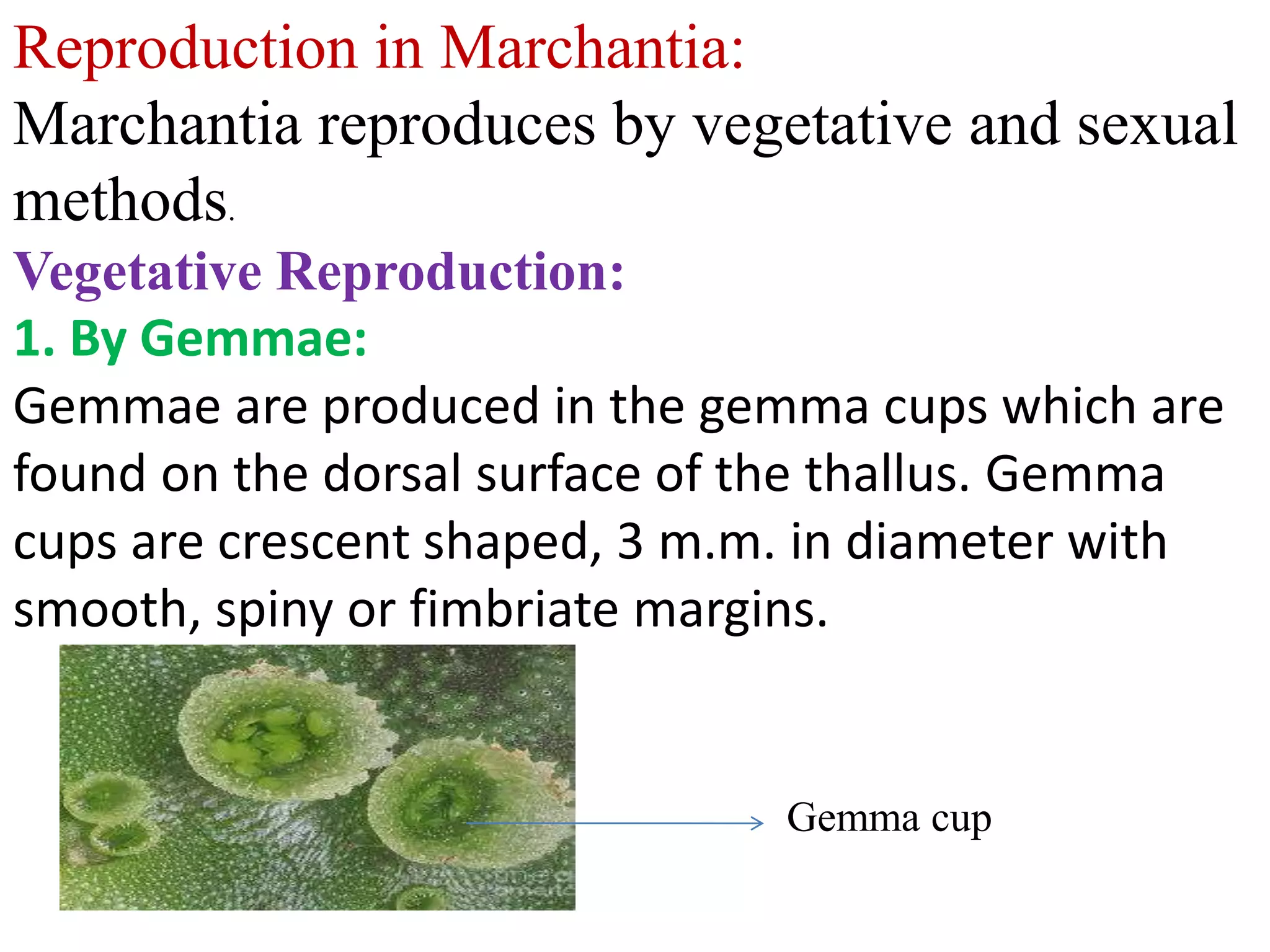
Gemmae are produced in the gemma cups which are
found on the dorsal surface of the thallus. Gemma
cups are crescent shaped, 3 m.m. in diameter with
smooth, spiny or fimbriate margins.
Gemma cup
V. S. gemma cup- 1)Upper photosynthetic region.2)
inner storage region .
The structure of both the zones is similar to that of
the thallus. Mature gemmae are found to be attached
at the base of the gemma cup by a single celled stalk.
Intermingled with gemmae are many mucilage hairs.
Each gemma is autotrophic, multicellular, bilaterally
symmetrical, thick in the centre and thin at the apex. It
consists parenchymatous cells, oil cells and rhizoidal
cells. It is notched on two sides in which lies the
growing point. All cells of the gemma contain
chloroplast except rhizoidal cells and oil cells.
Rhizoidal cells are colourless and large in size. Oil
cells are present just within the margins and contain
oil bodies instead of chloroplast. The gemmae are
dispersed over long distances by water currents. After
falling on a suitable substratum gemmae germinate.
From a single gemmae two thalli are formed.
2. Fragmentation: The basal part of the thallus
rots and disintegrates due to ageing. The
detached lobes or fragments develop into
independent thalli by apical growth.
3. By adventitious branches: The adventitious
branches develop from any part of the thallus or
the ventral surface of the thallus or rarely from
the stalk and disc of the archegoniophore .On
being detached, these branches develop into new
thalli.
Sexual Reproduction:
It is oogamous.All species are dioecious. Male reproductive
bodies are known as antheridia and female as archegonia.
Antheridia and archegonia are produced an special, erect
modified lateral branches of thallus called antheridiophore and
archegoniophore arpocephalum)
Antheridiophore: It consists of 1-3 centimetre long stalk and
a lobed disc at the apex . The disc is usually eight lobed
.
T.S. Antheridiophore or Archcgoniophore: It shows two
sides: ventral side and dorsal side. Ventral side has two
longitudinal tows with scales and rhizoids. These grooves, run
longitudinally through the entire length of the stalk. Dorsal
side shows an internal differentiation of air chambers.
L.S. through disc of Antheridiophore: The disc
consists of air chambers alternating with heridial
cavities. Air chambers are more or less triangular and
open on upper surface by n pore Called ostiole.
Mature Antheridium: A mature antheridium is
globular in shape and can be differentiated into two
parts stalk and body. Stalk is short multicellular and
attaches the body to the base of the antheridial
chamber. A single layered sterile jacket encloses the
mass of androcyte mother cells which metamorphosis
into antherozoids. The antherozoid is a minute rod like
biflagellate structure.
Archegoniophore or Carpocephalum:
It arises at the apical notch and consists of a stalk and
terminal disc. It is slightly longer than the
antheridiophore. It may be five to seven cm. long. The
young apex of the archegoniophore divides by three
successive dichotomies to form eight lobed rosette like
disc.Each lobe of the disc contains a growing point.
The archegonia begin to develop in each lobe in
acropetal succession, i.e., the oldest archegonium near
the centre and the young archegonium near the apex of
the disc. Thus, eight groups of archegonia develop on
the upper surface of the disc. There are twelve to
fourteen archegonia in a single row in each lobe of the
disc.
Mature Archegonium:
A mature archegonium is a flask shaped structure. It
remains attached to the archegonial disc by a short
stalk. It consists upper elongated slender neck and
basal globular portion called venter. The neck consists
of six vertical rows enclosing eight neck canal cells
and large egg. Four cover cells are present at the top of
the neck.
Fertilization-Marchantia is dioecious. Fertilization
takes place when male and female thalli grow near
each other. Water is essential for fertilization. The
neck of the archegonium is directed upwards on the
dorsal surface of the disc of the archegoniophore.
In the mature archegonium the venter canal cell and
neck canal cells disintegrate and form a mucilaginous
mass. It absorbs water, swells up and comes out of the
archegonial mouth by pushing the cover cells apart.
This mucilaginous mass consists of chemical
substances. Many antherozoids enter the archegonial
neck & reach up to egg. One of the antherozoids
penetrates the egg and fertilization is effected. The
fusion of both male and female nuclei results in the
formation of diploid zygote or oospore. Fertilization
ends the gametophytic phase.
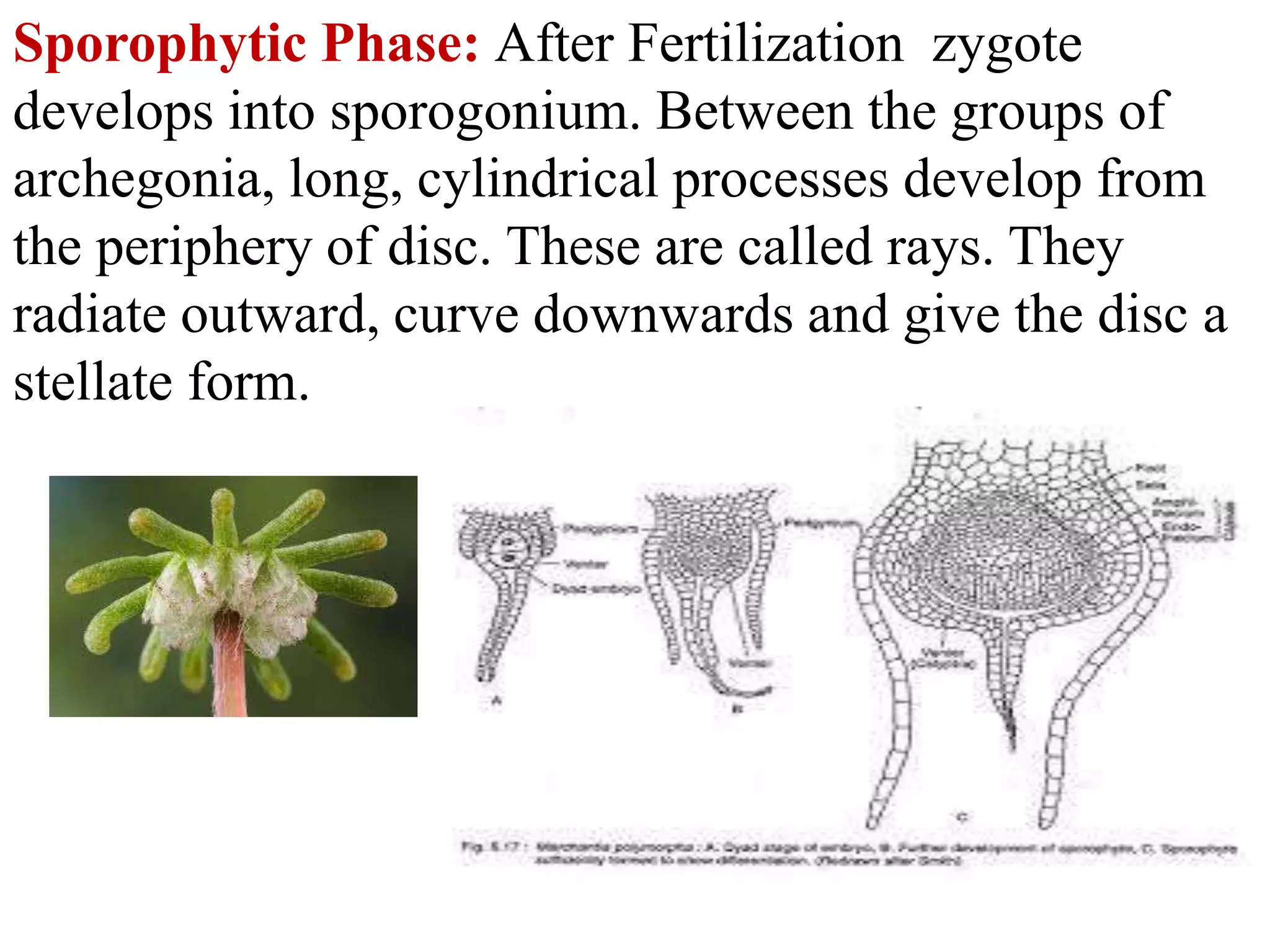
Sporophytic Phase: After Fertilization zygote
develops into sporogonium. Between the groups of
archegonia, long, cylindrical processes develop from
the periphery of disc. These are called rays. They
radiate outward, curve downwards and give the disc a
stellate form.
Mature Sporogonium:A mature sporogonium can be
differentiated into three parts, viz., the foot, seta and capsule.
Foot: It is bulbous and multicellular. It is composed of
parenchymatous cells. It acts as anchoring and absorbing
organ. It absorbs the food from the adjoining gametophytic
cells for the developing sporophyte.
Seta:
It connects the foot and the capsule. At maturity, due to many
transverse divisions it elongates and pushes the capsule
through three protective layers viz., calyptra, perigynium and
perichaetium.
Capsule:It is oval in shape and has a single layered wall
which encloses spores and elaters. It has been estimated that as
many as 3, 00,000 spores may be produced in single
sporogonium and there are 128 spores in relation to one elater.
Spores are carried out by air currents.
Structure of Spore:
Spores are very small (0.012 to 0.30 mm in diameter). They
are haploid, uninucleate, globose and surrounded by only two
wall layers. The outer well layer is thick, smooth or reticulate
and is known as exospore or exine. The inner wall layer is thin
and is called endospore or intine. Under favourable conditions,
the spores germinate immediately to form protonema.
Marchantia is dioecious, 50% of the spores develop into male
thalli and 50% develop into female thalli.
Alternation of Generation-One of the generations is
Haplophase and the other is diplophase.
Haplophase or Gametophytic Phase:
In Marchantia this phase is dominant and produces the sex
organs. Sex organs produce gametes to form a diploid zygote.
Diploid Phase or Sporophytic Phase:
Zygote develops into sporophyte. In Marchantia sporophyte is
represented by foot, seta and capsule. The sporophyte
produces the spores in the capsule. The spores on germination
produce the gametophyte. The life cycle of this type which is
characterised by alternation of generations and sporogenic
meiosis is known as heteromorphic and diplohaplontic.
Marchantia
Marchantia
Marchantia

Marchantia

  • 1.
    Marchantia V.S.Patil Associate Professor, Departmentof Botany Shri Shivaji College of Arts, Commerce,& Science Akola
  • 2.
  • 3.
    Habitat- Family Marchantiaceaeis represented by about 65 species. All species are terrestrial and cosmopolitan in distribution. The species prefer to grow in moist and shady places like wet open woodlands, banks of streams, wood rocks or on shaded stub rocks. Thallus-The plant body is gametophytic, thalloid, flat, prostrate, plagiotropic, 2-10 cm.long & dichotomously branched. Dorsal surface: Dorsal surface is dark green. It has a conspicuous midrib and a number of polygonal areas called areolae. The midrib ends in a depression at the apical region forming an apical notch in which growing point is situated.
  • 4.
    Dorsal surface alsobears the vegetative and sexual reproductive structures. The vegetative reproductive structures are gemma cup and develop along the midrib. Sexual reproductive structures are borne on special Stalked structures called gametophores or gamctangiophores. The gametophores bearing archegonia are called archegoniophores and that bearing antheridia are called antheridiophores
  • 5.
    Ventral surface: The ventralsurface of the thallus bears scales and rhizoids along the midrib. Scales are violet coloured, multicellular, one cell thick and arranged in 2-4 rows. Scales are of two types: (i) Simple or ligulate (ii) Appendiculate. Appendiculate- scales form the inner row of the scales close with midrib. Ligulate scales form the outer or marginal row and are smaller than the appendiculate scales. Rhizoids are unicellular, branched and develop as prolongation of the lower epidermal cells. They are of two types:(i) Smooth-walled rhizoids,
  • 6.
    (ii) Tuberculate rhizoids. Insmooth-walled rhizoids both the inner and outer wall layers are fully stretched while in tuber-culate rhizoids appear like circular dots in surface view. The main functions of the rhizoids are to anchor the thallus on the substratum and to absorb water and mineral nutrients from the soil.
  • 7.
  • 8.
    T.S.Thallus-A vertical crosssection of the thallus can be differentiated photosynthetic zone and lower storage zone. The outermost layer is upper epidermis. Its cells are thin walled square, compactly arranged and contain few chloroplasts. Its continuity is broken by the presence of many barrel shaped air pores. Each pore is surrounded by four to eight superimposed tiers of concentric rings with three to four cells in each tier. Just below the upper epidermis photosynthetic chambers are present in a horizontal layer. Each air pore opens inside the air chamber and helps in exchange of gases during photosynthesis. These chambers are separated from each other by single layered partition walls. The partition walls are two to four cells in height. Cells contain chloroplast. Many simple or branched photosynthetic filaments arise from the base of the air chambers .
  • 9.
    Storage zone: It liesbelow the air chambers. It is more thickened in the centre and gradually tapers towards the margins. It consists of several lasers of compactly arranged, thin walled parenchymatous isodiametric cells. The cells of this zone contain starch. Some cells contain a single large oil body or filled with mucilage. The lower most cell layer of the zone forms the lower epidermis. Some cells of the middle layer of lower epidermis extend to form both types of scales and rhizoids.
  • 11.
    Reproduction in Marchantia: Marchantiareproduces by vegetative and sexual methods. Vegetative Reproduction: 1. By Gemmae: Gemmae are produced in the gemma cups which are found on the dorsal surface of the thallus. Gemma cups are crescent shaped, 3 m.m. in diameter with smooth, spiny or fimbriate margins. Gemma cup
  • 12.
    V. S. gemmacup- 1)Upper photosynthetic region.2) inner storage region . The structure of both the zones is similar to that of the thallus. Mature gemmae are found to be attached at the base of the gemma cup by a single celled stalk.
  • 13.
    Intermingled with gemmaeare many mucilage hairs. Each gemma is autotrophic, multicellular, bilaterally symmetrical, thick in the centre and thin at the apex. It consists parenchymatous cells, oil cells and rhizoidal cells. It is notched on two sides in which lies the growing point. All cells of the gemma contain chloroplast except rhizoidal cells and oil cells. Rhizoidal cells are colourless and large in size. Oil cells are present just within the margins and contain oil bodies instead of chloroplast. The gemmae are dispersed over long distances by water currents. After falling on a suitable substratum gemmae germinate. From a single gemmae two thalli are formed.
  • 14.
    2. Fragmentation: Thebasal part of the thallus rots and disintegrates due to ageing. The detached lobes or fragments develop into independent thalli by apical growth. 3. By adventitious branches: The adventitious branches develop from any part of the thallus or the ventral surface of the thallus or rarely from the stalk and disc of the archegoniophore .On being detached, these branches develop into new thalli.
  • 16.
    Sexual Reproduction: It isoogamous.All species are dioecious. Male reproductive bodies are known as antheridia and female as archegonia. Antheridia and archegonia are produced an special, erect modified lateral branches of thallus called antheridiophore and archegoniophore arpocephalum)
  • 17.
    Antheridiophore: It consistsof 1-3 centimetre long stalk and a lobed disc at the apex . The disc is usually eight lobed . T.S. Antheridiophore or Archcgoniophore: It shows two sides: ventral side and dorsal side. Ventral side has two longitudinal tows with scales and rhizoids. These grooves, run longitudinally through the entire length of the stalk. Dorsal side shows an internal differentiation of air chambers.
  • 18.
    L.S. through discof Antheridiophore: The disc consists of air chambers alternating with heridial cavities. Air chambers are more or less triangular and open on upper surface by n pore Called ostiole. Mature Antheridium: A mature antheridium is globular in shape and can be differentiated into two parts stalk and body. Stalk is short multicellular and attaches the body to the base of the antheridial chamber. A single layered sterile jacket encloses the mass of androcyte mother cells which metamorphosis into antherozoids. The antherozoid is a minute rod like biflagellate structure.
  • 21.
    Archegoniophore or Carpocephalum: Itarises at the apical notch and consists of a stalk and terminal disc. It is slightly longer than the antheridiophore. It may be five to seven cm. long. The young apex of the archegoniophore divides by three successive dichotomies to form eight lobed rosette like disc.Each lobe of the disc contains a growing point. The archegonia begin to develop in each lobe in acropetal succession, i.e., the oldest archegonium near the centre and the young archegonium near the apex of the disc. Thus, eight groups of archegonia develop on the upper surface of the disc. There are twelve to fourteen archegonia in a single row in each lobe of the disc.
  • 23.
    Mature Archegonium: A maturearchegonium is a flask shaped structure. It remains attached to the archegonial disc by a short stalk. It consists upper elongated slender neck and basal globular portion called venter. The neck consists of six vertical rows enclosing eight neck canal cells and large egg. Four cover cells are present at the top of the neck. Fertilization-Marchantia is dioecious. Fertilization takes place when male and female thalli grow near each other. Water is essential for fertilization. The neck of the archegonium is directed upwards on the dorsal surface of the disc of the archegoniophore.
  • 24.
    In the maturearchegonium the venter canal cell and neck canal cells disintegrate and form a mucilaginous mass. It absorbs water, swells up and comes out of the archegonial mouth by pushing the cover cells apart. This mucilaginous mass consists of chemical substances. Many antherozoids enter the archegonial neck & reach up to egg. One of the antherozoids penetrates the egg and fertilization is effected. The fusion of both male and female nuclei results in the formation of diploid zygote or oospore. Fertilization ends the gametophytic phase.
  • 25.
    Sporophytic Phase: AfterFertilization zygote develops into sporogonium. Between the groups of archegonia, long, cylindrical processes develop from the periphery of disc. These are called rays. They radiate outward, curve downwards and give the disc a stellate form.
  • 26.
    Mature Sporogonium:A maturesporogonium can be differentiated into three parts, viz., the foot, seta and capsule. Foot: It is bulbous and multicellular. It is composed of parenchymatous cells. It acts as anchoring and absorbing organ. It absorbs the food from the adjoining gametophytic cells for the developing sporophyte. Seta: It connects the foot and the capsule. At maturity, due to many transverse divisions it elongates and pushes the capsule through three protective layers viz., calyptra, perigynium and perichaetium. Capsule:It is oval in shape and has a single layered wall which encloses spores and elaters. It has been estimated that as many as 3, 00,000 spores may be produced in single sporogonium and there are 128 spores in relation to one elater. Spores are carried out by air currents.
  • 27.
    Structure of Spore: Sporesare very small (0.012 to 0.30 mm in diameter). They are haploid, uninucleate, globose and surrounded by only two wall layers. The outer well layer is thick, smooth or reticulate and is known as exospore or exine. The inner wall layer is thin and is called endospore or intine. Under favourable conditions, the spores germinate immediately to form protonema. Marchantia is dioecious, 50% of the spores develop into male thalli and 50% develop into female thalli.
  • 29.
    Alternation of Generation-Oneof the generations is Haplophase and the other is diplophase. Haplophase or Gametophytic Phase: In Marchantia this phase is dominant and produces the sex organs. Sex organs produce gametes to form a diploid zygote. Diploid Phase or Sporophytic Phase: Zygote develops into sporophyte. In Marchantia sporophyte is represented by foot, seta and capsule. The sporophyte produces the spores in the capsule. The spores on germination produce the gametophyte. The life cycle of this type which is characterised by alternation of generations and sporogenic meiosis is known as heteromorphic and diplohaplontic.