By- RISHIKA PASEBAND
VOLUNTEER OF APPLIED FORENSIC
RESEARCH SCIENCES
PART 1
 Introduction of Diatoms
-Definition of diatoms
-Classification of diatoms
-Structure of diatoms
-Types of diatoms
-Reproduction in diatoms
-Question
Diatoms are a major group of
algae, specifically microalgae
found in the oceans, waterways
and soils. They make up a
significant portion of the earth’s
biomass. They are among the
most common types of
phytoplankton.
Diatoms are unicellular(single
celled) organisms.
• Domain: Eukaryota
• Kingdom: Chromalveolata
• Phylum: Ochrophyta
• Class: Bacillariophyceae
• Order: Centrales
Pennales
Diatoms require high levels of silicon as an
essential nutrient and since they are
photosynthesizing organisms, diatoms also
require sunlight. They are a major source of
atmospheric oxygen responsible for 20-30% of
all carbon fixation on the planet and also act as
environmental indicators of climate change.
In ecology, diatoms are used to monitor the
water quality of large water bodies.
Diatomaceous Earth:
It is a powdery substance made from the
fossilized remains of a single-celled algae.
 Diatoms are Protists.
 This class of organism is distinguished by the
presence of an inorganic cell wall that is
composed of silica.
-Endoplasmic cysts
-They store oil rather than starch
-A bipartite(consisting of two parts) cell wall
-Secretion of silica
1.Size:About 2-200 micrometers.
2.Cells are typically circular, some cells may be
triangular, square or elliptical.
3.In diatoms, the site of photosynthesis is
yellowish brown chloroplasts.
4.They are often referred as jewels of the sea or
‘living opals’ due to their ornate silica outer
shell, known as frustule.
5.Frustule can be defined as the hard and porous
cell wall or external layer of diatoms.
This cell wall is primarily composed of
silica(hydrated silicon dioxide)made from
silica acid, and is coated with a layer of
organic substance called pectin, a fiber most
commonly found in cell walls.
6.Pores,ribs,marginal ridges, minute spines
and elevations can be seen on this siliceous
wall, all of which can be used to describe
genera and species.
7.Diatom cell consists of two halves where
each half essentially contains a valve(a flat
plate) and girdle(marginal connecting).
Two halves are:
•Hypotheca
•Epitheca
-hypotheca is slightly smaller than epitheca
nucleus
nucleolus
cell wall
pyrenoid
mitochondria
valves
vacuoles
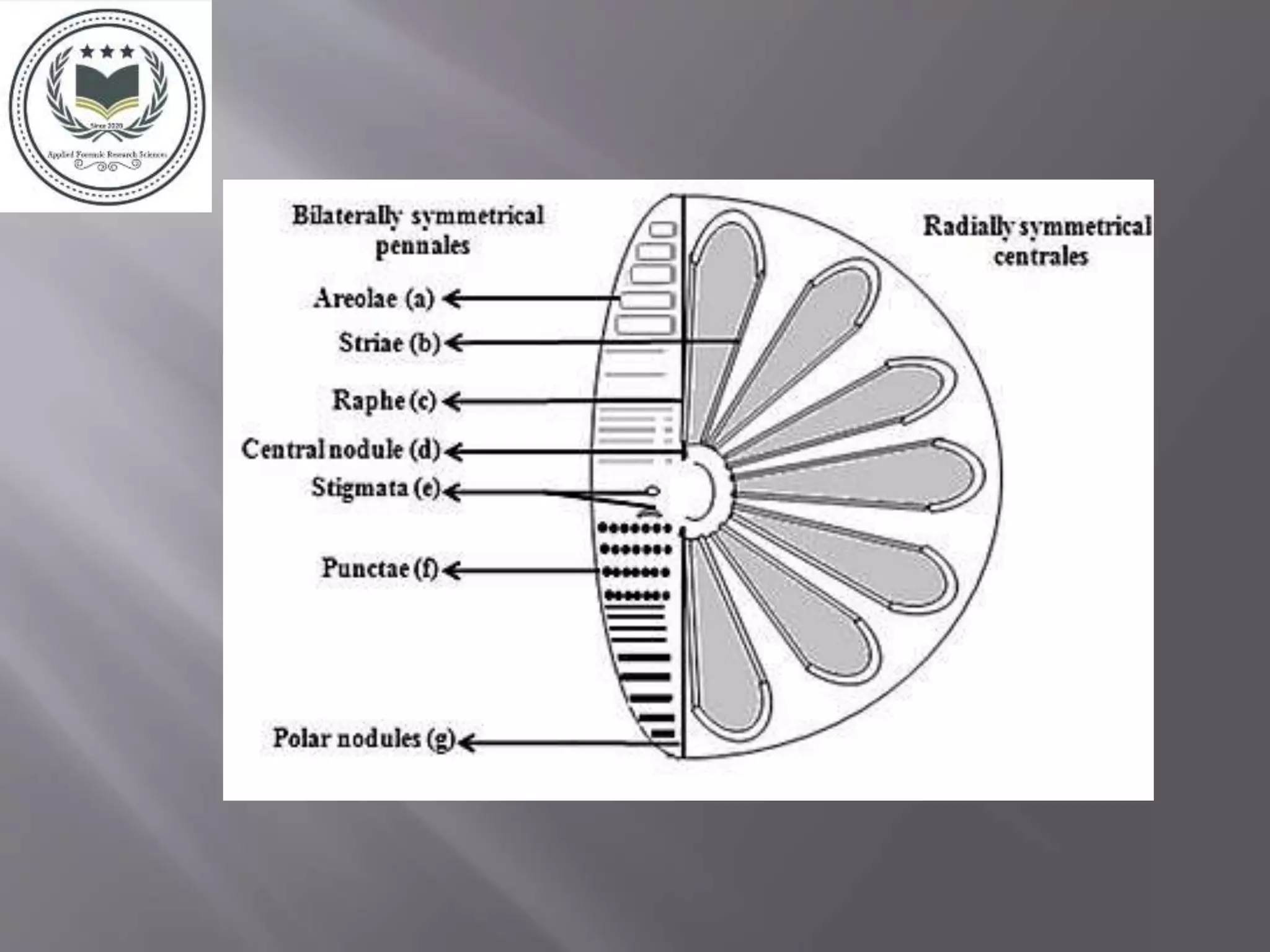
Diatoms are divided into two main Orders, which are
Centrales and Pennales.
Centrales(Centric Diatoms)
They are also referred as Biddulphiales.They are
radially symmetrical.
Pennales(Pennate Diatoms)
They are also referred as Bacillariales.They are
bilaterally symmetrical.
Diatoms divide and reproduce by a process called
as vegetative division, which involves the
division of a single cell into two new cells.
During the reproduction cycle, the new cell is
formed inside the parent cell. The new cell is
smaller in size given that it forms within the
mother cell that has a rigid cell wall that does not
expand.
Golden brown colour of diatoms is due to
presence of__________?
A. Mycoxanthin, mucoxanthin and
myxoxanthophylls
B. Alpha and beta carotenes and myxoxanthin
C. Fucoxanthin , diatoxanthin, diadinoxanthin
D. None of the above

Diatoms and its Forensic Significance.pptx

  • 1.
    By- RISHIKA PASEBAND VOLUNTEEROF APPLIED FORENSIC RESEARCH SCIENCES PART 1
  • 2.
     Introduction ofDiatoms -Definition of diatoms -Classification of diatoms -Structure of diatoms -Types of diatoms -Reproduction in diatoms -Question
  • 3.
    Diatoms are amajor group of algae, specifically microalgae found in the oceans, waterways and soils. They make up a significant portion of the earth’s biomass. They are among the most common types of phytoplankton. Diatoms are unicellular(single celled) organisms.
  • 4.
    • Domain: Eukaryota •Kingdom: Chromalveolata • Phylum: Ochrophyta • Class: Bacillariophyceae • Order: Centrales Pennales
  • 5.
    Diatoms require highlevels of silicon as an essential nutrient and since they are photosynthesizing organisms, diatoms also require sunlight. They are a major source of atmospheric oxygen responsible for 20-30% of all carbon fixation on the planet and also act as environmental indicators of climate change.
  • 6.
    In ecology, diatomsare used to monitor the water quality of large water bodies. Diatomaceous Earth: It is a powdery substance made from the fossilized remains of a single-celled algae.
  • 7.
     Diatoms areProtists.  This class of organism is distinguished by the presence of an inorganic cell wall that is composed of silica.
  • 8.
    -Endoplasmic cysts -They storeoil rather than starch -A bipartite(consisting of two parts) cell wall -Secretion of silica
  • 9.
    1.Size:About 2-200 micrometers. 2.Cellsare typically circular, some cells may be triangular, square or elliptical. 3.In diatoms, the site of photosynthesis is yellowish brown chloroplasts. 4.They are often referred as jewels of the sea or ‘living opals’ due to their ornate silica outer shell, known as frustule. 5.Frustule can be defined as the hard and porous cell wall or external layer of diatoms.
  • 10.
    This cell wallis primarily composed of silica(hydrated silicon dioxide)made from silica acid, and is coated with a layer of organic substance called pectin, a fiber most commonly found in cell walls. 6.Pores,ribs,marginal ridges, minute spines and elevations can be seen on this siliceous wall, all of which can be used to describe genera and species. 7.Diatom cell consists of two halves where each half essentially contains a valve(a flat plate) and girdle(marginal connecting).
  • 11.
    Two halves are: •Hypotheca •Epitheca -hypothecais slightly smaller than epitheca
  • 12.
  • 13.
    Diatoms are dividedinto two main Orders, which are Centrales and Pennales. Centrales(Centric Diatoms) They are also referred as Biddulphiales.They are radially symmetrical. Pennales(Pennate Diatoms) They are also referred as Bacillariales.They are bilaterally symmetrical.
  • 15.
    Diatoms divide andreproduce by a process called as vegetative division, which involves the division of a single cell into two new cells. During the reproduction cycle, the new cell is formed inside the parent cell. The new cell is smaller in size given that it forms within the mother cell that has a rigid cell wall that does not expand.
  • 17.
    Golden brown colourof diatoms is due to presence of__________? A. Mycoxanthin, mucoxanthin and myxoxanthophylls B. Alpha and beta carotenes and myxoxanthin C. Fucoxanthin , diatoxanthin, diadinoxanthin D. None of the above