Introduction of Bryophytes and their
Classification
Etymology:
Bryophyte is derived from a Greek word
‘BRYON’ means Mosses and ‘Phyca’
means Plant.
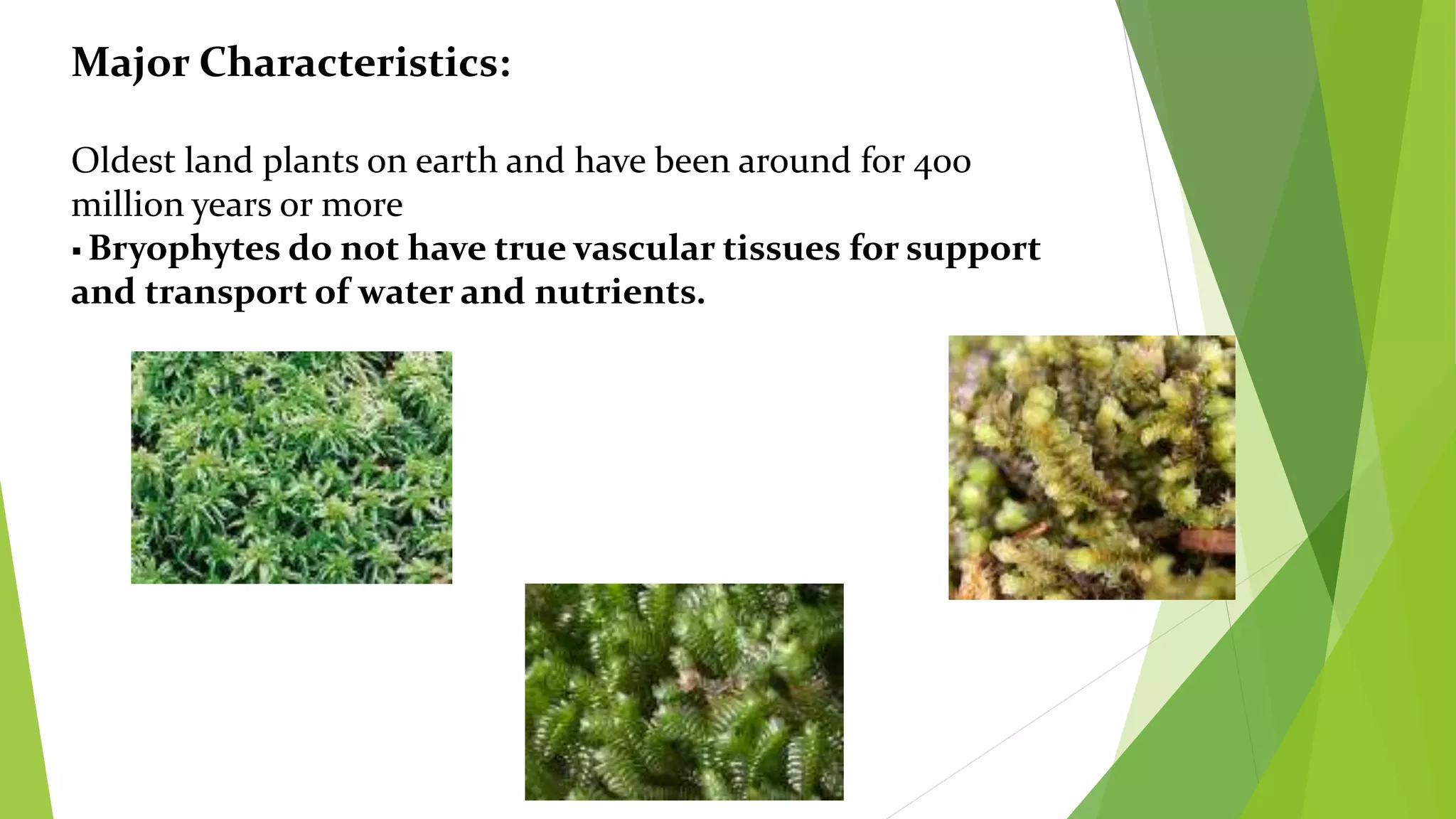
Major Characteristics:
Oldest land plants on earth and have been around for 400
million years or more
 Bryophytes do not have true vascular tissues for support
and transport of water and nutrients.
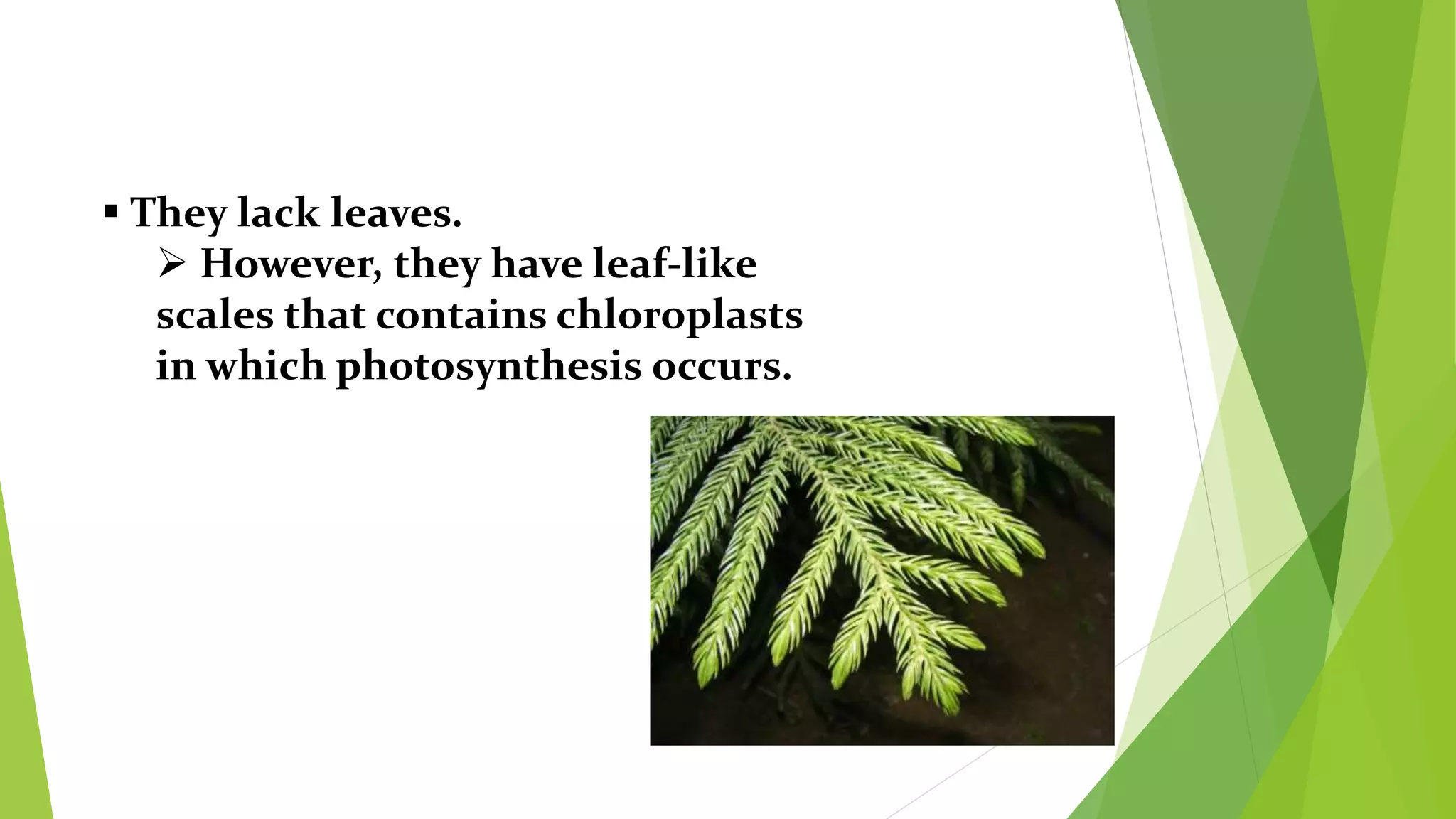
 They lack leaves.
 However, they have leaf-like
scales that contains chloroplasts
in which photosynthesis occurs.
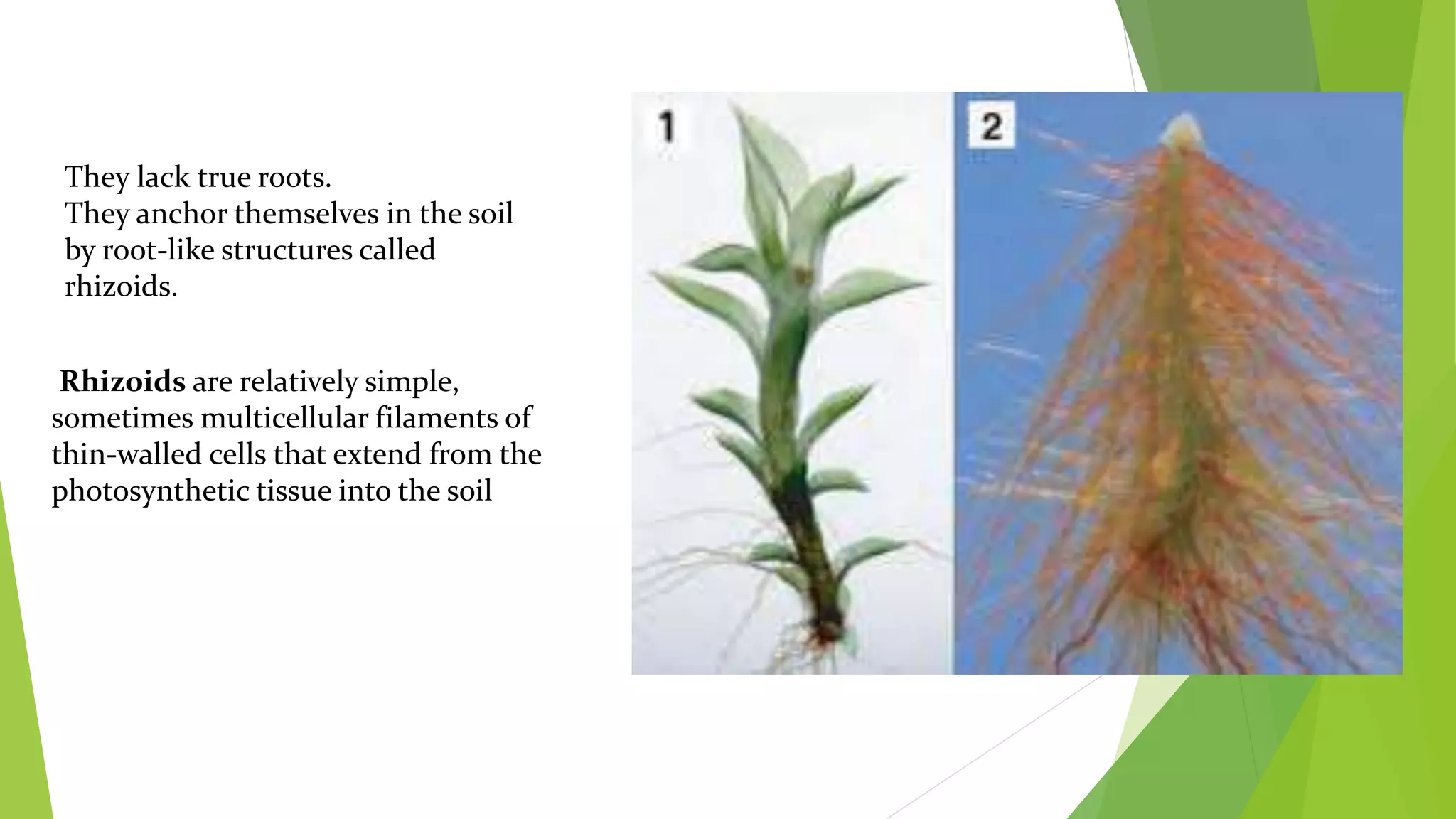
They lack true roots.

They anchor themselves in the soil
by root-like structures called
rhizoids.
Rhizoids are relatively simple,
sometimes multicellular filaments of
thin-walled cells that extend from the
photosynthetic tissue into the soil
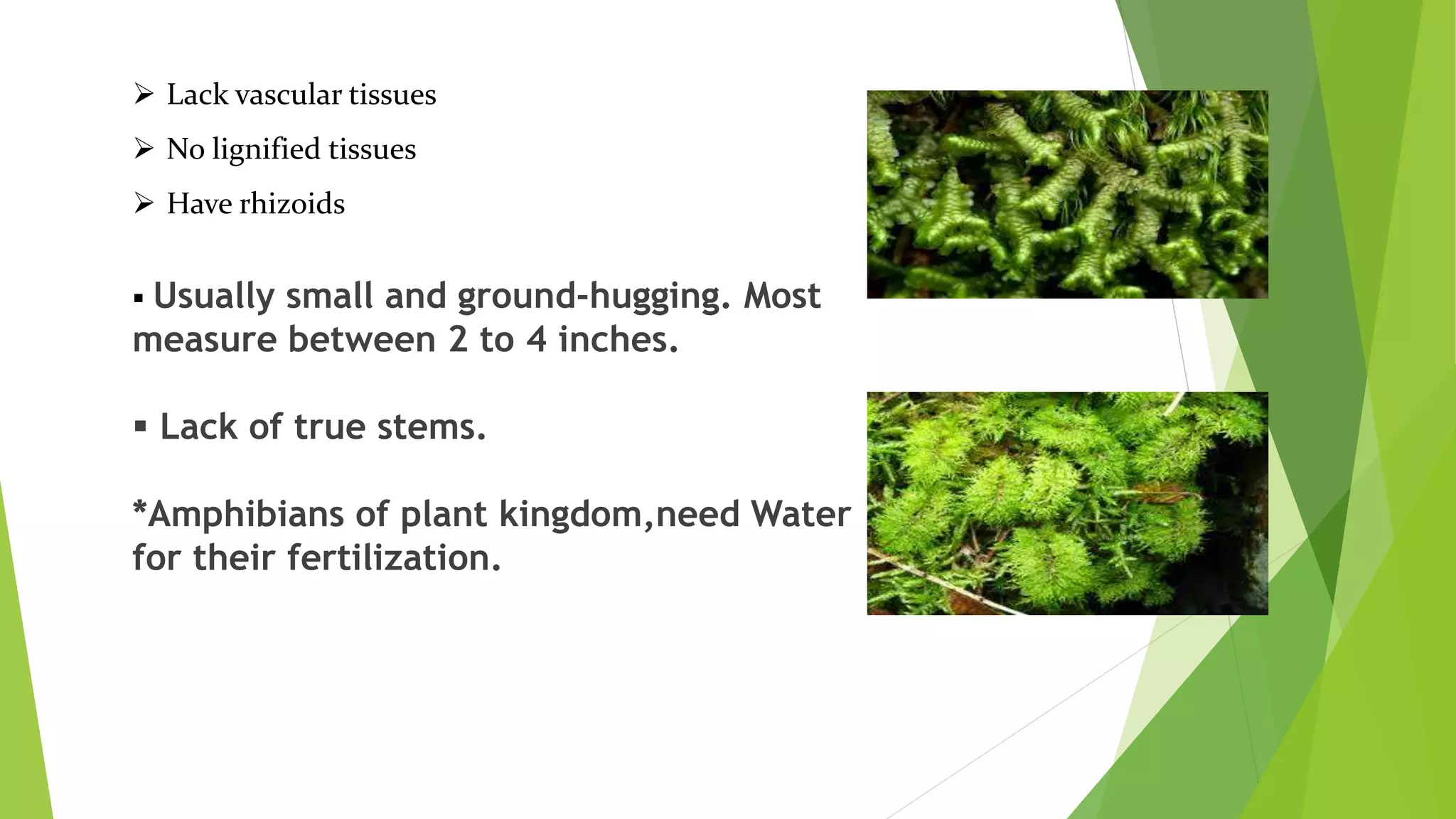
 Usually small and ground-hugging. Most
measure between 2 to 4 inches.
 Lack of true stems.
*Amphibians of plant kingdom,need Water
for their fertilization.
 Lack vascular tissues
 No lignified tissues
 Have rhizoids
Habitat: lived in moist places and humid
environment.
9000genera,24,000species
Mode of nutrition autotrohic as well as
saprophytic.
Plant body is thallus (not differentiated
into Root,stem and leaf) e.g
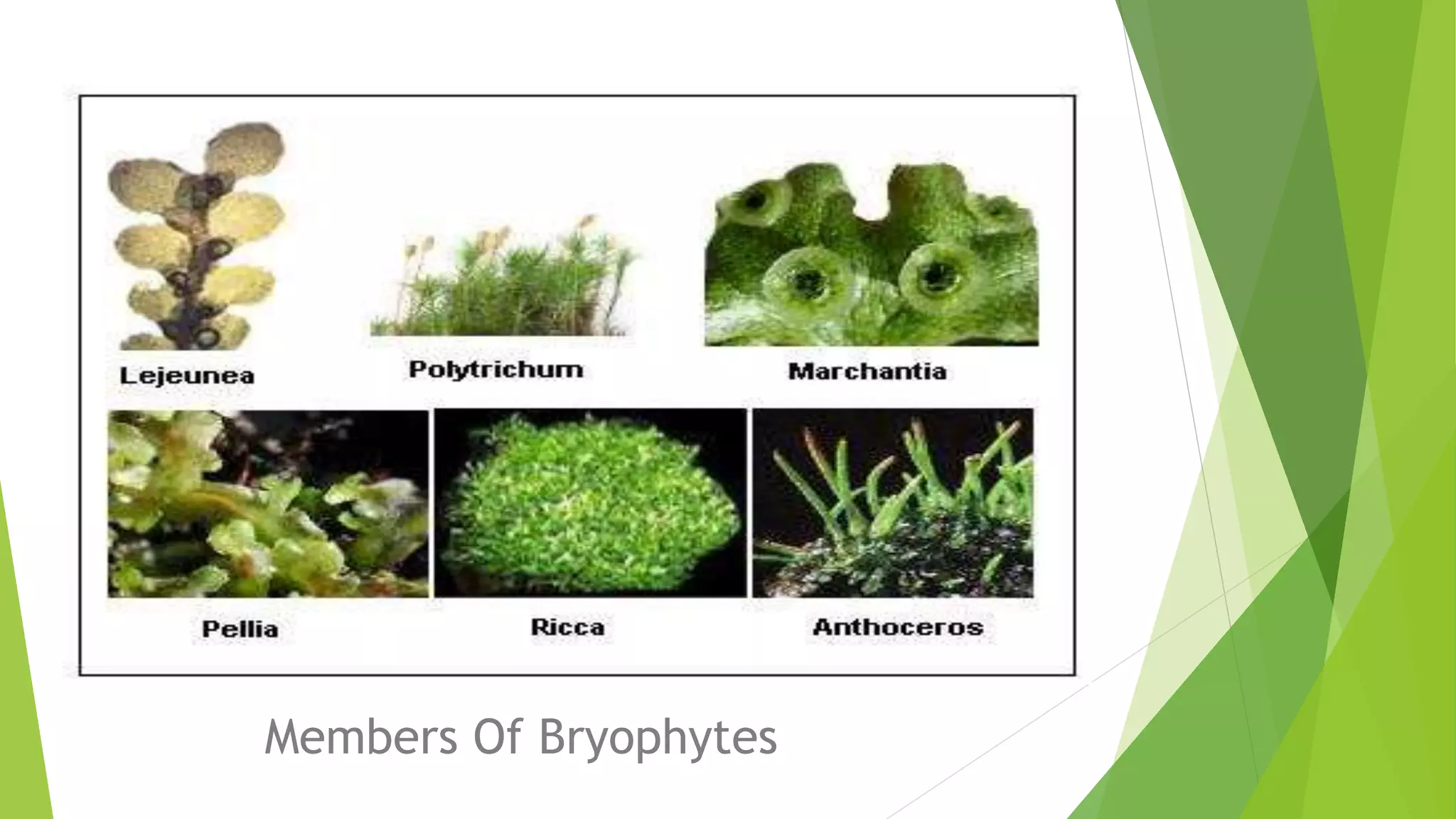
Marchantia,Anthoceros.
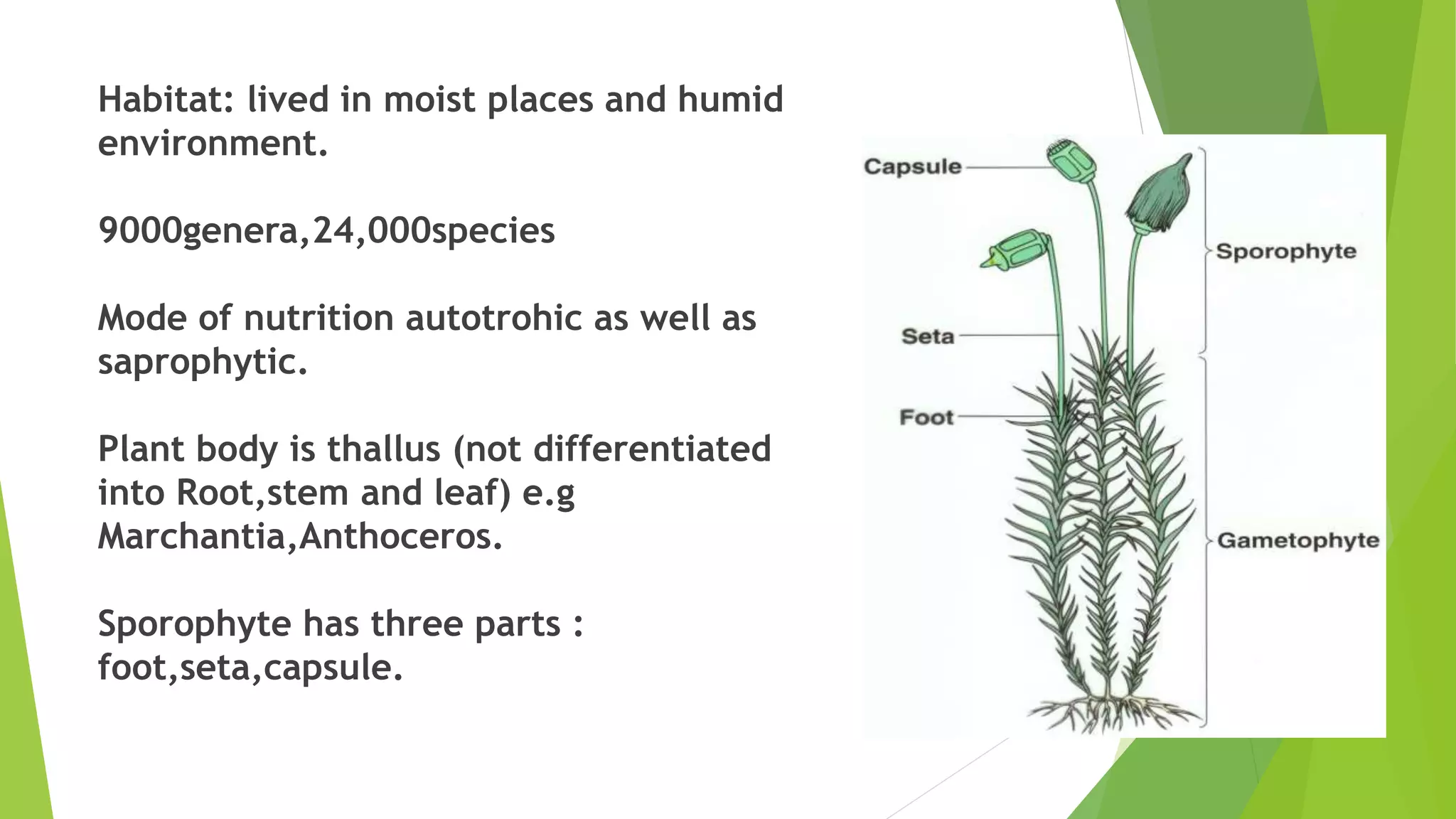
Sporophyte has three parts :
foot,seta,capsule.
Classifications
There are 3 classes of
bryophytes:
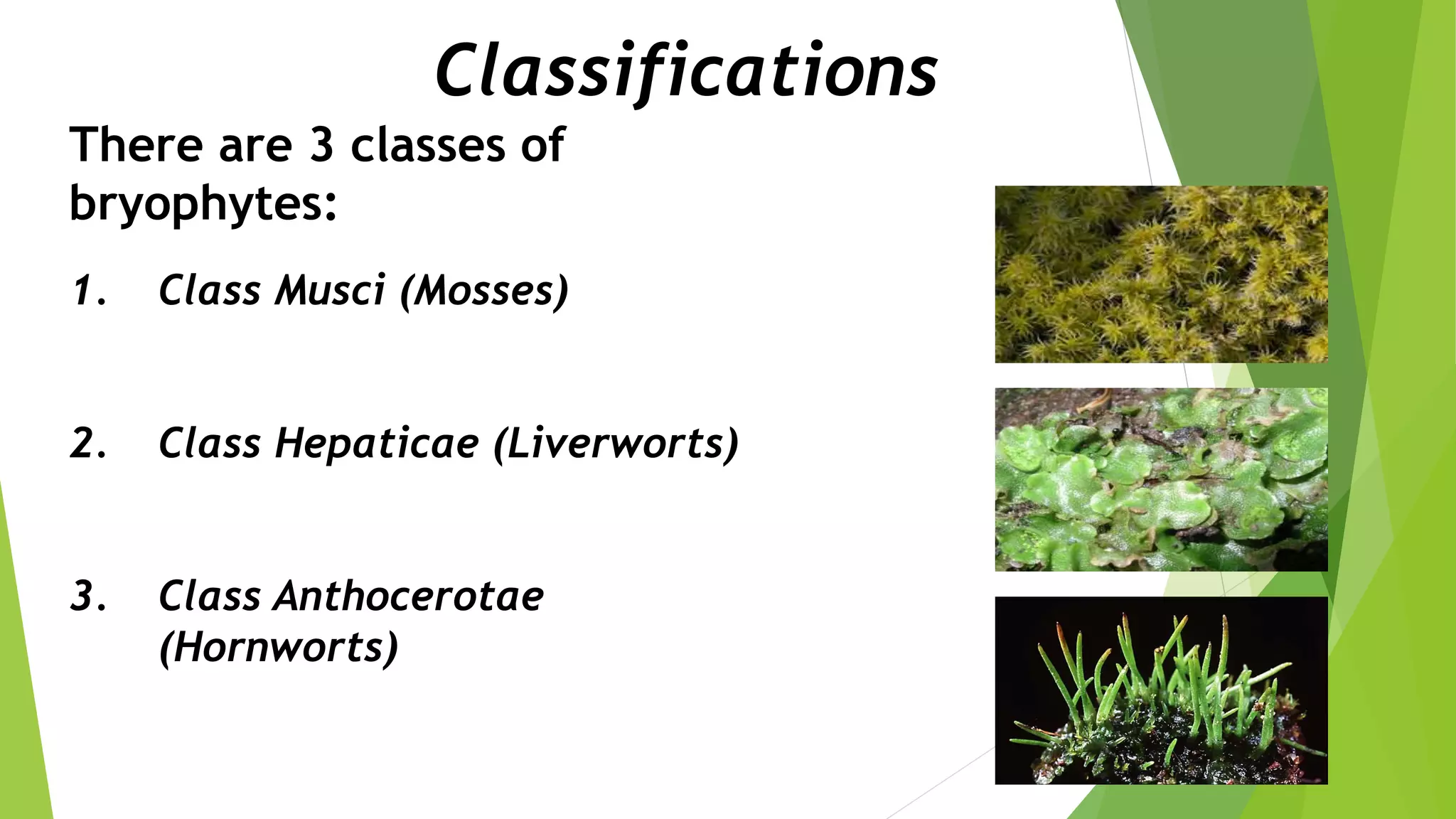
1. Class Musci (Mosses)
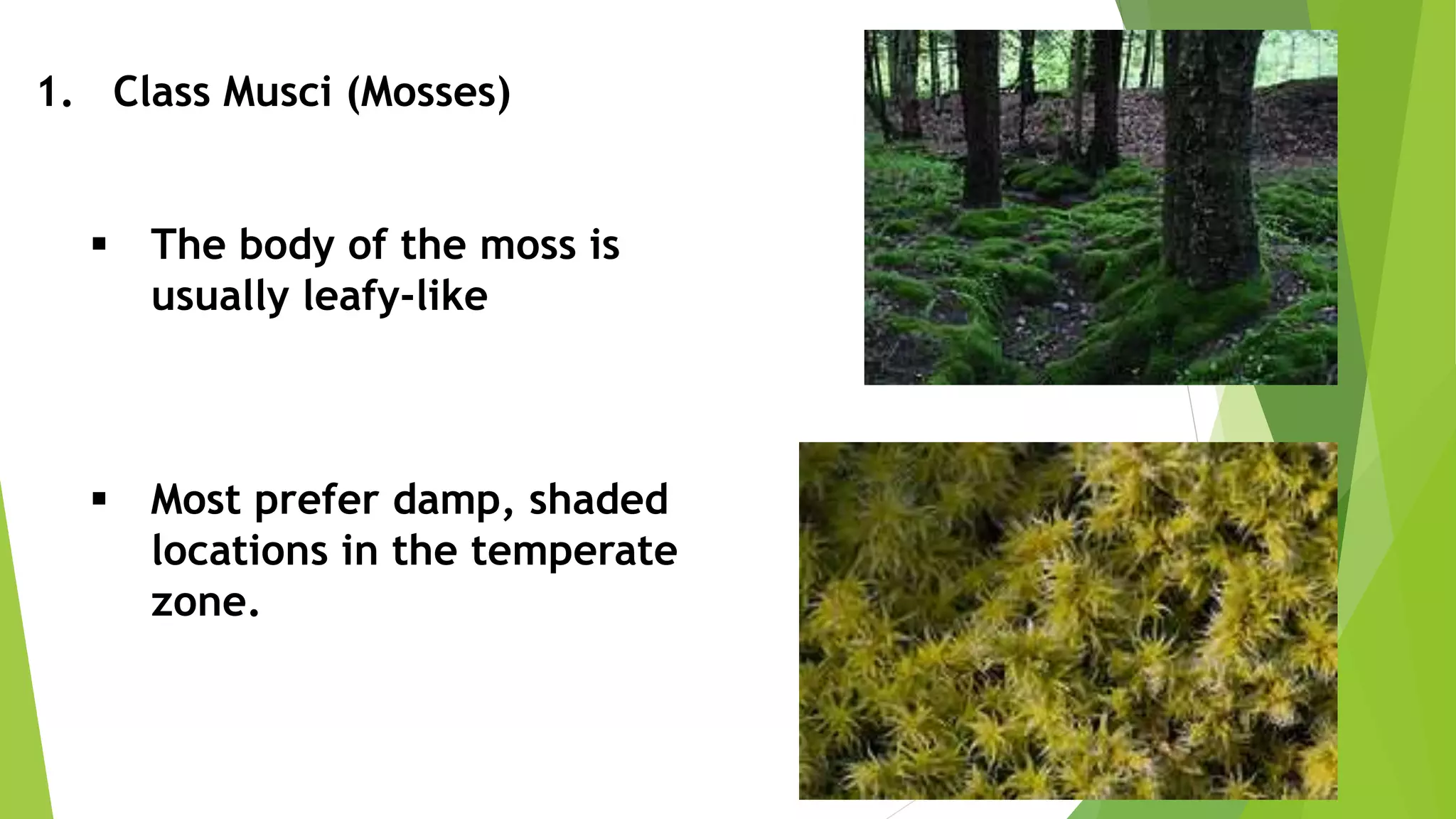
2. Class Hepaticae (Liverworts)
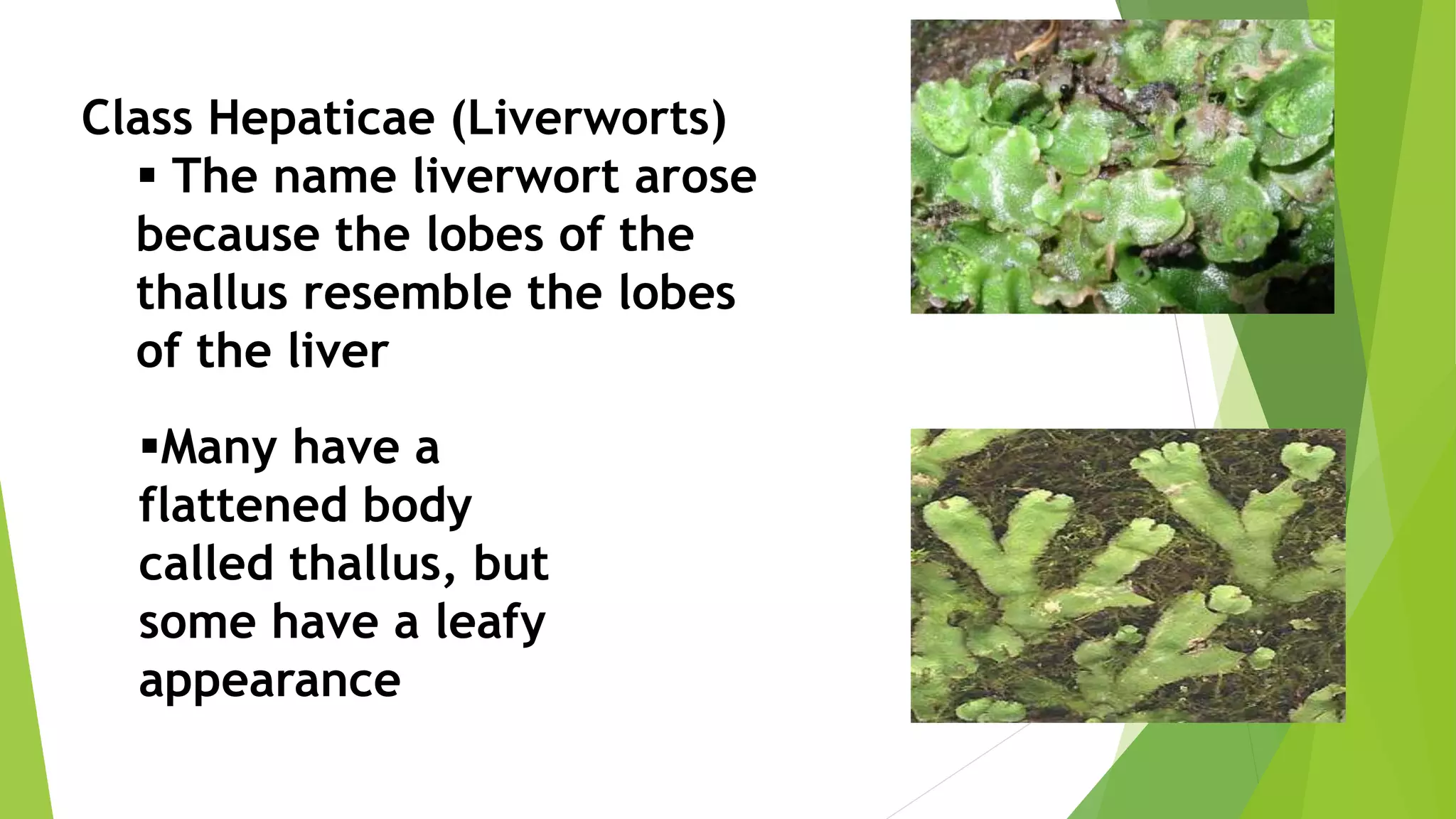
3. Class Anthocerotae
(Hornworts)
1. Class Musci (Mosses)
 The body of the moss is
usually leafy-like
 Most prefer damp, shaded
locations in the temperate
zone.
Class Hepaticae (Liverworts)
 The name liverwort arose
because the lobes of the
thallus resemble the lobes
of the liver
Many have a
flattened body
called thallus, but
some have a leafy
appearance
Class Anthocerotae (Hornworts)
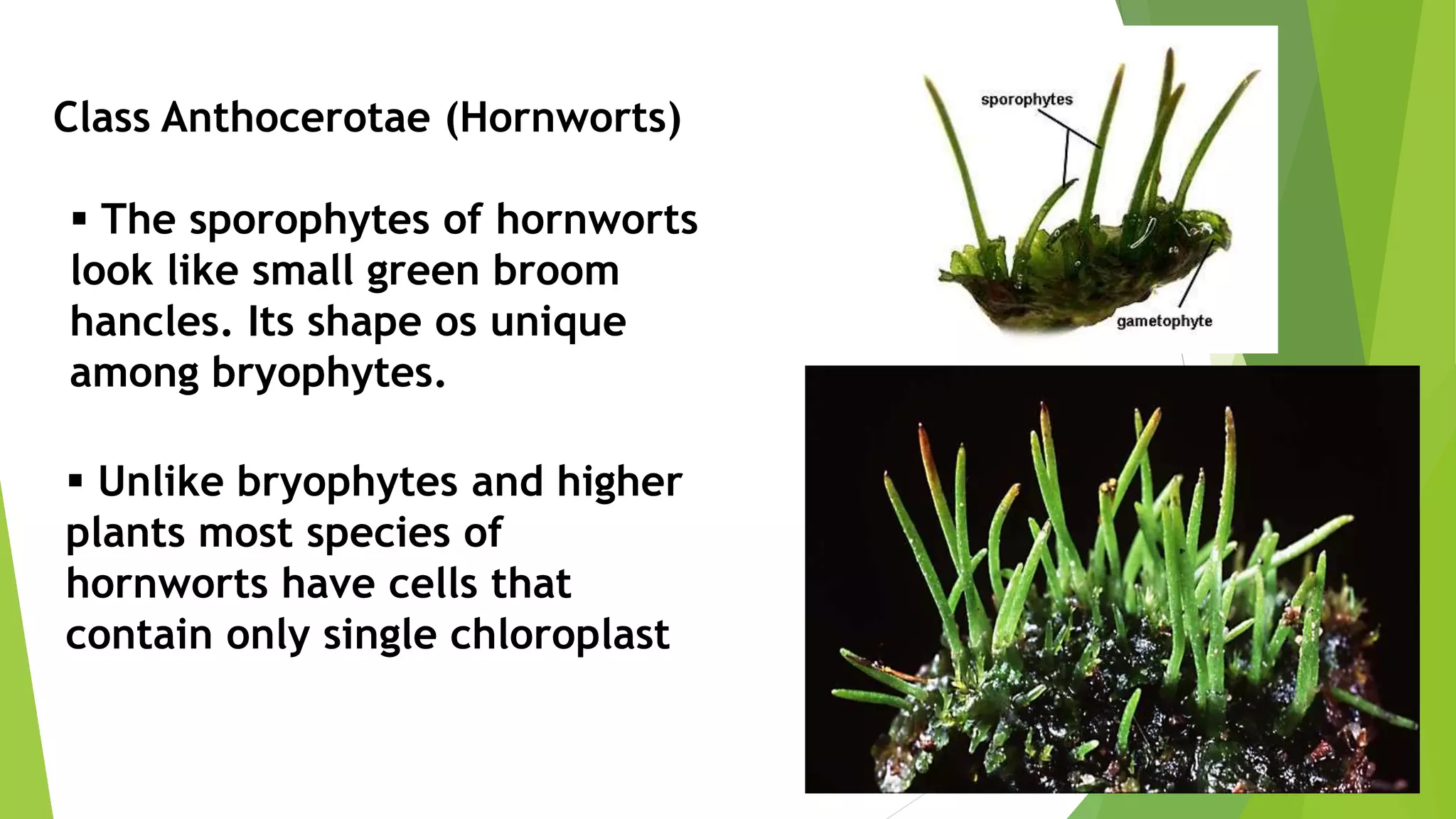
 The sporophytes of hornworts
look like small green broom
hancles. Its shape os unique
among bryophytes.
 Unlike bryophytes and higher
plants most species of
hornworts have cells that
contain only single chloroplast
Members Of Bryophytes
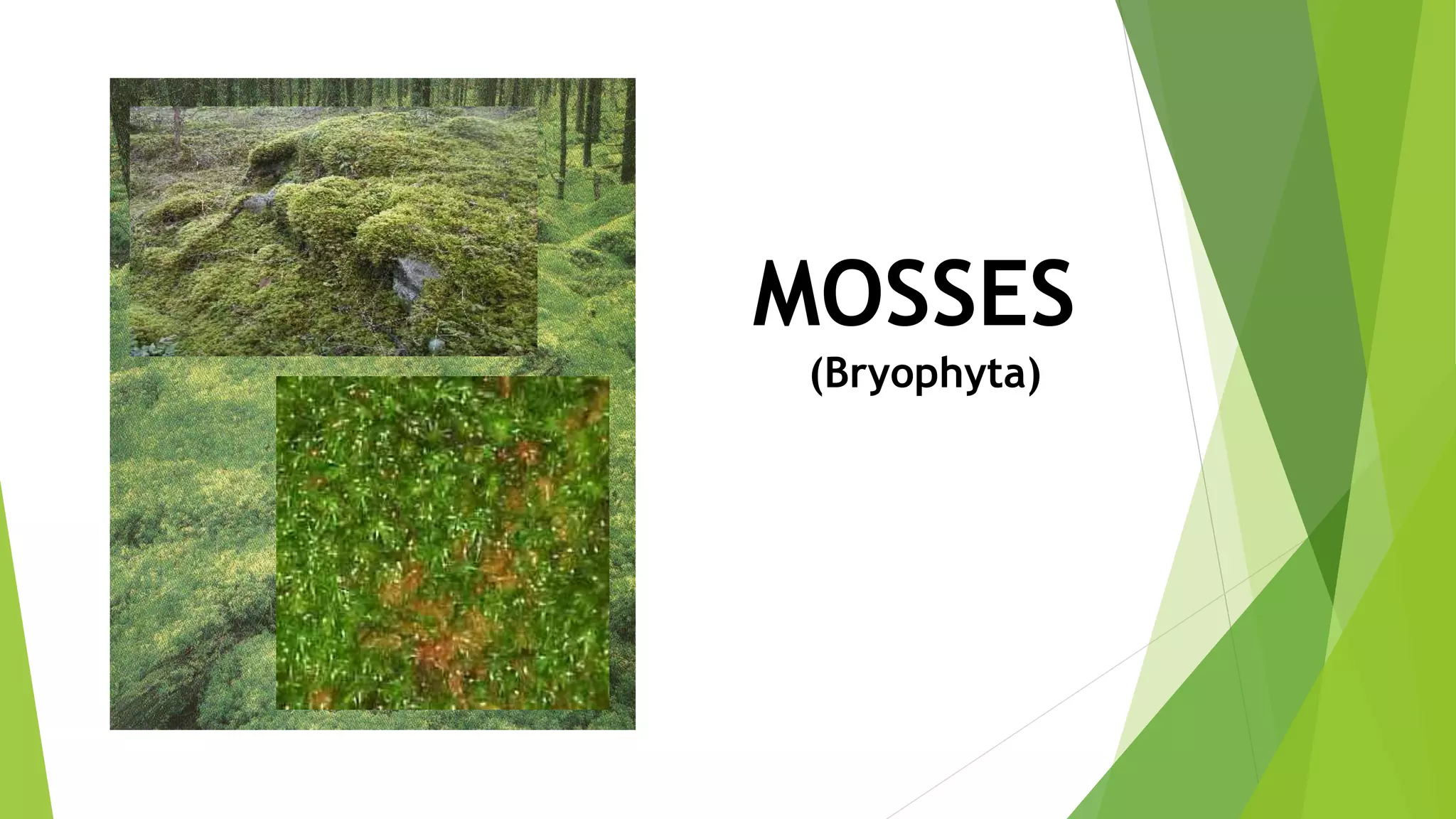
MOSSES
(Bryophyta)
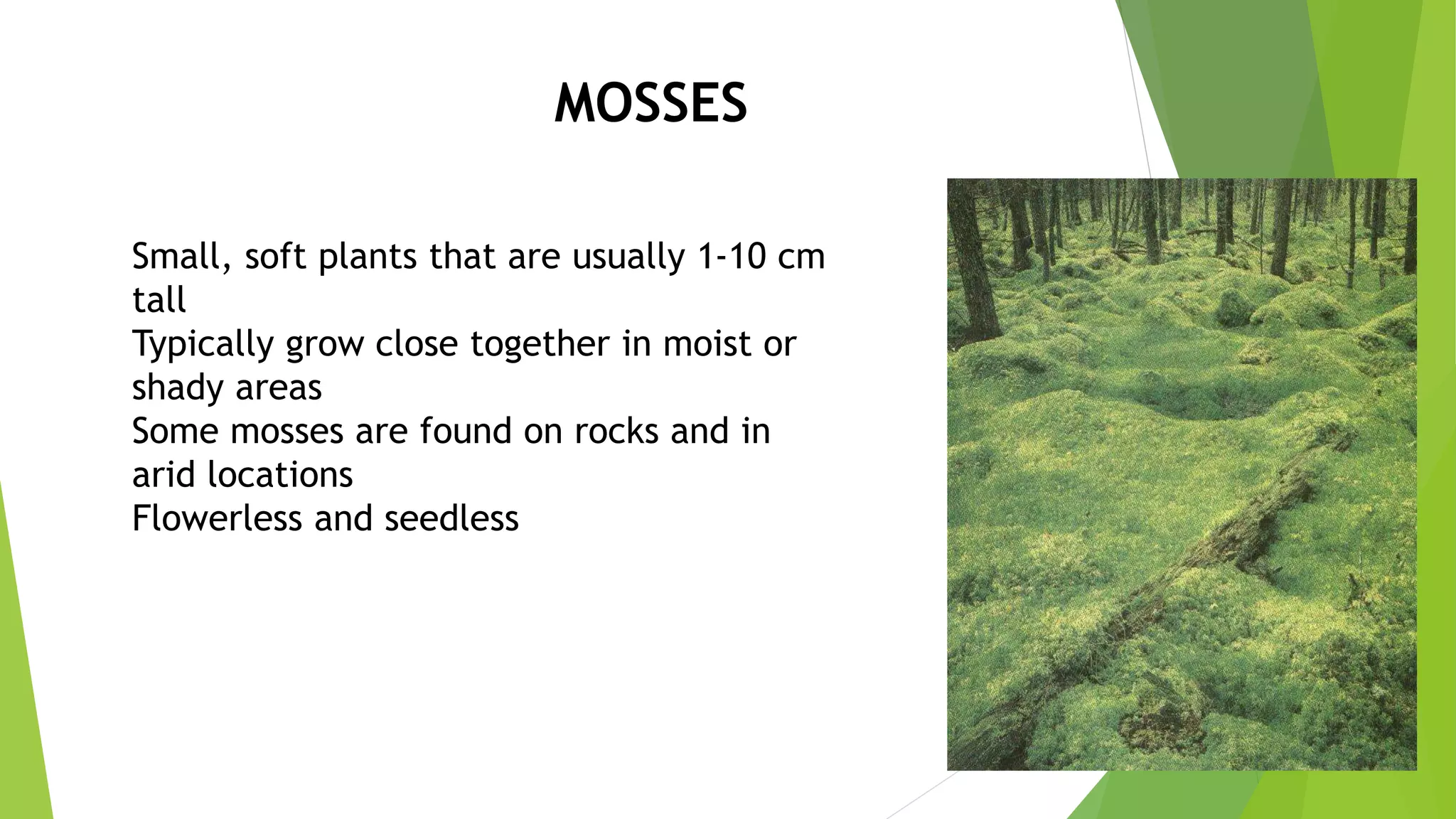
Small, soft plants that are usually 1-10 cm
tall
Typically grow close together in moist or
shady areas
Some mosses are found on rocks and in
arid locations
Flowerless and seedless
MOSSES
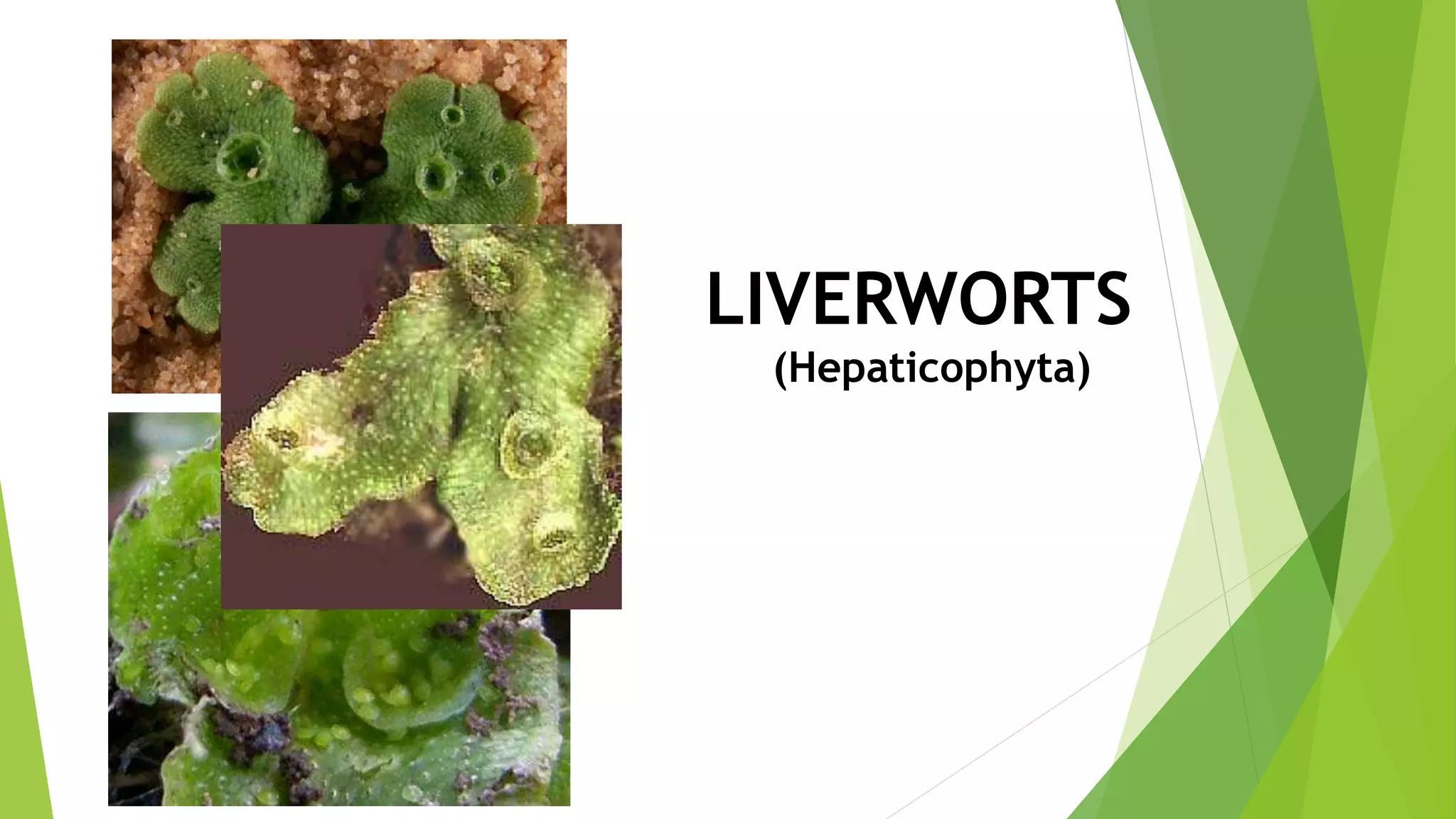
LIVERWORTS
(Hepaticophyta)
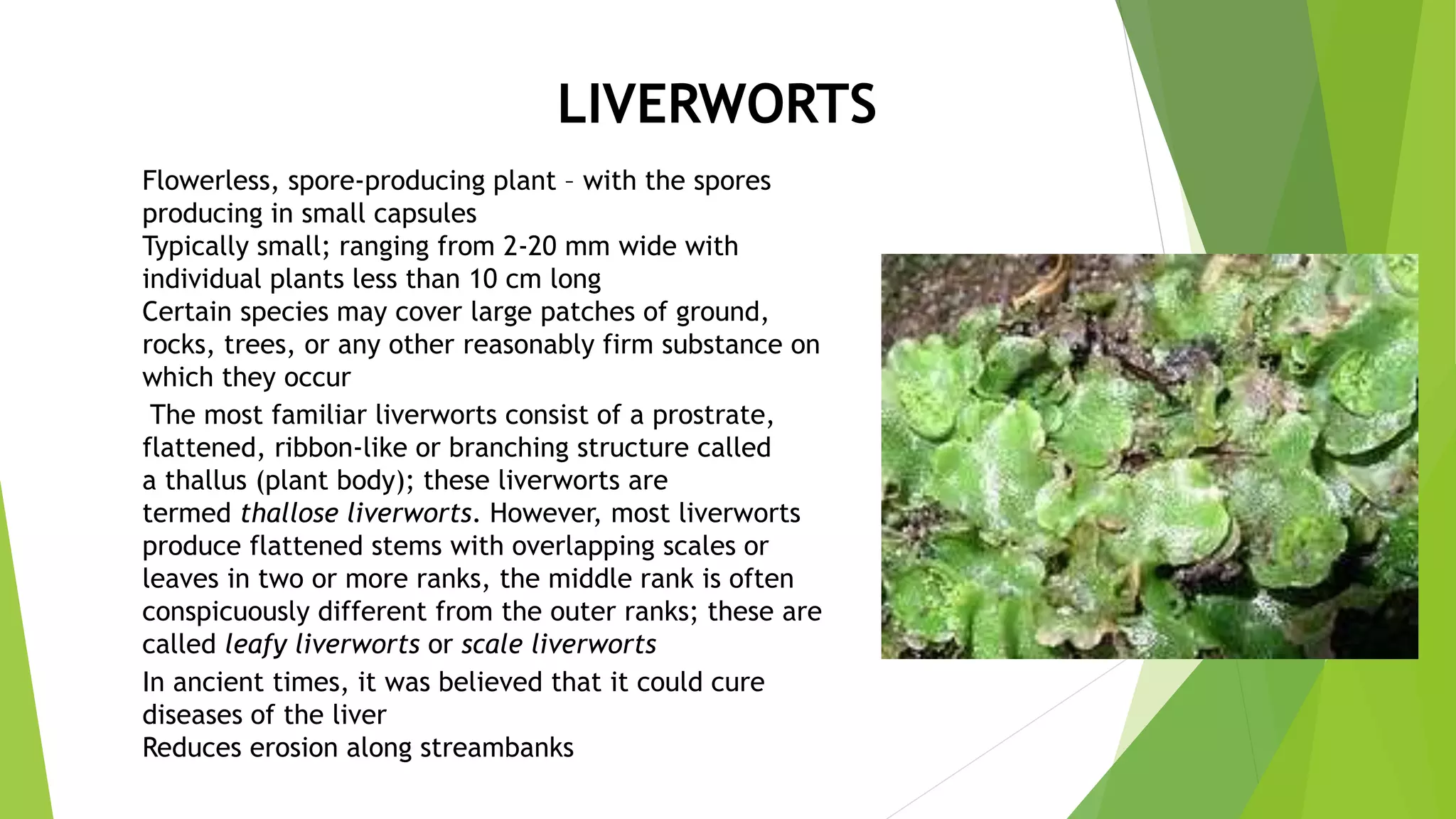
The most familiar liverworts consist of a prostrate,
flattened, ribbon-like or branching structure called
a thallus (plant body); these liverworts are
termed thallose liverworts. However, most liverworts
produce flattened stems with overlapping scales or
leaves in two or more ranks, the middle rank is often
conspicuously different from the outer ranks; these are
called leafy liverworts or scale liverworts
Flowerless, spore-producing plant – with the spores
producing in small capsules
Typically small; ranging from 2-20 mm wide with
individual plants less than 10 cm long
Certain species may cover large patches of ground,
rocks, trees, or any other reasonably firm substance on
which they occur
LIVERWORTS
In ancient times, it was believed that it could cure
diseases of the liver
Reduces erosion along streambanks
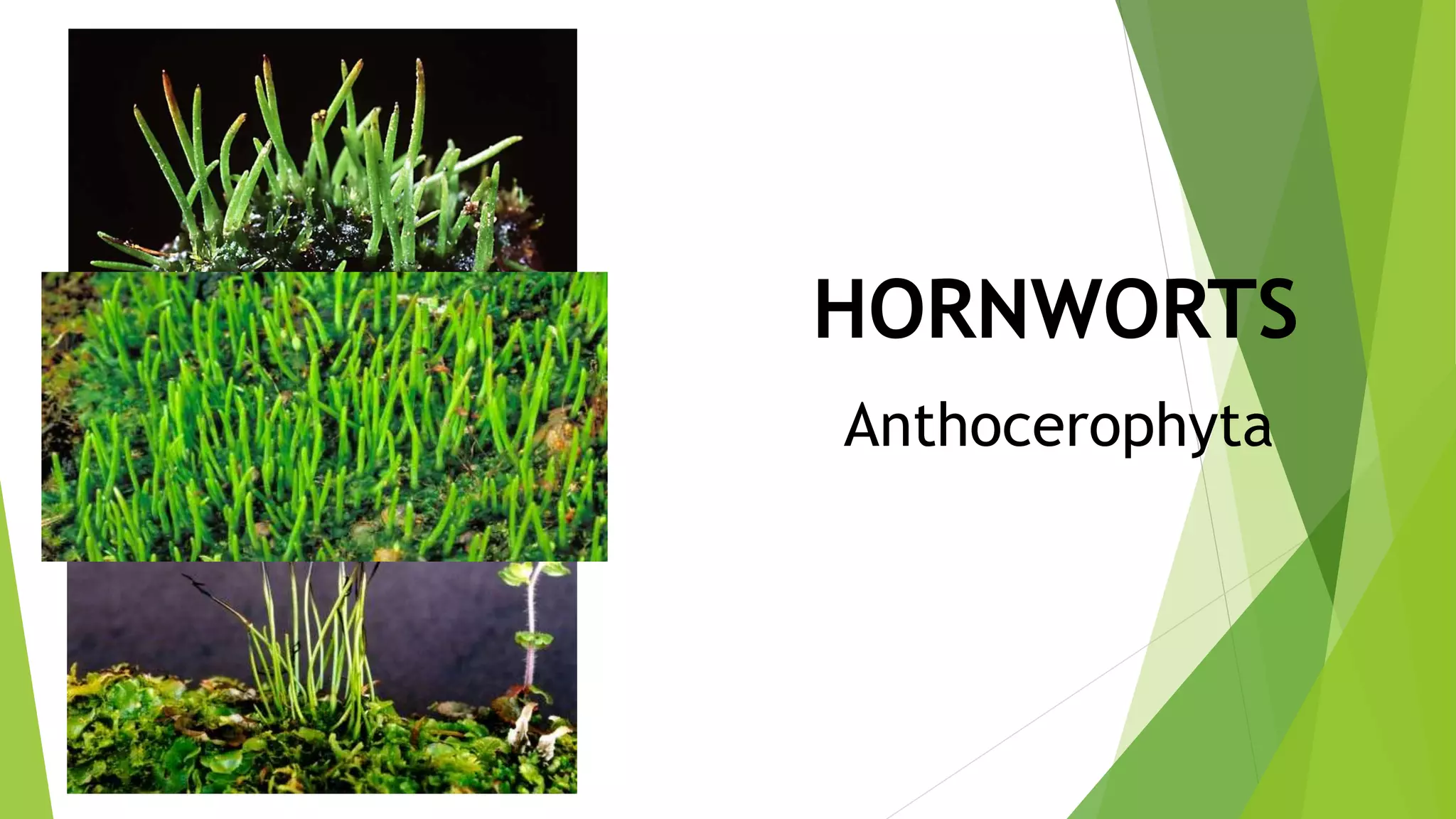
HORNWORTS
Anthocerophyta
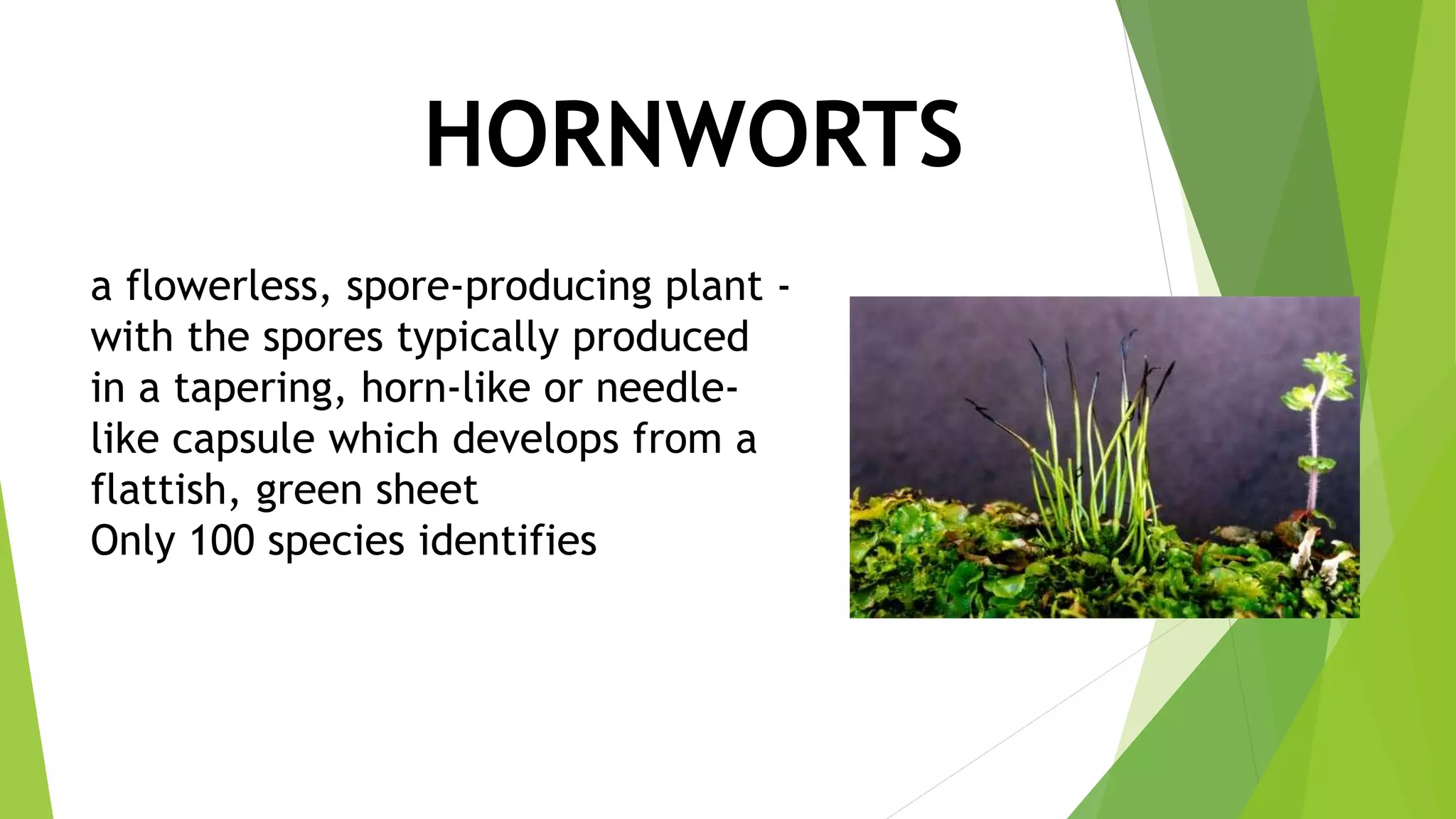
a flowerless, spore-producing plant -
with the spores typically produced
in a tapering, horn-like or needle-
like capsule which develops from a
flattish, green sheet
Only 100 species identifies
HORNWORTS
The bryophytes reproduce by vegetative, sexual
and asexual modes of reproduction. The
gametophyte reproduces sexually by formation of
gametes whereas the sporophyte reproduces by the
formation of spores, therefore the mode of
reproduction is asexual.
Reproduction
Types Of Reproduction
1=Vegetative reproduction
2=Asexual reproduction
3=Sexual reproduction
In some species asexual reproduction takes place by the
vegetative methods of fragmentation and genome.
However asexual spores like endospores or akinetes
produced in algae are absent.
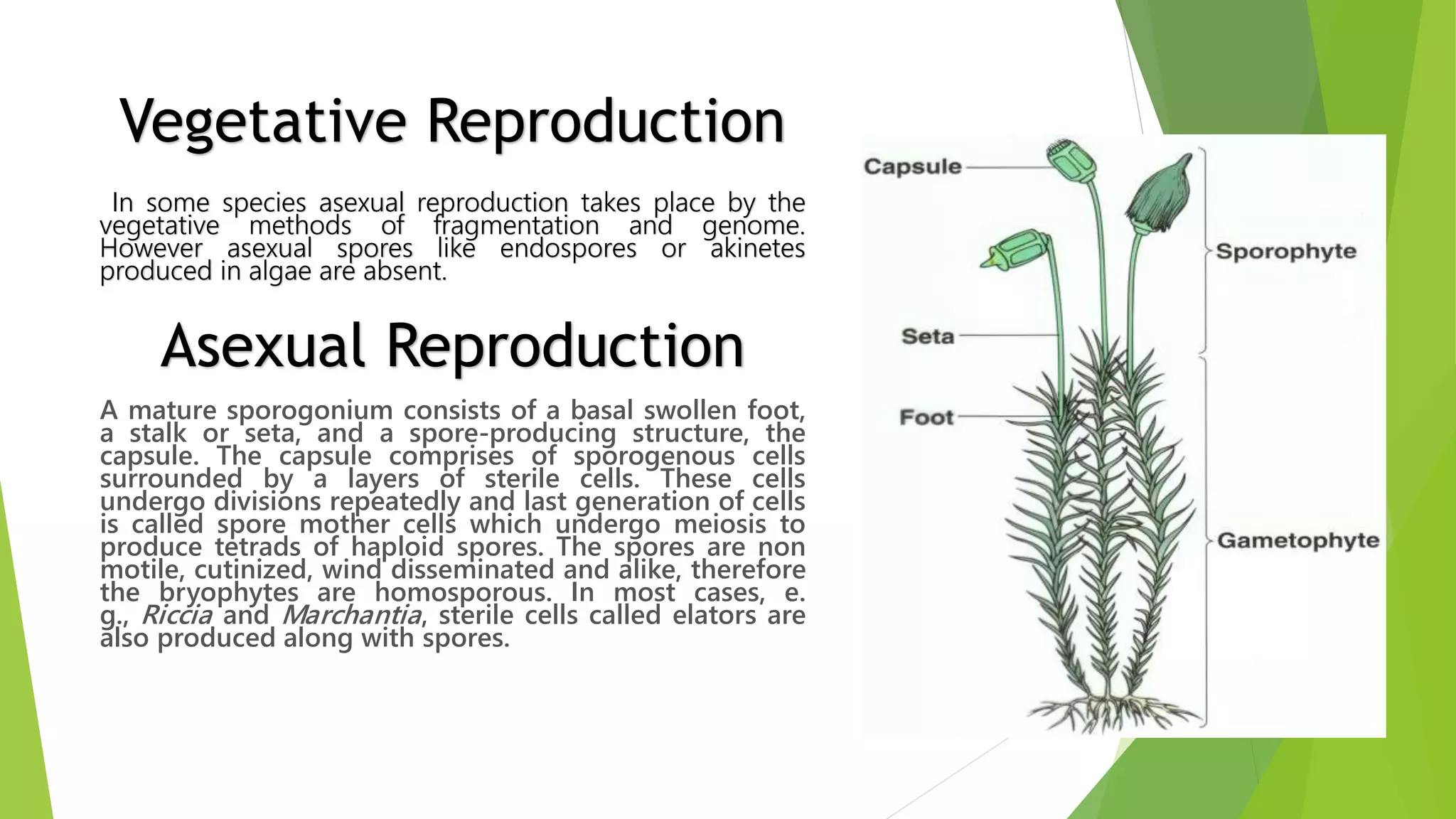
A mature sporogonium consists of a basal swollen foot,
a stalk or seta, and a spore-producing structure, the
capsule. The capsule comprises of sporogenous cells
surrounded by a layers of sterile cells. These cells
undergo divisions repeatedly and last generation of cells
is called spore mother cells which undergo meiosis to
produce tetrads of haploid spores. The spores are non
motile, cutinized, wind disseminated and alike, therefore
the bryophytes are homosporous. In most cases, e.
g., Riccia and Marchantia, sterile cells called elators are
also produced along with spores.
Asexual Reproduction
Vegetative Reproduction
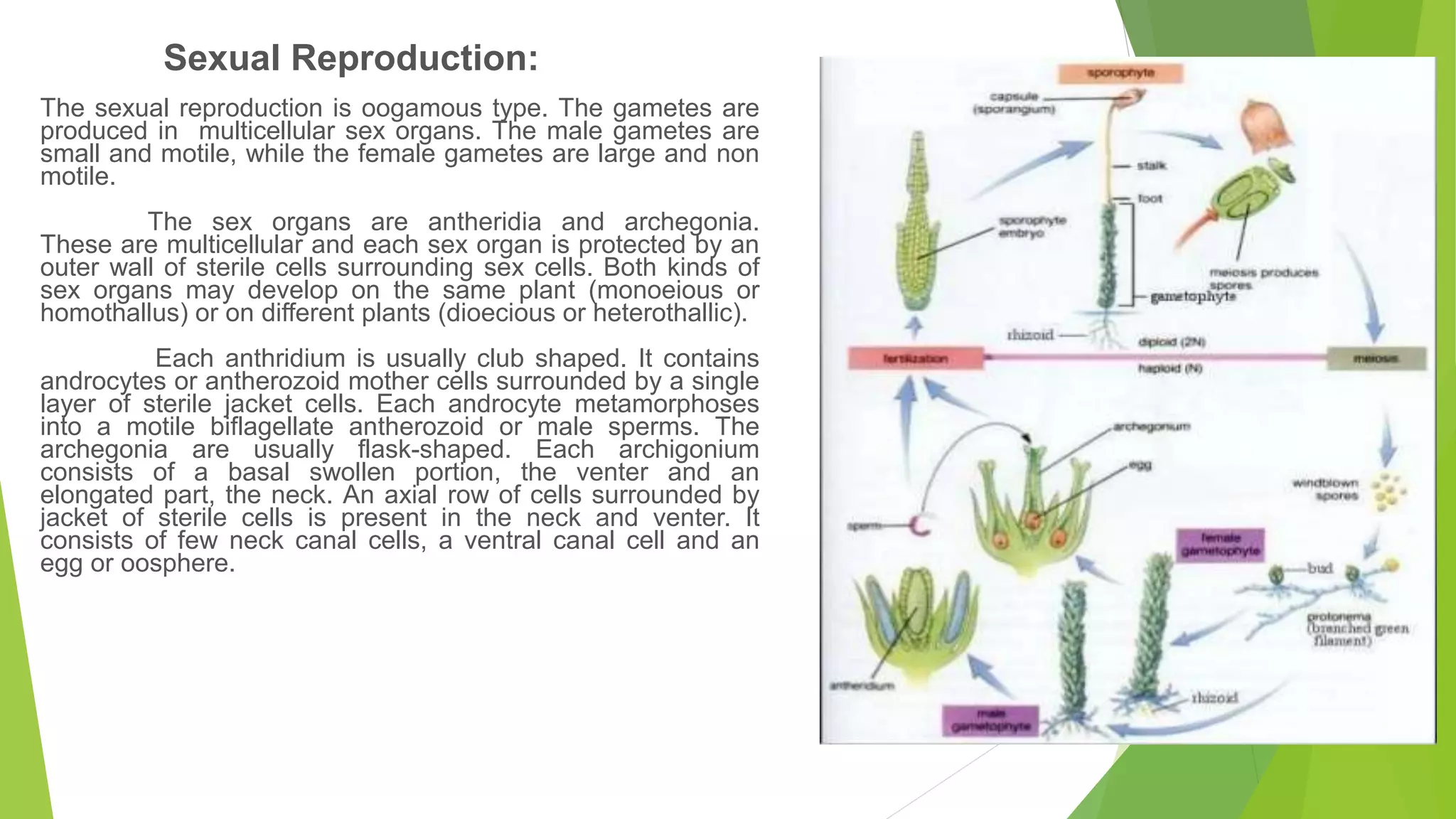
The sexual reproduction is oogamous type. The gametes are
produced in multicellular sex organs. The male gametes are
small and motile, while the female gametes are large and non
motile.
The sex organs are antheridia and archegonia.
These are multicellular and each sex organ is protected by an
outer wall of sterile cells surrounding sex cells. Both kinds of
sex organs may develop on the same plant (monoeious or
homothallus) or on different plants (dioecious or heterothallic).
Each anthridium is usually club shaped. It contains
androcytes or antherozoid mother cells surrounded by a single
layer of sterile jacket cells. Each androcyte metamorphoses
into a motile biflagellate antherozoid or male sperms. The
archegonia are usually flask-shaped. Each archigonium
consists of a basal swollen portion, the venter and an
elongated part, the neck. An axial row of cells surrounded by
jacket of sterile cells is present in the neck and venter. It
consists of few neck canal cells, a ventral canal cell and an
egg or oosphere.
Sexual Reproduction:
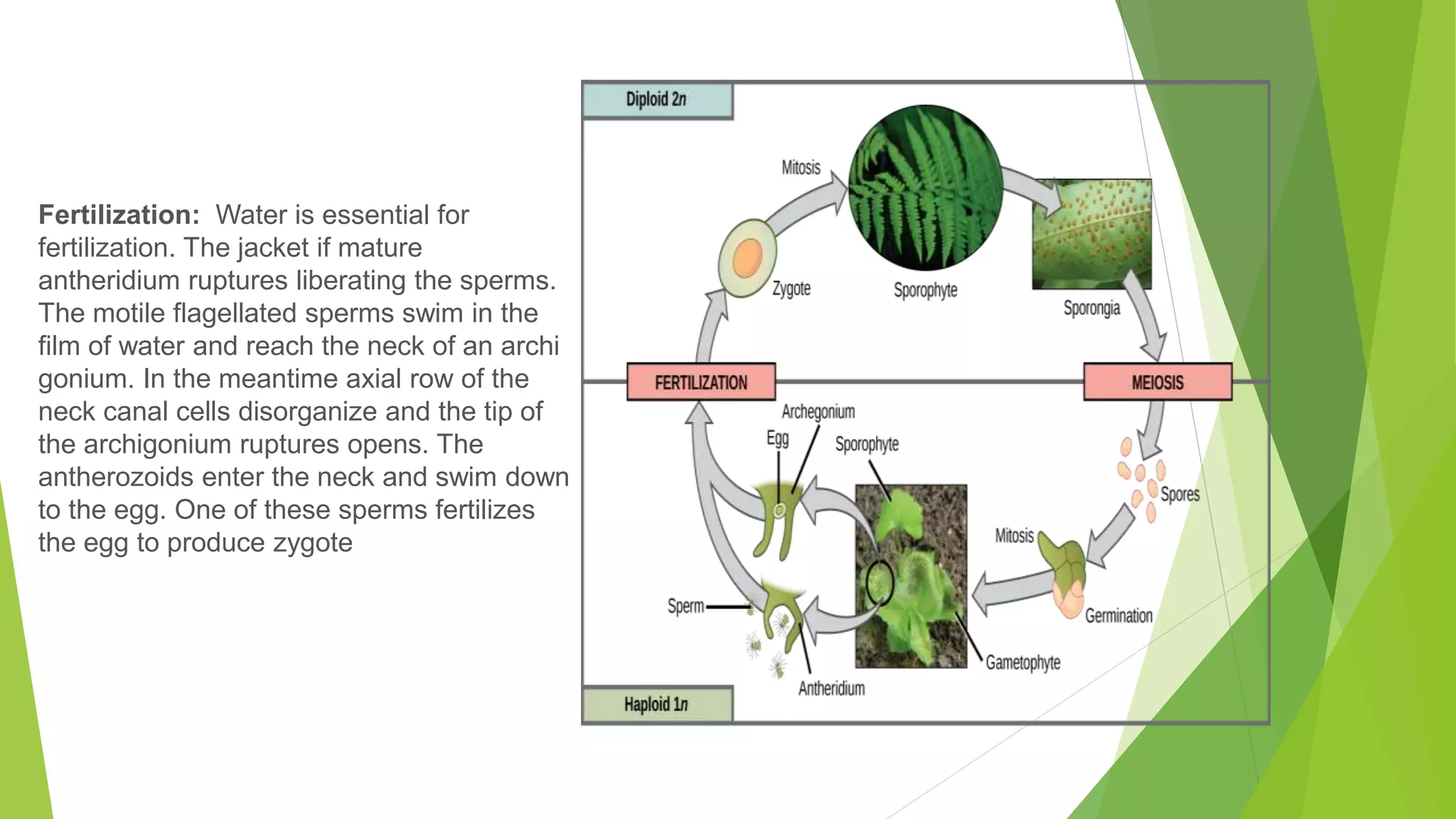
Fertilization: Water is essential for
fertilization. The jacket if mature
antheridium ruptures liberating the sperms.
The motile flagellated sperms swim in the
film of water and reach the neck of an archi
gonium. In the meantime axial row of the
neck canal cells disorganize and the tip of
the archigonium ruptures opens. The
antherozoids enter the neck and swim down
to the egg. One of these sperms fertilizes
the egg to produce zygote
Alternation of generation
In
Bryophytes
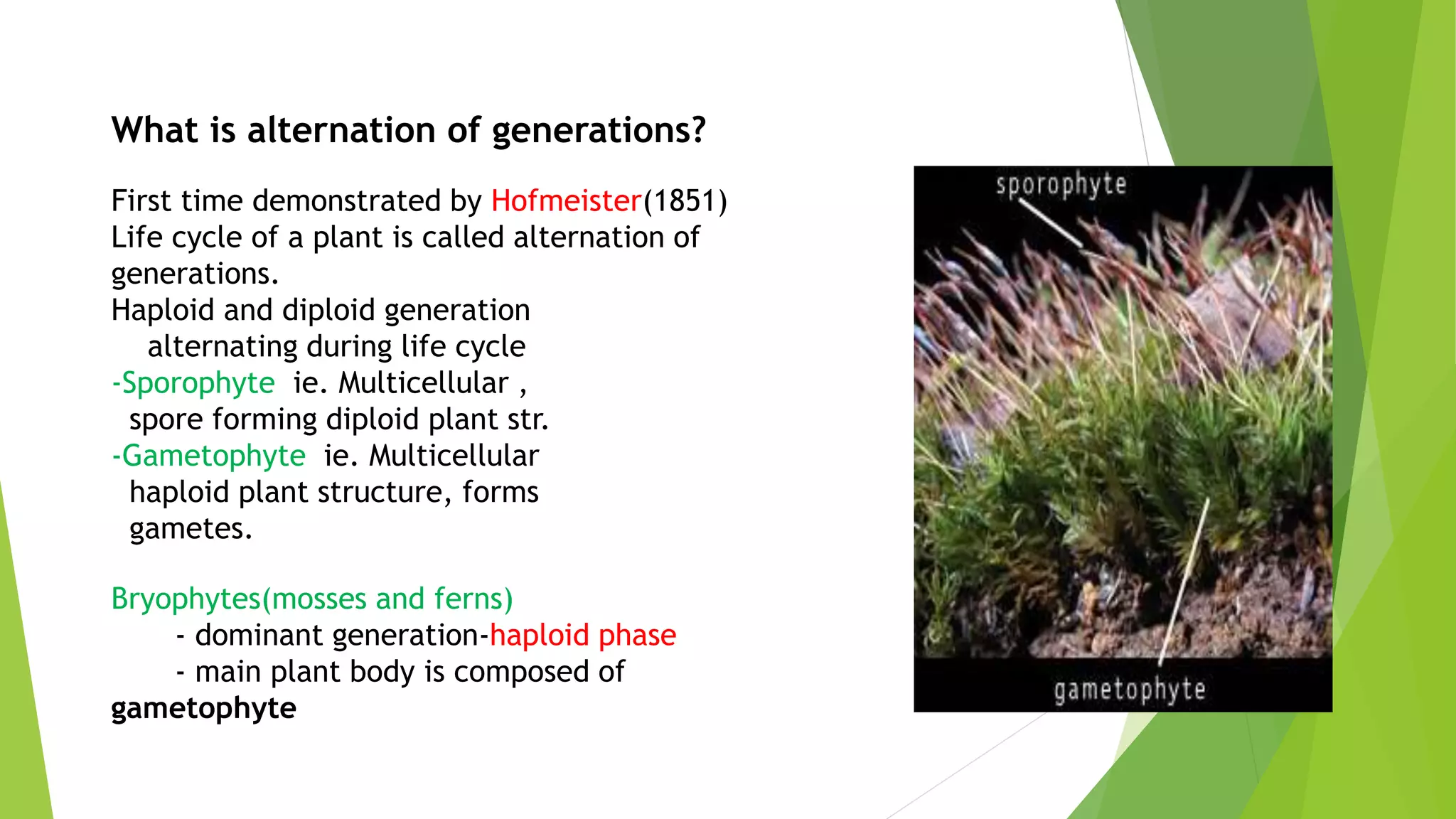
First time demonstrated by Hofmeister(1851)
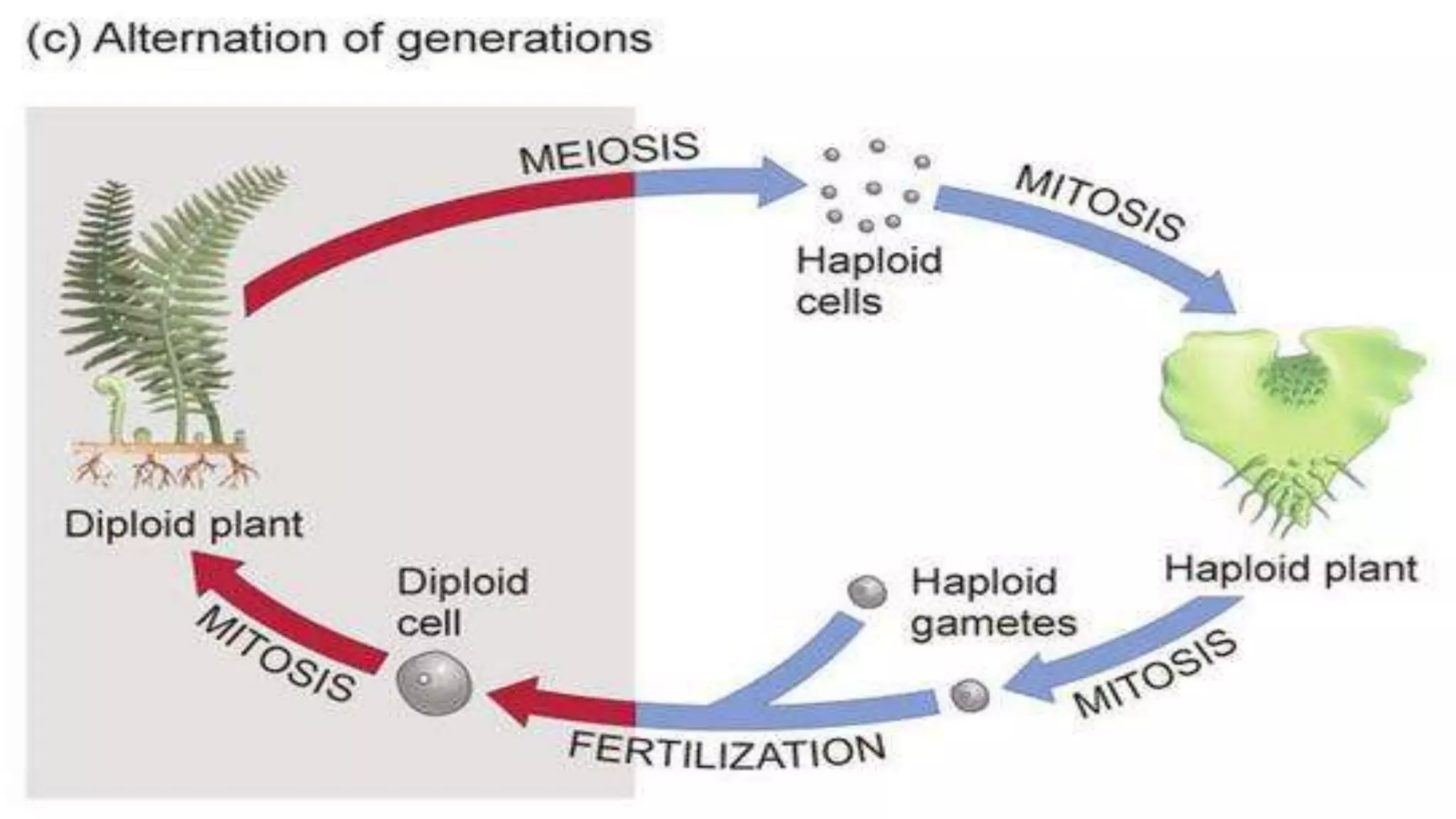
Life cycle of a plant is called alternation of
generations.
Haploid and diploid generation
alternating during life cycle
-Sporophyte ie. Multicellular ,
spore forming diploid plant str.
-Gametophyte ie. Multicellular
haploid plant structure, forms
gametes.
What is alternation of generations?
Bryophytes(mosses and ferns)
- dominant generation-haploid phase
- main plant body is composed of
gametophyte
Better chance for survival
Better adapted to environment
Newer varieties develop
Variations are produced during meiosis
Significance:
Alternation of generation in
Bryophytes
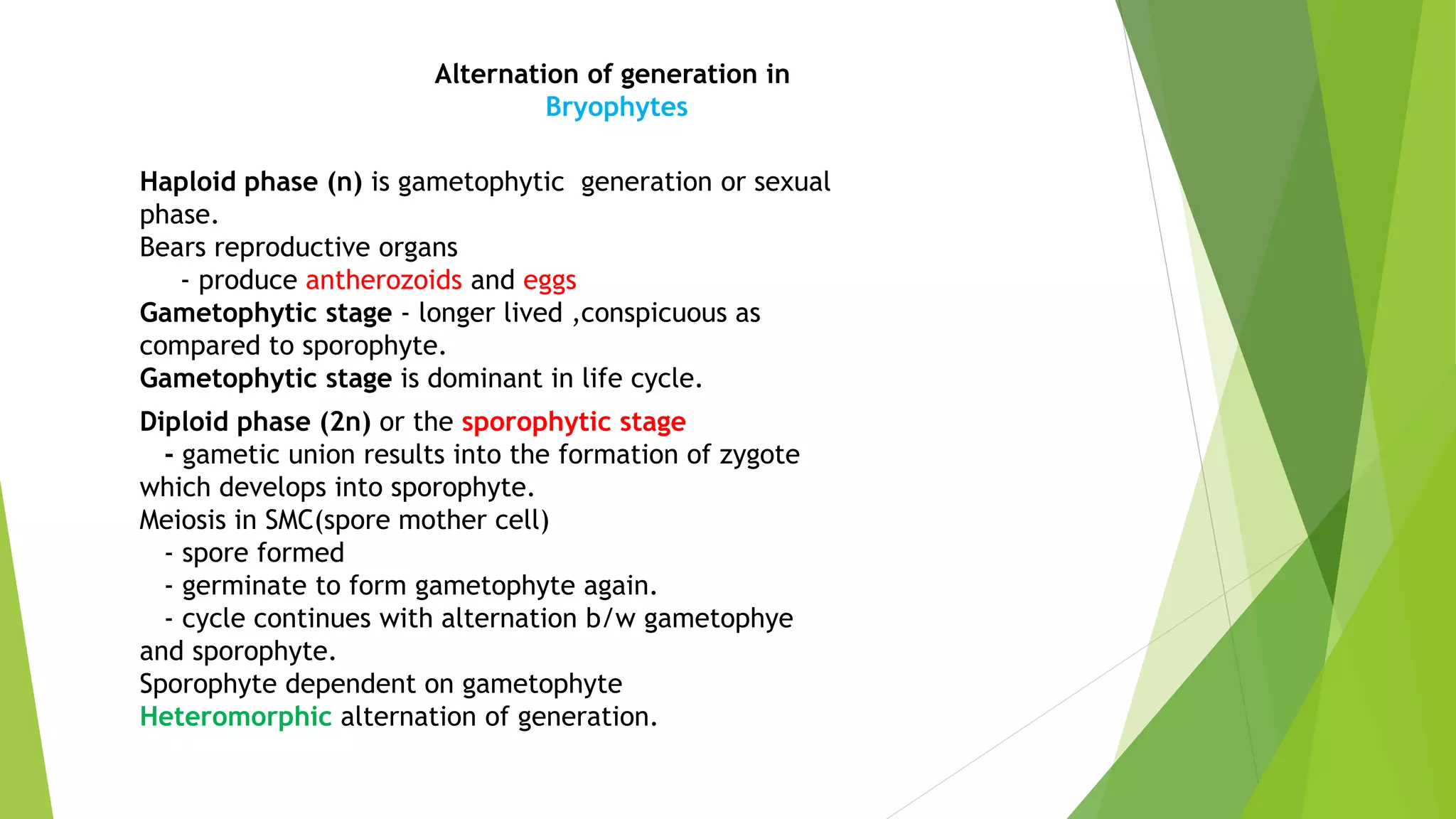
Haploid phase (n) is gametophytic generation or sexual
phase.
Bears reproductive organs
- produce antherozoids and eggs
Gametophytic stage - longer lived ,conspicuous as
compared to sporophyte.
Gametophytic stage is dominant in life cycle.
Diploid phase (2n) or the sporophytic stage
- gametic union results into the formation of zygote
which develops into sporophyte.
Meiosis in SMC(spore mother cell)
- spore formed
- germinate to form gametophyte again.
- cycle continues with alternation b/w gametophye
and sporophyte.
Sporophyte dependent on gametophyte
Heteromorphic alternation of generation.
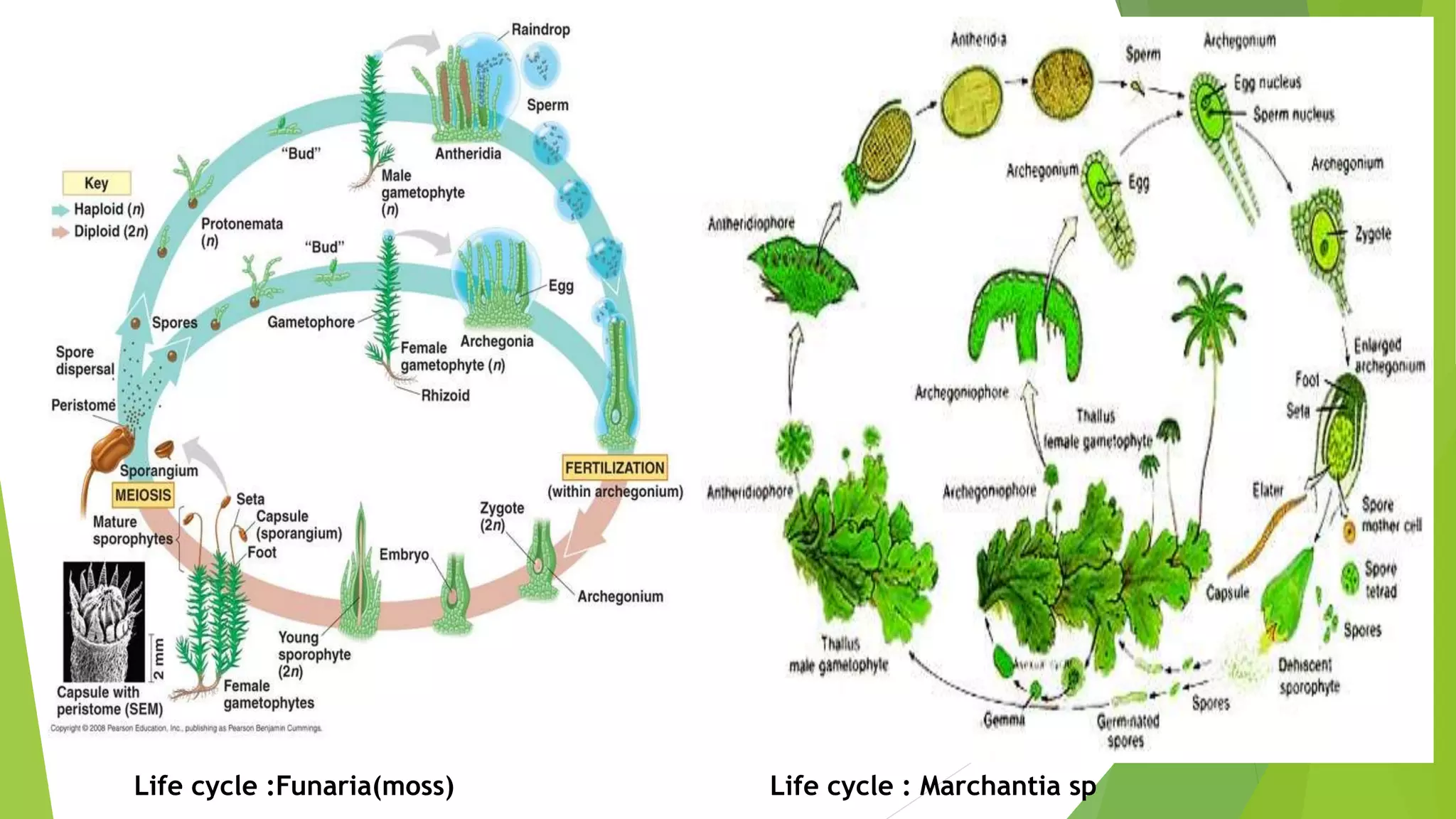
Life cycle :Funaria(moss) Life cycle : Marchantia sp
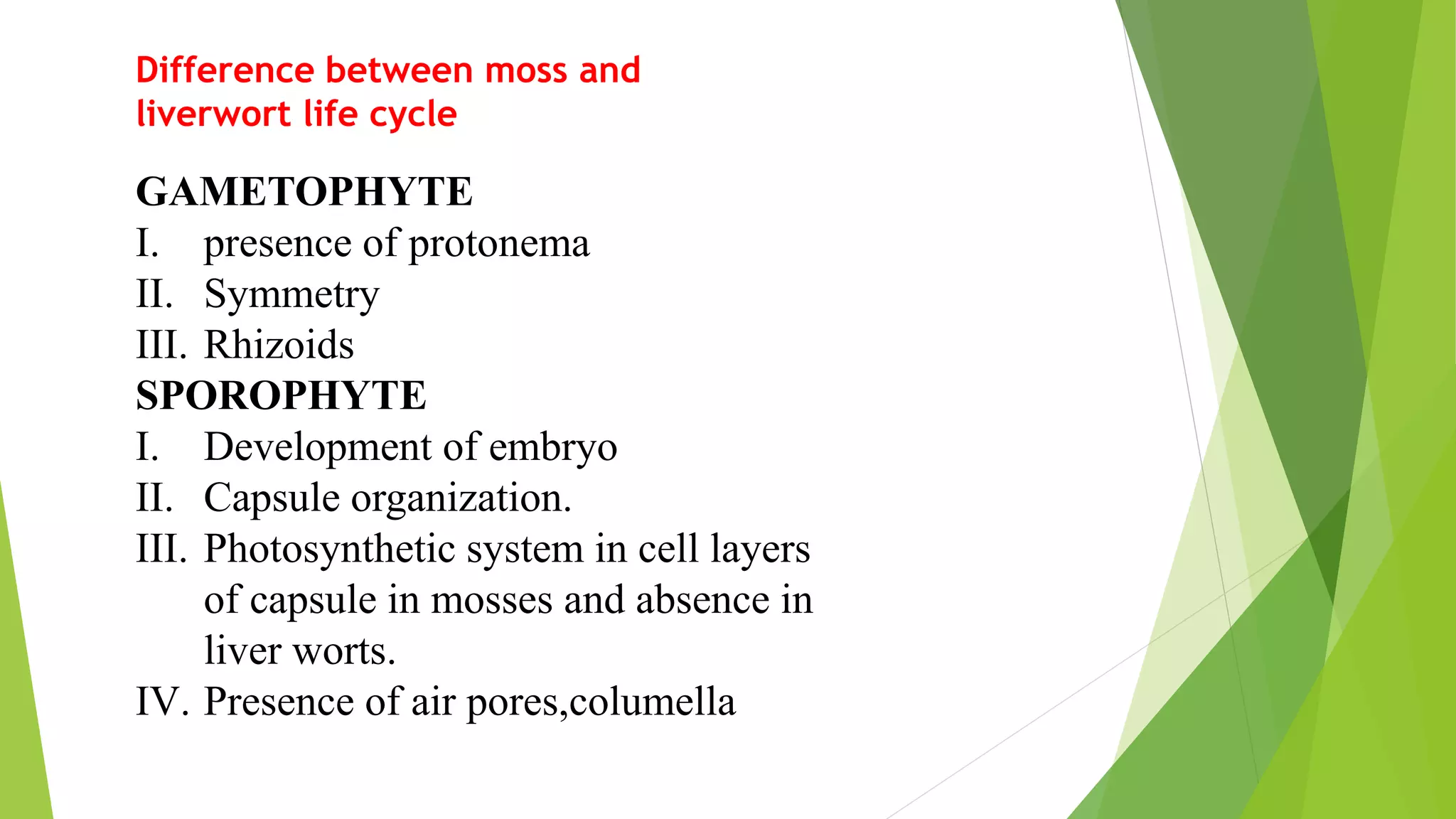
Difference between moss and
liverwort life cycle
GAMETOPHYTE
I. presence of protonema
II. Symmetry
III. Rhizoids
SPOROPHYTE
I. Development of embryo
II. Capsule organization.
III. Photosynthetic system in cell layers
of capsule in mosses and absence in
liver worts.
IV. Presence of air pores,columella
Affinities of Bryophytes with Algae
The origin of bryophytes from algae is supported from following facts:
1=There is a close resemblance between CHLOROPHYLLS and XANTHOPHYLLS of algae
to that of bryophytes.
2=The presence of motile sperms in bryophytes supports algal ancestry.
3=The development of green, filamentous, alga-like PROTONEMA in the life cycle of
some bryophytes.
Importance of
Bryophytes
Importance's of
bryophytes
Ecological
importance'
s
Economical
importance's
Economical Importance's of
bryophytes
Source of fuel Horticulture,
Preservative
agent
Household Uses
House
Construction
pharmaceutical
industry
Moss industry
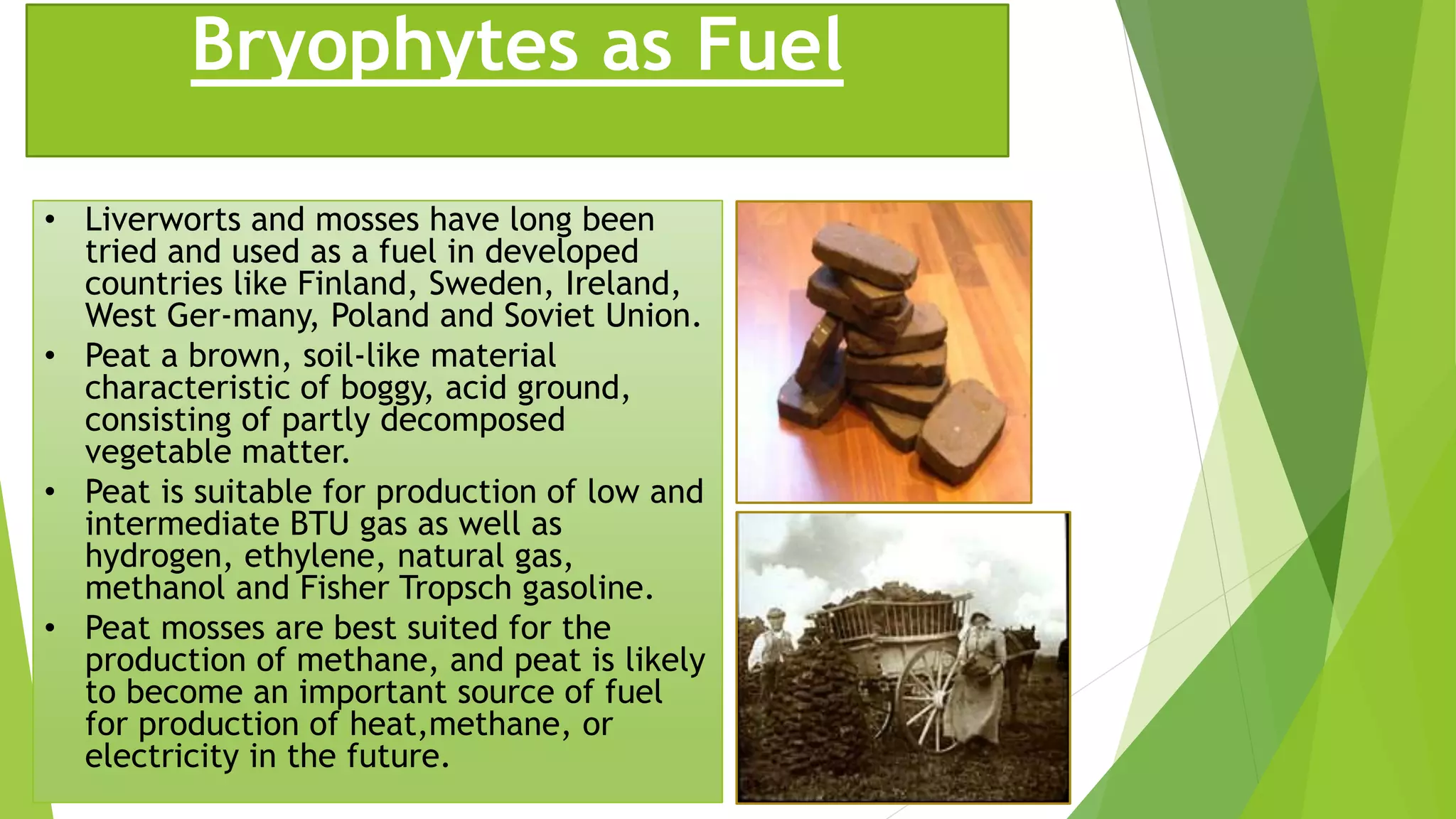
Bryophytes as Fuel
• Liverworts and mosses have long been
tried and used as a fuel in developed
countries like Finland, Sweden, Ireland,
West Ger-many, Poland and Soviet Union.
• Peat a brown, soil-like material
characteristic of boggy, acid ground,
consisting of partly decomposed
vegetable matter.
• Peat is suitable for production of low and
intermediate BTU gas as well as
hydrogen, ethylene, natural gas,
methanol and Fisher Tropsch gasoline.
• Peat mosses are best suited for the
production of methane, and peat is likely
to become an important source of fuel
for production of heat,methane, or
electricity in the future.
Horticultural Uses
• There is a long tradition
of use of bryophytes in
horticulture as soil
additives, because of
their high water holding
capacity and to air. Peat
is an important soil
conditioner and is
commonly used for
agricultural and
horticultural purposes
around the world.
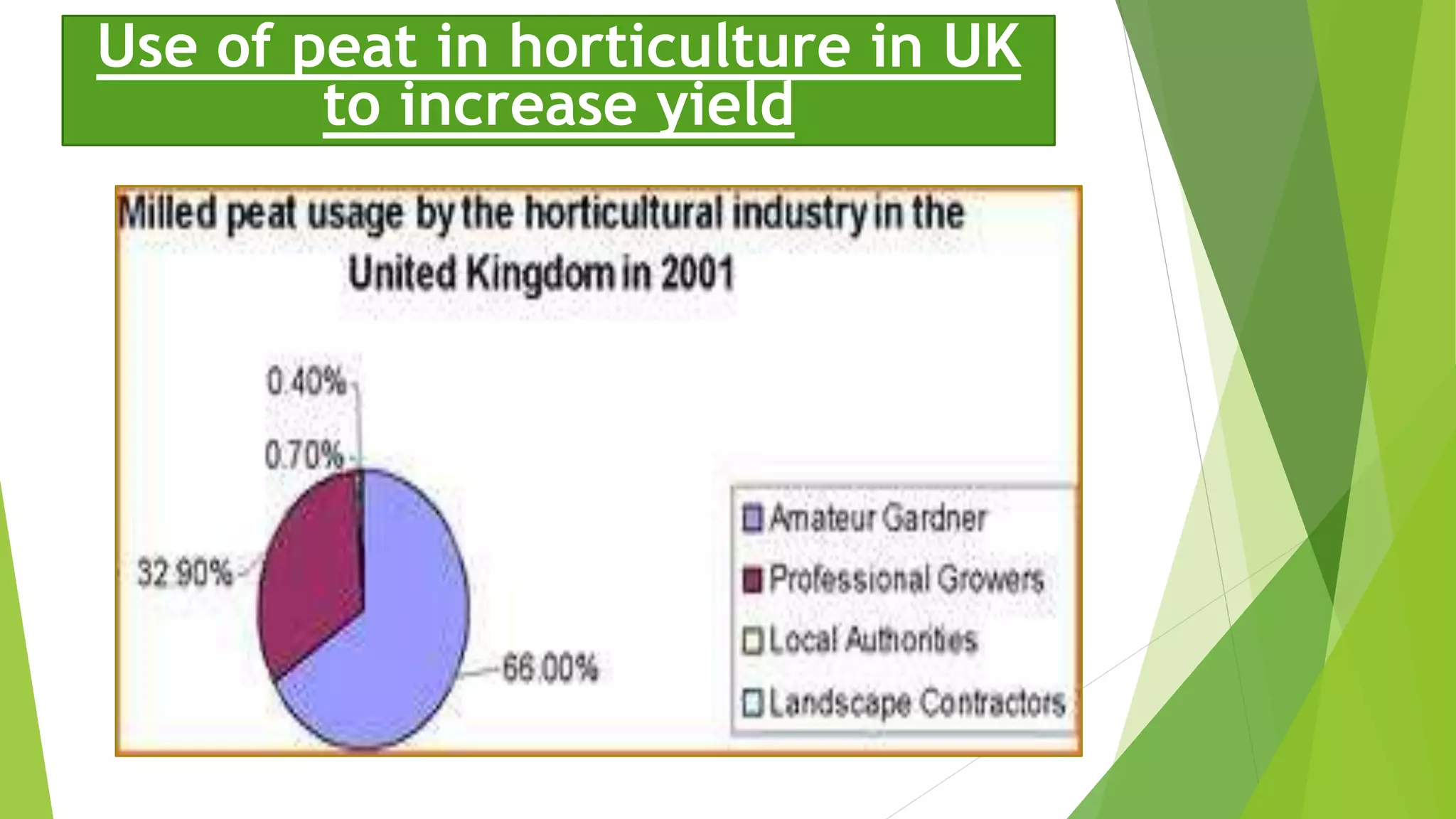
Use of peat in horticulture in UK
to increase yield
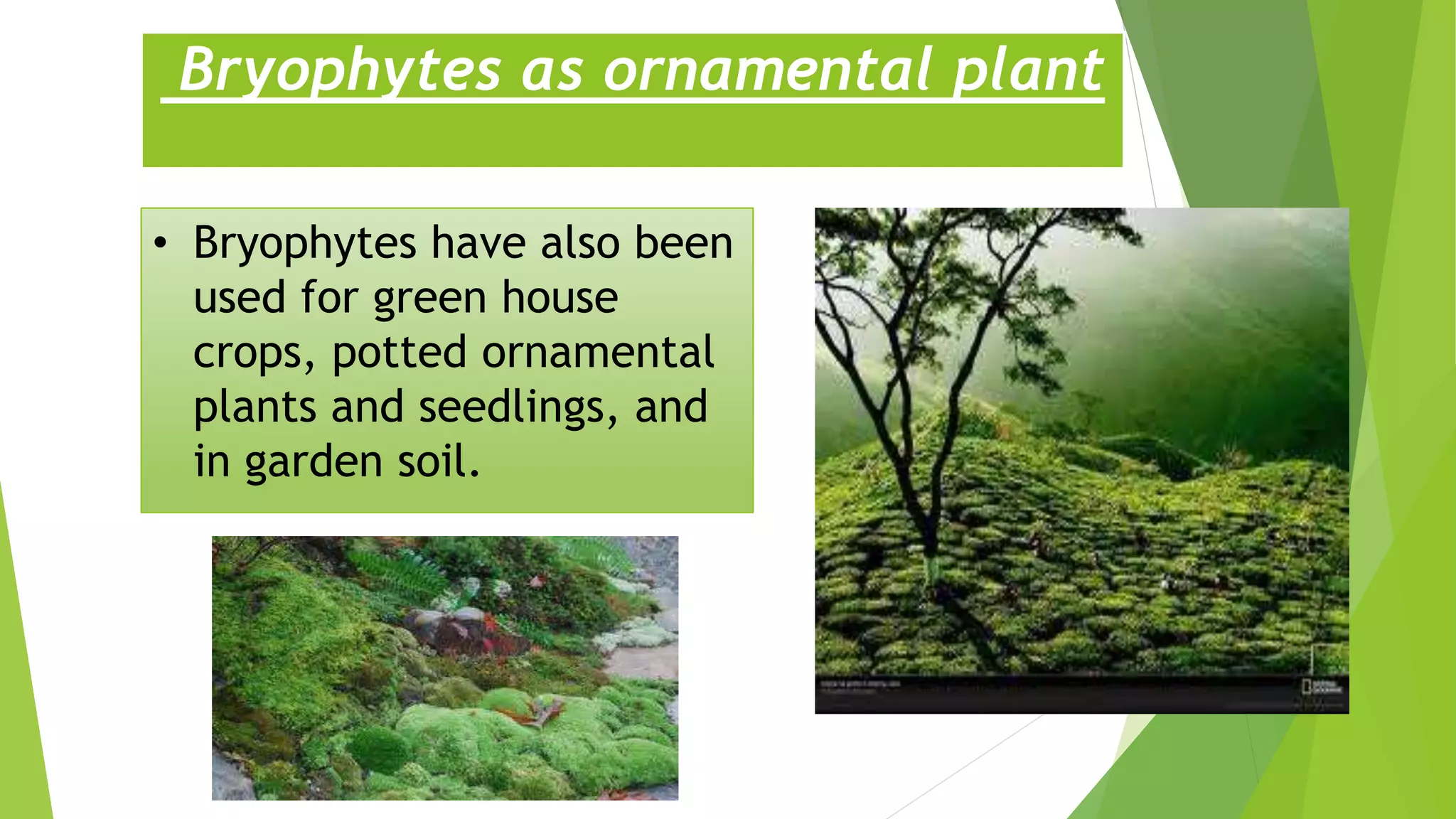
Bryophytes as ornamental plant
• Bryophytes have also been
used for green house
crops, potted ornamental
plants and seedlings, and
in garden soil.
As preservative agent
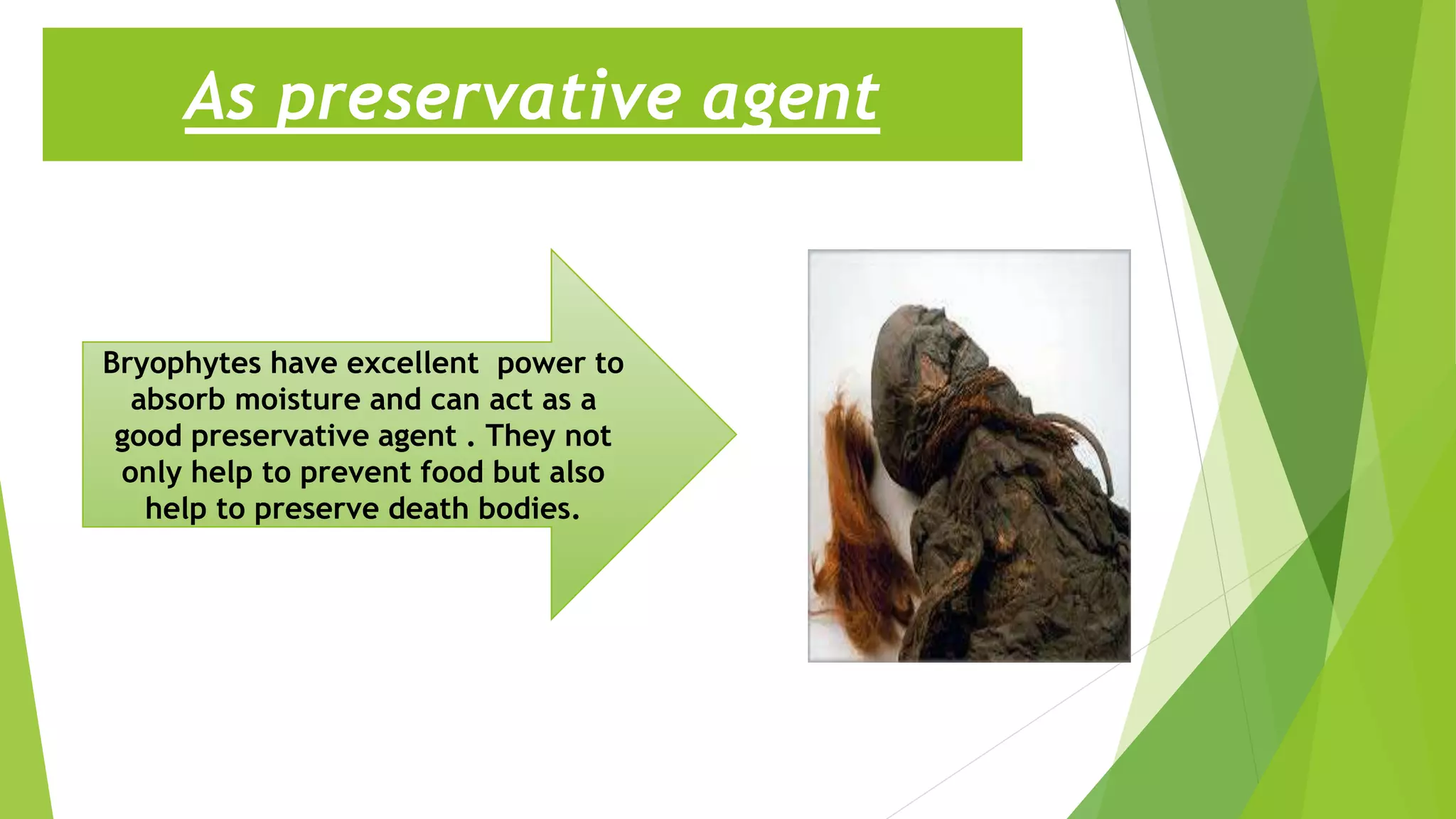
Bryophytes have excellent power to
absorb moisture and can act as a
good preservative agent . They not
only help to prevent food but also
help to preserve death bodies.
House Construction
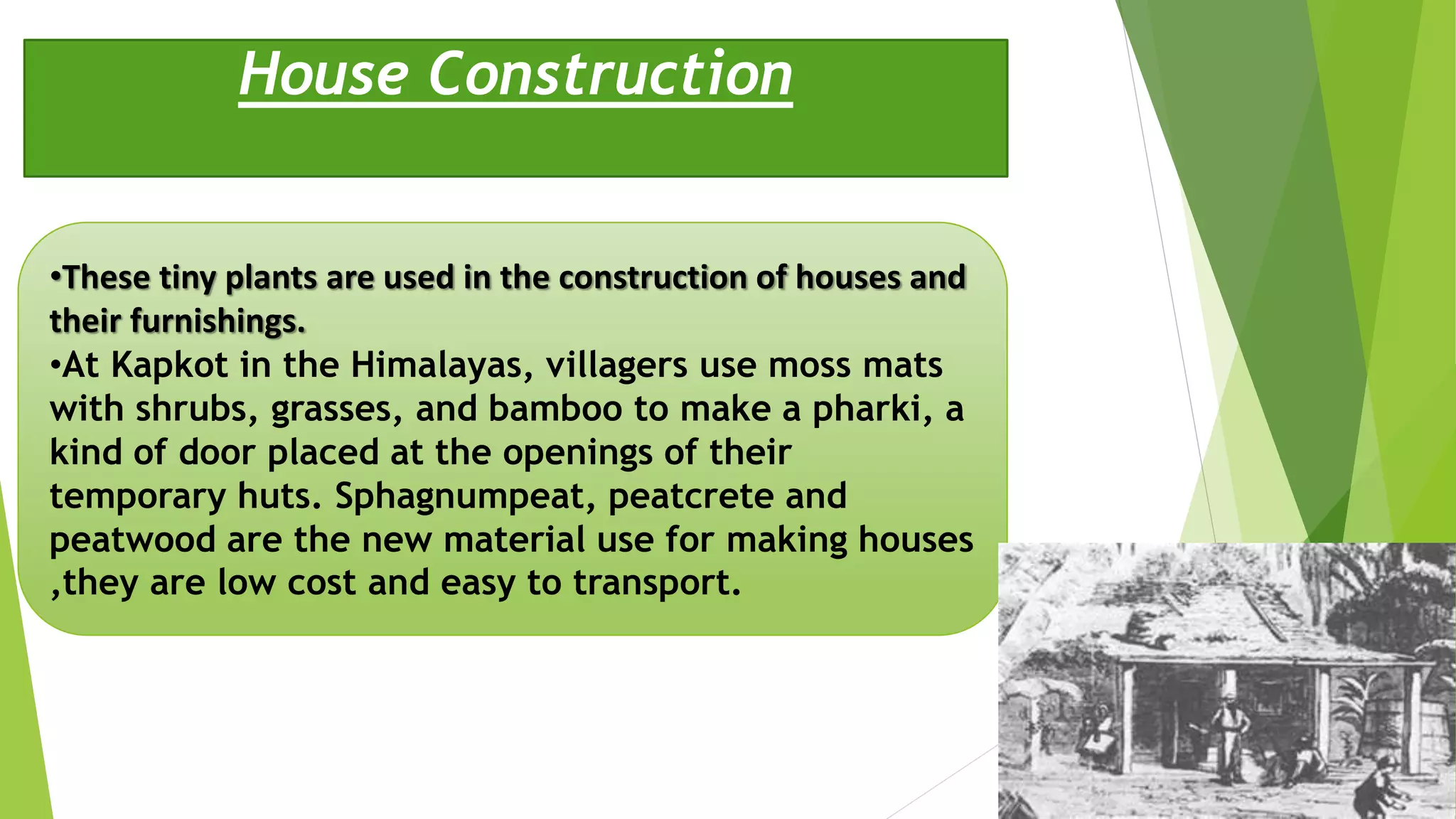
•These tiny plants are used in the construction of houses and
their furnishings.
•At Kapkot in the Himalayas, villagers use moss mats
with shrubs, grasses, and bamboo to make a pharki, a
kind of door placed at the openings of their
temporary huts. Sphagnumpeat, peatcrete and
peatwood are the new material use for making houses
,they are low cost and easy to transport.
Fibre industries
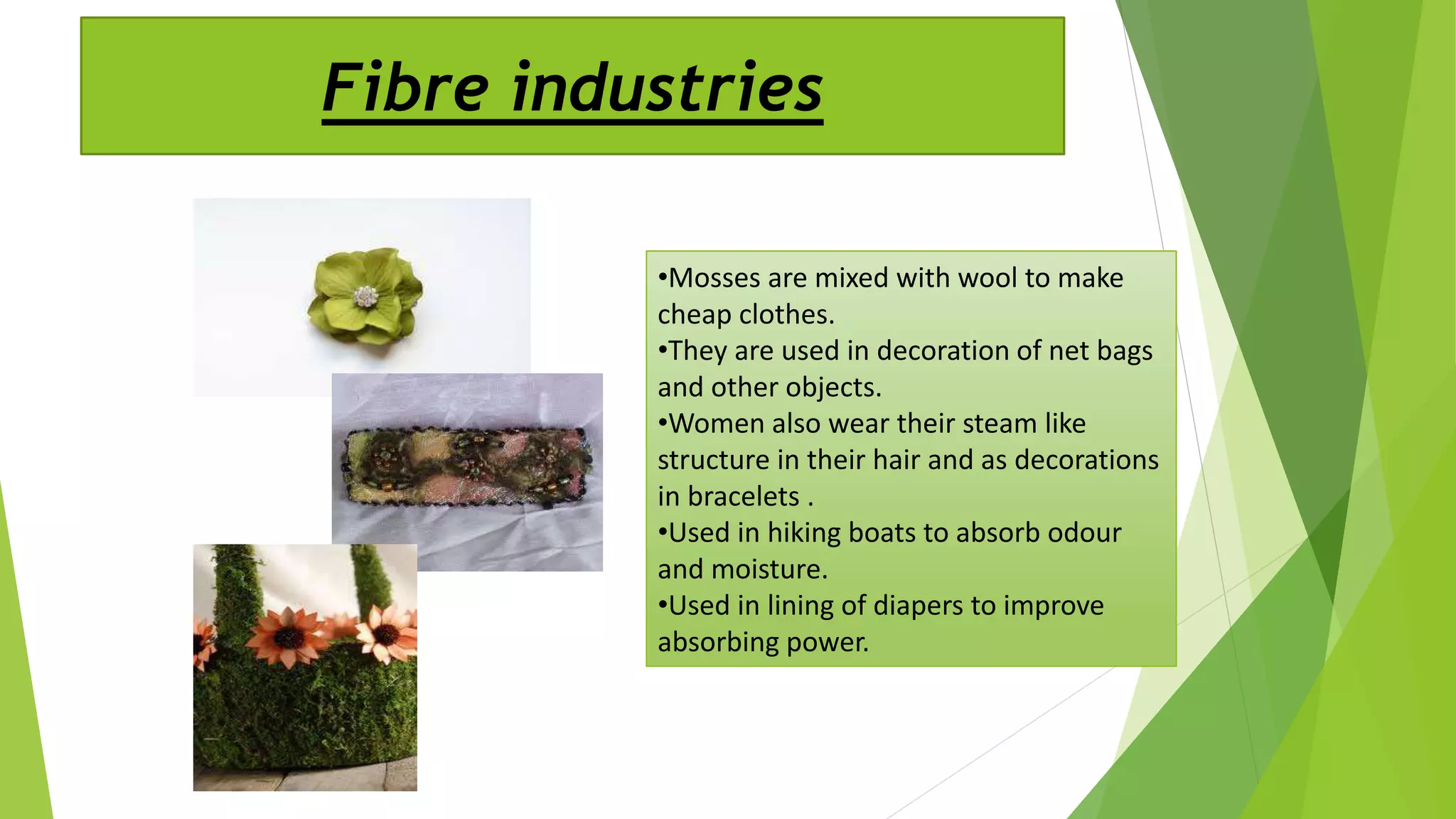
•Mosses are mixed with wool to make
cheap clothes.
•They are used in decoration of net bags
and other objects.
•Women also wear their steam like
structure in their hair and as decorations
in bracelets .
•Used in hiking boats to absorb odour
and moisture.
•Used in lining of diapers to improve
absorbing power.
Skin
treatment
Sphagnol’chilblains,
scabies, acne and
other forms of skin
diseases
Help to cure
ringworms.
Ash of moss is mixed with
honey and fat to treat cuts,
burns and wounds
Use for curing for
allaying arising
from insect bites.
Medicinal Uses
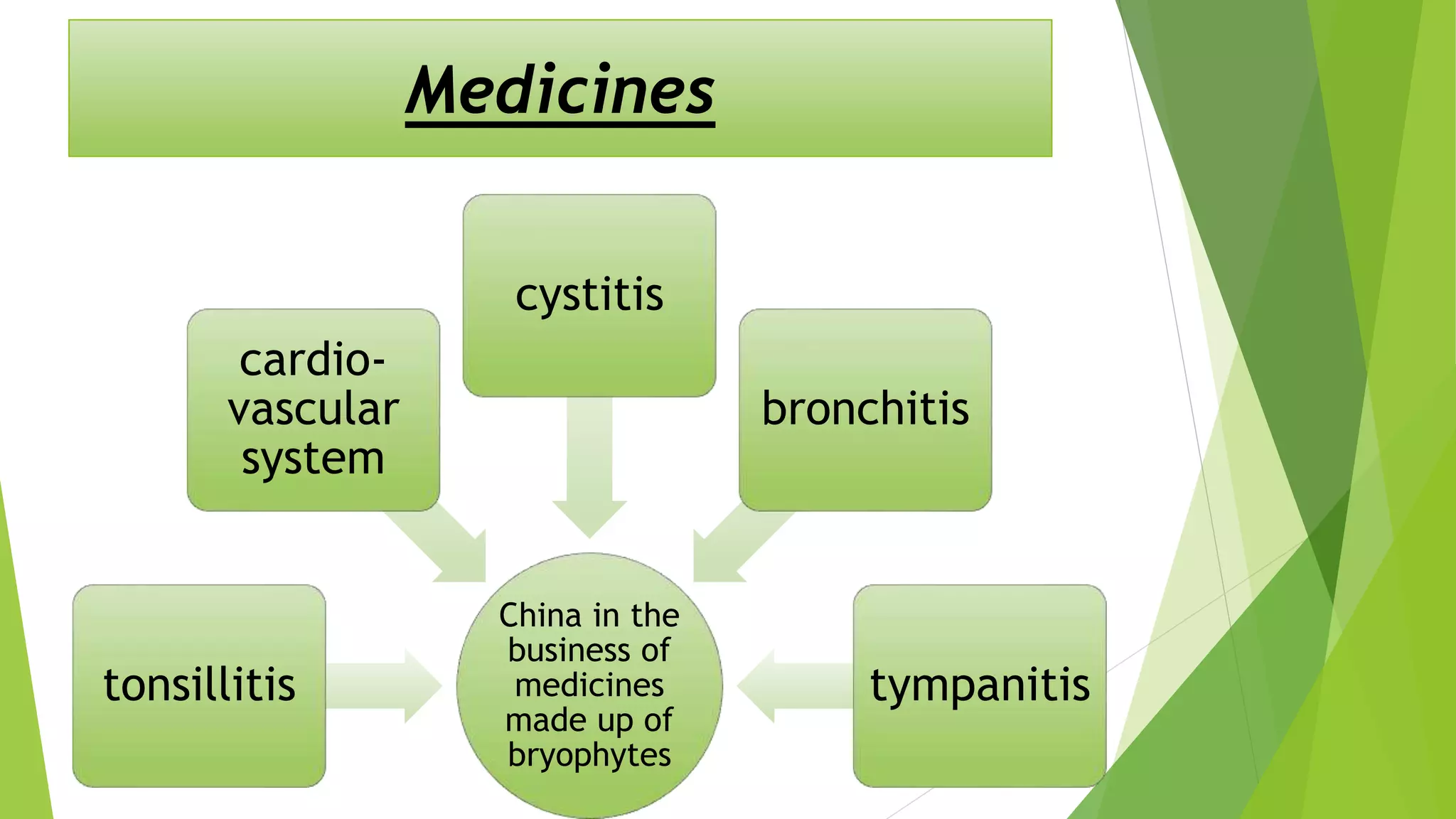
Medicines
China in the
business of
medicines
made up of
bryophytes
tonsillitis
cardio-
vascular
system
cystitis
bronchitis
tympanitis
Ecological Importance
of Bryophytes
Role of Bryophytes in
Different Ways
PEAT
FORMATION
SEED BEDS
FOOD AND
SHELTER
POLLUTION SOIL
CONSERVATION
INDICATOR OF
soil PH
INDICATOR OF
ACID RAIN
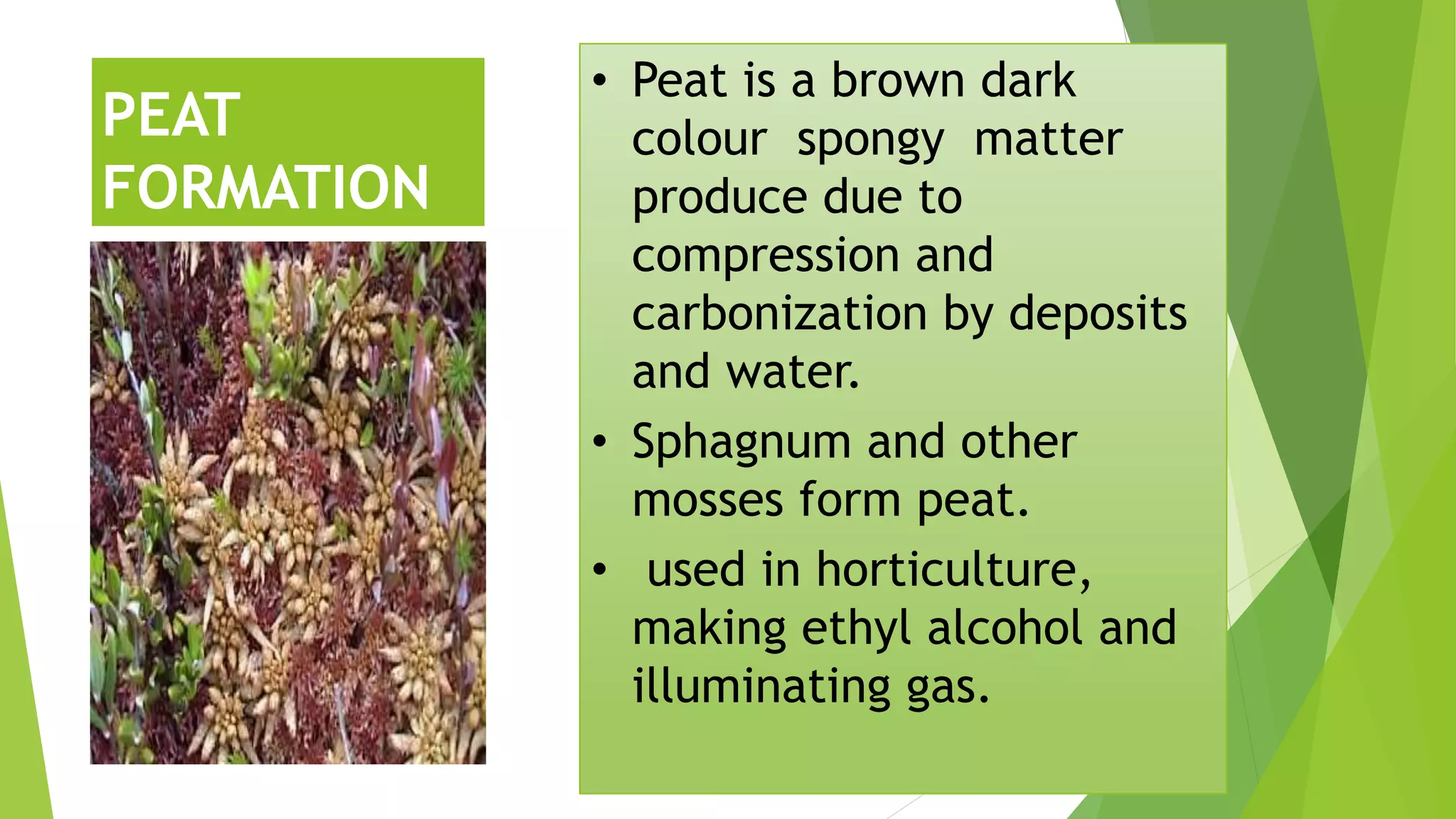
PEAT
FORMATION
• Peat is a brown dark
colour spongy matter
produce due to
compression and
carbonization by deposits
and water.
• Sphagnum and other
mosses form peat.
• used in horticulture,
making ethyl alcohol and
illuminating gas.
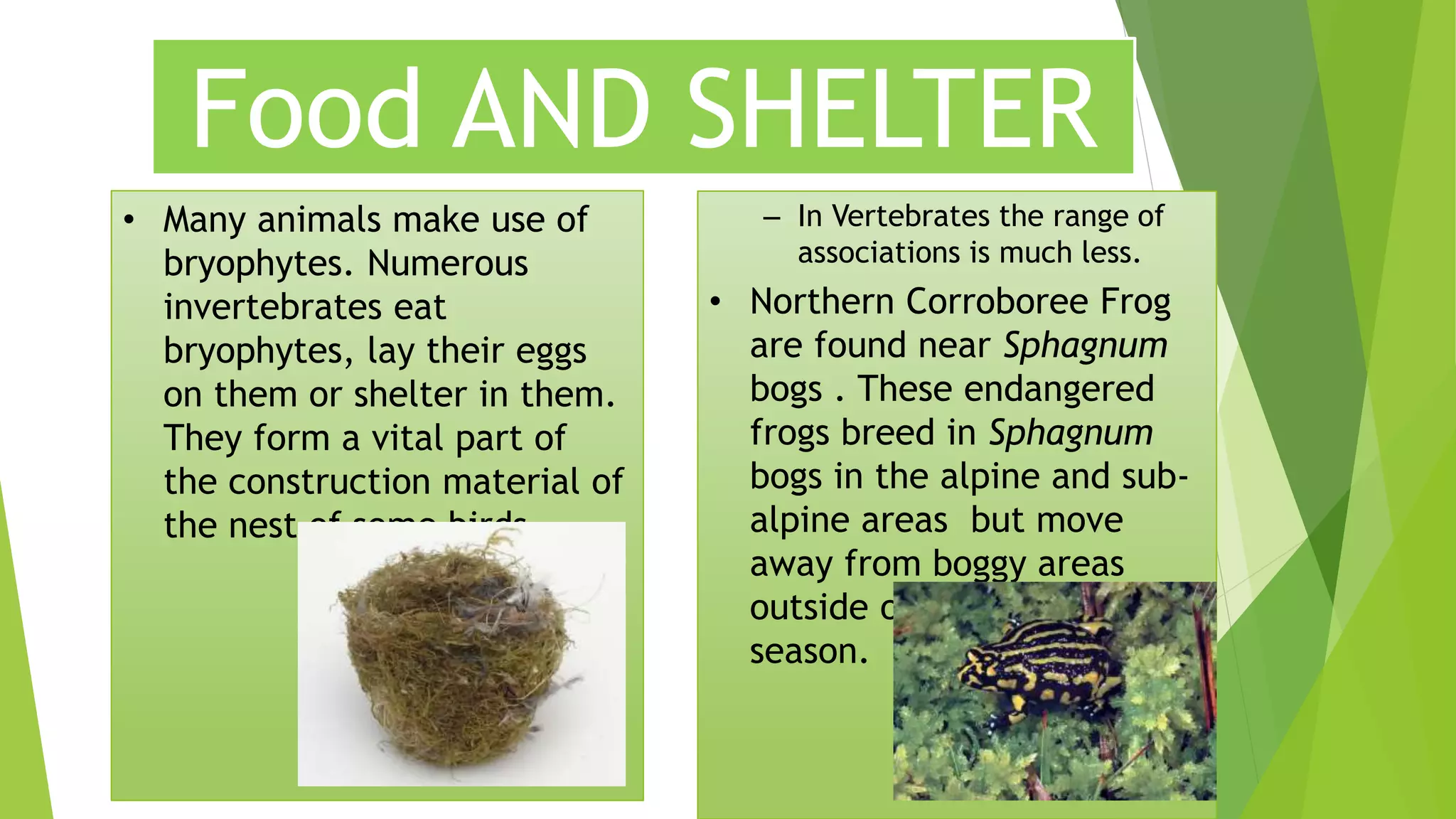
Food AND SHELTER
• Many animals make use of
bryophytes. Numerous
invertebrates eat
bryophytes, lay their eggs
on them or shelter in them.
They form a vital part of
the construction material of
the nest of some birds
– In Vertebrates the range of
associations is much less.
• Northern Corroboree Frog
are found near Sphagnum
bogs . These endangered
frogs breed in Sphagnum
bogs in the alpine and sub-
alpine areas but move
away from boggy areas
outside of the breeding
season.
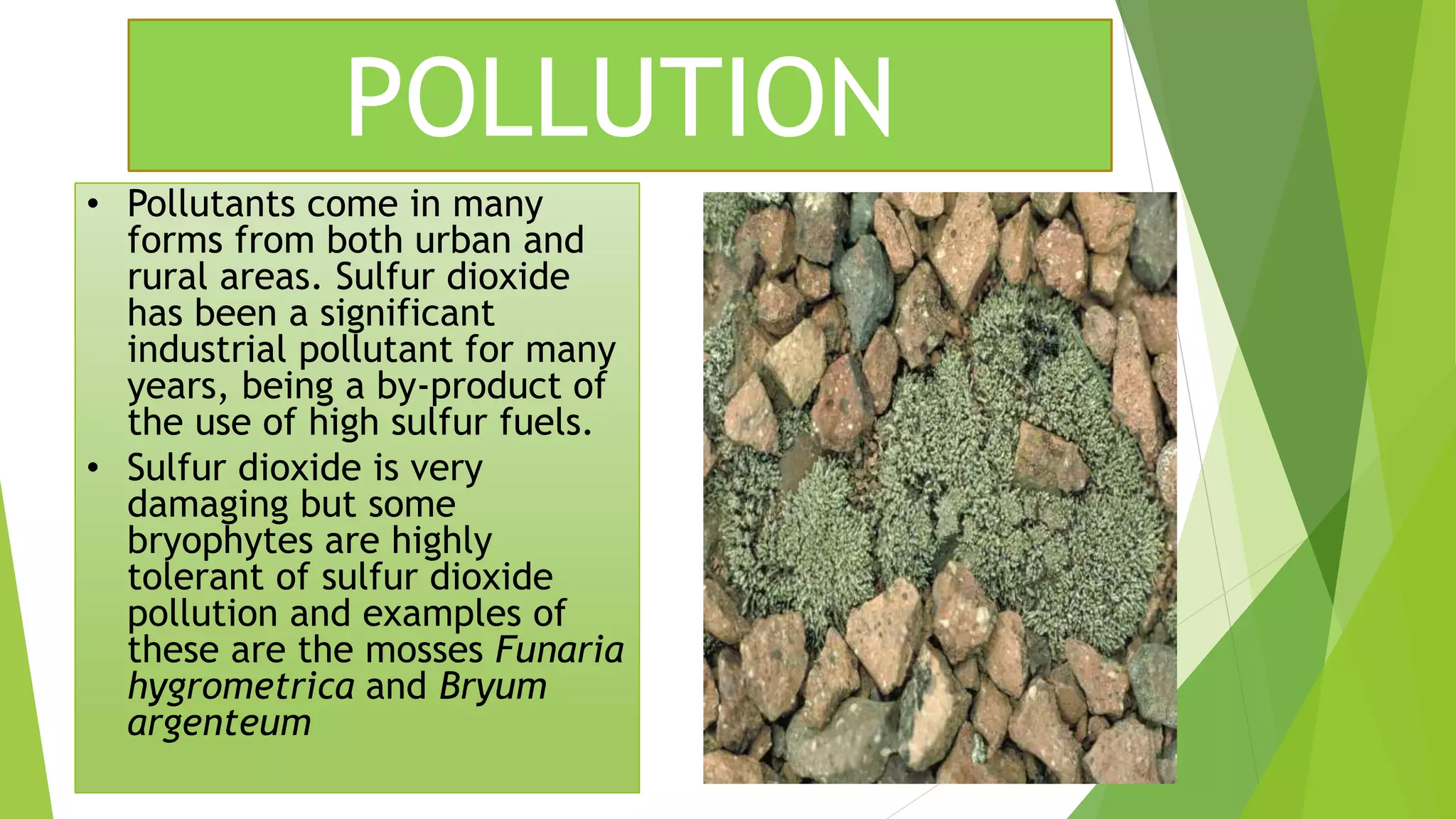
• Pollutants come in many
forms from both urban and
rural areas. Sulfur dioxide
has been a significant
industrial pollutant for many
years, being a by-product of
the use of high sulfur fuels.
• Sulfur dioxide is very
damaging but some
bryophytes are highly
tolerant of sulfur dioxide
pollution and examples of
these are the mosses Funaria
hygrometrica and Bryum
argenteum
POLLUTION
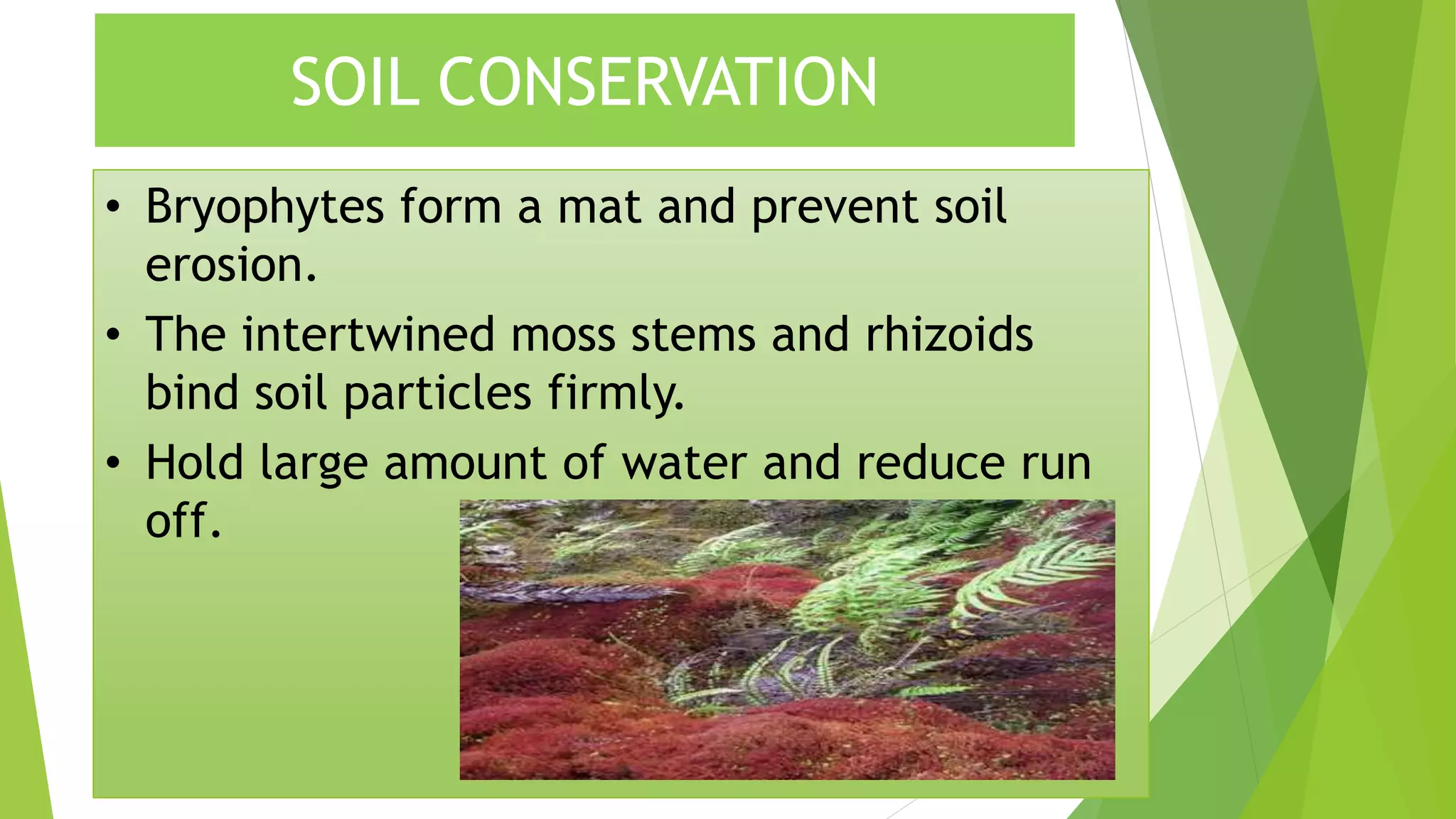
• Bryophytes form a mat and prevent soil
erosion.
• The intertwined moss stems and rhizoids
bind soil particles firmly.
• Hold large amount of water and reduce run
off.
SOIL CONSERVATION
Indicator of soil pH
• Liverworts and mosses are good indicators of soil
ph.
• Some bryophytes can grow in narrow and specific
range of pH so therefore their presence can be
used as an indicator of soil ph.
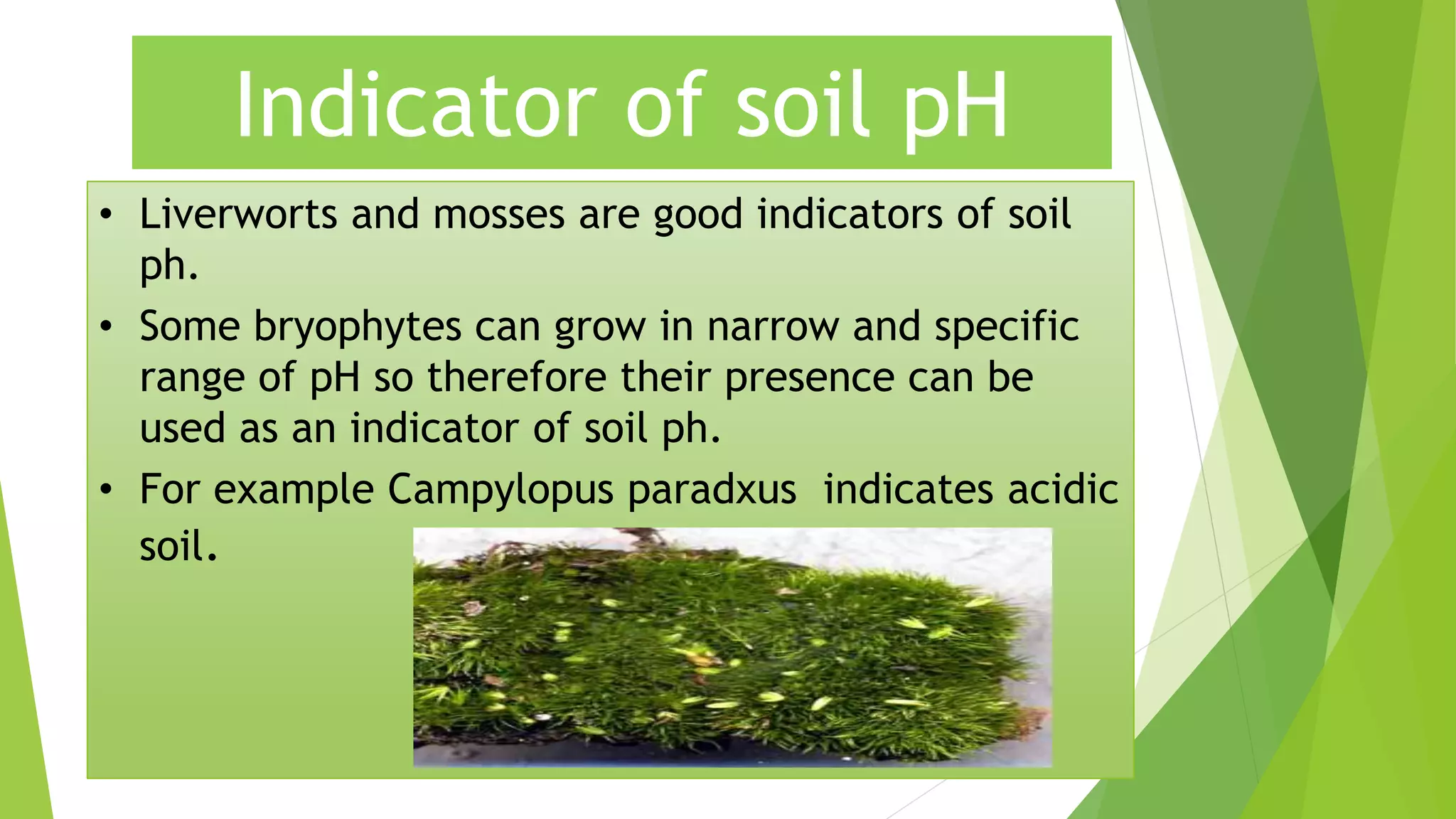
• For example Campylopus paradxus indicates acidic
soil.
Indicator of acid rain
• Mosses are good indicators of acid rain
because they lack a protective epidermis
and cuticle hence are most susceptible
than vascular plants.
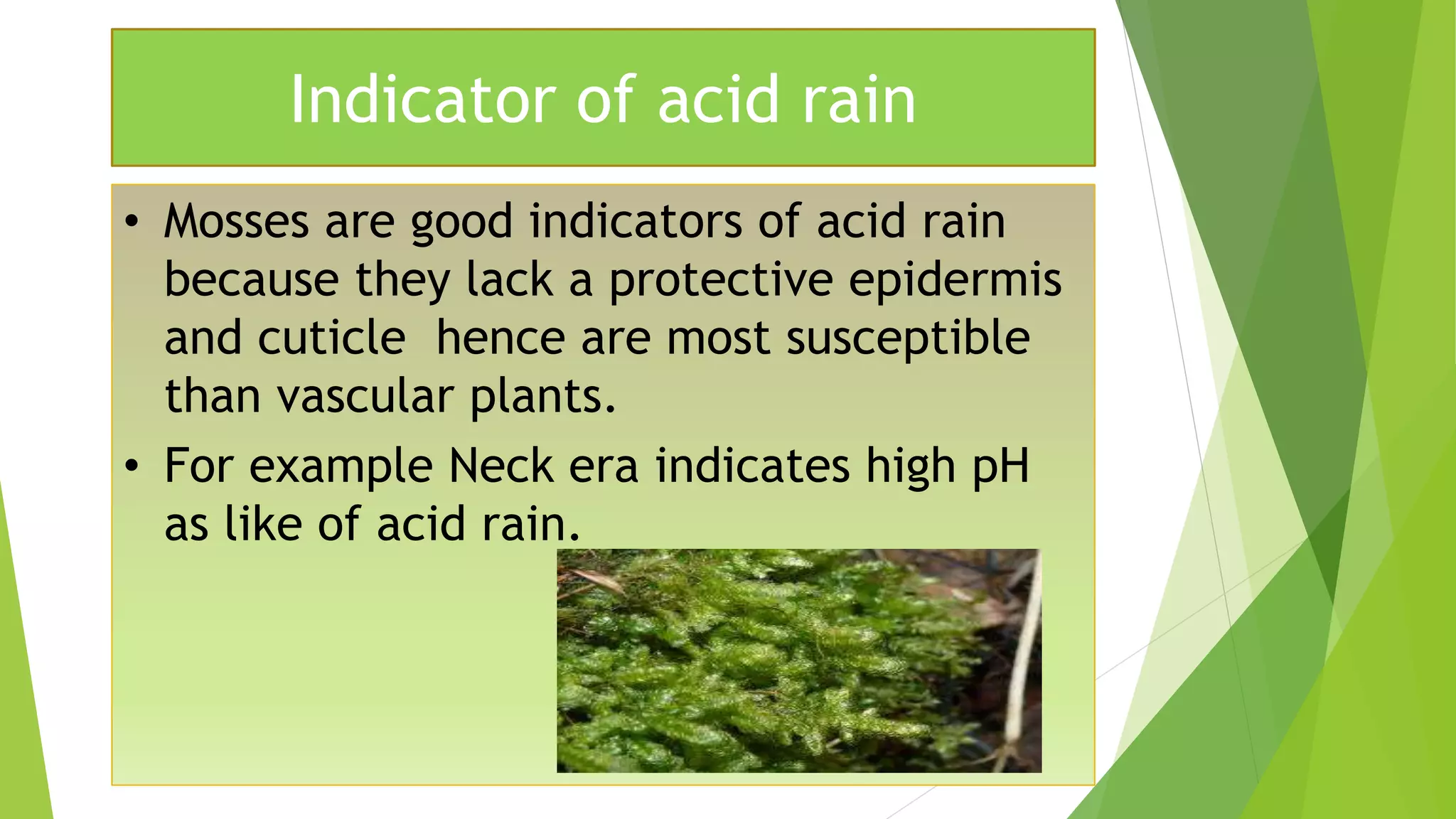
• For example Neck era indicates high pH
as like of acid rain.
Bryophytes
Bryophytes

Bryophytes

  • 3.
    Introduction of Bryophytesand their Classification
  • 4.
    Etymology: Bryophyte is derivedfrom a Greek word ‘BRYON’ means Mosses and ‘Phyca’ means Plant.
  • 5.
    Major Characteristics: Oldest landplants on earth and have been around for 400 million years or more  Bryophytes do not have true vascular tissues for support and transport of water and nutrients.
  • 6.
     They lackleaves.  However, they have leaf-like scales that contains chloroplasts in which photosynthesis occurs.
  • 7.
    They lack trueroots. They anchor themselves in the soil by root-like structures called rhizoids. Rhizoids are relatively simple, sometimes multicellular filaments of thin-walled cells that extend from the photosynthetic tissue into the soil
  • 8.
     Usually smalland ground-hugging. Most measure between 2 to 4 inches.  Lack of true stems. *Amphibians of plant kingdom,need Water for their fertilization.  Lack vascular tissues  No lignified tissues  Have rhizoids
  • 9.
    Habitat: lived inmoist places and humid environment. 9000genera,24,000species Mode of nutrition autotrohic as well as saprophytic. Plant body is thallus (not differentiated into Root,stem and leaf) e.g Marchantia,Anthoceros. Sporophyte has three parts : foot,seta,capsule.
  • 10.
    Classifications There are 3classes of bryophytes: 1. Class Musci (Mosses) 2. Class Hepaticae (Liverworts) 3. Class Anthocerotae (Hornworts)
  • 11.
    1. Class Musci(Mosses)  The body of the moss is usually leafy-like  Most prefer damp, shaded locations in the temperate zone.
  • 12.
    Class Hepaticae (Liverworts) The name liverwort arose because the lobes of the thallus resemble the lobes of the liver Many have a flattened body called thallus, but some have a leafy appearance
  • 13.
    Class Anthocerotae (Hornworts) The sporophytes of hornworts look like small green broom hancles. Its shape os unique among bryophytes.  Unlike bryophytes and higher plants most species of hornworts have cells that contain only single chloroplast
  • 15.
  • 16.
  • 17.
    Small, soft plantsthat are usually 1-10 cm tall Typically grow close together in moist or shady areas Some mosses are found on rocks and in arid locations Flowerless and seedless MOSSES
  • 18.
  • 19.
    The most familiarliverworts consist of a prostrate, flattened, ribbon-like or branching structure called a thallus (plant body); these liverworts are termed thallose liverworts. However, most liverworts produce flattened stems with overlapping scales or leaves in two or more ranks, the middle rank is often conspicuously different from the outer ranks; these are called leafy liverworts or scale liverworts Flowerless, spore-producing plant – with the spores producing in small capsules Typically small; ranging from 2-20 mm wide with individual plants less than 10 cm long Certain species may cover large patches of ground, rocks, trees, or any other reasonably firm substance on which they occur LIVERWORTS In ancient times, it was believed that it could cure diseases of the liver Reduces erosion along streambanks
  • 20.
  • 21.
    a flowerless, spore-producingplant - with the spores typically produced in a tapering, horn-like or needle- like capsule which develops from a flattish, green sheet Only 100 species identifies HORNWORTS
  • 23.
    The bryophytes reproduceby vegetative, sexual and asexual modes of reproduction. The gametophyte reproduces sexually by formation of gametes whereas the sporophyte reproduces by the formation of spores, therefore the mode of reproduction is asexual. Reproduction Types Of Reproduction 1=Vegetative reproduction 2=Asexual reproduction 3=Sexual reproduction
  • 24.
    In some speciesasexual reproduction takes place by the vegetative methods of fragmentation and genome. However asexual spores like endospores or akinetes produced in algae are absent. A mature sporogonium consists of a basal swollen foot, a stalk or seta, and a spore-producing structure, the capsule. The capsule comprises of sporogenous cells surrounded by a layers of sterile cells. These cells undergo divisions repeatedly and last generation of cells is called spore mother cells which undergo meiosis to produce tetrads of haploid spores. The spores are non motile, cutinized, wind disseminated and alike, therefore the bryophytes are homosporous. In most cases, e. g., Riccia and Marchantia, sterile cells called elators are also produced along with spores. Asexual Reproduction Vegetative Reproduction
  • 25.
    The sexual reproductionis oogamous type. The gametes are produced in multicellular sex organs. The male gametes are small and motile, while the female gametes are large and non motile. The sex organs are antheridia and archegonia. These are multicellular and each sex organ is protected by an outer wall of sterile cells surrounding sex cells. Both kinds of sex organs may develop on the same plant (monoeious or homothallus) or on different plants (dioecious or heterothallic). Each anthridium is usually club shaped. It contains androcytes or antherozoid mother cells surrounded by a single layer of sterile jacket cells. Each androcyte metamorphoses into a motile biflagellate antherozoid or male sperms. The archegonia are usually flask-shaped. Each archigonium consists of a basal swollen portion, the venter and an elongated part, the neck. An axial row of cells surrounded by jacket of sterile cells is present in the neck and venter. It consists of few neck canal cells, a ventral canal cell and an egg or oosphere. Sexual Reproduction:
  • 26.
    Fertilization: Water isessential for fertilization. The jacket if mature antheridium ruptures liberating the sperms. The motile flagellated sperms swim in the film of water and reach the neck of an archi gonium. In the meantime axial row of the neck canal cells disorganize and the tip of the archigonium ruptures opens. The antherozoids enter the neck and swim down to the egg. One of these sperms fertilizes the egg to produce zygote
  • 27.
  • 28.
    First time demonstratedby Hofmeister(1851) Life cycle of a plant is called alternation of generations. Haploid and diploid generation alternating during life cycle -Sporophyte ie. Multicellular , spore forming diploid plant str. -Gametophyte ie. Multicellular haploid plant structure, forms gametes. What is alternation of generations? Bryophytes(mosses and ferns) - dominant generation-haploid phase - main plant body is composed of gametophyte
  • 29.
    Better chance forsurvival Better adapted to environment Newer varieties develop Variations are produced during meiosis Significance:
  • 30.
    Alternation of generationin Bryophytes Haploid phase (n) is gametophytic generation or sexual phase. Bears reproductive organs - produce antherozoids and eggs Gametophytic stage - longer lived ,conspicuous as compared to sporophyte. Gametophytic stage is dominant in life cycle. Diploid phase (2n) or the sporophytic stage - gametic union results into the formation of zygote which develops into sporophyte. Meiosis in SMC(spore mother cell) - spore formed - germinate to form gametophyte again. - cycle continues with alternation b/w gametophye and sporophyte. Sporophyte dependent on gametophyte Heteromorphic alternation of generation.
  • 32.
    Life cycle :Funaria(moss)Life cycle : Marchantia sp
  • 33.
    Difference between mossand liverwort life cycle GAMETOPHYTE I. presence of protonema II. Symmetry III. Rhizoids SPOROPHYTE I. Development of embryo II. Capsule organization. III. Photosynthetic system in cell layers of capsule in mosses and absence in liver worts. IV. Presence of air pores,columella
  • 34.
    Affinities of Bryophyteswith Algae The origin of bryophytes from algae is supported from following facts: 1=There is a close resemblance between CHLOROPHYLLS and XANTHOPHYLLS of algae to that of bryophytes. 2=The presence of motile sperms in bryophytes supports algal ancestry. 3=The development of green, filamentous, alga-like PROTONEMA in the life cycle of some bryophytes.
  • 35.
  • 36.
  • 37.
    Economical Importance's of bryophytes Sourceof fuel Horticulture, Preservative agent Household Uses House Construction pharmaceutical industry Moss industry
  • 38.
    Bryophytes as Fuel •Liverworts and mosses have long been tried and used as a fuel in developed countries like Finland, Sweden, Ireland, West Ger-many, Poland and Soviet Union. • Peat a brown, soil-like material characteristic of boggy, acid ground, consisting of partly decomposed vegetable matter. • Peat is suitable for production of low and intermediate BTU gas as well as hydrogen, ethylene, natural gas, methanol and Fisher Tropsch gasoline. • Peat mosses are best suited for the production of methane, and peat is likely to become an important source of fuel for production of heat,methane, or electricity in the future.
  • 39.
    Horticultural Uses • Thereis a long tradition of use of bryophytes in horticulture as soil additives, because of their high water holding capacity and to air. Peat is an important soil conditioner and is commonly used for agricultural and horticultural purposes around the world.
  • 40.
    Use of peatin horticulture in UK to increase yield
  • 41.
    Bryophytes as ornamentalplant • Bryophytes have also been used for green house crops, potted ornamental plants and seedlings, and in garden soil.
  • 42.
    As preservative agent Bryophyteshave excellent power to absorb moisture and can act as a good preservative agent . They not only help to prevent food but also help to preserve death bodies.
  • 43.
    House Construction •These tinyplants are used in the construction of houses and their furnishings. •At Kapkot in the Himalayas, villagers use moss mats with shrubs, grasses, and bamboo to make a pharki, a kind of door placed at the openings of their temporary huts. Sphagnumpeat, peatcrete and peatwood are the new material use for making houses ,they are low cost and easy to transport.
  • 44.
    Fibre industries •Mosses aremixed with wool to make cheap clothes. •They are used in decoration of net bags and other objects. •Women also wear their steam like structure in their hair and as decorations in bracelets . •Used in hiking boats to absorb odour and moisture. •Used in lining of diapers to improve absorbing power.
  • 45.
    Skin treatment Sphagnol’chilblains, scabies, acne and otherforms of skin diseases Help to cure ringworms. Ash of moss is mixed with honey and fat to treat cuts, burns and wounds Use for curing for allaying arising from insect bites. Medicinal Uses
  • 46.
    Medicines China in the businessof medicines made up of bryophytes tonsillitis cardio- vascular system cystitis bronchitis tympanitis
  • 47.
  • 48.
    Role of Bryophytesin Different Ways PEAT FORMATION SEED BEDS FOOD AND SHELTER POLLUTION SOIL CONSERVATION INDICATOR OF soil PH INDICATOR OF ACID RAIN
  • 49.
    PEAT FORMATION • Peat isa brown dark colour spongy matter produce due to compression and carbonization by deposits and water. • Sphagnum and other mosses form peat. • used in horticulture, making ethyl alcohol and illuminating gas.
  • 50.
    Food AND SHELTER •Many animals make use of bryophytes. Numerous invertebrates eat bryophytes, lay their eggs on them or shelter in them. They form a vital part of the construction material of the nest of some birds – In Vertebrates the range of associations is much less. • Northern Corroboree Frog are found near Sphagnum bogs . These endangered frogs breed in Sphagnum bogs in the alpine and sub- alpine areas but move away from boggy areas outside of the breeding season.
  • 51.
    • Pollutants comein many forms from both urban and rural areas. Sulfur dioxide has been a significant industrial pollutant for many years, being a by-product of the use of high sulfur fuels. • Sulfur dioxide is very damaging but some bryophytes are highly tolerant of sulfur dioxide pollution and examples of these are the mosses Funaria hygrometrica and Bryum argenteum POLLUTION
  • 52.
    • Bryophytes forma mat and prevent soil erosion. • The intertwined moss stems and rhizoids bind soil particles firmly. • Hold large amount of water and reduce run off. SOIL CONSERVATION
  • 53.
    Indicator of soilpH • Liverworts and mosses are good indicators of soil ph. • Some bryophytes can grow in narrow and specific range of pH so therefore their presence can be used as an indicator of soil ph. • For example Campylopus paradxus indicates acidic soil.
  • 54.
    Indicator of acidrain • Mosses are good indicators of acid rain because they lack a protective epidermis and cuticle hence are most susceptible than vascular plants. • For example Neck era indicates high pH as like of acid rain.