ALLOSTERIC ENZYMES
Presented By:
Inchara R
6th Semester
Molecular Biology
23/05/2020
Guided By:
Prof. Cletus D’Souza
Dept. of Molecular
Biology
CONTENTS
• Introduction
• Allosteric effector
• Properties of allosteric enzyme
• Kinetic property of allosteric enzyme
• Classes of allosteric enzymes
• Allosteric regulation mechanism
• Feedback regulation
• Aspartate transcarbamoylase
• Conclusion
• References
• Acknowledgement
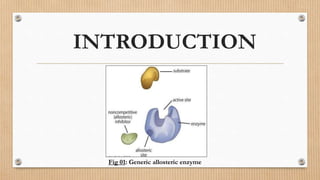
INTRODUCTION
Fig 01: Generic allosteric enzyme
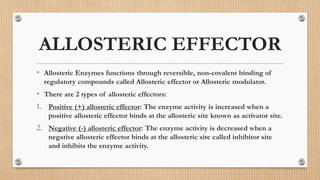
ALLOSTERIC EFFECTOR
• Allosteric Enzymes functions through reversible, non-covalent binding of
regulatory compounds called Allosteric effector or Allosteric modulator.
• There are 2 types of allosteric effectors:
1. Positive (+) allosteric effector: The enzyme activity is increased when a
positive allosteric effector binds at the allosteric site known as activator site.
2. Negative (-) allosteric effector: The enzyme activity is decreased when a
negative allosteric effector binds at the allosteric site called inhibitor site
and inhibits the enzyme activity.
PROPERTIES
• The properties of allosteric enzymes are significantly different from those of
simple non regulatory enzymes.
• Catalyze essentially irreversible reactions.
• Generally contain more than one polypeptide chain.
• There can be more than one allosteric sites present in an enzyme molecule.
• Allosteric enzymes are generally larger & more complex than non-allosteric
enzymes. Most have 2 or more subunits.
• An allosteric site is specific for its ligand, just as the active site is specific for
its substrate.
KINETIC PROPERTY
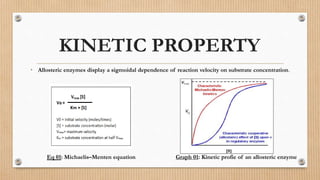
Graph 01: Kinetic profie of an allosteric enzyme
• Allosteric enzymes display a sigmoidal dependence of reaction velocity on substrate concentration.
Eq 01: Michaelis–Menten equation
o
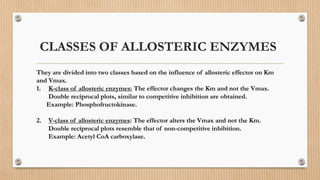
CLASSES OF ALLOSTERIC ENZYMES
They are divided into two classes based on the influence of allosteric effector on Km
and Vmax.
1. K-class of allosteric enzymes: The effector changes the Km and not the Vmax.
Double reciprocal plots, similar to competitive inhibition are obtained.
Example: Phosphofructokinase.
2. V-class of allosteric enzymes: The effector alters the Vmax and not the Km.
Double reciprocal plots resemble that of non-competitive inhibition.
Example: Acetyl CoA carboxylase.
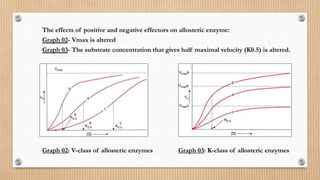
Graph 02: V-class of allosteric enzymes Graph 03: K-class of allosteric enzymes
The effects of positive and negative effectors on allosteric enzyme:
Graph 02- Vmax is altered
Graph 03- The substrate concentration that gives half maximal velocity (K0.5) is altered.
o o
ALLOSTERIC REGULATION
MECHANISM
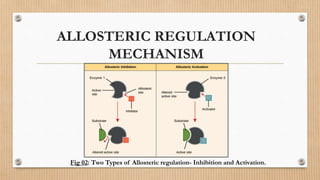
Fig 02: Two Types of Allosteric regulation- Inhibition and Activation.
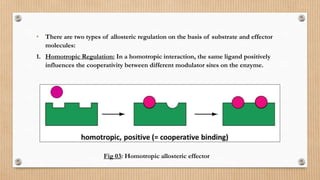
• There are two types of allosteric regulation on the basis of substrate and effector
molecules:
1. Homotropic Regulation: In a homotropic interaction, the same ligand positively
influences the cooperativity between different modulator sites on the enzyme.
Fig 03: Homotropic allosteric effector
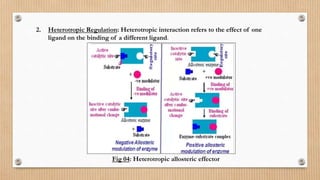
2. Heterotropic Regulation: Heterotropic interaction refers to the effect of one
ligand on the binding of a different ligand.
Fig 04: Heterotropic allosteric effector
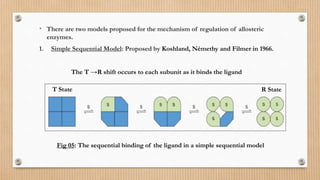
• There are two models proposed for the mechanism of regulation of allosteric
enzymes.
1. Simple Sequential Model: Proposed by Koshland, Némethy and Filmer in 1966.
The T →R shift occurs to each subunit as it binds the ligand
Fig 05: The sequential binding of the ligand in a simple sequential model
T State R State
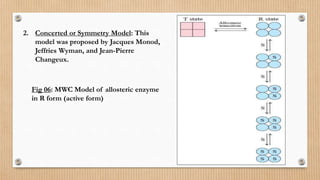
2. Concerted or Symmetry Model: This
model was proposed by Jacques Monod,
Jeffries Wyman, and Jean-Pierre
Changeux.
Fig 06: MWC Model of allosteric enzyme
in R form (active form)
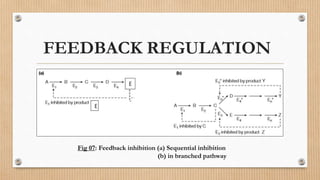
FEEDBACK REGULATION
Fig 07: Feedback inhibition (a) Sequential inhibition
(b) in branched pathway
ASPARTATE
TRANSCARBAMOYLASE
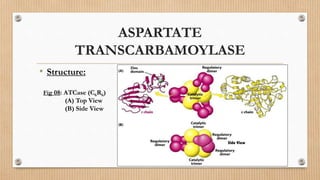
• Structure:
Fig 08: ATCase (C6R6)
(A) Top View
(B) Side View
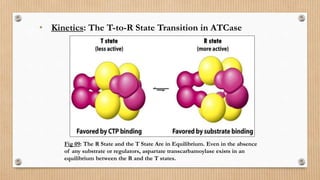
• Kinetics: The T-to-R State Transition in ATCase
Fig 09: The R State and the T State Are in Equilibrium. Even in the absence
of any substrate or regulators, aspartate transcarbamoylase exists in an
equilibrium between the R and the T states.
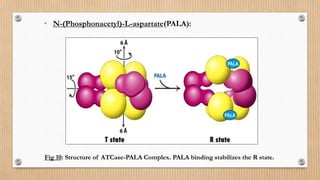
• N-(Phosphonacetyl)-L-aspartate(PALA):
Fig 10: Structure of ATCase-PALA Complex. PALA binding stabilizes the R state.
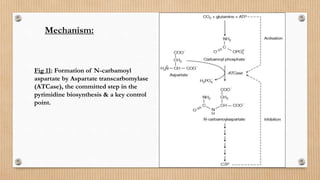
Fig 11: Formation of N-carbamoyl
aspartate by Aspartate transcarbomylase
(ATCase), the committed step in the
pyrimidine biosynthesis & a key control
point.
Mechanism:
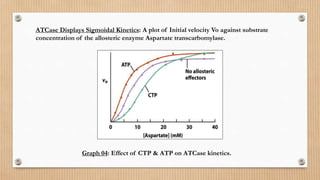
Graph 04: Effect of CTP & ATP on ATCase kinetics.
ATCase Displays Sigmoidal Kinetics: A plot of Initial velocity Vo against substrate
concentration of the allosteric enzyme Aspartate transcarbomylase.
CONCLUSION
REFERENCES
• Bhagavan N. V. & Chung-Eun Ha. 2001. Essentials of Medical Biochemistry with
Clinical Cases, 2nd Edition, Elsevier publication, London, UK, 719pp.
• Jeremy M. Berg, John L. Tymoczko & Lubert Stryer. 2007. Biochemistry, 6th edition,
W. H. Freeman & Company, New York, USA, 1158pp.
• Satyanarayana U. & Chakrapani U. 2007. Biochemistry, Books and allied (P) Ltd,
Kolkata, India, 794pp.
• Hames B.D. & Hooper N.M. 2000. Biochemistry, 2nd Edition, BIOS Scientific
Publishers Limited, New York, USA, 433pp.
• https://alevelchemistry.co.uk/definition/allosteric-enzymes/
• https://byjus.com/neet/allosteric-enzyme/
• https://en.wikibooks.org/wiki/Structural_Biochemistry/Enzyme_Re
gulation/Allosteric Control
• https://www.slideshare.net/Haddies/allosteric-enzymes
• https://www.sciencedirect.com/topics/biochemistry-genetics-and-
molecular-biology/allosteric-enzyme
ACKNOWLEDGEMENT
I would like to thank the dept. of Molecular Biology for providing this
opportunity to present this seminar.
I would also like to thank my guide Prof. Cletus D’Souza for his valuable
guidance.
Thank you one and all.

Allosteric enzymes

  • 1.
    ALLOSTERIC ENZYMES Presented By: IncharaR 6th Semester Molecular Biology 23/05/2020 Guided By: Prof. Cletus D’Souza Dept. of Molecular Biology
  • 2.
    CONTENTS • Introduction • Allostericeffector • Properties of allosteric enzyme • Kinetic property of allosteric enzyme • Classes of allosteric enzymes • Allosteric regulation mechanism • Feedback regulation • Aspartate transcarbamoylase • Conclusion • References • Acknowledgement
  • 3.
  • 4.
    ALLOSTERIC EFFECTOR • AllostericEnzymes functions through reversible, non-covalent binding of regulatory compounds called Allosteric effector or Allosteric modulator. • There are 2 types of allosteric effectors: 1. Positive (+) allosteric effector: The enzyme activity is increased when a positive allosteric effector binds at the allosteric site known as activator site. 2. Negative (-) allosteric effector: The enzyme activity is decreased when a negative allosteric effector binds at the allosteric site called inhibitor site and inhibits the enzyme activity.
  • 5.
    PROPERTIES • The propertiesof allosteric enzymes are significantly different from those of simple non regulatory enzymes. • Catalyze essentially irreversible reactions. • Generally contain more than one polypeptide chain. • There can be more than one allosteric sites present in an enzyme molecule. • Allosteric enzymes are generally larger & more complex than non-allosteric enzymes. Most have 2 or more subunits. • An allosteric site is specific for its ligand, just as the active site is specific for its substrate.
  • 6.
    KINETIC PROPERTY Graph 01:Kinetic profie of an allosteric enzyme • Allosteric enzymes display a sigmoidal dependence of reaction velocity on substrate concentration. Eq 01: Michaelis–Menten equation o
  • 7.
    CLASSES OF ALLOSTERICENZYMES They are divided into two classes based on the influence of allosteric effector on Km and Vmax. 1. K-class of allosteric enzymes: The effector changes the Km and not the Vmax. Double reciprocal plots, similar to competitive inhibition are obtained. Example: Phosphofructokinase. 2. V-class of allosteric enzymes: The effector alters the Vmax and not the Km. Double reciprocal plots resemble that of non-competitive inhibition. Example: Acetyl CoA carboxylase.
  • 8.
    Graph 02: V-classof allosteric enzymes Graph 03: K-class of allosteric enzymes The effects of positive and negative effectors on allosteric enzyme: Graph 02- Vmax is altered Graph 03- The substrate concentration that gives half maximal velocity (K0.5) is altered. o o
  • 9.
    ALLOSTERIC REGULATION MECHANISM Fig 02:Two Types of Allosteric regulation- Inhibition and Activation.
  • 10.
    • There aretwo types of allosteric regulation on the basis of substrate and effector molecules: 1. Homotropic Regulation: In a homotropic interaction, the same ligand positively influences the cooperativity between different modulator sites on the enzyme. Fig 03: Homotropic allosteric effector
  • 11.
    2. Heterotropic Regulation:Heterotropic interaction refers to the effect of one ligand on the binding of a different ligand. Fig 04: Heterotropic allosteric effector
  • 12.
    • There aretwo models proposed for the mechanism of regulation of allosteric enzymes. 1. Simple Sequential Model: Proposed by Koshland, Némethy and Filmer in 1966. The T →R shift occurs to each subunit as it binds the ligand Fig 05: The sequential binding of the ligand in a simple sequential model T State R State
  • 13.
    2. Concerted orSymmetry Model: This model was proposed by Jacques Monod, Jeffries Wyman, and Jean-Pierre Changeux. Fig 06: MWC Model of allosteric enzyme in R form (active form)
  • 14.
    FEEDBACK REGULATION Fig 07:Feedback inhibition (a) Sequential inhibition (b) in branched pathway
  • 15.
    ASPARTATE TRANSCARBAMOYLASE • Structure: Fig 08:ATCase (C6R6) (A) Top View (B) Side View
  • 16.
    • Kinetics: TheT-to-R State Transition in ATCase Fig 09: The R State and the T State Are in Equilibrium. Even in the absence of any substrate or regulators, aspartate transcarbamoylase exists in an equilibrium between the R and the T states.
  • 17.
    • N-(Phosphonacetyl)-L-aspartate(PALA): Fig 10:Structure of ATCase-PALA Complex. PALA binding stabilizes the R state.
  • 18.
    Fig 11: Formationof N-carbamoyl aspartate by Aspartate transcarbomylase (ATCase), the committed step in the pyrimidine biosynthesis & a key control point. Mechanism:
  • 19.
    Graph 04: Effectof CTP & ATP on ATCase kinetics. ATCase Displays Sigmoidal Kinetics: A plot of Initial velocity Vo against substrate concentration of the allosteric enzyme Aspartate transcarbomylase.
  • 20.
  • 21.
    REFERENCES • Bhagavan N.V. & Chung-Eun Ha. 2001. Essentials of Medical Biochemistry with Clinical Cases, 2nd Edition, Elsevier publication, London, UK, 719pp. • Jeremy M. Berg, John L. Tymoczko & Lubert Stryer. 2007. Biochemistry, 6th edition, W. H. Freeman & Company, New York, USA, 1158pp. • Satyanarayana U. & Chakrapani U. 2007. Biochemistry, Books and allied (P) Ltd, Kolkata, India, 794pp. • Hames B.D. & Hooper N.M. 2000. Biochemistry, 2nd Edition, BIOS Scientific Publishers Limited, New York, USA, 433pp.
  • 22.
    • https://alevelchemistry.co.uk/definition/allosteric-enzymes/ • https://byjus.com/neet/allosteric-enzyme/ •https://en.wikibooks.org/wiki/Structural_Biochemistry/Enzyme_Re gulation/Allosteric Control • https://www.slideshare.net/Haddies/allosteric-enzymes • https://www.sciencedirect.com/topics/biochemistry-genetics-and- molecular-biology/allosteric-enzyme
  • 23.
    ACKNOWLEDGEMENT I would liketo thank the dept. of Molecular Biology for providing this opportunity to present this seminar. I would also like to thank my guide Prof. Cletus D’Souza for his valuable guidance. Thank you one and all.