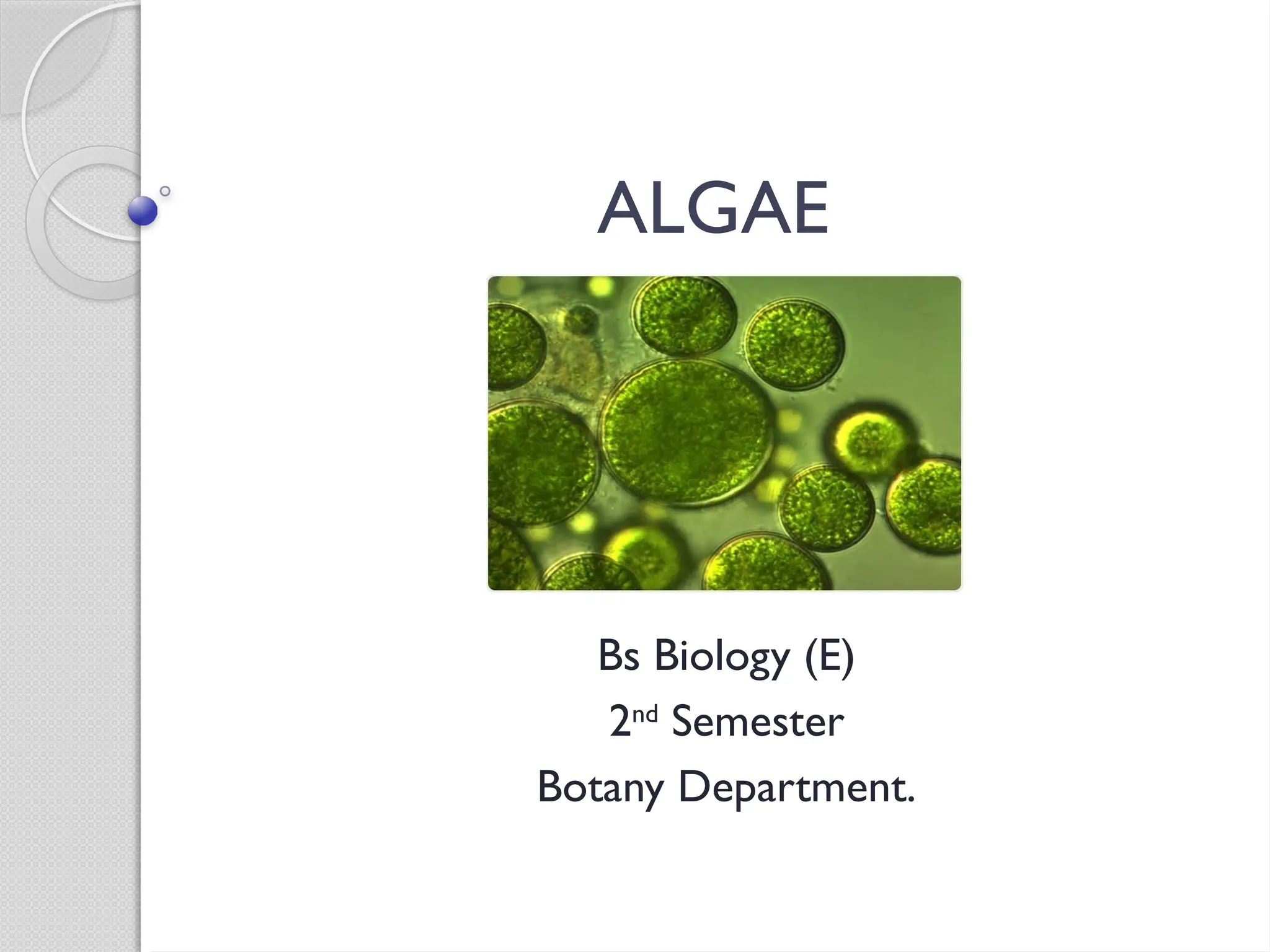
ALGAE
Bs Biology (E)
2nd
Semester
Botany Department.
 Organization ofThallus
 Form & Size of Algae
 Pigment Constitution of Algae
 Reproduction of Algae
 Classification of Algae
 Economic Importance of Algae
 Conclusion
 References
SYNOPSIS:-
 Algae are a diverse group of aquatic
organisms that have the ability to conduct
photosynthesis.
 Certain algae are familiar to most
people; for instance, seaweeds (such as kelp
or phytoplankton), pond scum or the algal
blooms in lakes.
INTRODUCTION:-
 Algae are photosynthetic organisms.
 They can be either unicellular or multicellular.
 Algae lack a well-defined body, so structures like
roots, stems, or leaves are absent.
 Algae are found where there is adequate moisture.
 Reproduction in algae occurs in both asexual and
sexual forms.
 Asexual reproduction occurs by spore formation.
General Characteristics Features:-
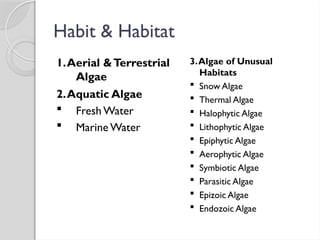
Habit & Habitat
1.Aerial &Terrestrial
Algae
2.Aquatic Algae
 Fresh Water
 Marine Water
3.Algae of Unusual
Habitats
 Snow Algae
 Thermal Algae
 Halophytic Algae
 Lithophytic Algae
 Epiphytic Algae
 Aerophytic Algae
 Symbiotic Algae
 Parasitic Algae
 Epizoic Algae
 Endozoic Algae
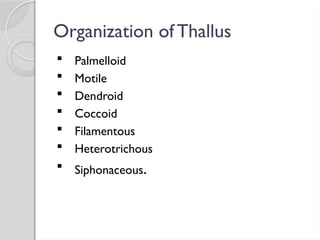
Organization of Thallus
 Palmelloid
 Motile
 Dendroid
 Coccoid
 Filamentous
 Heterotrichous
 Siphonaceous.
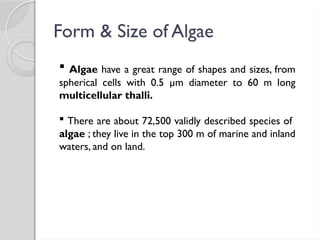
Form & Size of Algae
 Algae have a great range of shapes and sizes, from
spherical cells with 0.5 µm diameter to 60 m long
multicellular thalli.
 There are about 72,500 validly described species of
algae ; they live in the top 300 m of marine and inland
waters, and on land.
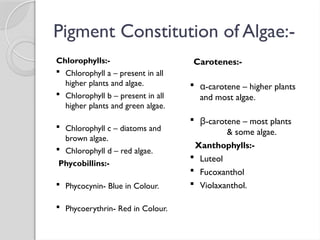
Pigment Constitution of Algae:-
Chlorophylls:-
 Chlorophyll a – present in all
higher plants and algae.
 Chlorophyll b – present in all
higher plants and green algae.
 Chlorophyll c – diatoms and
brown algae.
 Chlorophyll d – red algae.
Phycobillins:-
 Phycocynin- Blue in Colour.
 Phycoerythrin- Red in Colour.
Carotenes:-
 -
α carotene – higher plants
and most algae.
 -
β carotene – most plants
& some algae.
Xanthophylls:-
 Luteol
 Fucoxanthol
 Violaxanthol.
Reproduction in Algae:-
 Vegetative Reproduction
 Asexual Reproduction
 Sexual Reproduction
Vegetative Reproduction
 Fragmentation
 Fission
 Tubers
 Adventitious Branches
 Hormogonia
 Budding
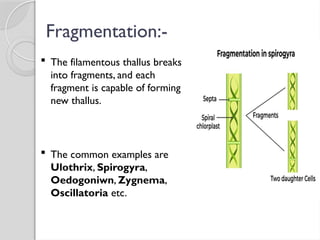
Fragmentation:-
 The filamentous thallus breaks
into fragments, and each
fragment is capable of forming
new thallus.
 The common examples are
Ulothrix, Spirogyra,
Oedogoniwn, Zygnema,
Oscillatoria etc.
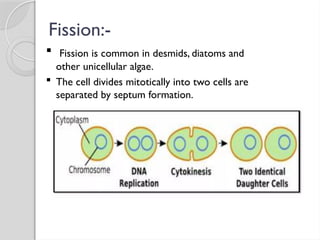
Fission:-
 Fission is common in desmids, diatoms and
other unicellular algae.
 The cell divides mitotically into two cells are
separated by septum formation.
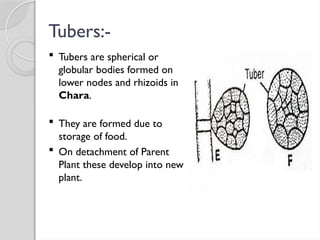
Tubers:-
 Tubers are spherical or
globular bodies formed on
lower nodes and rhizoids in
Chara.
 They are formed due to
storage of food.
 On detachment of Parent
Plant these develop into new
plant.
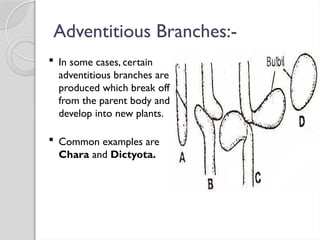
Adventitious Branches:-
 In some cases, certain
adventitious branches are
produced which break off
from the parent body and
develop into new plants.
 Common examples are
Chara and Dictyota.
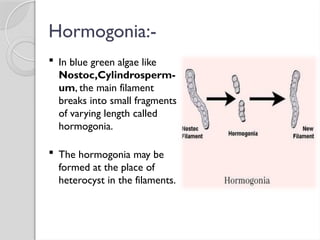
Hormogonia:-
 In blue green algae like
Nostoc,Cylindrosperm-
um, the main filament
breaks into small fragments
of varying length called
hormogonia.
 The hormogonia may be
formed at the place of
heterocyst in the filaments.
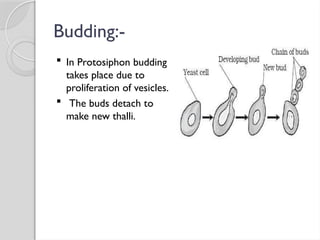
Budding:-
 In Protosiphon budding
takes place due to
proliferation of vesicles.
 The buds detach to
make new thalli.
Asexual Reproduction:-
 Formation from protoplast.
 Multiply directly without fusion .
 By varieties of motile or non mobile spores.
Spores can be of
different types:
1.Zoospores
2.Aplanospores
3.Akinetes
4.Hypnospores
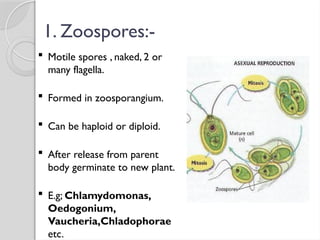
1. Zoospores:-
 Motile spores , naked, 2 or
many flagella.
 Formed in zoosporangium.
 Can be haploid or diploid.
 After release from parent
body germinate to new plant.
 E.g; Chlamydomonas,
Oedogonium,
Vaucheria,Chladophorae
etc.
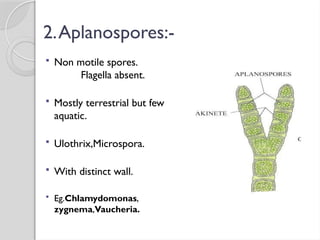
2.Aplanospores:-
 Non motile spores.
Flagella absent.
 Mostly terrestrial but few
aquatic.
 Ulothrix,Microspora.
 With distinct wall.
 Eg.Chlamydomonas,
zygnema,Vaucheria.
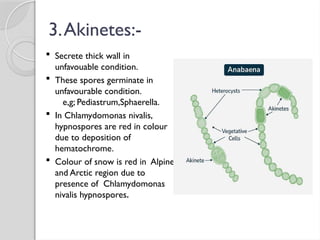
3.Akinetes:-
 Secrete thick wall in
unfavouable condition.
 These spores germinate in
unfavourable condition.
e,g; Pediastrum,Sphaerella.
 In Chlamydomonas nivalis,
hypnospores are red in colour
due to deposition of
hematochrome.
 Colour of snow is red in Alpine
and Arctic region due to
presence of Chlamydomonas
nivalis hypnospores.
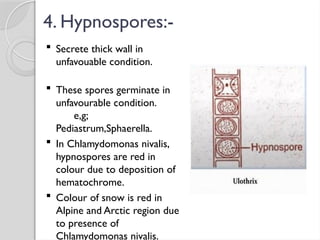
4. Hypnospores:-
 Secrete thick wall in
unfavouable condition.
 These spores germinate in
unfavourable condition.
e,g;
Pediastrum,Sphaerella.
 In Chlamydomonas nivalis,
hypnospores are red in
colour due to deposition of
hematochrome.
 Colour of snow is red in
Alpine and Arctic region due
to presence of
Chlamydomonas nivalis.
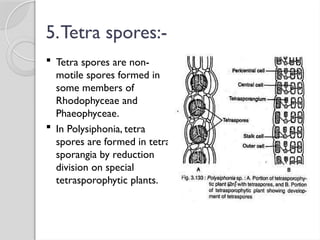
5.Tetra spores:-
 Tetra spores are non-
motile spores formed in
some members of
Rhodophyceae and
Phaeophyceae.
 In Polysiphonia, tetra
spores are formed in tetra
sporangia by reduction
division on special
tetrasporophytic plants.
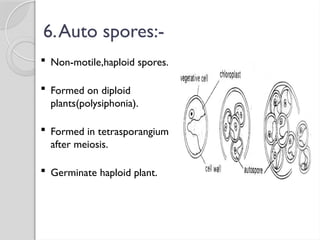
6.Auto spores:-
 Non-motile,haploid spores.
 Formed on diploid
plants(polysiphonia).
 Formed in tetrasporangium
after meiosis.
 Germinate haploid plant.
Sexual Reproduction:-
 Isogamy
 Anisogamy
 Oogamy
 Hologamy
 Autogamy
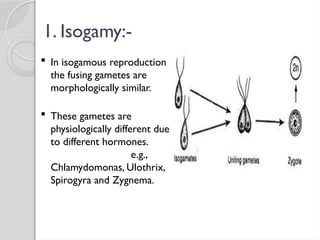
1. Isogamy:-
 In isogamous reproduction
the fusing gametes are
morphologically similar.
 These gametes are
physiologically different due
to different hormones.
e.g.,
Chlamydomonas, Ulothrix,
Spirogyra and Zygnema.
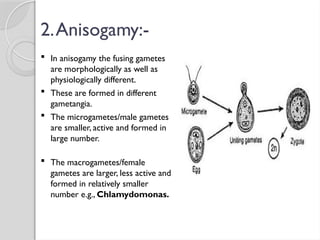
2.Anisogamy:-
 In anisogamy the fusing gametes
are morphologically as well as
physiologically different.
 These are formed in different
gametangia.
 The microgametes/male gametes
are smaller, active and formed in
large number.
 The macrogametes/female
gametes are larger, less active and
formed in relatively smaller
number e.g., Chlamydomonas.
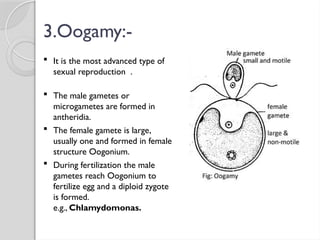
3.Oogamy:-
 It is the most advanced type of
sexual reproduction .
 The male gametes or
microgametes are formed in
antheridia.
 The female gamete is large,
usually one and formed in female
structure Oogonium.
 During fertilization the male
gametes reach Oogonium to
fertilize egg and a diploid zygote
is formed.
e.g., Chlamydomonas.
 The unicellular thallus of opposite strains (-) and
(+) behaves as gametes directly.
 The thalli fuse to make diploid zygote.
e.g., Chlamydomonas.
A. Hologamy:-
B.Autogamy:-
 Autogamy two gametes of same mother cell fuse
to form diploid zygote.
 Since both gametes are formed by same cell there
is no genetic recombination.
e.g., diatoms.
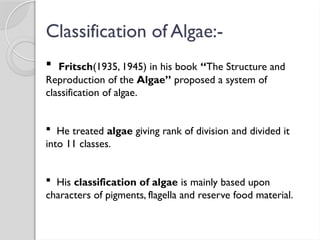
Classification of Algae:-
 Fritsch(1935, 1945) in his book “The Structure and
Reproduction of the Algae” proposed a system of
classification of algae.
 He treated algae giving rank of division and divided it
into 11 classes.
 His classification of algae is mainly based upon
characters of pigments, flagella and reserve food material.
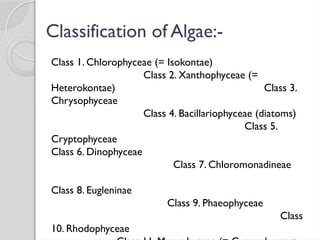
Classification of Algae:-
Class 1. Chlorophyceae (= Isokontae)
Class 2. Xanthophyceae (=
Heterokontae) Class 3.
Chrysophyceae
Class 4. Bacillariophyceae (diatoms)
Class 5.
Cryptophyceae
Class 6. Dinophyceae
Class 7. Chloromonadineae
Class 8. Eugleninae
Class 9. Phaeophyceae
Class
10. Rhodophyceae
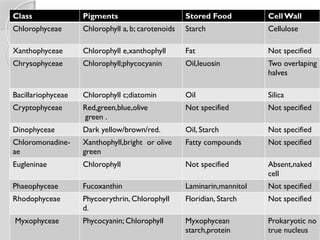
Class Pigments Stored Food Cell Wall
Chlorophyceae Chlorophyll a, b; carotenoids Starch Cellulose
Xanthophyceae Chlorophyll e,xanthophyll Fat Not specified
Chrysophyceae Chlorophyll;phycocyanin Oil,leuosin Two overlaping
halves
Bacillariophyceae Chlorophyll c;diatomin Oil Silica
Cryptophyceae Red,green,blue,olive
green .
Not specified Not specified
Dinophyceae Dark yellow/brown/red. Oil, Starch Not specified
Chloromonadine-
ae
Xanthophyll,bright or olive
green
Fatty compounds Not specified
Eugleninae Chlorophyll Not specified Absent,naked
cell
Phaeophyceae Fucoxanthin Laminarin,mannitol Not specified
Rhodophyceae Phycoerythrin, Chlorophyll
d.
Floridian, Starch Not specified
Myxophyceae Phycocyanin; Chlorophyll Myxophycean
starch,protein
Prokaryotic no
true nucleus
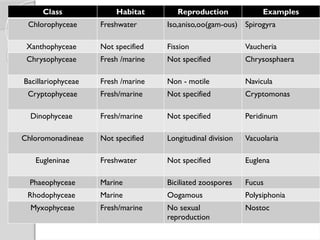
Class Habitat Reproduction Examples
Chlorophyceae Freshwater Iso,aniso,oo(gam-ous) Spirogyra
Xanthophyceae Not specified Fission Vaucheria
Chrysophyceae Fresh /marine Not specified Chrysosphaera
Bacillariophyceae Fresh /marine Non - motile Navicula
Cryptophyceae Fresh/marine Not specified Cryptomonas
Dinophyceae Fresh/marine Not specified Peridinum
Chloromonadineae Not specified Longitudinal division Vacuolaria
Eugleninae Freshwater Not specified Euglena
Phaeophyceae Marine Biciliated zoospores Fucus
Rhodophyceae Marine Oogamous Polysiphonia
Myxophyceae Fresh/marine No sexual
reproduction
Nostoc
ECONOMIC IMPORTANCE OF
ALGAE:-
Algae as Food
Algae as fodder for cattle
Utilization of Algae as Fertilizers
Utilization of Algae in water Purification
Utilization of Algae in Medicine & Antibiotic
Use of Algae in Industries
Algae in Sewage Disposal
Conclusion:-
 According to some scientists , algae produce half
of the earth's oxygen.
 They are a source of crude oil.These algal biofuels
could well be a replacement for the fossil fuels.
 Algae also play an effective role in keeping the
atmospheric carbon dioxide.
 The food industry also uses some algae.Agar is
obtained from Gelidium and Gracilaria and is
making ice-creams and jellies .The other food
supplements that are algae and which are widely
used are Chlorella and Spirulina.
REFERENCES:-
THANKYOU.

Hursin Sarwar 2 change.pptx.............

  • 1.
  • 2.
     Organization ofThallus Form & Size of Algae  Pigment Constitution of Algae  Reproduction of Algae  Classification of Algae  Economic Importance of Algae  Conclusion  References SYNOPSIS:-
  • 3.
     Algae area diverse group of aquatic organisms that have the ability to conduct photosynthesis.  Certain algae are familiar to most people; for instance, seaweeds (such as kelp or phytoplankton), pond scum or the algal blooms in lakes. INTRODUCTION:-
  • 4.
     Algae arephotosynthetic organisms.  They can be either unicellular or multicellular.  Algae lack a well-defined body, so structures like roots, stems, or leaves are absent.  Algae are found where there is adequate moisture.  Reproduction in algae occurs in both asexual and sexual forms.  Asexual reproduction occurs by spore formation. General Characteristics Features:-
  • 5.
    Habit & Habitat 1.Aerial&Terrestrial Algae 2.Aquatic Algae  Fresh Water  Marine Water 3.Algae of Unusual Habitats  Snow Algae  Thermal Algae  Halophytic Algae  Lithophytic Algae  Epiphytic Algae  Aerophytic Algae  Symbiotic Algae  Parasitic Algae  Epizoic Algae  Endozoic Algae
  • 6.
    Organization of Thallus Palmelloid  Motile  Dendroid  Coccoid  Filamentous  Heterotrichous  Siphonaceous.
  • 7.
    Form & Sizeof Algae  Algae have a great range of shapes and sizes, from spherical cells with 0.5 µm diameter to 60 m long multicellular thalli.  There are about 72,500 validly described species of algae ; they live in the top 300 m of marine and inland waters, and on land.
  • 8.
    Pigment Constitution ofAlgae:- Chlorophylls:-  Chlorophyll a – present in all higher plants and algae.  Chlorophyll b – present in all higher plants and green algae.  Chlorophyll c – diatoms and brown algae.  Chlorophyll d – red algae. Phycobillins:-  Phycocynin- Blue in Colour.  Phycoerythrin- Red in Colour. Carotenes:-  - α carotene – higher plants and most algae.  - β carotene – most plants & some algae. Xanthophylls:-  Luteol  Fucoxanthol  Violaxanthol.
  • 9.
    Reproduction in Algae:- Vegetative Reproduction  Asexual Reproduction  Sexual Reproduction
  • 10.
    Vegetative Reproduction  Fragmentation Fission  Tubers  Adventitious Branches  Hormogonia  Budding
  • 11.
    Fragmentation:-  The filamentousthallus breaks into fragments, and each fragment is capable of forming new thallus.  The common examples are Ulothrix, Spirogyra, Oedogoniwn, Zygnema, Oscillatoria etc.
  • 12.
    Fission:-  Fission iscommon in desmids, diatoms and other unicellular algae.  The cell divides mitotically into two cells are separated by septum formation.
  • 13.
    Tubers:-  Tubers arespherical or globular bodies formed on lower nodes and rhizoids in Chara.  They are formed due to storage of food.  On detachment of Parent Plant these develop into new plant.
  • 14.
    Adventitious Branches:-  Insome cases, certain adventitious branches are produced which break off from the parent body and develop into new plants.  Common examples are Chara and Dictyota.
  • 15.
    Hormogonia:-  In bluegreen algae like Nostoc,Cylindrosperm- um, the main filament breaks into small fragments of varying length called hormogonia.  The hormogonia may be formed at the place of heterocyst in the filaments.
  • 16.
    Budding:-  In Protosiphonbudding takes place due to proliferation of vesicles.  The buds detach to make new thalli.
  • 17.
    Asexual Reproduction:-  Formationfrom protoplast.  Multiply directly without fusion .  By varieties of motile or non mobile spores. Spores can be of different types: 1.Zoospores 2.Aplanospores 3.Akinetes 4.Hypnospores
  • 18.
    1. Zoospores:-  Motilespores , naked, 2 or many flagella.  Formed in zoosporangium.  Can be haploid or diploid.  After release from parent body germinate to new plant.  E.g; Chlamydomonas, Oedogonium, Vaucheria,Chladophorae etc.
  • 19.
    2.Aplanospores:-  Non motilespores. Flagella absent.  Mostly terrestrial but few aquatic.  Ulothrix,Microspora.  With distinct wall.  Eg.Chlamydomonas, zygnema,Vaucheria.
  • 20.
    3.Akinetes:-  Secrete thickwall in unfavouable condition.  These spores germinate in unfavourable condition. e,g; Pediastrum,Sphaerella.  In Chlamydomonas nivalis, hypnospores are red in colour due to deposition of hematochrome.  Colour of snow is red in Alpine and Arctic region due to presence of Chlamydomonas nivalis hypnospores.
  • 21.
    4. Hypnospores:-  Secretethick wall in unfavouable condition.  These spores germinate in unfavourable condition. e,g; Pediastrum,Sphaerella.  In Chlamydomonas nivalis, hypnospores are red in colour due to deposition of hematochrome.  Colour of snow is red in Alpine and Arctic region due to presence of Chlamydomonas nivalis.
  • 22.
    5.Tetra spores:-  Tetraspores are non- motile spores formed in some members of Rhodophyceae and Phaeophyceae.  In Polysiphonia, tetra spores are formed in tetra sporangia by reduction division on special tetrasporophytic plants.
  • 23.
    6.Auto spores:-  Non-motile,haploidspores.  Formed on diploid plants(polysiphonia).  Formed in tetrasporangium after meiosis.  Germinate haploid plant.
  • 24.
    Sexual Reproduction:-  Isogamy Anisogamy  Oogamy  Hologamy  Autogamy
  • 25.
    1. Isogamy:-  Inisogamous reproduction the fusing gametes are morphologically similar.  These gametes are physiologically different due to different hormones. e.g., Chlamydomonas, Ulothrix, Spirogyra and Zygnema.
  • 26.
    2.Anisogamy:-  In anisogamythe fusing gametes are morphologically as well as physiologically different.  These are formed in different gametangia.  The microgametes/male gametes are smaller, active and formed in large number.  The macrogametes/female gametes are larger, less active and formed in relatively smaller number e.g., Chlamydomonas.
  • 27.
    3.Oogamy:-  It isthe most advanced type of sexual reproduction .  The male gametes or microgametes are formed in antheridia.  The female gamete is large, usually one and formed in female structure Oogonium.  During fertilization the male gametes reach Oogonium to fertilize egg and a diploid zygote is formed. e.g., Chlamydomonas.
  • 28.
     The unicellularthallus of opposite strains (-) and (+) behaves as gametes directly.  The thalli fuse to make diploid zygote. e.g., Chlamydomonas. A. Hologamy:- B.Autogamy:-  Autogamy two gametes of same mother cell fuse to form diploid zygote.  Since both gametes are formed by same cell there is no genetic recombination. e.g., diatoms.
  • 29.
    Classification of Algae:- Fritsch(1935, 1945) in his book “The Structure and Reproduction of the Algae” proposed a system of classification of algae.  He treated algae giving rank of division and divided it into 11 classes.  His classification of algae is mainly based upon characters of pigments, flagella and reserve food material.
  • 30.
    Classification of Algae:- Class1. Chlorophyceae (= Isokontae) Class 2. Xanthophyceae (= Heterokontae) Class 3. Chrysophyceae Class 4. Bacillariophyceae (diatoms) Class 5. Cryptophyceae Class 6. Dinophyceae Class 7. Chloromonadineae Class 8. Eugleninae Class 9. Phaeophyceae Class 10. Rhodophyceae
  • 31.
    Class Pigments StoredFood Cell Wall Chlorophyceae Chlorophyll a, b; carotenoids Starch Cellulose Xanthophyceae Chlorophyll e,xanthophyll Fat Not specified Chrysophyceae Chlorophyll;phycocyanin Oil,leuosin Two overlaping halves Bacillariophyceae Chlorophyll c;diatomin Oil Silica Cryptophyceae Red,green,blue,olive green . Not specified Not specified Dinophyceae Dark yellow/brown/red. Oil, Starch Not specified Chloromonadine- ae Xanthophyll,bright or olive green Fatty compounds Not specified Eugleninae Chlorophyll Not specified Absent,naked cell Phaeophyceae Fucoxanthin Laminarin,mannitol Not specified Rhodophyceae Phycoerythrin, Chlorophyll d. Floridian, Starch Not specified Myxophyceae Phycocyanin; Chlorophyll Myxophycean starch,protein Prokaryotic no true nucleus
  • 32.
    Class Habitat ReproductionExamples Chlorophyceae Freshwater Iso,aniso,oo(gam-ous) Spirogyra Xanthophyceae Not specified Fission Vaucheria Chrysophyceae Fresh /marine Not specified Chrysosphaera Bacillariophyceae Fresh /marine Non - motile Navicula Cryptophyceae Fresh/marine Not specified Cryptomonas Dinophyceae Fresh/marine Not specified Peridinum Chloromonadineae Not specified Longitudinal division Vacuolaria Eugleninae Freshwater Not specified Euglena Phaeophyceae Marine Biciliated zoospores Fucus Rhodophyceae Marine Oogamous Polysiphonia Myxophyceae Fresh/marine No sexual reproduction Nostoc
  • 33.
    ECONOMIC IMPORTANCE OF ALGAE:- Algaeas Food Algae as fodder for cattle Utilization of Algae as Fertilizers Utilization of Algae in water Purification Utilization of Algae in Medicine & Antibiotic Use of Algae in Industries Algae in Sewage Disposal
  • 34.
    Conclusion:-  According tosome scientists , algae produce half of the earth's oxygen.  They are a source of crude oil.These algal biofuels could well be a replacement for the fossil fuels.  Algae also play an effective role in keeping the atmospheric carbon dioxide.  The food industry also uses some algae.Agar is obtained from Gelidium and Gracilaria and is making ice-creams and jellies .The other food supplements that are algae and which are widely used are Chlorella and Spirulina.
  • 35.
  • 36.

Editor's Notes