University of Allahabad
Department of Botany
Topic:Pyrrophyta
Presented by: Presented to:
Priyanshu Jaiswal Dr.K. Suresh Kumar
M.Sc,1 Semester. Dr.Prateek Srivastava
Introduction
 Pyrrophyta are unicellular algae.
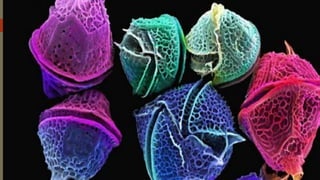
 The division pyrrophyta comprises of the dinoflagellates.
 They are microscopic and range from 15 to 40 microns in size. The
largest,Noctiluca,can be as large as 2 mm in diameter.
 They are mostly marine(Noctiluca ,Gonyaulax ),some live in fresh
water(Gymnodinium,Ceratium)
 Pyrrophyta contains luciferin pigment that produces light without
heat and thus is also referred to as fire algae.
 They are Yellow/ reddish-brown in colour and have two ribbon-
shaped flagella.
 It contains photosynthetic pigments such as chlorophyll-a,
chlorophyll-b, and fucoxanthin
 Food reserves: starch and oil.
•They are also known as dinoflagellates as some of them are
bioluminescent.
•They are found in colonial or filamentous form.
•Motile forms have two flagella. A longer flagellum lies in a
groove called the sulcus, and a shorter flagellum lies
perpendicular to the first in a groove called the girdle.
•The positioning of the flagella causes the cell to swim in a
rotating motion.
•Two classes are recognized in the phylum Pyrrophyta:
1-Dinophyceae (dinoflagellates)
2-Cryptophyceae (cryptomonads).
Dinophyceae-Dinoflagellates
 The prefix dino- here refers to the whirling motion of the cells.
 Dinoflagellates are surrounded by a complex covering called
the amphiesma.
 They involved in the formation of Red tide(Gonyaulax).
 These organism occur as flagellate or sessile unicells,
colonies and filamentous form.
 Both Marine and freshwater form are found.
 Because of chemistry of wall material, which is not easily
decomposed,several genera are known from the fossil record
Eg.Sysematophora penicillata
 Most organism are free living but others are symbionts.
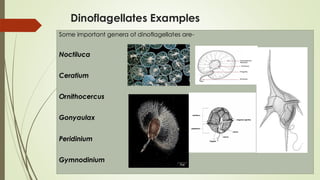
Dinoflagellates Examples
Some important genera of dinoflagellates are-
Noctiluca
Ceratium
Ornithocercus
Gonyaulax
Peridinium
Gymnodinium
Characteristics of the Dinoflagellates-
1. Pigments
The organism contain chlorophyll a and c ,beta carotene and
several xanthophylls , especially peridine or fucoxanthin,which gives
a brownish colour. The pigments are located in the plastics.
2. Food Reserve
•the food reserve is either true starch or oils.
•the starch can be stored in plastid,but many orgaanism store
starch outside the plastid
3. Motilty
Dinoflagellates are motile unicellular organisms that move using two
flagella:
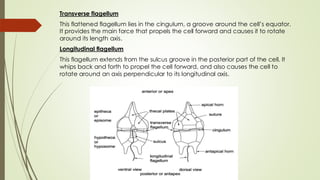
Transverse flagellum
This flattened flagellum lies in the cingulum, a groove around the cell’s equator.
It provides the main force that propels the cell forward and causes it to rotate
around its length axis.
Longitudinal flagellum
This flagellum extends from the sulcus groove in the posterior part of the cell. It
whips back and forth to propel the cell forward, and also causes the cell to
rotate around an axis perpendicular to its longitudinal axis.
4.Cell covering
 The exterior surface of a dinoflagellate is usually covered by a plasmalemma but in
some forms there is typical wall.
 Some forms, for example Pyrosystis may have a wall composed of several layers The
inner layer is cellulose and the outer layer is amorphous .
 A layer of sporopollenin,very resistant to decay,probably present in some
dinoflagellates.
 calcium carbonate also present in the wall.
5.Eyespots or light-sensitive organelles.
 Few dinoflagellates contain eye spots.
 The range from simple collection of carotenoid – containing lipid globules not
surrounded by any membrane (Eg.Woloszynskia coronata) to more complex
association of layers of lipid droplets surrounded by membrane envelopes in a plastid
like structure Eg.Peridinium westii.
6.Nucleus
 The nucleus of the dinoflagellates is called dinokaryon.
 Dinokaryon nucleus has chromosome ,attached to the nuclear membrane and
condensed throughout. They lack histones and have a fibrillar appearance.
Dinoflagellates Nutrition
 Dinoflagellates are mostly photosynthetic autotrophs.
 Heterotrophic dinoflagellates ingest other microorganisms and
protozoans to get nutrients
 They are also present as endosymbionts in marine invertebrates such as
corals, jellyfishes, etc.
 The photosynthetic endosymbionts are called Zooxanthellae.
 Dinoflagellates are important producers in the marine ecosystem
 The chloroplast of dinoflagellates is bound by three membranes and
originated from engulfing algae.
 It contains chlorophyll a, c and may contain various accessory pigments
such as peridinin, fucoxanthin, etc.
 Some dinoflagellates are photosynthetic as well as heterotrophic, they
are known as mixotrophic.
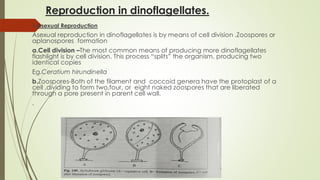
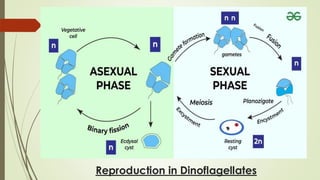
Reproduction in dinoflagellates.
1.Asexual Reproduction
Asexual reproduction in dinoflagellates is by means of cell division .Zoospores or
aplanospores formation
a.Cell division –The most common means of producing more dinoflagellates
flashlight is by cell division. This process “splits” the organism, producing two
identical copies
Eg.Ceratium hirundinella
b.Zoospores-Both of the filament and coccoid genera have the protoplast of a
cell ,dividing to form two,four, or eight naked zoospores that are liberated
through a pore present in parent cell wall.
.
C Aplanospores
Division of the protoplast of cell followed by formation of aplanospores instead
of Zoospores.
Eg.Glenodinium uliginosum
2.Sexual Reproduction
 Sexual reproduction occurs by fusion to form a zygote. The zygote may
form a resting stage known as dinocyst or may remain motile
 The zygote later undergoes meiosis to form haploid cells
 In unfavourable conditions, vegetative cells of dinoflagellates fuse together
to form Planozygote. It takes in excess fat and oil, its shell becomes harder
and size increases, the stage is known as Hypnozygote, that is very similar to
the hibernating stage. Sometimes even spikes are formed
 Under favourable conditions, dinoflagellates break out the shell and
present in a temporary stage known as Planomeiocyte. They quickly
reorganise to their actual shape as a dinoflagellate.
Reproduction in Dinoflagellates
Bioluminescent Dinoflagellates
 Bioluminescence is the characteristic feature of dinoflagellates. More than 18 genera of
dinoflagellates are bioluminescent.
 Dinoflagellates are the only algae that luminesce.
 Bioluminescent dinoflagellates have an enzyme called luciferase, present in the
cytoplasmic bodies known as scintillons. The substrate of the light-producing biochemical
reaction is luciferin.
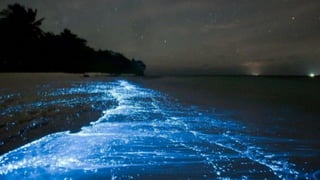
 Blooms of dinoflagellates emit short flashes of light when disturbed mechanically by waves,
ships or swimming. This appears as a bluish flicker in the ocean water at night.
 Dinoflagellates use bioluminescence as a defence mechanism against their predators. Their
predators become more vulnerable and in turn become prey of organisms of higher trophic
levels.
 Noctiluca.Gymnodinium and Procystis, luminesced only in the dark period.
 Bioluinescent places-
1. Mosquito Bay, Puerto Rico.
2. Halong Bay: Located in Vietnam
3. Havelock Island, Andaman Island
4. Waitomo: Located in New Zealand
Dinoflagellates Red Tide(Toxic form)
 Dinoflagellates sometimes multiply rapidly, resulting in
population explosions or blooms.
 Red tides are caused by Gonyaulax .
 Rapid multiplication is due to the presence of
abundant nutrient present in the water. This might be
due to human activities or other natural reasons.
Human input of phosphate accelerates the formation
of red tides.
 These blooms release neurotoxin which kills the fishes.
The colour of the sea appears red so it is known as “Red
Tide”. This phenomenon is also referred to as “Harmful
algal bloom (HAB)”
 It may cause fatal or non-fatal illness in various other
species eating contaminated fish including humans.
After eating contaminated fishes, birds may die. Red
tide has been found to cause the death of dolphins
and manatees too.
 Alexendrium fundyense is responsible for the red tide in
the Gulf of Maine, produces a toxin named saxitoxin..
Florida red tide.
A case study of a man who developed
hypersensitivity pneumonitis after exposure
to a Florida red tide. The man experienced a
four-week history of dyspnea. He was treated
with steroids, which resolved his symptoms.
Cryptophyceae
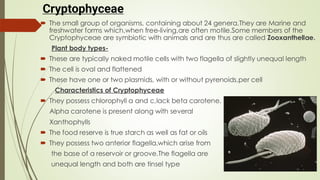
 The small group of organisms, containing about 24 genera.They are Marine and
freshwater forms which,when free-living,are often motile.Some members of the
Cryptophyceae are symbiotic with animals and are thus are called Zooxanthellae.
Plant body types-
 These are typically naked motile cells with two flagella of slightly unequal length
 The cell is oval and flattened
 These have one or two plasmids, with or without pyrenoids,per cell
Characteristics of Cryptophyceae
 They possess chlorophyll a and c,lack beta carotene.
Alpha carotene is present along with several
Xanthophylls
 The food reserve is true starch as well as fat or oils
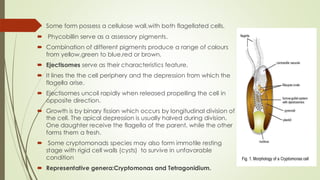
 They possess two anterior flagella,which arise from
the base of a reservoir or groove.The flagella are
unequal length and both are tinsel type
 Some form possess a cellulose wall,with both flagellated cells.
 Phycobillin serve as a assessory pigments.
 Combination of different pigments produce a range of colours
from yellow,green to blue,red or brown.
 Ejectisomes serve as their characteristics feature.
 It lines the the cell periphery and the depression from which the
flagella arise.
 Ejectisomes uncoil rapidly when released propelling the cell in
opposite direction.
 Growth is by binary fission which occurs by longitudinal division of
the cell. The apical depression is usually halved during division.
One daughter receive the flagella of the parent, while the other
forms them a fresh.
 Some cryptomonads species may also form immotile resting
stage with rigid cell walls (cysts) to survive in unfavorable
condition
 Representative genera:Cryptomonas and Tetragonidium.
Reference
 Basic phycology-By S.C Aggrawal
 Introduction to phycology-By F.R Trainor
Presentation on the topic pyrrophyta....

Presentation on the topic pyrrophyta....

  • 1.
    University of Allahabad Departmentof Botany Topic:Pyrrophyta Presented by: Presented to: Priyanshu Jaiswal Dr.K. Suresh Kumar M.Sc,1 Semester. Dr.Prateek Srivastava
  • 3.
    Introduction  Pyrrophyta areunicellular algae.  The division pyrrophyta comprises of the dinoflagellates.  They are microscopic and range from 15 to 40 microns in size. The largest,Noctiluca,can be as large as 2 mm in diameter.  They are mostly marine(Noctiluca ,Gonyaulax ),some live in fresh water(Gymnodinium,Ceratium)  Pyrrophyta contains luciferin pigment that produces light without heat and thus is also referred to as fire algae.  They are Yellow/ reddish-brown in colour and have two ribbon- shaped flagella.  It contains photosynthetic pigments such as chlorophyll-a, chlorophyll-b, and fucoxanthin  Food reserves: starch and oil.
  • 4.
    •They are alsoknown as dinoflagellates as some of them are bioluminescent. •They are found in colonial or filamentous form. •Motile forms have two flagella. A longer flagellum lies in a groove called the sulcus, and a shorter flagellum lies perpendicular to the first in a groove called the girdle. •The positioning of the flagella causes the cell to swim in a rotating motion. •Two classes are recognized in the phylum Pyrrophyta: 1-Dinophyceae (dinoflagellates) 2-Cryptophyceae (cryptomonads).
  • 5.
    Dinophyceae-Dinoflagellates  The prefixdino- here refers to the whirling motion of the cells.  Dinoflagellates are surrounded by a complex covering called the amphiesma.  They involved in the formation of Red tide(Gonyaulax).  These organism occur as flagellate or sessile unicells, colonies and filamentous form.  Both Marine and freshwater form are found.  Because of chemistry of wall material, which is not easily decomposed,several genera are known from the fossil record Eg.Sysematophora penicillata  Most organism are free living but others are symbionts.
  • 6.
    Dinoflagellates Examples Some importantgenera of dinoflagellates are- Noctiluca Ceratium Ornithocercus Gonyaulax Peridinium Gymnodinium
  • 7.
    Characteristics of theDinoflagellates- 1. Pigments The organism contain chlorophyll a and c ,beta carotene and several xanthophylls , especially peridine or fucoxanthin,which gives a brownish colour. The pigments are located in the plastics. 2. Food Reserve •the food reserve is either true starch or oils. •the starch can be stored in plastid,but many orgaanism store starch outside the plastid 3. Motilty Dinoflagellates are motile unicellular organisms that move using two flagella:
  • 8.
    Transverse flagellum This flattenedflagellum lies in the cingulum, a groove around the cell’s equator. It provides the main force that propels the cell forward and causes it to rotate around its length axis. Longitudinal flagellum This flagellum extends from the sulcus groove in the posterior part of the cell. It whips back and forth to propel the cell forward, and also causes the cell to rotate around an axis perpendicular to its longitudinal axis.
  • 9.
    4.Cell covering  Theexterior surface of a dinoflagellate is usually covered by a plasmalemma but in some forms there is typical wall.  Some forms, for example Pyrosystis may have a wall composed of several layers The inner layer is cellulose and the outer layer is amorphous .  A layer of sporopollenin,very resistant to decay,probably present in some dinoflagellates.  calcium carbonate also present in the wall. 5.Eyespots or light-sensitive organelles.  Few dinoflagellates contain eye spots.  The range from simple collection of carotenoid – containing lipid globules not surrounded by any membrane (Eg.Woloszynskia coronata) to more complex association of layers of lipid droplets surrounded by membrane envelopes in a plastid like structure Eg.Peridinium westii. 6.Nucleus  The nucleus of the dinoflagellates is called dinokaryon.  Dinokaryon nucleus has chromosome ,attached to the nuclear membrane and condensed throughout. They lack histones and have a fibrillar appearance.
  • 10.
    Dinoflagellates Nutrition  Dinoflagellatesare mostly photosynthetic autotrophs.  Heterotrophic dinoflagellates ingest other microorganisms and protozoans to get nutrients  They are also present as endosymbionts in marine invertebrates such as corals, jellyfishes, etc.  The photosynthetic endosymbionts are called Zooxanthellae.  Dinoflagellates are important producers in the marine ecosystem  The chloroplast of dinoflagellates is bound by three membranes and originated from engulfing algae.  It contains chlorophyll a, c and may contain various accessory pigments such as peridinin, fucoxanthin, etc.  Some dinoflagellates are photosynthetic as well as heterotrophic, they are known as mixotrophic.
  • 11.
    Reproduction in dinoflagellates. 1.AsexualReproduction Asexual reproduction in dinoflagellates is by means of cell division .Zoospores or aplanospores formation a.Cell division –The most common means of producing more dinoflagellates flashlight is by cell division. This process “splits” the organism, producing two identical copies Eg.Ceratium hirundinella b.Zoospores-Both of the filament and coccoid genera have the protoplast of a cell ,dividing to form two,four, or eight naked zoospores that are liberated through a pore present in parent cell wall. .
  • 12.
    C Aplanospores Division ofthe protoplast of cell followed by formation of aplanospores instead of Zoospores. Eg.Glenodinium uliginosum 2.Sexual Reproduction  Sexual reproduction occurs by fusion to form a zygote. The zygote may form a resting stage known as dinocyst or may remain motile  The zygote later undergoes meiosis to form haploid cells  In unfavourable conditions, vegetative cells of dinoflagellates fuse together to form Planozygote. It takes in excess fat and oil, its shell becomes harder and size increases, the stage is known as Hypnozygote, that is very similar to the hibernating stage. Sometimes even spikes are formed  Under favourable conditions, dinoflagellates break out the shell and present in a temporary stage known as Planomeiocyte. They quickly reorganise to their actual shape as a dinoflagellate.
  • 13.
  • 14.
    Bioluminescent Dinoflagellates  Bioluminescenceis the characteristic feature of dinoflagellates. More than 18 genera of dinoflagellates are bioluminescent.  Dinoflagellates are the only algae that luminesce.  Bioluminescent dinoflagellates have an enzyme called luciferase, present in the cytoplasmic bodies known as scintillons. The substrate of the light-producing biochemical reaction is luciferin.  Blooms of dinoflagellates emit short flashes of light when disturbed mechanically by waves, ships or swimming. This appears as a bluish flicker in the ocean water at night.  Dinoflagellates use bioluminescence as a defence mechanism against their predators. Their predators become more vulnerable and in turn become prey of organisms of higher trophic levels.  Noctiluca.Gymnodinium and Procystis, luminesced only in the dark period.  Bioluinescent places- 1. Mosquito Bay, Puerto Rico. 2. Halong Bay: Located in Vietnam 3. Havelock Island, Andaman Island 4. Waitomo: Located in New Zealand
  • 16.
    Dinoflagellates Red Tide(Toxicform)  Dinoflagellates sometimes multiply rapidly, resulting in population explosions or blooms.  Red tides are caused by Gonyaulax .  Rapid multiplication is due to the presence of abundant nutrient present in the water. This might be due to human activities or other natural reasons. Human input of phosphate accelerates the formation of red tides.  These blooms release neurotoxin which kills the fishes. The colour of the sea appears red so it is known as “Red Tide”. This phenomenon is also referred to as “Harmful algal bloom (HAB)”  It may cause fatal or non-fatal illness in various other species eating contaminated fish including humans. After eating contaminated fishes, birds may die. Red tide has been found to cause the death of dolphins and manatees too.  Alexendrium fundyense is responsible for the red tide in the Gulf of Maine, produces a toxin named saxitoxin.. Florida red tide. A case study of a man who developed hypersensitivity pneumonitis after exposure to a Florida red tide. The man experienced a four-week history of dyspnea. He was treated with steroids, which resolved his symptoms.
  • 17.
    Cryptophyceae  The smallgroup of organisms, containing about 24 genera.They are Marine and freshwater forms which,when free-living,are often motile.Some members of the Cryptophyceae are symbiotic with animals and are thus are called Zooxanthellae. Plant body types-  These are typically naked motile cells with two flagella of slightly unequal length  The cell is oval and flattened  These have one or two plasmids, with or without pyrenoids,per cell Characteristics of Cryptophyceae  They possess chlorophyll a and c,lack beta carotene. Alpha carotene is present along with several Xanthophylls  The food reserve is true starch as well as fat or oils  They possess two anterior flagella,which arise from the base of a reservoir or groove.The flagella are unequal length and both are tinsel type
  • 18.
     Some formpossess a cellulose wall,with both flagellated cells.  Phycobillin serve as a assessory pigments.  Combination of different pigments produce a range of colours from yellow,green to blue,red or brown.  Ejectisomes serve as their characteristics feature.  It lines the the cell periphery and the depression from which the flagella arise.  Ejectisomes uncoil rapidly when released propelling the cell in opposite direction.  Growth is by binary fission which occurs by longitudinal division of the cell. The apical depression is usually halved during division. One daughter receive the flagella of the parent, while the other forms them a fresh.  Some cryptomonads species may also form immotile resting stage with rigid cell walls (cysts) to survive in unfavorable condition  Representative genera:Cryptomonas and Tetragonidium.
  • 19.
    Reference  Basic phycology-ByS.C Aggrawal  Introduction to phycology-By F.R Trainor