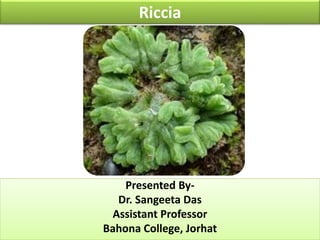
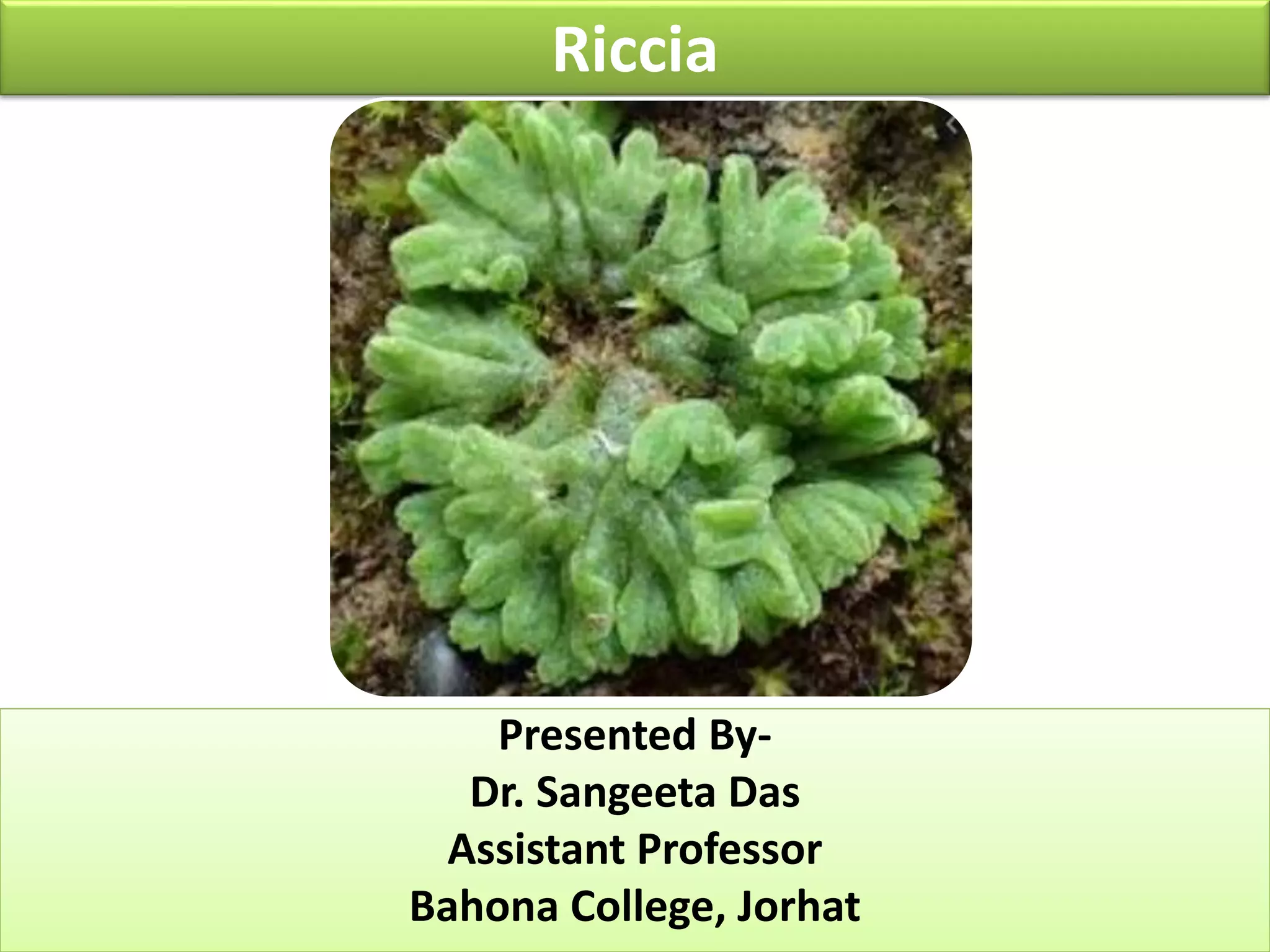

Riccia
Presented By-
Dr. Sangeeta Das
Assistant Professor
Bahona College, Jorhat
Systematic Position of Riccia:
Division- Bryophyta
Class- Hepaticopsida
Order- Marchantiales
Family- Ricciaceae
Genus- Riccia
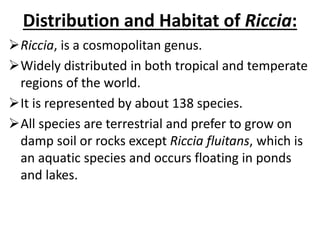
Distribution and Habitat of Riccia:
Riccia, is a cosmopolitan genus.
Widely distributed in both tropical and temperate
regions of the world.
It is represented by about 138 species.
All species are terrestrial and prefer to grow on
damp soil or rocks except Riccia fluitans, which is
an aquatic species and occurs floating in ponds
and lakes.
GAMETOPHYTIC PHASE
A. External Morphology:
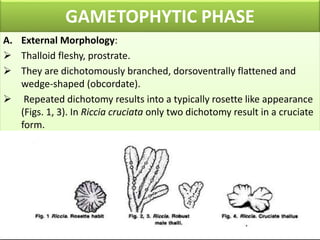
 Thalloid fleshy, prostrate.
 They are dichotomously branched, dorsoventrally flattened and
wedge-shaped (obcordate).
 Repeated dichotomy results into a typically rosette like appearance
(Figs. 1, 3). In Riccia cruciata only two dichotomy result in a cruciate
form.
Anatomy
The thallus of Riccia is internally differentiated into:
1. Upper Assimilatory Region:
2. Lower storage region.
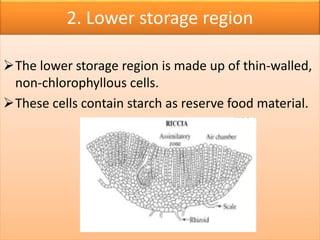
1. Upper Assimilatory Region:
The chloroplast-rich assimilatory cells are stacked
over one another, forming a filament which serves
as a column of air chamber.
 The uppermost cells of assimilatory filaments lack
chloroplasts and together form a loose epidermis.
Each air chamber opens on the dorsal surface by an
air pore which help in the gaseous exchange.
2. Lower storage region
The lower storage region is made up of thin-walled,
non-chlorophyllous cells.
These cells contain starch as reserve food material.
Reproduction in Riccia:
Riccia reproduces by vegetative and sexual
methods.
A. Vegetative Reproduction:
1. By death and decay of the older portion of the
thallus.
2. By adventitious branches: The adventitious
branches develop from the ventral surface of the
thallus e.g., Riccia fluitans. On being separated,
these branches develop into new thalli.
3. By persistent apices: Due to prolonged dry summer
or towards the end of growing season the whole
thallus in some species (e.g., Riccia discolor) dries
and gets destroyed except the growing point. Under
favourable environmental conditions it develops
into a new thallus.
A. Vegetative Reproduction:
4. By tubers.
5. By rhizoids:The apical part of the young rhizoids
divides and re-divides to form a gemma like mass of
chloroplast containing cells in some species (e.g.,
Riccia glauca). These cells are capable of developing
into new thallus.
B. Sexual Reproduction:
Sexual reproduction in Riccia is of oogamous type.
The species of Riccia may be homothallic
(monoecious) e.g., H. billaridieri, R. crystallina, R.
glauca or heterothallic (dioecious) e.g., R. discolor,
R. perssonii, R. frostii.
The sex organs are born in the region of median
furrow and are embedded in the thallus.
The male sex organ is known as the antheridium
and the female, the archegonium.
SPOROPHYTIC PHASE
After fertilization the diploid zygote or oospore is
formed.
It then enlarges until it completely fills the cavity of
the venter of the archegonium.
It secretes a cell wall around the oospore. The wall
of the venter also undergoes division.
It divides anticlinally and periclinally to form a two-
layered calyptra along the developing sporophyte.
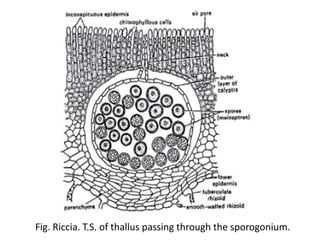
Fig. Riccia. T.S. of thallus passing through the sporogonium.
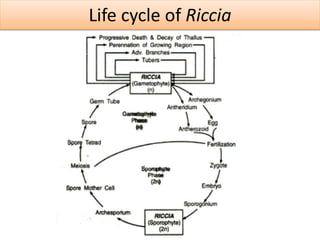
Life cycle of Riccia

Riccia

  • 1.
    Riccia Presented By- Dr. SangeetaDas Assistant Professor Bahona College, Jorhat
  • 2.
    Systematic Position ofRiccia: Division- Bryophyta Class- Hepaticopsida Order- Marchantiales Family- Ricciaceae Genus- Riccia
  • 3.
    Distribution and Habitatof Riccia: Riccia, is a cosmopolitan genus. Widely distributed in both tropical and temperate regions of the world. It is represented by about 138 species. All species are terrestrial and prefer to grow on damp soil or rocks except Riccia fluitans, which is an aquatic species and occurs floating in ponds and lakes.
  • 4.
    GAMETOPHYTIC PHASE A. ExternalMorphology:  Thalloid fleshy, prostrate.  They are dichotomously branched, dorsoventrally flattened and wedge-shaped (obcordate).  Repeated dichotomy results into a typically rosette like appearance (Figs. 1, 3). In Riccia cruciata only two dichotomy result in a cruciate form.
  • 5.
    Anatomy The thallus ofRiccia is internally differentiated into: 1. Upper Assimilatory Region: 2. Lower storage region.
  • 6.
    1. Upper AssimilatoryRegion: The chloroplast-rich assimilatory cells are stacked over one another, forming a filament which serves as a column of air chamber.  The uppermost cells of assimilatory filaments lack chloroplasts and together form a loose epidermis. Each air chamber opens on the dorsal surface by an air pore which help in the gaseous exchange.
  • 7.
    2. Lower storageregion The lower storage region is made up of thin-walled, non-chlorophyllous cells. These cells contain starch as reserve food material.
  • 8.
    Reproduction in Riccia: Ricciareproduces by vegetative and sexual methods.
  • 9.
    A. Vegetative Reproduction: 1.By death and decay of the older portion of the thallus. 2. By adventitious branches: The adventitious branches develop from the ventral surface of the thallus e.g., Riccia fluitans. On being separated, these branches develop into new thalli. 3. By persistent apices: Due to prolonged dry summer or towards the end of growing season the whole thallus in some species (e.g., Riccia discolor) dries and gets destroyed except the growing point. Under favourable environmental conditions it develops into a new thallus.
  • 10.
    A. Vegetative Reproduction: 4.By tubers. 5. By rhizoids:The apical part of the young rhizoids divides and re-divides to form a gemma like mass of chloroplast containing cells in some species (e.g., Riccia glauca). These cells are capable of developing into new thallus.
  • 11.
    B. Sexual Reproduction: Sexualreproduction in Riccia is of oogamous type. The species of Riccia may be homothallic (monoecious) e.g., H. billaridieri, R. crystallina, R. glauca or heterothallic (dioecious) e.g., R. discolor, R. perssonii, R. frostii. The sex organs are born in the region of median furrow and are embedded in the thallus. The male sex organ is known as the antheridium and the female, the archegonium.
  • 12.
    SPOROPHYTIC PHASE After fertilizationthe diploid zygote or oospore is formed. It then enlarges until it completely fills the cavity of the venter of the archegonium. It secretes a cell wall around the oospore. The wall of the venter also undergoes division. It divides anticlinally and periclinally to form a two- layered calyptra along the developing sporophyte.
  • 13.
    Fig. Riccia. T.S.of thallus passing through the sporogonium.
  • 14.