THE ALGAE
PRESENTED BY: SHANTANU SHRIVASTAVA
DEPARTMENT OF MICROBIOLOGY
CONTENTS:-
 INTRODUCTION TO ALGAE
 CLASSIFICATION OF ALGAE
 ULTRASTRUCTURE OF ALGAL CELL
 CHARACTERISTIC OF ALGAL DIVISIONS
• CHLOROPHYTA
• CHAROPHYTA
• EUGLENOPHYTA
• CHRYSOPHYTA
• PHAEOPHYTA
• RHODOPHYTA
• PYRRHOPHYTA
INTRODUCTION :-
• PHYCOLOGY OR ALGOLOGY IS THE STUDY OF ALGAE.
• The algae are a very diverse group of organisms, ranging in size from
microscopic Single cells to kelps over 75 m in length.
• Algae grow in a wide variety of habitats. Within the oceans and fresh
water environments, they are the major producers of OXYGEN and
ORGANIC Material.
• Algae can be described as EUKARYOTIC organisms that Lack roots,
stems, and leaves but have chlorophyll and other pigments for carrying
out oxygen producing photosynthesis. Many can be placed in the
kingdom protista.
SOME ALGAE SHOWING :-
•DISTRIBUTION OF ALGAE
 Algae most commonly occur in water (fresh, marine, or brackish) in
which they may be suspended (planktonic) or attached and living on
the bottom (benthic).
 Phytoplankton is made up of algae and small plants, whereas
Zooplankton consists of animals and non photosynthetic protests.
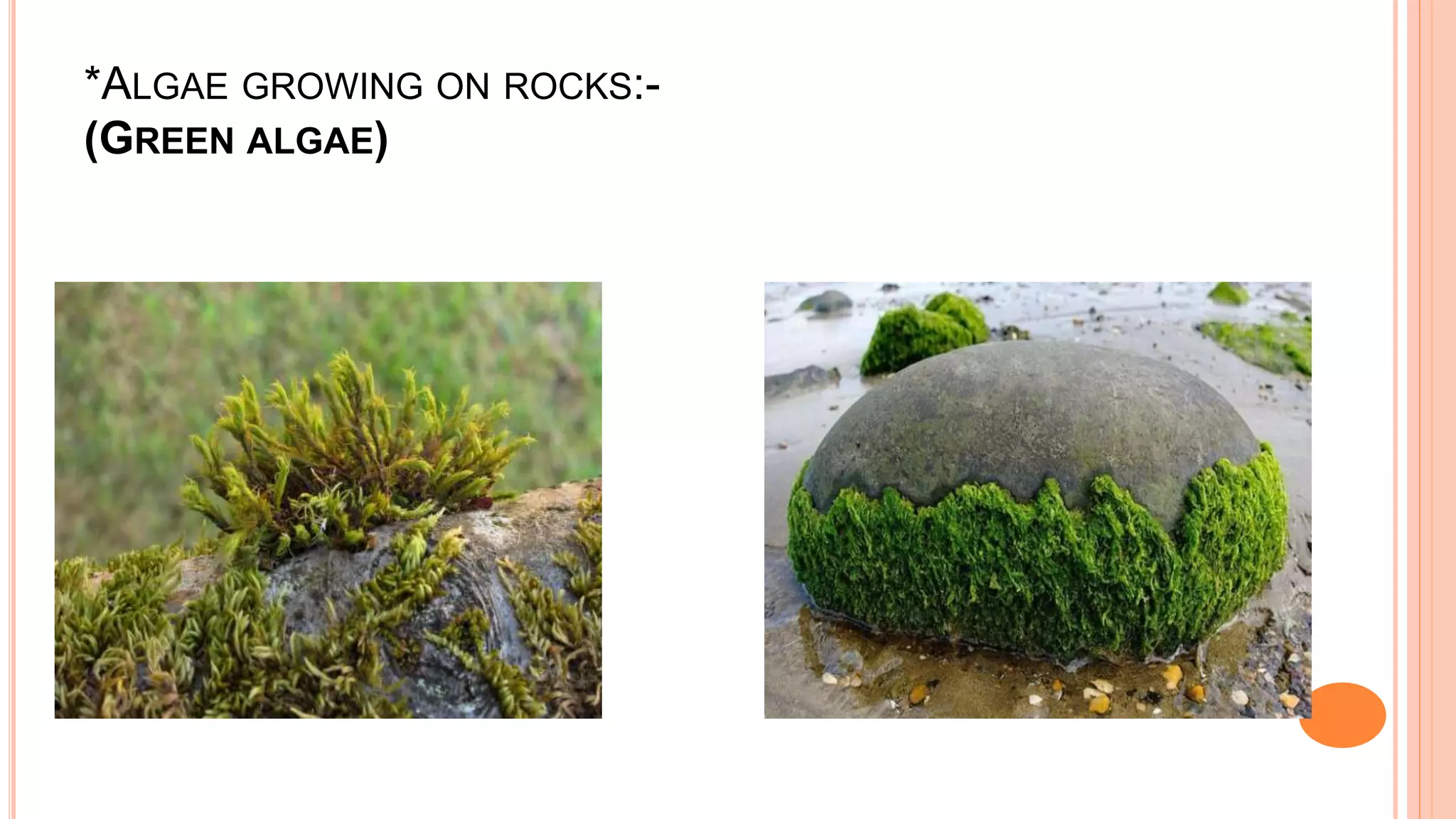
 Some algae grow on moist rocks, wood, trees, and on the surface of
moist soil.
 Algae also live as endosymbionts in various protozoa, mollusks,
worms, and corals.
 Algae also associate with fungi to form lichens.
*ALGAE GROWING ON ROCKS:-
(GREEN ALGAE)
•ULTRASTRUCTURE OF ALGAL CELL
 The EUKARYOTIC algal cell is surrounded by a thin, rigid cell wall.
 Some algae have an outer matrix lying outside the cell wall. This
usually is flexible and gelatinous, similar to bacterial capsules.
 The nucleus has a typical nuclear envelope with pores; within the
nucleus are a nucleolus, chromatin, and karyolymph.
 A dense proteinaceous area, the pyrenoid that
is associated with synthesis and storage of starch
May be present in the chloroplasts.
•CHARACTERISTICS OF ALGAL DIVISIONS:-
 CHLOROPHYTA (Green Algae)
• The chlorophyta or green algae [Greek Chloros, green] are an
extremely varied division.
• They grow in fresh and salt water, in soil, on other organisms, and
within other organisms.
• The CHLOROPHYTA have chlorophylls a and b along with specific
carotenoids, and they store carbohydrates as starch.
• Many have cell walls of cellulose. They exhibit a wide diversity of body
forms, ranging from unicellular to colonial, filamentous, membranous or
sheet like, and tubular types.
• Some species have a holdfast structure that anchors them to the
substratum. Both asexual and sexual reproduction occur in green algae.
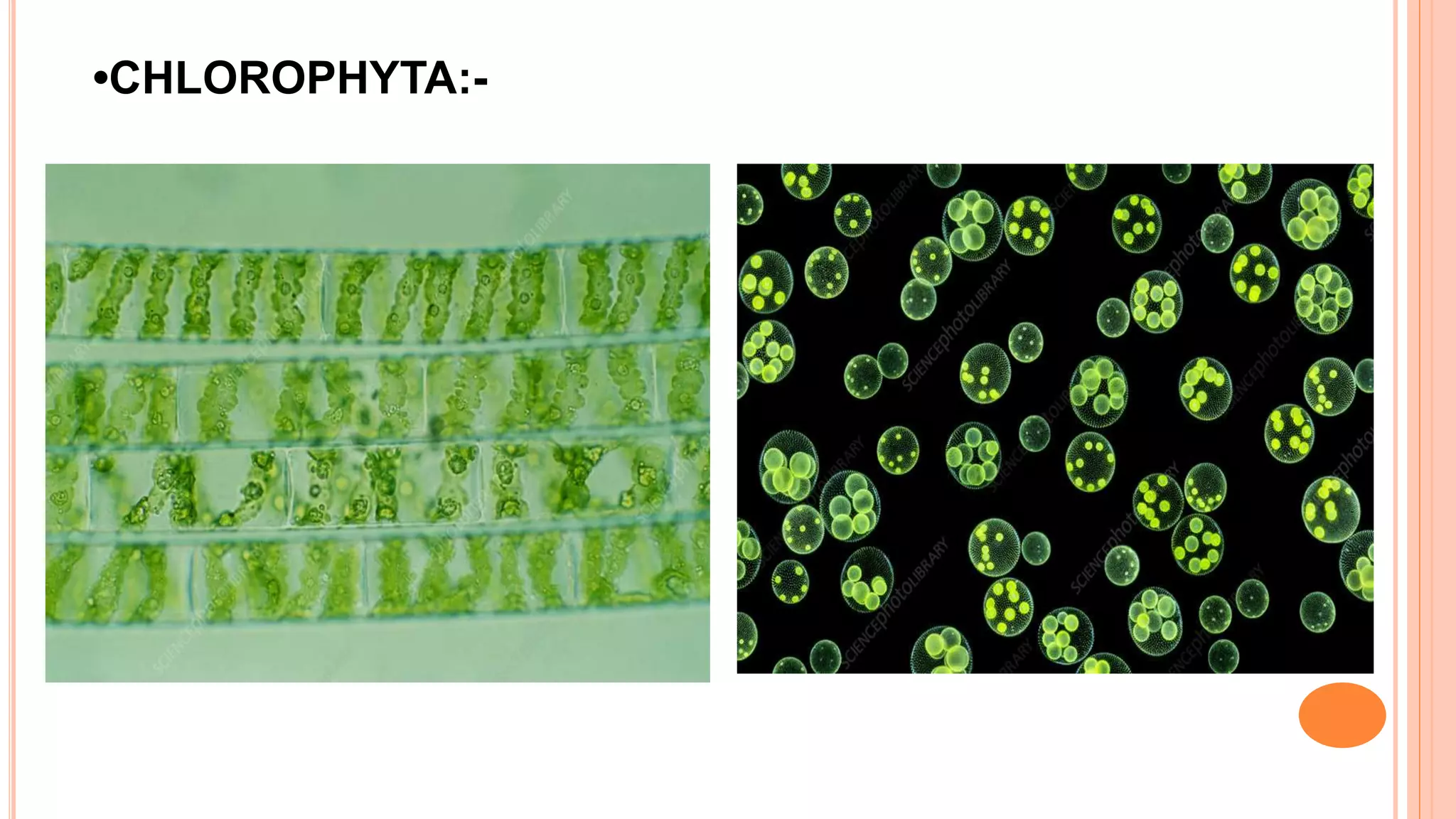
•CHLOROPHYTA:-
• From organisms like Chlamydomonas, several distinct lines of
evolutionary specialization have evolved in the green algae.
• The first line contains non motile unicellular green algae, such as
Chlorella. Chlorella is widespread both in fresh and salt water and
also in soil.
• It only reproduces asexually and lacks flagella, eyespots, and
contractile vacuoles; the nucleus is very small.
• One green alga, prototheca moriformis, causes the disease
protothecosis in humans and animals.
 CHAROPHYTA (Stoneworts/Brittleworts)
• The Stoneworts are abundant in fresh to brackish waters and
have a worldwide distribution.
• Often they appear as a dense covering on the bottom of
shallow ponds.
• Some species precipitate calcium and magnesium carbonate
from the water to form a limestone covering, thus giving the
Charophyta their common names of Stoneworts or brittleworts.
 EUGLENOPHYTA (Euglenoids)
• The Euglenoids share with the chlorophyta and Charophyta
the presence of chlorophylls a and b In their chloroplasts.
• The primary storage product is paramylon (a
polysacchaharide composed of β-1,3 linked glucose molecules),
which is unique to Euglenoids.
• They occur in fresh, brackish, and marine waters and on moist
soils; they often form Water blooms in ponds and cattle water
tanks.
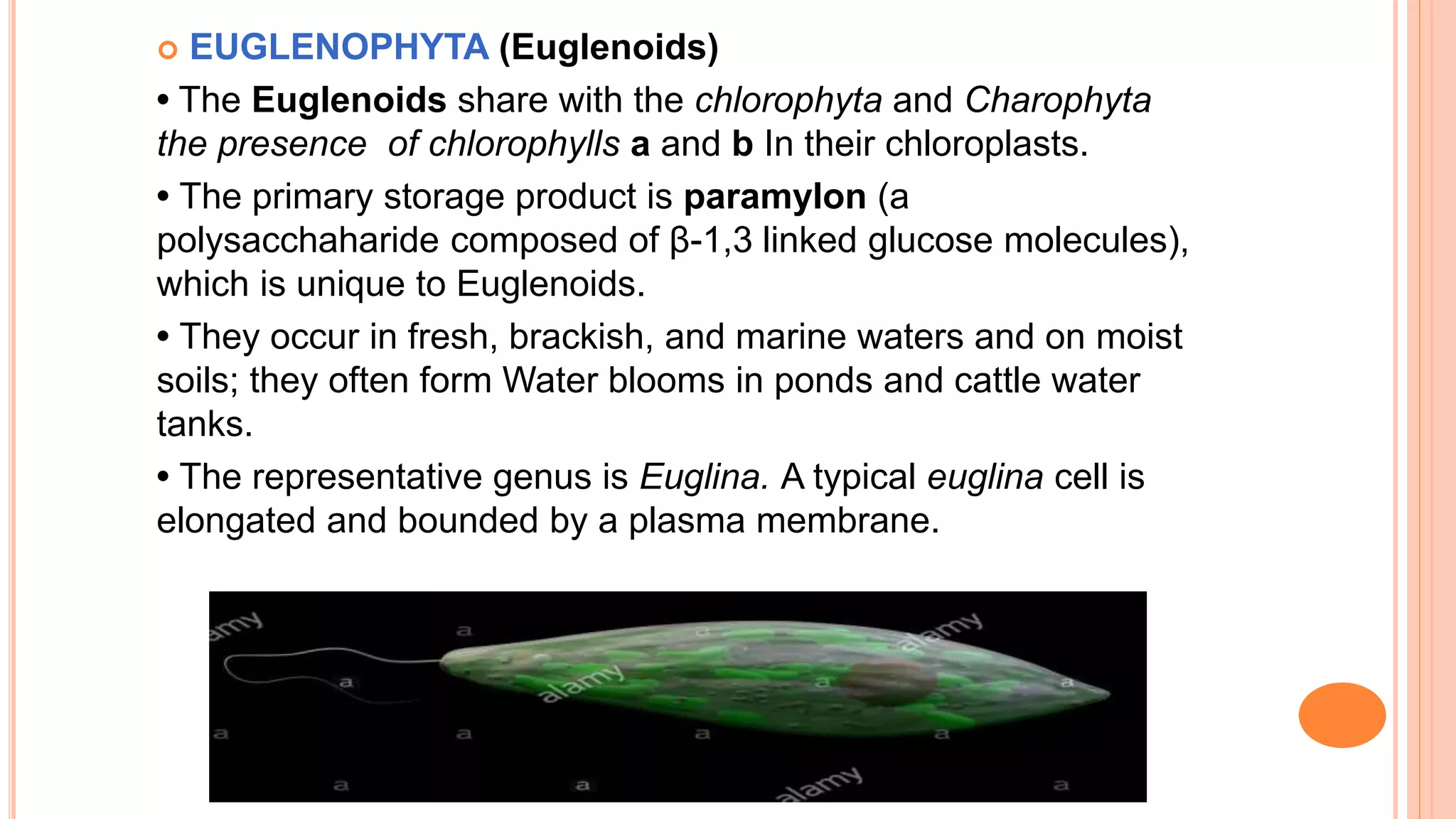
• The representative genus is Euglina. A typical euglina cell is
elongated and bounded by a plasma membrane.
 CRYSOPHYTA (Golden-Brown and Yellow-Green Algae; Diatoms)
• The division Crysophyta is quite diversified with respect to pigment
composition, cell wall, and type of flagellated cells.
• The division is divided into three Major classes; Golden-Brown algae,
Yellow-Green algae, and diatoms.
• The major photosynthetic pigments are usually chlorophylls a and c1/c2, and
the carotenoid fucoxanthin.
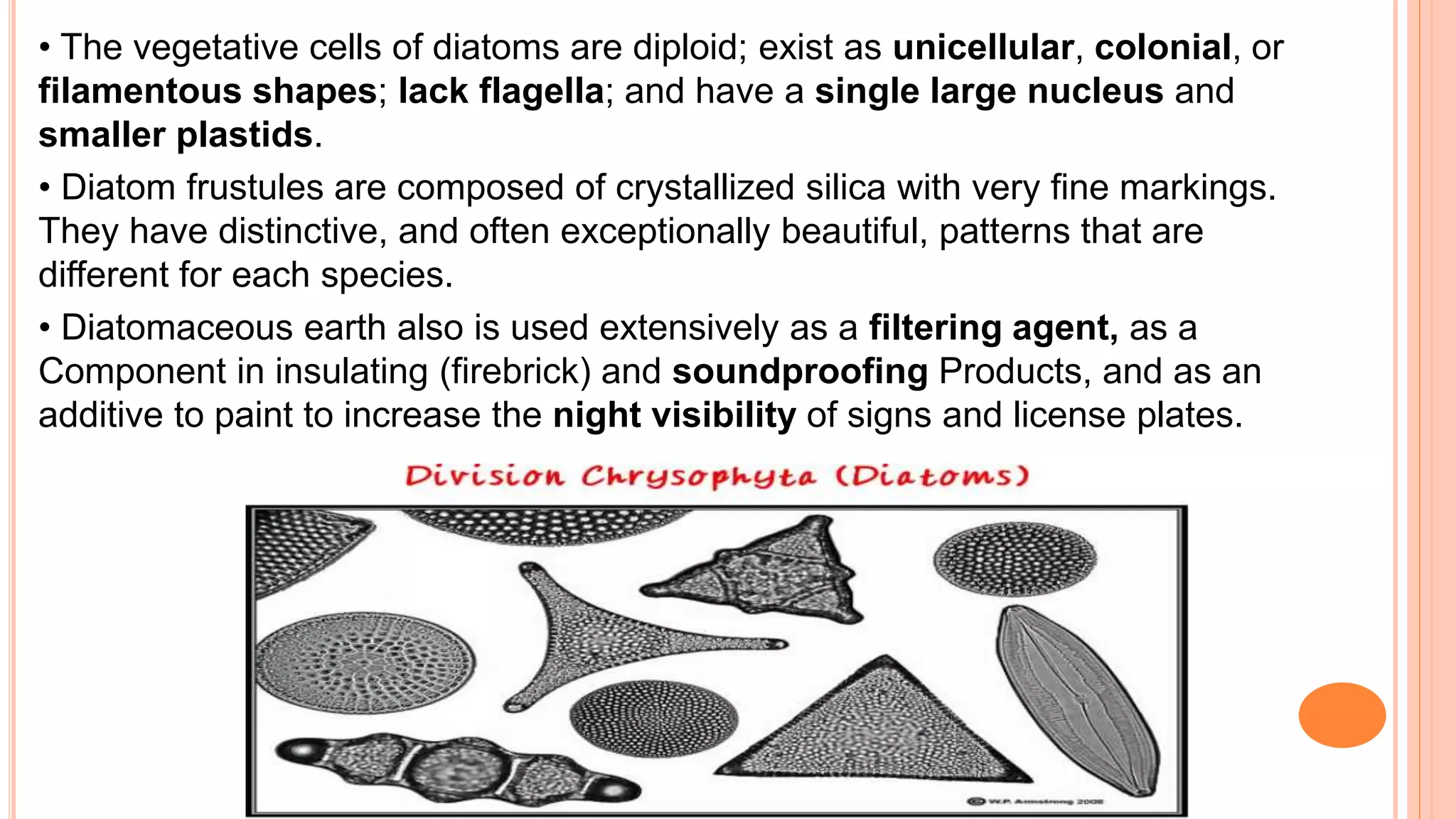
• Diatoms have a distinctive two-piece wall of silica, called a Frustule.
• Two anteriorly attached flagella of unequal length are common among
chrysophyta, but some species have no flagella, and others have either one
flagellum or two that are of equal length.
• Blooms of some species produce unpleasant odors and tastes in drinking
water.
• Diatoms grow in fresh water, salt water, and moist soil, and compromise a
large part of the Phytoplankton.
• The chloroplasts of these chrysophytes Contain chlorophylls a and c as well
as carotenoids.
• The vegetative cells of diatoms are diploid; exist as unicellular, colonial, or
filamentous shapes; lack flagella; and have a single large nucleus and
smaller plastids.
• Diatom frustules are composed of crystallized silica with very fine markings.
They have distinctive, and often exceptionally beautiful, patterns that are
different for each species.
• Diatomaceous earth also is used extensively as a filtering agent, as a
Component in insulating (firebrick) and soundproofing Products, and as an
additive to paint to increase the night visibility of signs and license plates.
 PHAEOPHYTA (Brown Algae)
• The Phaeophyta or brown algae [Greek Phaeo, brown] Consists of multicellular
organisms that occur almost exclusively in the sea.
• The simplest brown algae consists of small openly branched filaments; the larger,
more advanced species have a complex arrangement.
• The color of these algae reflects the presence of the brown pigment fucoxanthin,
in addition to chlorophylls a and c, β-carotene, and violaxanthin.
• The main storage product is laminarin, which is quite similar in structure to
chrysolaminarin.
 RHODOPHYTA (Red Algae)
• The division Rhodophyta, the red algae [Greek rhodon, rose], includes most of
the seaweeds.
• A few reds are unicellular but most are filamentous and multicellular. Some red
algae are up-to 1 m long.
• The red algae contain the red pigment phycoerythrin, one of the two types of
phycobilins they possess.
• The other accessory Pigment is the blue pigment phycocyanin.
• The wavelength of light (green, violet, and blue) that penetrates these depths
are not absorbed by chlorophyll a but instead by these phycobilins.
• Many red algae also deposit calcium carbonate in their cell walls and play an
important role in building coral reefs.
 PYRRHOPHYTA (Dinoflagellates)
• The pyrrhophyta Or dinoflagellates are unicellular, photosynthetic protistan
algae.
• Most dinoflagellates are marine, but some live in fresh water.
• Species of Noctiluca, pyrodinium, Gonyaulax, and other genera can produce
light and are responsible for much of the luminescence (phosphorescence)
seen in ocean waters at night.
• TOXIC ALGAL BLOOMS:
 The poisonous and destructive red tides that occur frequently in
coastal areas often are associated with population explosions, or
“blooms,” of dinoflagellates.
 The pigments in the dinoflagellate cells are responsible For the red
colour of the water. Under these bloom conditions, the dinoflagellates
produce a powerful neurotoxin called saxitoxin.
THANK YOU

Algae (classifications) & Algal Blooms

  • 1.
    THE ALGAE PRESENTED BY:SHANTANU SHRIVASTAVA DEPARTMENT OF MICROBIOLOGY
  • 2.
    CONTENTS:-  INTRODUCTION TOALGAE  CLASSIFICATION OF ALGAE  ULTRASTRUCTURE OF ALGAL CELL  CHARACTERISTIC OF ALGAL DIVISIONS • CHLOROPHYTA • CHAROPHYTA • EUGLENOPHYTA • CHRYSOPHYTA • PHAEOPHYTA • RHODOPHYTA • PYRRHOPHYTA
  • 3.
    INTRODUCTION :- • PHYCOLOGYOR ALGOLOGY IS THE STUDY OF ALGAE. • The algae are a very diverse group of organisms, ranging in size from microscopic Single cells to kelps over 75 m in length. • Algae grow in a wide variety of habitats. Within the oceans and fresh water environments, they are the major producers of OXYGEN and ORGANIC Material. • Algae can be described as EUKARYOTIC organisms that Lack roots, stems, and leaves but have chlorophyll and other pigments for carrying out oxygen producing photosynthesis. Many can be placed in the kingdom protista.
  • 4.
  • 5.
    •DISTRIBUTION OF ALGAE Algae most commonly occur in water (fresh, marine, or brackish) in which they may be suspended (planktonic) or attached and living on the bottom (benthic).  Phytoplankton is made up of algae and small plants, whereas Zooplankton consists of animals and non photosynthetic protests.  Some algae grow on moist rocks, wood, trees, and on the surface of moist soil.  Algae also live as endosymbionts in various protozoa, mollusks, worms, and corals.  Algae also associate with fungi to form lichens.
  • 6.
    *ALGAE GROWING ONROCKS:- (GREEN ALGAE)
  • 7.
    •ULTRASTRUCTURE OF ALGALCELL  The EUKARYOTIC algal cell is surrounded by a thin, rigid cell wall.  Some algae have an outer matrix lying outside the cell wall. This usually is flexible and gelatinous, similar to bacterial capsules.  The nucleus has a typical nuclear envelope with pores; within the nucleus are a nucleolus, chromatin, and karyolymph.  A dense proteinaceous area, the pyrenoid that is associated with synthesis and storage of starch May be present in the chloroplasts.
  • 8.
    •CHARACTERISTICS OF ALGALDIVISIONS:-  CHLOROPHYTA (Green Algae) • The chlorophyta or green algae [Greek Chloros, green] are an extremely varied division. • They grow in fresh and salt water, in soil, on other organisms, and within other organisms. • The CHLOROPHYTA have chlorophylls a and b along with specific carotenoids, and they store carbohydrates as starch. • Many have cell walls of cellulose. They exhibit a wide diversity of body forms, ranging from unicellular to colonial, filamentous, membranous or sheet like, and tubular types. • Some species have a holdfast structure that anchors them to the substratum. Both asexual and sexual reproduction occur in green algae.
  • 9.
  • 10.
    • From organismslike Chlamydomonas, several distinct lines of evolutionary specialization have evolved in the green algae. • The first line contains non motile unicellular green algae, such as Chlorella. Chlorella is widespread both in fresh and salt water and also in soil. • It only reproduces asexually and lacks flagella, eyespots, and contractile vacuoles; the nucleus is very small. • One green alga, prototheca moriformis, causes the disease protothecosis in humans and animals.
  • 11.
     CHAROPHYTA (Stoneworts/Brittleworts) •The Stoneworts are abundant in fresh to brackish waters and have a worldwide distribution. • Often they appear as a dense covering on the bottom of shallow ponds. • Some species precipitate calcium and magnesium carbonate from the water to form a limestone covering, thus giving the Charophyta their common names of Stoneworts or brittleworts.
  • 12.
     EUGLENOPHYTA (Euglenoids) •The Euglenoids share with the chlorophyta and Charophyta the presence of chlorophylls a and b In their chloroplasts. • The primary storage product is paramylon (a polysacchaharide composed of β-1,3 linked glucose molecules), which is unique to Euglenoids. • They occur in fresh, brackish, and marine waters and on moist soils; they often form Water blooms in ponds and cattle water tanks. • The representative genus is Euglina. A typical euglina cell is elongated and bounded by a plasma membrane.
  • 13.
     CRYSOPHYTA (Golden-Brownand Yellow-Green Algae; Diatoms) • The division Crysophyta is quite diversified with respect to pigment composition, cell wall, and type of flagellated cells. • The division is divided into three Major classes; Golden-Brown algae, Yellow-Green algae, and diatoms. • The major photosynthetic pigments are usually chlorophylls a and c1/c2, and the carotenoid fucoxanthin. • Diatoms have a distinctive two-piece wall of silica, called a Frustule. • Two anteriorly attached flagella of unequal length are common among chrysophyta, but some species have no flagella, and others have either one flagellum or two that are of equal length. • Blooms of some species produce unpleasant odors and tastes in drinking water. • Diatoms grow in fresh water, salt water, and moist soil, and compromise a large part of the Phytoplankton. • The chloroplasts of these chrysophytes Contain chlorophylls a and c as well as carotenoids.
  • 14.
    • The vegetativecells of diatoms are diploid; exist as unicellular, colonial, or filamentous shapes; lack flagella; and have a single large nucleus and smaller plastids. • Diatom frustules are composed of crystallized silica with very fine markings. They have distinctive, and often exceptionally beautiful, patterns that are different for each species. • Diatomaceous earth also is used extensively as a filtering agent, as a Component in insulating (firebrick) and soundproofing Products, and as an additive to paint to increase the night visibility of signs and license plates.
  • 15.
     PHAEOPHYTA (BrownAlgae) • The Phaeophyta or brown algae [Greek Phaeo, brown] Consists of multicellular organisms that occur almost exclusively in the sea. • The simplest brown algae consists of small openly branched filaments; the larger, more advanced species have a complex arrangement. • The color of these algae reflects the presence of the brown pigment fucoxanthin, in addition to chlorophylls a and c, β-carotene, and violaxanthin. • The main storage product is laminarin, which is quite similar in structure to chrysolaminarin.
  • 16.
     RHODOPHYTA (RedAlgae) • The division Rhodophyta, the red algae [Greek rhodon, rose], includes most of the seaweeds. • A few reds are unicellular but most are filamentous and multicellular. Some red algae are up-to 1 m long. • The red algae contain the red pigment phycoerythrin, one of the two types of phycobilins they possess. • The other accessory Pigment is the blue pigment phycocyanin. • The wavelength of light (green, violet, and blue) that penetrates these depths are not absorbed by chlorophyll a but instead by these phycobilins. • Many red algae also deposit calcium carbonate in their cell walls and play an important role in building coral reefs.
  • 17.
     PYRRHOPHYTA (Dinoflagellates) •The pyrrhophyta Or dinoflagellates are unicellular, photosynthetic protistan algae. • Most dinoflagellates are marine, but some live in fresh water. • Species of Noctiluca, pyrodinium, Gonyaulax, and other genera can produce light and are responsible for much of the luminescence (phosphorescence) seen in ocean waters at night.
  • 18.
    • TOXIC ALGALBLOOMS:  The poisonous and destructive red tides that occur frequently in coastal areas often are associated with population explosions, or “blooms,” of dinoflagellates.  The pigments in the dinoflagellate cells are responsible For the red colour of the water. Under these bloom conditions, the dinoflagellates produce a powerful neurotoxin called saxitoxin.
  • 19.