DIATOMS 
General Features, Morphology and Reproduction
Diatoms are a major group of algae, and are among the most common types of phytoplankton. 
Most diatoms are unicellular, although they can exist as colonies in the shape of filaments or ribbons (e.g. Fragilaria), zigzags (e.g. Tabellaria), or stars (e.g. Asterionella). 
Diatoms generally range in size from 2-200μm. The skeleton of a diatom, or frustule, is made of very pure silica (hydrated silicon dioxide) coated with a layer of organic material. These frustules show a wide diversity in form, but are usually almost bilaterally symmetrical.
The skeleton or frustuleis divided into two parts, one of which (the epitheca) overlaps the other (the hypotheca) like the lid of a box or petridish.
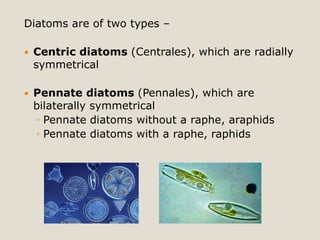
Diatoms are of two types – 
Centric diatoms (Centrales), which are radiallysymmetrical 
Pennatediatoms (Pennales), which are bilaterally symmetrical 
◦Pennatediatoms without a raphe, araphids 
◦Pennatediatoms with a raphe, raphids
Both parts of a frustulemay be highly perforated. Pennatediatoms show a long slit, the raphe, along the long axis. 
Through the raphe, the living diatom secretes mucilage, with which it may attach to a substrate or move by gliding over the substrate.
Major pigments of diatoms are – 
◦Chlorophylls a and c 
◦Beta-carotene 
◦Fucoxanthin 
◦Diatoxanthin 
◦Diadinoxanthin 
Major storage products are – 
◦Chrysolaminarin 
◦Lipids
Reproduction 
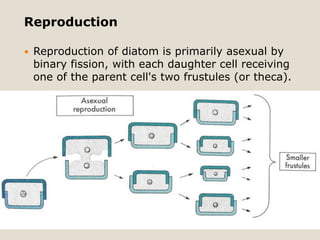
Reproduction of diatom is primarily asexual by binary fission, with each daughter cell receiving one of the parent cell's two frustules (or theca).
This is used by each daughter cell as the larger frustule(or epitheca) into which a second, small frustule(or hypotheca) is constructed. 
This form of division results in a size reduction of the daughter cell that received the smaller frustulefrom the parent and therefore the average cell size of a diatom population decreases. 
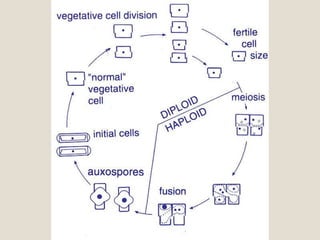
Nonetheless, in order to restore the cell size of a diatom population for those that do endure size reduction, sexual reproduction and auxosporeformation must occur.
Vegetative cells of diatoms are diploid (2N) and so meiosis can take place, producing male and female gametes which then fuse to form the zygote. 
The zygote sheds its silica theca and grows into a large sphere covered by an organic membrane, the auxospore. 
A new diatom cell of maximum size, the initial cell, forms within the auxosporethus beginning a new generation.

Diatom - Overview

  • 1.
    DIATOMS General Features,Morphology and Reproduction
  • 2.
    Diatoms are amajor group of algae, and are among the most common types of phytoplankton. Most diatoms are unicellular, although they can exist as colonies in the shape of filaments or ribbons (e.g. Fragilaria), zigzags (e.g. Tabellaria), or stars (e.g. Asterionella). Diatoms generally range in size from 2-200μm. The skeleton of a diatom, or frustule, is made of very pure silica (hydrated silicon dioxide) coated with a layer of organic material. These frustules show a wide diversity in form, but are usually almost bilaterally symmetrical.
  • 3.
    The skeleton orfrustuleis divided into two parts, one of which (the epitheca) overlaps the other (the hypotheca) like the lid of a box or petridish.
  • 5.
    Diatoms are oftwo types – Centric diatoms (Centrales), which are radiallysymmetrical Pennatediatoms (Pennales), which are bilaterally symmetrical ◦Pennatediatoms without a raphe, araphids ◦Pennatediatoms with a raphe, raphids
  • 6.
    Both parts ofa frustulemay be highly perforated. Pennatediatoms show a long slit, the raphe, along the long axis. Through the raphe, the living diatom secretes mucilage, with which it may attach to a substrate or move by gliding over the substrate.
  • 7.
    Major pigments ofdiatoms are – ◦Chlorophylls a and c ◦Beta-carotene ◦Fucoxanthin ◦Diatoxanthin ◦Diadinoxanthin Major storage products are – ◦Chrysolaminarin ◦Lipids
  • 8.
    Reproduction Reproduction ofdiatom is primarily asexual by binary fission, with each daughter cell receiving one of the parent cell's two frustules (or theca).
  • 9.
    This is usedby each daughter cell as the larger frustule(or epitheca) into which a second, small frustule(or hypotheca) is constructed. This form of division results in a size reduction of the daughter cell that received the smaller frustulefrom the parent and therefore the average cell size of a diatom population decreases. Nonetheless, in order to restore the cell size of a diatom population for those that do endure size reduction, sexual reproduction and auxosporeformation must occur.
  • 11.
    Vegetative cells ofdiatoms are diploid (2N) and so meiosis can take place, producing male and female gametes which then fuse to form the zygote. The zygote sheds its silica theca and grows into a large sphere covered by an organic membrane, the auxospore. A new diatom cell of maximum size, the initial cell, forms within the auxosporethus beginning a new generation.