RESTRICTION
ENDONUCLEASE
Presented by:
Asha Raj
Inchara R
VII Semester
Molecular Biology
Yuvaraja College
(Autonomous)
Mysuru
CONTENTS
• INTRODUCTION
• HISTORY
• NOMENCLATURE
• RECOGNITION SEQUENCES AND CLEAVAGE
• CLASSIFICATION
• MECHANISM
• CONCLUSION
• REFERENCES
• ACKNOWLEDGEMENT
INTRODUCTION
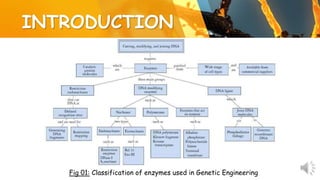
Fig 01: Classification of enzymes used in Genetic Engineering
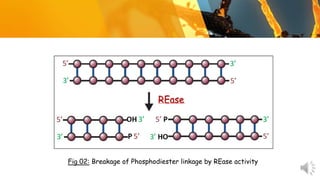
Fig 02: Breakage of Phosphodiester linkage by REase activity
HISTORY
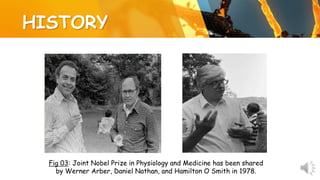
Fig 03: Joint Nobel Prize in Physiology and Medicine has been shared
by Werner Arber, Daniel Nathan, and Hamilton O Smith in 1978.
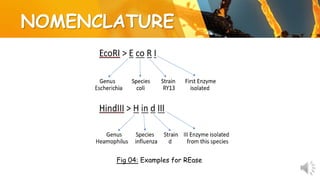
NOMENCLATURE
Fig 04: Examples for REase
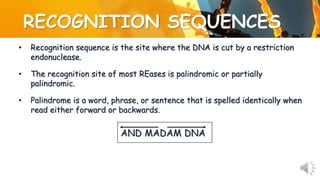
RECOGNITION SEQUENCES
• Recognition sequence is the site where the DNA is cut by a restriction
endonuclease.
• The recognition site of most REases is palindromic or partially
palindromic.
• Palindrome is a word, phrase, or sentence that is spelled identically when
read either forward or backwards.
AND MADAM DNA
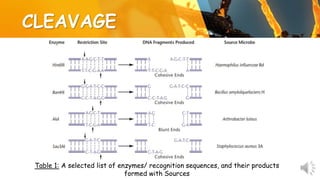
CLEAVAGE
Table 1: A selected list of enzymes/ recognition sequences, and their products
formed with Sources
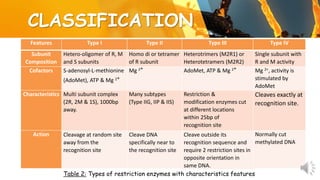
Type I
Hetero-oligomer of R, M
and S subunits
S-adenosyl-L-methionine
(AdoMet), ATP & Mg 2+
Multi subunit complex
(2R, 2M & 1S), 1000bp
away.
Cleavage at random site
away from the
recognition site
Type II
Homo di or tetramer
of R subunit
Mg 2+
Many subtypes
(Type IIG, IIP & IIS)
Cleave DNA
specifically near to
the recognition site
Features
Subunit
Composition
Cofactors
Characteristics
Action
Type III
Heterotrimers (M2R1) or
Heterotetramers (M2R2)
AdoMet, ATP & Mg 2+
Restriction &
modification enzymes cut
at different locations
within 25bp of
recognition site
Cleave outside its
recognition sequence and
require 2 restriction sites in
opposite orientation in
same DNA.
Type IV
Single subunit with
R and M activity
Mg 2+, activity is
stimulated by
AdoMet
Cleaves exactly at
recognition site.
Normally cut
methylated DNA
Table 2: Types of restriction enzymes with characteristics features
CLASSIFICATION
MECHANISM
Mg2+
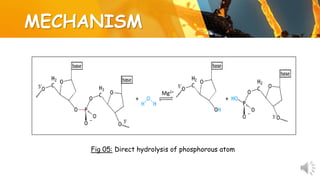
Fig 05: Direct hydrolysis of phosphorous atom
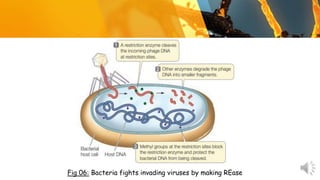
Fig 06: Bacteria fights invading viruses by making REase
CONCLUSION
REFERENCES
• Craig Heller, David Hillis, May Berenbaum & David Sadava. 2011. LIFE: The
Science of Biology, 9th Edition, Sinauer Associates, Inc., Sunderland, U.S.A,
1392pp.
• Brown T. A. 2010. Gene Cloning & DNA Analysis: An Introduction, 6th Edition,
John Wiley & Sons, Ltd., Publication, West Sussex, UK, 338pp.
• James D. Watson, Alexander Gann, Tania A. Baker, Michael Levine, Stephen P.
Bell & Richard Losick with Stephen C. Harrison. 2014. Molecular Biology of the
gene, 7th edition, Cold Spring Harbor Laboratory Press, Cold Spring Harbor,
New York, USA, 911pp.
• https://international.neb.com/products/restriction-endonucleases/restriction-
endonucleases/types-of-restriction-endonucleases
• http://epgp.inflibnet.ac.in/Home/ViewSubject?catid=3
ACKNOWLEDGEMENT

Restriction Endonuclease

  • 1.
    RESTRICTION ENDONUCLEASE Presented by: Asha Raj IncharaR VII Semester Molecular Biology Yuvaraja College (Autonomous) Mysuru
  • 2.
    CONTENTS • INTRODUCTION • HISTORY •NOMENCLATURE • RECOGNITION SEQUENCES AND CLEAVAGE • CLASSIFICATION • MECHANISM • CONCLUSION • REFERENCES • ACKNOWLEDGEMENT
  • 3.
    INTRODUCTION Fig 01: Classificationof enzymes used in Genetic Engineering
  • 4.
    Fig 02: Breakageof Phosphodiester linkage by REase activity
  • 5.
    HISTORY Fig 03: JointNobel Prize in Physiology and Medicine has been shared by Werner Arber, Daniel Nathan, and Hamilton O Smith in 1978.
  • 6.
  • 7.
    RECOGNITION SEQUENCES • Recognitionsequence is the site where the DNA is cut by a restriction endonuclease. • The recognition site of most REases is palindromic or partially palindromic. • Palindrome is a word, phrase, or sentence that is spelled identically when read either forward or backwards. AND MADAM DNA
  • 8.
    CLEAVAGE Table 1: Aselected list of enzymes/ recognition sequences, and their products formed with Sources
  • 9.
    Type I Hetero-oligomer ofR, M and S subunits S-adenosyl-L-methionine (AdoMet), ATP & Mg 2+ Multi subunit complex (2R, 2M & 1S), 1000bp away. Cleavage at random site away from the recognition site Type II Homo di or tetramer of R subunit Mg 2+ Many subtypes (Type IIG, IIP & IIS) Cleave DNA specifically near to the recognition site Features Subunit Composition Cofactors Characteristics Action Type III Heterotrimers (M2R1) or Heterotetramers (M2R2) AdoMet, ATP & Mg 2+ Restriction & modification enzymes cut at different locations within 25bp of recognition site Cleave outside its recognition sequence and require 2 restriction sites in opposite orientation in same DNA. Type IV Single subunit with R and M activity Mg 2+, activity is stimulated by AdoMet Cleaves exactly at recognition site. Normally cut methylated DNA Table 2: Types of restriction enzymes with characteristics features CLASSIFICATION
  • 10.
    MECHANISM Mg2+ Fig 05: Directhydrolysis of phosphorous atom
  • 11.
    Fig 06: Bacteriafights invading viruses by making REase
  • 12.
  • 13.
    REFERENCES • Craig Heller,David Hillis, May Berenbaum & David Sadava. 2011. LIFE: The Science of Biology, 9th Edition, Sinauer Associates, Inc., Sunderland, U.S.A, 1392pp. • Brown T. A. 2010. Gene Cloning & DNA Analysis: An Introduction, 6th Edition, John Wiley & Sons, Ltd., Publication, West Sussex, UK, 338pp. • James D. Watson, Alexander Gann, Tania A. Baker, Michael Levine, Stephen P. Bell & Richard Losick with Stephen C. Harrison. 2014. Molecular Biology of the gene, 7th edition, Cold Spring Harbor Laboratory Press, Cold Spring Harbor, New York, USA, 911pp. • https://international.neb.com/products/restriction-endonucleases/restriction- endonucleases/types-of-restriction-endonucleases • http://epgp.inflibnet.ac.in/Home/ViewSubject?catid=3
  • 14.