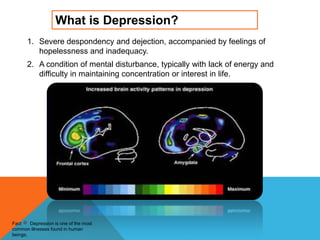
What is Depression?
      1. Severe despondency and dejection, accompanied by feelings of
         hopelessness and inadequacy.
      2. A condition of mental disturbance, typically with lack of energy and
         difficulty in maintaining concentration or interest in life.


Fact    Depression is one of the most
common illnesses found in human
beings.
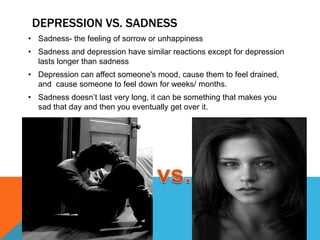
DEPRESSION VS. SADNESS
• Sadness- the feeling of sorrow or unhappiness
• Sadness and depression have similar reactions except for depression
  lasts longer than sadness
• Depression can affect someone's mood, cause them to feel drained,
  and cause someone to feel down for weeks/ months.
• Sadness doesn’t last very long, it can be something that makes you
  sad that day and then you eventually get over it.
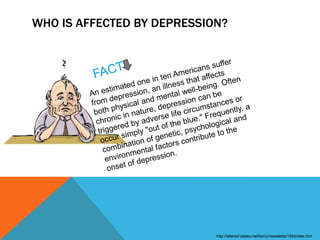
WHO IS AFFECTED BY DEPRESSION?


                            http://altered-states.net/barry/newsletter155/index.htm
FACTS ABOUT DEPRESSION
•   One of the most common illnesses found in human beings
•   Serious and sometimes can be chronic
•   Afflicts 20 percent of the population in the United States and worldwide
•   Women are two to three times more likely to fall victim to the mood disorder
    than men
•   Depression tends to run in families
•   Approximately one in five adults in the United States suffer from depression
    one time in their lives
•   Affects more than 17 million Americans each year
•   Hundreds of thousands of medications are given out each year to treat
    depression
FERTILE GROUND THEORY
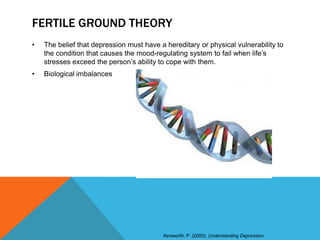
•   The belief that depression must have a hereditary or physical vulnerability to
    the condition that causes the mood-regulating system to fail when life’s
    stresses exceed the person’s ability to cope with them.
•   Biological imbalances


                                          Ainsworth, P. (2000). Understanding Depression
WHAT HAPPENS IN THE BRAIN
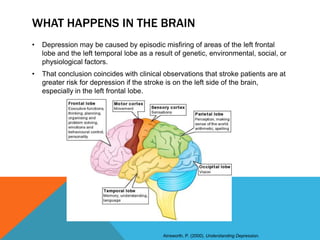
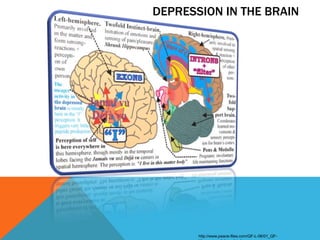
•   Depression may be caused by episodic misfiring of areas of the left frontal
    lobe and the left temporal lobe as a result of genetic, environmental, social, or
    physiological factors.
•   That conclusion coincides with clinical observations that stroke patients are at
    greater risk for depression if the stroke is on the left side of the brain,
    especially in the left frontal lobe.


                                            Ainsworth, P. (2000). Understanding Depression.
DEPRESSION IN THE BRAIN


       http://www.peace-files.com/QF-L-06/01_QF-
If the video doesn’t work I
placed the link here for you to
view on your own!
   http://www.youtube.com/watch?v=IeZCmqePLzM
MOST COMMON SYMPTOMS OF DEPRESSION
-Feelings of helplessness and hopelessness.
-Feeling useless, inadequate, bad.
-Self hatred, constant questioning of thoughts and actions, an overwhelming need for
reassurance.
-Being vulnerable and "over-sensitive".
-Feeling guilty.
-A loss of energy and motivation, that makes even the simplest tasks or decisions seem
difficult.
-Self harm.
-Loss or gain in weight.
-Difficulty with getting off to sleep, or (less frequently) an excessive desire to sleep.
-Agitation and restlessness.
-Loss of sex drive.
-Finding it impossible to concentrate for any length of time, forgetfulness.
--A sense of unreality.
-Physical aches and pains, sometimes with the fear that you are seriously ill.
*In severe depression, these feelings may also include:
-Suicidal ideas.
-Failure to eat or drink.
-Delusions and/or hallucinations.
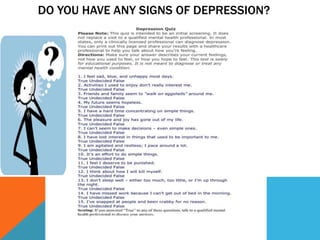
DO YOU HAVE ANY SIGNS OF DEPRESSION?
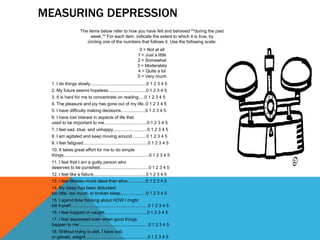
MEASURING DEPRESSION
                      The items below refer to how you have felt and behaved **during the past
                            week.** For each item, indicate the extent to which it is true, by
                         circling one of the numbers that follows it. Use the following scale:
                                                                 0 = Not at all
                                                                1 = Just a little
                                                                2 = Somewhat
                                                                3 = Moderately
                                                                4 = Quite a lot
                                                                5 = Very much
 1. I do things slowly..............................................0 1 2 3 4 5
 2. My future seems hopeless...............................0 1 2 3 4 5
 3. It is hard for me to concentrate on reading.....0 1 2 3 4 5
 4. The pleasure and joy has gone out of my life..0 1 2 3 4 5
 5. I have difficulty making decisions...................,0 1 2 3 4 5
 6. I have lost interest in aspects of life that
 used to be important to me...................................0 1 2 3 4 5
 7. I feel sad, blue, and unhappy............................0 1 2 3 4 5
 8. I am agitated and keep moving around............0 1 2 3 4 5
 9. I feel fatigued.....................................................0 1 2 3 4 5
 10. It takes great effort for me to do simple
 things......................................................................0 1 2 3 4 5
 11. I feel that I am a guilty person who
 deserves to be punished........................................0 1 2 3 4 5
 12. I feel like a failure...........................................0 1 2 3 4 5
 13. I feel lifeless--more dead than alive...............0 1 2 3 4 5
 14. My sleep has been disturbed:
 too little, too much, or broken sleep.....................0 1 2 3 4 5
 15. I spend time thinking about HOW I might
 kill myself...............................................................0 1 2 3 4 5
 16. I feel trapped or caught...................................0 1 2 3 4 5
 17. I feel depressed even when good things
 happen to me.........................................................0 1 2 3 4 5
 18. Without trying to diet, I have lost,
 or gained, weight...................................................0 1 2 3 4 5
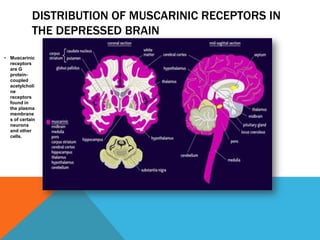
DISTRIBUTION OF MUSCARINIC RECEPTORS IN
            THE DEPRESSED BRAIN

• Muscarinic
  receptors
  are G
  protein-
  coupled
  acetylcholi
  ne
  receptors
  found in
  the plasma
  membrane
  s of certain
  neurons
  and other
  cells.
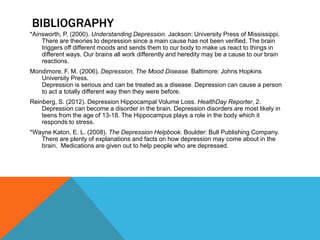
BIBLIOGRAPHY
*Ainsworth, P. (2000). Understanding Depression. Jackson: University Press of Mississippi.
    There are theories to depression since a main cause has not been verified. The brain
    triggers off different moods and sends them to our body to make us react to things in
    different ways. Our brains all work differently and heredity may be a cause to our brain
    reactions.
Mondimore, F. M. (2006). Depression, The Mood Disease. Baltimore: Johns Hopkins
   University Press.
   Depression is serious and can be treated as a disease. Depression can cause a person
   to act a totally different way then they were before.
Reinberg, S. (2012). Depression Hippocampal Volume Loss. HealthDay Reporter, 2.
    Depression can become a disorder in the brain. Depression disorders are most likely in
    teens from the age of 13-18. The Hippocampus plays a role in the body which it
    responds to stress.
*Wayne Katon, E. L. (2008). The Depression Helpbook. Boulder: Bull Publishing Company.
   There are plenty of explanations and facts on how depression may come about in the
   brain. Medications are given out to help people who are depressed.

Depression powerpoint

  • 2.
    What is Depression? 1. Severe despondency and dejection, accompanied by feelings of hopelessness and inadequacy. 2. A condition of mental disturbance, typically with lack of energy and difficulty in maintaining concentration or interest in life. Fact Depression is one of the most common illnesses found in human beings.
  • 3.
    DEPRESSION VS. SADNESS •Sadness- the feeling of sorrow or unhappiness • Sadness and depression have similar reactions except for depression lasts longer than sadness • Depression can affect someone's mood, cause them to feel drained, and cause someone to feel down for weeks/ months. • Sadness doesn’t last very long, it can be something that makes you sad that day and then you eventually get over it.
  • 4.
    WHO IS AFFECTEDBY DEPRESSION? http://altered-states.net/barry/newsletter155/index.htm
  • 5.
    FACTS ABOUT DEPRESSION • One of the most common illnesses found in human beings • Serious and sometimes can be chronic • Afflicts 20 percent of the population in the United States and worldwide • Women are two to three times more likely to fall victim to the mood disorder than men • Depression tends to run in families • Approximately one in five adults in the United States suffer from depression one time in their lives • Affects more than 17 million Americans each year • Hundreds of thousands of medications are given out each year to treat depression
  • 6.
    FERTILE GROUND THEORY • The belief that depression must have a hereditary or physical vulnerability to the condition that causes the mood-regulating system to fail when life’s stresses exceed the person’s ability to cope with them. • Biological imbalances Ainsworth, P. (2000). Understanding Depression
  • 7.
    WHAT HAPPENS INTHE BRAIN • Depression may be caused by episodic misfiring of areas of the left frontal lobe and the left temporal lobe as a result of genetic, environmental, social, or physiological factors. • That conclusion coincides with clinical observations that stroke patients are at greater risk for depression if the stroke is on the left side of the brain, especially in the left frontal lobe. Ainsworth, P. (2000). Understanding Depression.
  • 8.
    DEPRESSION IN THEBRAIN http://www.peace-files.com/QF-L-06/01_QF-
  • 9.
    If the videodoesn’t work I placed the link here for you to view on your own! http://www.youtube.com/watch?v=IeZCmqePLzM
  • 10.
    MOST COMMON SYMPTOMSOF DEPRESSION -Feelings of helplessness and hopelessness. -Feeling useless, inadequate, bad. -Self hatred, constant questioning of thoughts and actions, an overwhelming need for reassurance. -Being vulnerable and "over-sensitive". -Feeling guilty. -A loss of energy and motivation, that makes even the simplest tasks or decisions seem difficult. -Self harm. -Loss or gain in weight. -Difficulty with getting off to sleep, or (less frequently) an excessive desire to sleep. -Agitation and restlessness. -Loss of sex drive. -Finding it impossible to concentrate for any length of time, forgetfulness. --A sense of unreality. -Physical aches and pains, sometimes with the fear that you are seriously ill. *In severe depression, these feelings may also include: -Suicidal ideas. -Failure to eat or drink. -Delusions and/or hallucinations.
  • 11.
    DO YOU HAVEANY SIGNS OF DEPRESSION?
  • 12.
    MEASURING DEPRESSION The items below refer to how you have felt and behaved **during the past week.** For each item, indicate the extent to which it is true, by circling one of the numbers that follows it. Use the following scale: 0 = Not at all 1 = Just a little 2 = Somewhat 3 = Moderately 4 = Quite a lot 5 = Very much 1. I do things slowly..............................................0 1 2 3 4 5 2. My future seems hopeless...............................0 1 2 3 4 5 3. It is hard for me to concentrate on reading.....0 1 2 3 4 5 4. The pleasure and joy has gone out of my life..0 1 2 3 4 5 5. I have difficulty making decisions...................,0 1 2 3 4 5 6. I have lost interest in aspects of life that used to be important to me...................................0 1 2 3 4 5 7. I feel sad, blue, and unhappy............................0 1 2 3 4 5 8. I am agitated and keep moving around............0 1 2 3 4 5 9. I feel fatigued.....................................................0 1 2 3 4 5 10. It takes great effort for me to do simple things......................................................................0 1 2 3 4 5 11. I feel that I am a guilty person who deserves to be punished........................................0 1 2 3 4 5 12. I feel like a failure...........................................0 1 2 3 4 5 13. I feel lifeless--more dead than alive...............0 1 2 3 4 5 14. My sleep has been disturbed: too little, too much, or broken sleep.....................0 1 2 3 4 5 15. I spend time thinking about HOW I might kill myself...............................................................0 1 2 3 4 5 16. I feel trapped or caught...................................0 1 2 3 4 5 17. I feel depressed even when good things happen to me.........................................................0 1 2 3 4 5 18. Without trying to diet, I have lost, or gained, weight...................................................0 1 2 3 4 5
  • 13.
    DISTRIBUTION OF MUSCARINICRECEPTORS IN THE DEPRESSED BRAIN • Muscarinic receptors are G protein- coupled acetylcholi ne receptors found in the plasma membrane s of certain neurons and other cells.
  • 14.
    BIBLIOGRAPHY *Ainsworth, P. (2000).Understanding Depression. Jackson: University Press of Mississippi. There are theories to depression since a main cause has not been verified. The brain triggers off different moods and sends them to our body to make us react to things in different ways. Our brains all work differently and heredity may be a cause to our brain reactions. Mondimore, F. M. (2006). Depression, The Mood Disease. Baltimore: Johns Hopkins University Press. Depression is serious and can be treated as a disease. Depression can cause a person to act a totally different way then they were before. Reinberg, S. (2012). Depression Hippocampal Volume Loss. HealthDay Reporter, 2. Depression can become a disorder in the brain. Depression disorders are most likely in teens from the age of 13-18. The Hippocampus plays a role in the body which it responds to stress. *Wayne Katon, E. L. (2008). The Depression Helpbook. Boulder: Bull Publishing Company. There are plenty of explanations and facts on how depression may come about in the brain. Medications are given out to help people who are depressed.