World Suicide Prevention Day/Week
Sept 10th/7th to 13th Sept
Understanding
Depression
What causes Depression?
Family History
Having family members who have
depression may increase a person’s
risk
Imbalances of certain chemicals in
the brain may lead to depression
Major Life Changes
Positive or negative
events can trigger
depression.
Examples include the
death of a loved one
or a promotion.
Major Illnesses such
as heart attack,
stroke or cancer may
trigger depression.
Certain medications used
alone or in combination can
cause side effects much like
the symptoms of depression.
Use of Alcohol or other Drugs
can lead to or worsen
depression.
Depression can also occur for
no apparent reason!
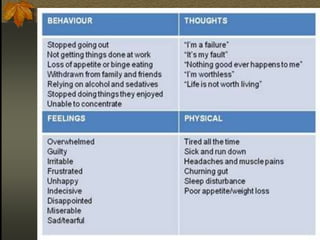
Symptoms of Depression
Vary from person to
person
2 key signs are loss of
interest in things you
like to do and sadness
or irritability
Additional Signs include:
 Changes in feelings which may include:
 Feeling empty
 Inability to enjoy anything
 Hopelessness
 Loss of sexual desire
 Loss of warm feelings for family or friends
 Feelings of self blame or guilt
 Loss of self esteem
 Inexplicable crying spells, sadness or
irritability
Changes in behavior and
attitude
 These may include:
 General slowing down
 Neglect of responsibilities and appearance
 Poor memory
 Inability to concentrate
 Suicidal thoughts, feelings or behaviors
 Difficulty making decisions
Physical Complaints
 These may include:
 Sleep disturbances such as
early morning waking, sleeping
too much or insomnia
 Lack of energy
 Loss of appetite
 Weight loss or gain
 Unexplained headaches or
backaches
 Stomachaches, indigestion or
changes in bowl habits
Late Life Depression
Common Types of Depression
Major Depression
Dysthymia
Bipolar Disorder
Seasonal Affective Disorder
(SAD)
Major Depression
 This type causes symptoms that may:
 Begin suddenly, possibly triggered by a loss,
crisis or change
 Interfere with normal functioning
 Continue for months or years
 It is possible for a person to have only one
episode of major depression. It is more
common for episodes to be long lasting or to
occur several times during a person’s life
Dysthymia
People with this illness are mildly
depressed for years. They function
fairly well on a daily basis but their
relationships suffer over time.
Bipolar Disorder
 People with this type of illness change
back and forth between periods of
depression and periods of mania (an
extreme high).
 Symptoms of mania may include:
 Less need for sleep
 Overconfidence
 Racing thoughts
 Reckless behavior
 Increased energy
 Mood changes are usually gradual, but can
be sudden
Season Affective Disorder
 This is a depression that results from
changes in the season. Most cases
begin in the fall or winter, or when there
is a decrease in sunlight.
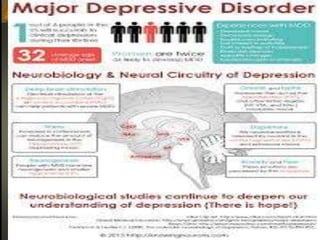
The brain uses a number of
chemicals as messengers to
communicate with other parts of
itself and with the nervous system.
These chemical messengers,
called neurotransmitters, are
released and received by the
brain's many nerve cells, which are
also called neurons. Neurons are
constantly communicating with
each other by way of exchanging
neurotransmitters. This
communication system is essential
to all of the brain's functions.
Neurotransmitters
 Depression has been linked to problems
or imbalances in the brain with regard to
the neurotransmitters serotonin,
norepinephrine, and dopamine. The
evidence is somewhat indirect on these
points because it is very difficult to
actually measure the level of
neurotransmitter in a person's brain.
Serotonin
 The neurotransmitter serotonin is involved in
regulating many important physiological
(body-oriented) functions, including sleep,
aggression, eating, sexual behavior, and
mood. Serotonin is produced by serotonergic
neurons. Current research suggests that a
decrease in the production of serotonin by
these neurons can cause depression in some
people, and more specifically, a mood state
that can cause some people to feel suicidal.
Norepinephrine
 In the 1960s, the "catecholamine hypothesis" was a popular
explanation for why people developed depression. This hypothesis
suggested that a deficiency of the neurotransmitter norepinephrine
(also known as noradrenaline) in certain areas of the brain was
responsible for creating depressed mood. More recent research
suggests that there is indeed a subset of depressed people who have
low levels of norepinephrine. For example, autopsy studies show that
people who have experienced multiple depressive episodes have fewer
norepinephrinergic neurons than people who have no depressive
history. However, research results also tell us that not all people
experience mood changes in response to decreased norepinephrine
levels. Some people who are depressed actually show hyperactivity
within the neurons that produce norepinephrine. More current studies
suggest that in some people, low levels of serotonin trigger a drop in
norepinephrine levels, which then leads to depression.

Norepinephrine
 Another line of research has investigated linkages
between stress, depression, and norepinephrine.
Norepinephrine helps our bodies to recognize and
respond to stressful situations. Researchers suggest
that people who are vulnerable to depression may
have a norepinephrinergic system that doesn't handle
the effects of stress very efficiently.
Dopamine
 The neurotransmitter dopamine is also linked
to depression. Dopamine plays an important
role in regulating our drive to seek out
rewards, as well as our ability to obtain a
sense of pleasure. Low dopamine levels may
in part explain why depressed people don't
derive the same sense of pleasure out of
activities or people that they did before
becoming depressed.
New Research-Glutamate
 Recently, another neurotransmitter,
glutamate, has been implicated in
depression as well, but more research
is necessary at this time to determine
the nature of this relationship.

Professional treatment is
essential to treat depression.
Treatment for Depression
 Medication
 Antidepressants can help ease the
symptoms of depression and return a
person to normal functioning.
Antidepressants are not habit forming.
Psychotherapy
 This can help many depressed people
understand themselves and cope with
their problems. For example:
 Interpersonal therapy works to change
relationships that affect depression
 Cognitive-behavioral therapy helps people
change negative thinking and behavior
patterns
If you or someone you know
has symptoms of
depression…
Take Action!
 See a doctor for a complete check up.
 Go to a Counseling Center or talk to
AASRA (91-22-27546669).
 Talk things over with a friend, family
member or anyone who you feel can
listen to you without judgement or
criticism.
 Don’t expect too much of yourself
 Take a break
 Get some exercise
 Avoid extra stress and big changes
Things to do
 Reduce or eliminate the use of alcohol
or drugs
 Exercise or engage in some form of
physical activity
 Eat a proper, well-balanced diet
Complementary&Alternative Medicine
 Obtain an adequate amount of sleep
 Seek emotional support from family and
friends
 Focus on positive aspects of your life
 Pace yourself, modify your schedule,
and set realistic goals
Things to Avoid
 Don’t make long-term commitments or
important decisions unless necessary
 Don’t assume things are hopeless
 Don’t engage in “emotional reasoning” (i.e.:
because I feel awful, my life is terrible)
 Don’t assume responsibility for events which
are outside of your control
 Don’t avoid treatment as a way of coping
Intervening with a depressed
friend
 Be empathetic and understanding
 Don’t try to “cheer up” a depressed
person
 Avoid critical or shaming statements
 Challenge expressions of hopelessness
 Empathize with feelings of sadness,
grief, anger and frustration
 Don’t argue about how bad things are
 Don’t insist that depression or sadness
are the wrong feelings to be
experiencing
 Don’t become angry even though your
efforts may be resisted or rejected
Helping a depressed friend…
Helping a depressed
friend…
 Advocate for their recovery
from depression
 Emphasize that depression is treatable
 Seek consultation
 Encourage them to seek help, go with
them to the counseling center/call
AASRA
 Be supportive of counselor or doctor
suggestions
Aasra Crisis Intervention Center
 Helpline (24x7) 91-22-27546669
 FREE!!! FREE!!! FREE!!!
 Confidential & Anonymous
 One time or many times-the choice is
yours.
 Individual, Group and Couples face-to
face interventions on appointments.
 Awareness, Publicity, Outreach ,
Training Workshops, Talks, Advocacy,
Support Groups,Volunteering
 http://www.aasra,info
Depression And How We Combat It For Suicide Prevention

Depression And How We Combat It For Suicide Prevention

  • 3.
    World Suicide PreventionDay/Week Sept 10th/7th to 13th Sept
  • 4.
  • 5.
    What causes Depression? FamilyHistory Having family members who have depression may increase a person’s risk Imbalances of certain chemicals in the brain may lead to depression
  • 6.
    Major Life Changes Positiveor negative events can trigger depression. Examples include the death of a loved one or a promotion. Major Illnesses such as heart attack, stroke or cancer may trigger depression.
  • 7.
    Certain medications used aloneor in combination can cause side effects much like the symptoms of depression. Use of Alcohol or other Drugs can lead to or worsen depression. Depression can also occur for no apparent reason!
  • 8.
    Symptoms of Depression Varyfrom person to person 2 key signs are loss of interest in things you like to do and sadness or irritability
  • 10.
    Additional Signs include: Changes in feelings which may include:  Feeling empty  Inability to enjoy anything  Hopelessness  Loss of sexual desire  Loss of warm feelings for family or friends  Feelings of self blame or guilt  Loss of self esteem  Inexplicable crying spells, sadness or irritability
  • 12.
    Changes in behaviorand attitude  These may include:  General slowing down  Neglect of responsibilities and appearance  Poor memory  Inability to concentrate  Suicidal thoughts, feelings or behaviors  Difficulty making decisions
  • 13.
    Physical Complaints  Thesemay include:  Sleep disturbances such as early morning waking, sleeping too much or insomnia  Lack of energy  Loss of appetite  Weight loss or gain  Unexplained headaches or backaches  Stomachaches, indigestion or changes in bowl habits
  • 17.
  • 23.
    Common Types ofDepression Major Depression Dysthymia Bipolar Disorder Seasonal Affective Disorder (SAD)
  • 24.
    Major Depression  Thistype causes symptoms that may:  Begin suddenly, possibly triggered by a loss, crisis or change  Interfere with normal functioning  Continue for months or years  It is possible for a person to have only one episode of major depression. It is more common for episodes to be long lasting or to occur several times during a person’s life
  • 25.
    Dysthymia People with thisillness are mildly depressed for years. They function fairly well on a daily basis but their relationships suffer over time.
  • 26.
    Bipolar Disorder  Peoplewith this type of illness change back and forth between periods of depression and periods of mania (an extreme high).  Symptoms of mania may include:  Less need for sleep  Overconfidence  Racing thoughts  Reckless behavior  Increased energy  Mood changes are usually gradual, but can be sudden
  • 27.
    Season Affective Disorder This is a depression that results from changes in the season. Most cases begin in the fall or winter, or when there is a decrease in sunlight.
  • 33.
    The brain usesa number of chemicals as messengers to communicate with other parts of itself and with the nervous system. These chemical messengers, called neurotransmitters, are released and received by the brain's many nerve cells, which are also called neurons. Neurons are constantly communicating with each other by way of exchanging neurotransmitters. This communication system is essential to all of the brain's functions.
  • 34.
    Neurotransmitters  Depression hasbeen linked to problems or imbalances in the brain with regard to the neurotransmitters serotonin, norepinephrine, and dopamine. The evidence is somewhat indirect on these points because it is very difficult to actually measure the level of neurotransmitter in a person's brain.
  • 35.
    Serotonin  The neurotransmitterserotonin is involved in regulating many important physiological (body-oriented) functions, including sleep, aggression, eating, sexual behavior, and mood. Serotonin is produced by serotonergic neurons. Current research suggests that a decrease in the production of serotonin by these neurons can cause depression in some people, and more specifically, a mood state that can cause some people to feel suicidal.
  • 36.
    Norepinephrine  In the1960s, the "catecholamine hypothesis" was a popular explanation for why people developed depression. This hypothesis suggested that a deficiency of the neurotransmitter norepinephrine (also known as noradrenaline) in certain areas of the brain was responsible for creating depressed mood. More recent research suggests that there is indeed a subset of depressed people who have low levels of norepinephrine. For example, autopsy studies show that people who have experienced multiple depressive episodes have fewer norepinephrinergic neurons than people who have no depressive history. However, research results also tell us that not all people experience mood changes in response to decreased norepinephrine levels. Some people who are depressed actually show hyperactivity within the neurons that produce norepinephrine. More current studies suggest that in some people, low levels of serotonin trigger a drop in norepinephrine levels, which then leads to depression. 
  • 37.
    Norepinephrine  Another lineof research has investigated linkages between stress, depression, and norepinephrine. Norepinephrine helps our bodies to recognize and respond to stressful situations. Researchers suggest that people who are vulnerable to depression may have a norepinephrinergic system that doesn't handle the effects of stress very efficiently.
  • 38.
    Dopamine  The neurotransmitterdopamine is also linked to depression. Dopamine plays an important role in regulating our drive to seek out rewards, as well as our ability to obtain a sense of pleasure. Low dopamine levels may in part explain why depressed people don't derive the same sense of pleasure out of activities or people that they did before becoming depressed.
  • 39.
    New Research-Glutamate  Recently,another neurotransmitter, glutamate, has been implicated in depression as well, but more research is necessary at this time to determine the nature of this relationship. 
  • 40.
  • 41.
    Treatment for Depression Medication  Antidepressants can help ease the symptoms of depression and return a person to normal functioning. Antidepressants are not habit forming.
  • 42.
    Psychotherapy  This canhelp many depressed people understand themselves and cope with their problems. For example:  Interpersonal therapy works to change relationships that affect depression  Cognitive-behavioral therapy helps people change negative thinking and behavior patterns
  • 44.
    If you orsomeone you know has symptoms of depression… Take Action!
  • 45.
     See adoctor for a complete check up.  Go to a Counseling Center or talk to AASRA (91-22-27546669).  Talk things over with a friend, family member or anyone who you feel can listen to you without judgement or criticism.
  • 46.
     Don’t expecttoo much of yourself  Take a break  Get some exercise  Avoid extra stress and big changes
  • 47.
    Things to do Reduce or eliminate the use of alcohol or drugs  Exercise or engage in some form of physical activity  Eat a proper, well-balanced diet
  • 61.
  • 62.
     Obtain anadequate amount of sleep  Seek emotional support from family and friends  Focus on positive aspects of your life  Pace yourself, modify your schedule, and set realistic goals
  • 63.
    Things to Avoid Don’t make long-term commitments or important decisions unless necessary  Don’t assume things are hopeless  Don’t engage in “emotional reasoning” (i.e.: because I feel awful, my life is terrible)  Don’t assume responsibility for events which are outside of your control  Don’t avoid treatment as a way of coping
  • 64.
    Intervening with adepressed friend  Be empathetic and understanding  Don’t try to “cheer up” a depressed person  Avoid critical or shaming statements  Challenge expressions of hopelessness  Empathize with feelings of sadness, grief, anger and frustration
  • 65.
     Don’t argueabout how bad things are  Don’t insist that depression or sadness are the wrong feelings to be experiencing  Don’t become angry even though your efforts may be resisted or rejected Helping a depressed friend…
  • 66.
    Helping a depressed friend… Advocate for their recovery from depression  Emphasize that depression is treatable  Seek consultation  Encourage them to seek help, go with them to the counseling center/call AASRA  Be supportive of counselor or doctor suggestions
  • 67.
    Aasra Crisis InterventionCenter  Helpline (24x7) 91-22-27546669  FREE!!! FREE!!! FREE!!!  Confidential & Anonymous  One time or many times-the choice is yours.  Individual, Group and Couples face-to face interventions on appointments.  Awareness, Publicity, Outreach , Training Workshops, Talks, Advocacy, Support Groups,Volunteering  http://www.aasra,info