Media
 Yi-Ping Lu
Statistic


98 % of American households have a TV set
66% of American youth aged from 8 to 18
have a TV set in the bedroom
70% of children's television shows contain
displays of physical aggression with 14
violent acts displayed per hour, compared
with less than four violent acts in non-
children's programming.
The Use of Media

Youth daily TV view:
           3:19 for aged 8 to 10
          3:30 for aged 11 to 14
          2:23 for aged 15 to 18
Almost 20 % of youth between the ages
 of 2 to 17 watch more than 35 hours of
 TV per week
Youth with internet access use 1 hour
 per day
Heavy v.s. Light Viewers

Heavy viewers are
more likely to report
distress and fears of
vulnerability to crime.
Heavy TV viewing is
associated with
elevated perceptions of
personal (but not
societal) vulnerability
to world threat such as
earthquake and flood
with high anxiety.
Parental Regulation
Children with no restrictions on their television
consumption watch more TV and tend to be
more aggressive than children who does.
Parental regulation doesn’t relate to the home
income/maternal use/ mothers’ age/ gender of
the children
27% of mothers monitor the quantity of
television viewing
26% have rules for maximum Internet use.
2.2% have rules for both television and Internet
use.
Threat Perception
Threat perception after being exposed to
 massive media:
 Children have greater societal
 threat perception (Crime>
 earthquake > hurricane/flood)
 than personal threat perception.
 The older the children are the
 higher perception they have.
 With higher TV use, children have higher
 personal threat perception, but no
 significant relation with Internet use.
Media Use as
           Educational Tools
Included: Audio components, digital video
  cameras, television, and computer-based
  programs and games.
Active learning (using media): students take
  control over their own learning and are more
  active and participating in learning.
Passive learning (without media): replying
  more on teachers' material.
Students who watched a multimedia story
  recalled more story elements than students
  exposed to only one medium.
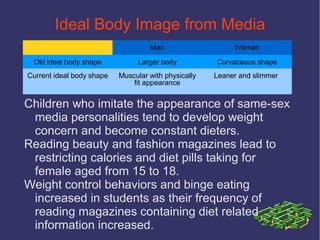
Ideal Body Image from Media
                                    Man                    Woman

 Old ideal body shape            Larger body          Curvaceous shape
Current ideal body shape   Muscular with physically   Leaner and slimmer
                               fit appearance


Children who imitate the appearance of same-sex
 media personalities tend to develop weight
 concern and become constant dieters.
Reading beauty and fashion magazines lead to
 restricting calories and diet pills taking for
 female aged from 15 to 18.
Weight control behaviors and binge eating
 increased in students as their frequency of
 reading magazines containing diet related
 information increased.
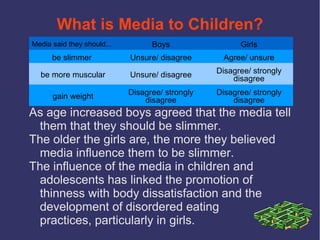
What is Media to Children?
Media said they should...         Boys                 Girls
      be slimmer            Unsure/ disagree      Agree/ unsure

  be more muscular          Unsure/ disagree     Disagree/ strongly
                                                     disagree

      gain weight           Disagree/ strongly   Disagree/ strongly
                                disagree             disagree
As age increased boys agreed that the media tell
 them that they should be slimmer.
The older the girls are, the more they believed
 media influence them to be slimmer.
The influence of the media in children and
 adolescents has linked the promotion of
 thinness with body dissatisfaction and the
 development of disordered eating
 practices, particularly in girls.
Reaction to Media
Girls tend to adopt strategies to lose weight while
  boys increase muscle mass.
Exposure to violent media leads to physical,
  verbal, and relational aggression (using the
  relationships as the means of harm via ignoring,
  direct exclusion or by spreading malicious
  rumors, gossip or lies) among young children.
Boys tend to use physical aggression, while girls
  tend to use relational aggression to fulfill gender
  specific social goals.
Higher socioeconomic states children tend to be
  exposed to relational aggression via television,
  video, and movies and tend to understand
  and model these behaviors in the future.
Extra Video
xTEDx Children and Media
Annotated Bibliography
Christakis, D. (Writer). (2011). TEDxRainier - Dimitri
  Christakis - Media [Online video]. Retrieved August 13,
  2012, from Youtube.
Dimitri Christakis talked about the three experiments with
  young children's (mice's) brain processing the outside
  stimulation. The first experiment was to see the
  differences of two different mice's (one's childhood was
  in front of TV, one has regular stimulation) risk-taking
  skill in an open field, and the second experiment tested
  the two different mice's short-term memory. The third
  found out there is a relationship between building blocks
  game with language learning.
Annotated Bibliography
*Comer, J. S., Furr, J. M., Beidas, R. S., Babyar, H. M., &
  Kendall, P. C. (2008). Media Use and Children's
  Perceptions of Societal Threat and Personal
  Vulnerability. Journal Of Clinical Child & Adolescent
  Psychology, 37(3), 622-630.
  doi:10.1080/15374410802148145
This was a study that exanimated the correlation between
  television and internet use and the perception of societal
  threat and personal vulnerability of 90 children from age
  7 to 13 years old. They found that the more television
  the children watched the greater personal threat
  perception, but they didn’t find a significant correlation
  with internet use.
Annotated Bibliography
*Daluz, C. T., & Mapoy, M. J. (2011). The Effect of
  Interactive Media on Elementary School Childrens'
  Story Memory. International Journal Of Research &
  Review, 6(1), 108-119.
This experimental study exanimated first grade children’s
  responses and the number of correct answers to the study
  questionnaire after using four different computer-based
  presentation modes. While the result was that the audio-
  visual group had the best performance, audio group had
  the worst performance. Surprisingly, the interactive
  group had a similar performance as interactive
  observers.
Annotated Bibliography
Lawrie, Z. Z., Sullivan, E. A., Davies, P. W., & Hill,
  R. J. (2006). Media Influence on the Body Image of
  Children and Adolescents. Eating Disorders, 14(5),
  355-364. doi:10.1080/10640260600952506
This was an article focusing on the relationship
  between ideal body images for boys and girls from
  age 9 to 14 years old and media, specific fashion
  magazines. While neither group of the gender
  answered that the media was promoting bigger size
  of muscle, both of them agreed that the media was
  promoting thin ideal body shape.
Annotated Bibliography
*Messenger Davies, Mfire. (2010). Children, Media and Culture.
   Retrieved from http://site.ebrary.com/lib/spscclibrary/Doc?
  id=10403992&ppg=49.
This book talked about the combination of arts and media such as
  television, gaming, and social networking in educating or
  communicating with children. The modern convenience
  technology had changed the way children live their childhood
  lives, but there are some negative impact of this change.
Ostrov, J. M., Gentile, D. A., & Crick, N. R. (2006). Media
  Exposure, Aggression and Prosocial Behavior During Early
  Childhood: A Longitudinal Study. Social Development, 15(4),
  612-627. doi:10.1111/j.1467-9507.2006.00360.x
This longitudinal study followed and documented 78 preschoolers’
  current and future responses after exposing to violent media. They
  found that after exposed to violent media, both sexes responded
  differently: while girls tend to perform relational aggression,
  boys perform physical aggression.

Media1

  • 1.
  • 2.
    Statistic 98 % ofAmerican households have a TV set 66% of American youth aged from 8 to 18 have a TV set in the bedroom 70% of children's television shows contain displays of physical aggression with 14 violent acts displayed per hour, compared with less than four violent acts in non- children's programming.
  • 3.
    The Use ofMedia Youth daily TV view: 3:19 for aged 8 to 10 3:30 for aged 11 to 14 2:23 for aged 15 to 18 Almost 20 % of youth between the ages of 2 to 17 watch more than 35 hours of TV per week Youth with internet access use 1 hour per day
  • 4.
    Heavy v.s. LightViewers Heavy viewers are more likely to report distress and fears of vulnerability to crime. Heavy TV viewing is associated with elevated perceptions of personal (but not societal) vulnerability to world threat such as earthquake and flood with high anxiety.
  • 5.
    Parental Regulation Children withno restrictions on their television consumption watch more TV and tend to be more aggressive than children who does. Parental regulation doesn’t relate to the home income/maternal use/ mothers’ age/ gender of the children 27% of mothers monitor the quantity of television viewing 26% have rules for maximum Internet use. 2.2% have rules for both television and Internet use.
  • 6.
    Threat Perception Threat perceptionafter being exposed to massive media: Children have greater societal threat perception (Crime> earthquake > hurricane/flood) than personal threat perception. The older the children are the higher perception they have. With higher TV use, children have higher personal threat perception, but no significant relation with Internet use.
  • 7.
    Media Use as Educational Tools Included: Audio components, digital video cameras, television, and computer-based programs and games. Active learning (using media): students take control over their own learning and are more active and participating in learning. Passive learning (without media): replying more on teachers' material. Students who watched a multimedia story recalled more story elements than students exposed to only one medium.
  • 8.
    Ideal Body Imagefrom Media Man Woman Old ideal body shape Larger body Curvaceous shape Current ideal body shape Muscular with physically Leaner and slimmer fit appearance Children who imitate the appearance of same-sex media personalities tend to develop weight concern and become constant dieters. Reading beauty and fashion magazines lead to restricting calories and diet pills taking for female aged from 15 to 18. Weight control behaviors and binge eating increased in students as their frequency of reading magazines containing diet related information increased.
  • 9.
    What is Mediato Children? Media said they should... Boys Girls be slimmer Unsure/ disagree Agree/ unsure be more muscular Unsure/ disagree Disagree/ strongly disagree gain weight Disagree/ strongly Disagree/ strongly disagree disagree As age increased boys agreed that the media tell them that they should be slimmer. The older the girls are, the more they believed media influence them to be slimmer. The influence of the media in children and adolescents has linked the promotion of thinness with body dissatisfaction and the development of disordered eating practices, particularly in girls.
  • 10.
    Reaction to Media Girlstend to adopt strategies to lose weight while boys increase muscle mass. Exposure to violent media leads to physical, verbal, and relational aggression (using the relationships as the means of harm via ignoring, direct exclusion or by spreading malicious rumors, gossip or lies) among young children. Boys tend to use physical aggression, while girls tend to use relational aggression to fulfill gender specific social goals. Higher socioeconomic states children tend to be exposed to relational aggression via television, video, and movies and tend to understand and model these behaviors in the future.
  • 11.
  • 12.
    Annotated Bibliography Christakis, D.(Writer). (2011). TEDxRainier - Dimitri Christakis - Media [Online video]. Retrieved August 13, 2012, from Youtube. Dimitri Christakis talked about the three experiments with young children's (mice's) brain processing the outside stimulation. The first experiment was to see the differences of two different mice's (one's childhood was in front of TV, one has regular stimulation) risk-taking skill in an open field, and the second experiment tested the two different mice's short-term memory. The third found out there is a relationship between building blocks game with language learning.
  • 13.
    Annotated Bibliography *Comer, J.S., Furr, J. M., Beidas, R. S., Babyar, H. M., & Kendall, P. C. (2008). Media Use and Children's Perceptions of Societal Threat and Personal Vulnerability. Journal Of Clinical Child & Adolescent Psychology, 37(3), 622-630. doi:10.1080/15374410802148145 This was a study that exanimated the correlation between television and internet use and the perception of societal threat and personal vulnerability of 90 children from age 7 to 13 years old. They found that the more television the children watched the greater personal threat perception, but they didn’t find a significant correlation with internet use.
  • 14.
    Annotated Bibliography *Daluz, C.T., & Mapoy, M. J. (2011). The Effect of Interactive Media on Elementary School Childrens' Story Memory. International Journal Of Research & Review, 6(1), 108-119. This experimental study exanimated first grade children’s responses and the number of correct answers to the study questionnaire after using four different computer-based presentation modes. While the result was that the audio- visual group had the best performance, audio group had the worst performance. Surprisingly, the interactive group had a similar performance as interactive observers.
  • 15.
    Annotated Bibliography Lawrie, Z.Z., Sullivan, E. A., Davies, P. W., & Hill, R. J. (2006). Media Influence on the Body Image of Children and Adolescents. Eating Disorders, 14(5), 355-364. doi:10.1080/10640260600952506 This was an article focusing on the relationship between ideal body images for boys and girls from age 9 to 14 years old and media, specific fashion magazines. While neither group of the gender answered that the media was promoting bigger size of muscle, both of them agreed that the media was promoting thin ideal body shape.
  • 16.
    Annotated Bibliography *Messenger Davies,Mfire. (2010). Children, Media and Culture. Retrieved from http://site.ebrary.com/lib/spscclibrary/Doc? id=10403992&ppg=49. This book talked about the combination of arts and media such as television, gaming, and social networking in educating or communicating with children. The modern convenience technology had changed the way children live their childhood lives, but there are some negative impact of this change. Ostrov, J. M., Gentile, D. A., & Crick, N. R. (2006). Media Exposure, Aggression and Prosocial Behavior During Early Childhood: A Longitudinal Study. Social Development, 15(4), 612-627. doi:10.1111/j.1467-9507.2006.00360.x This longitudinal study followed and documented 78 preschoolers’ current and future responses after exposing to violent media. They found that after exposed to violent media, both sexes responded differently: while girls tend to perform relational aggression, boys perform physical aggression.