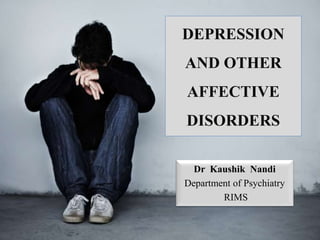
DEPRESSION
AND OTHER
AFFECTIVE
DISORDERS
Dr Kaushik Nandi
Department of Psychiatry
RIMS
DEPRESSION AND OTHER
AFFECTIVE DISORDERS
• Affective disorders encompass all disorders of mood
that are persistent and pervasive and lead to socio-
occupational dysfunction.
• By far, Depression is the most commonly
encountered mental disorder by a general practitioner
and hence a comprehensive understanding of the
disorder is indispensable.
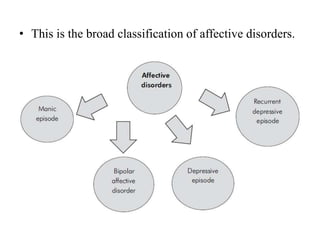
• This is the broad classification of affective disorders.
DEPRESSION : OUTLINE OF TEXT
• Learning objectives
• Introduction and Epidemiology
• Diagnosis
a. Criteria
b. Clinical features
c. Mental status examination
• Differential diagnosis ( general medical conditions overlapping with
depression)
• Management
a. Pharmacological
b. Non pharmacological
c. Special population
d. When to refer
LEARNING OBJECTIVES
• to be able to identify depression in outpatient settings
• to distinguish between unipolar depression and bipolar
mood disorders
• to be able to assess and decide treatment for depression
• to understand the dosages, duration and side effects of
antidepressants
• to know when to refer
INTRODUCTION AND
EPIDEMIOLOGY
• Mood disorders mainly manifest as either manic or
depressive episodes.
• The lifetime risk of depression varies from 10-15%
with the risk being twice more in women than men.
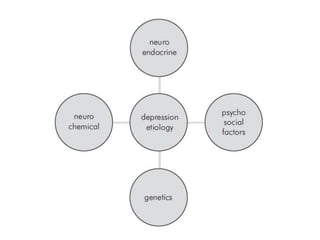
• Depression has a multifactorial aetiology as depicted
later.
• The disorder may manifest at any age but the
incidence seems to peak in 20s.
• The disorder may have a variable course but if
untreated can run a chronic and disabling course.
• Thus early identification and treatment increases the
likelihood of remission and recovery
Risk factors for depression
• Female sex
• Age <40 years
• Impaired interpersonal
• relationships
• Divorced, widowers
• Family history of depression
• Negative life events
DIAGNOSING DEPRESSION
• Transient depressed mood in reaction to negative
experiences is normal
• Feeling sad is a normal reaction to experiences that
are stressful or upsetting
• Most people, children as well as adults, feel low or
`blue' occasionally
• Depression becomes an illness when the depressed
mood is serious and prolonged, and is accompanied
by other symptoms and disturbances of functioning
For a depressive episode: diagnostic criteria :
For at least 2 weeks, has the person had at
least 2 of the following core symptoms:
1. Depressed mood (most of the day, almost every
day), (for children and adolescents irritability or
depressed mood)
2. Loss of interest or pleasure in activities that are
normally pleasurable
3. Decreased energy or easily fatigued
• Symptoms should be causing significant socio-
occupational dysfunction.
• Rule out bereavement in past 2 months
• Rule out the possibility of bipolar depression. (Ask
about prior episode of manic symptoms such as
elevated, expansive or irritable mood, increased
activity and talkativeness, flight of ideas, decreased
need for sleep, grandiosity, distractibility, loss of
social inhibitions and extreme optimism leading to
reckless behaviors.)
• During the last 2 weeks has the person had at least 2
other features of depression:
1. Reduced concentration and attention
2. Reduced self-esteem and self-confidence
3. Ideas of guilt and unworthiness
4. Bleak and pessimistic view of the future
5. Ideas or acts of self-harm or suicide
6. Disturbed sleep
7. Diminished appetite
• If 2 other features – mild depressive episode
• If 3 other features – moderate depressive episode
• If 3 of the core features and 4 other symptoms –
Severe depressive episode. It may b with or without
psychotic features
An episode can be with or without somatic syndrome
(4 or more of the following)
• loss of interest in activities and lack of emotional
reactivity,
• Loss of appetite, Weight loss,
• Insomnia mainly as early morning awakening,
depression worse in morning,
• Low libido,
• Psychomotor retardation or agitation
• Recurrent depressive disorder: Repeated episodes
of depression with current episode being mild,
moderate or severe
• Dysthymia: A chronic depressive state that does not
meet criteria for a depressive episode anytime and
lasts for at least 2 years
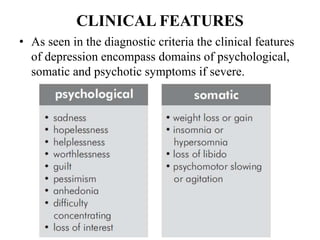
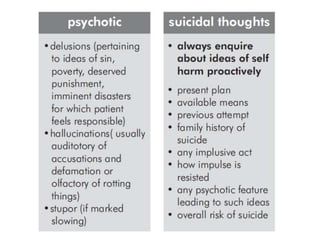
CLINICAL FEATURES
• As seen in the diagnostic criteria the clinical features
of depression encompass domains of psychological,
somatic and psychotic symptoms if severe.
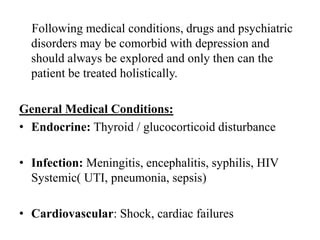
Following medical conditions, drugs and psychiatric
disorders may be comorbid with depression and
should always be explored and only then can the
patient be treated holistically.
General Medical Conditions:
• Endocrine: Thyroid / glucocorticoid disturbance
• Infection: Meningitis, encephalitis, syphilis, HIV
Systemic( UTI, pneumonia, sepsis)
• Cardiovascular: Shock, cardiac failures
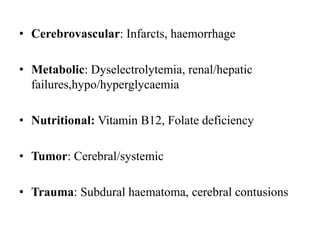
• Cerebrovascular: Infarcts, haemorrhage
• Metabolic: Dyselectrolytemia, renal/hepatic
failures,hypo/hyperglycaemia
• Nutritional: Vitamin B12, Folate deficiency
• Tumor: Cerebral/systemic
• Trauma: Subdural haematoma, cerebral contusions
Drugs :
• Withdrawal of : Prolonged use of
caffeine, nicotine, sedatives, amphetamines
• Prolonged use of
Antihypertensive drugs
Anti-inflammatory/ analgesics
Steroids
Antineoplastic drugs
Anti-parkinsonism drugs
Antipsychotics
Sedatives
Many antibacterial/ antifungals
Other psychiatric disorders
• Anxiety disorders
• Substance use disorders
MENTAL STATUS EXAMINATION
• Generalised psychomotor retardation ( or agitation in
elderly), stooped posture, slow spontaneous
movements, downcast gaze, decreased rate of speech
with increased reaction time, depressed mood and
restricted affect, with delusions or hallucinations in
perceptual disturbance may be seen.
• Thought process may be slow with poverty of ideas.
Though sensorium is intact memory may be impaired
with increased impulsivity (assess for suicide) with
impaired judgement (too pessimist) and insight may
be impaired.
• Usually the classic triad of pessimist thoughts about
self, future and others may be seen.
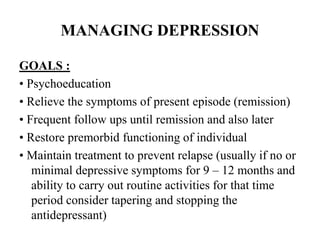
MANAGING DEPRESSION
GOALS :
• Psychoeducation
• Relieve the symptoms of present episode (remission)
• Frequent follow ups until remission and also later
• Restore premorbid functioning of individual
• Maintain treatment to prevent relapse (usually if no or
minimal depressive symptoms for 9 – 12 months and
ability to carry out routine activities for that time
period consider tapering and stopping the
antidepressant)
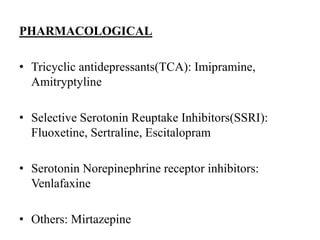
PHARMACOLOGICAL
• Tricyclic antidepressants(TCA): Imipramine,
Amitryptyline
• Selective Serotonin Reuptake Inhibitors(SSRI):
Fluoxetine, Sertraline, Escitalopram
• Serotonin Norepinephrine receptor inhibitors:
Venlafaxine
• Others: Mirtazepine
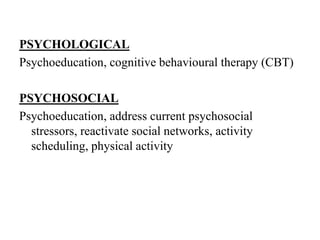
PSYCHOLOGICAL
Psychoeducation, cognitive behavioural therapy (CBT)
PSYCHOSOCIAL
Psychoeducation, address current psychosocial
stressors, reactivate social networks, activity
scheduling, physical activity
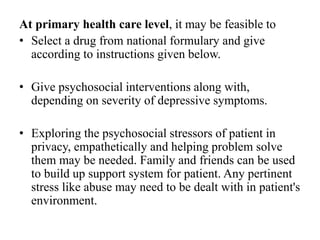
At primary health care level, it may be feasible to
• Select a drug from national formulary and give
according to instructions given below.
• Give psychosocial interventions along with,
depending on severity of depressive symptoms.
• Exploring the psychosocial stressors of patient in
privacy, empathetically and helping problem solve
them may be needed. Family and friends can be used
to build up support system for patient. Any pertinent
stress like abuse may need to be dealt with in patient's
environment.
• Patient should be encouraged to resume the earlier
pleasurable hobbies and social meetings to reactivate
his social circuits.
• Patient may need to be helped with a schedule
according to his strengths and weaknesses and
appropriately rewarded and applauded for the same
with the help of family members initially.
• Some sort of physical activity or yoga may be
advised (45 minutes 3-5 times/week)
• Any comorbid medical condition should be treated
adequately at primary health care level
When to refer:
• Patient has severe depression with psychotic features
• Suicidal ideations
• Psychological intervention needed ( lack of resources)
• Bipolar affective disorder
• Multiple comorbid conditions
• Special population if not manageable
• Any other emergency comorbid with mood disorder
INTERMISSION
BIPOLAR AFFECTIVE DISORDER
(BPAD)
• BPAD is characterised by an episode of mania or
hypomania.
• It may or may not be followed by a subsequent mood
episode.
• About 5-10% of patients with initial diagnosis of
major depressive episode have a manic episode later
on.
DIANOSTIC CRITERIA
Mania: Elevated, expansive or irritable mood + 3 of
the following (4 if mood is irritable)
• Increased activity, restlessness, excitement
• Increased talkativeness
• Loss of social inhibitions
• Decreased need for sleep
• Overspending or other reckless behaviours
• Distractibility
• Elevated sexual energy
Mania contd…
Multiple symptoms, lasting for at least 1 week Severe
enough to interfere significantly with work and social
activities or requiring hospitalization
DIANOSTIC CRITERIA
Hypomania: Same features as mania but with a lesser
severity and duration.
Some symptoms, lasting for at least 4 days Cause
some interference with work and social activities but
do not require hospitalization or have psychotic
features
• So a bipolar disorder may manifest as single manic
episode or a manic/hypomanic episode with
depression.
Clinical features and MSE
• Mood Changes as elation, euphoria or Irritable.
• The level of goal directed and pleasurable activities
increase that are usually reckless and involve risk.
• Patient is distractible with poor concentration. Speech
is rapid and patient jumps from one topic to another.
• Patient may have delusions mainly grandiose
delusions of power, worth or identity.
Clinical features and MSE
• There is decrease in need of sleep and still high levels
of energy
• Increased appetite, increased libido and sexual
activity, increased desire for substances.
• Also the disorder may be comorbid with other general
medical conditions as depicted under depression.
Comorbid psychiatric conditions and substances
are mentioned here :
• Other psychiatric disorders
• Anxiety disorders
• Substance use disorders
• Drugs Withdrawal of Sedatives, alcohol
• Prolonged use of Amphetamines, cocaine, Stimulants
(methylphenidate),Steroids, Bromocriptine, levodopa,
Baclofen, opioids
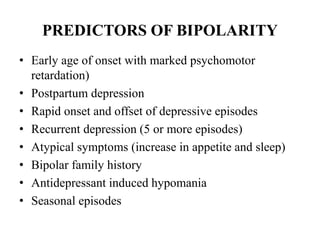
PREDICTORS OF BIPOLARITY
• Early age of onset with marked psychomotor
retardation)
• Postpartum depression
• Rapid onset and offset of depressive episodes
• Recurrent depression (5 or more episodes)
• Atypical symptoms (increase in appetite and sleep)
• Bipolar family history
• Antidepressant induced hypomania
• Seasonal episodes
MANAGEMENT
Goals:
• Psycho education
• Treat the present episode
• Prevent relapse by maintenance treatment ( at least 2
years after last bipolar episode )
• Know when to refer
• rehabilitation (appropriate economic, social, cultural
and educational activities)
If present episode is mania/hypomania
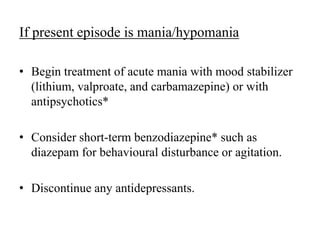
• Begin treatment of acute mania with mood stabilizer
(lithium, valproate, and carbamazepine) or with
antipsychotics*
• Consider short-term benzodiazepine* such as
diazepam for behavioural disturbance or agitation.
• Discontinue any antidepressants.
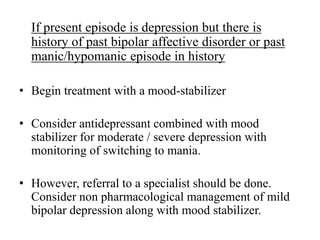
If present episode is depression but there is
history of past bipolar affective disorder or past
manic/hypomanic episode in history
• Begin treatment with a mood-stabilizer
• Consider antidepressant combined with mood
stabilizer for moderate / severe depression with
monitoring of switching to mania.
• However, referral to a specialist should be done.
Consider non pharmacological management of mild
bipolar depression along with mood stabilizer.
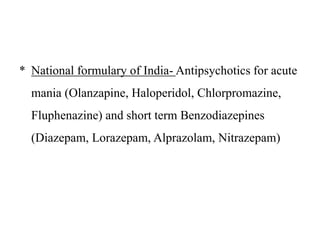
* National formulary of India- Antipsychotics for acute
mania (Olanzapine, Haloperidol, Chlorpromazine,
Fluphenazine) and short term Benzodiazepines
(Diazepam, Lorazepam, Alprazolam, Nitrazepam)
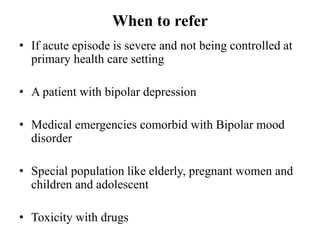
When to refer
• If acute episode is severe and not being controlled at
primary health care setting
• A patient with bipolar depression
• Medical emergencies comorbid with Bipolar mood
disorder
• Special population like elderly, pregnant women and
children and adolescent
• Toxicity with drugs
PEARLS TO REMEMBER
• Depression is the commonest psychiatric morbidity in
General Practice and should not be overlooked
• A depressed patient usually presents with physical
symptoms that should be explored
• Comorbid psychiatric and general medical conditions
are common and should be treated
• It is also important to ask about prior manic or
hypomanic episode to avoid misinterpreting bipolar
disorder for unipolar depression.
• Physicians should not be reluctant to ask about
suicide as proactive questioning may be life saving
• Not just short term treatment but maintenance
treatment, relapse prevention and psycho social
rehabilitation should be the goal
• Any comorbid medical illness needs to be addressed
adequately by the general practitioner
“The good
physician
treats the disease,
but
the great physician
treats the person”
William Osler
THANK YOU

Depression and other Affective disorders

  • 1.
    DEPRESSION AND OTHER AFFECTIVE DISORDERS Dr KaushikNandi Department of Psychiatry RIMS
  • 2.
    DEPRESSION AND OTHER AFFECTIVEDISORDERS • Affective disorders encompass all disorders of mood that are persistent and pervasive and lead to socio- occupational dysfunction. • By far, Depression is the most commonly encountered mental disorder by a general practitioner and hence a comprehensive understanding of the disorder is indispensable.
  • 3.
    • This isthe broad classification of affective disorders.
  • 4.
    DEPRESSION : OUTLINEOF TEXT • Learning objectives • Introduction and Epidemiology • Diagnosis a. Criteria b. Clinical features c. Mental status examination • Differential diagnosis ( general medical conditions overlapping with depression) • Management a. Pharmacological b. Non pharmacological c. Special population d. When to refer
  • 5.
    LEARNING OBJECTIVES • tobe able to identify depression in outpatient settings • to distinguish between unipolar depression and bipolar mood disorders • to be able to assess and decide treatment for depression • to understand the dosages, duration and side effects of antidepressants • to know when to refer
  • 6.
    INTRODUCTION AND EPIDEMIOLOGY • Mooddisorders mainly manifest as either manic or depressive episodes. • The lifetime risk of depression varies from 10-15% with the risk being twice more in women than men. • Depression has a multifactorial aetiology as depicted later.
  • 8.
    • The disordermay manifest at any age but the incidence seems to peak in 20s. • The disorder may have a variable course but if untreated can run a chronic and disabling course. • Thus early identification and treatment increases the likelihood of remission and recovery
  • 9.
    Risk factors fordepression • Female sex • Age <40 years • Impaired interpersonal • relationships • Divorced, widowers • Family history of depression • Negative life events
  • 10.
    DIAGNOSING DEPRESSION • Transientdepressed mood in reaction to negative experiences is normal • Feeling sad is a normal reaction to experiences that are stressful or upsetting • Most people, children as well as adults, feel low or `blue' occasionally • Depression becomes an illness when the depressed mood is serious and prolonged, and is accompanied by other symptoms and disturbances of functioning
  • 11.
    For a depressiveepisode: diagnostic criteria : For at least 2 weeks, has the person had at least 2 of the following core symptoms: 1. Depressed mood (most of the day, almost every day), (for children and adolescents irritability or depressed mood) 2. Loss of interest or pleasure in activities that are normally pleasurable 3. Decreased energy or easily fatigued
  • 12.
    • Symptoms shouldbe causing significant socio- occupational dysfunction. • Rule out bereavement in past 2 months • Rule out the possibility of bipolar depression. (Ask about prior episode of manic symptoms such as elevated, expansive or irritable mood, increased activity and talkativeness, flight of ideas, decreased need for sleep, grandiosity, distractibility, loss of social inhibitions and extreme optimism leading to reckless behaviors.)
  • 13.
    • During thelast 2 weeks has the person had at least 2 other features of depression: 1. Reduced concentration and attention 2. Reduced self-esteem and self-confidence 3. Ideas of guilt and unworthiness 4. Bleak and pessimistic view of the future 5. Ideas or acts of self-harm or suicide 6. Disturbed sleep 7. Diminished appetite
  • 14.
    • If 2other features – mild depressive episode • If 3 other features – moderate depressive episode • If 3 of the core features and 4 other symptoms – Severe depressive episode. It may b with or without psychotic features
  • 15.
    An episode canbe with or without somatic syndrome (4 or more of the following) • loss of interest in activities and lack of emotional reactivity, • Loss of appetite, Weight loss, • Insomnia mainly as early morning awakening, depression worse in morning, • Low libido, • Psychomotor retardation or agitation
  • 16.
    • Recurrent depressivedisorder: Repeated episodes of depression with current episode being mild, moderate or severe • Dysthymia: A chronic depressive state that does not meet criteria for a depressive episode anytime and lasts for at least 2 years
  • 17.
    CLINICAL FEATURES • Asseen in the diagnostic criteria the clinical features of depression encompass domains of psychological, somatic and psychotic symptoms if severe.
  • 19.
    Following medical conditions,drugs and psychiatric disorders may be comorbid with depression and should always be explored and only then can the patient be treated holistically. General Medical Conditions: • Endocrine: Thyroid / glucocorticoid disturbance • Infection: Meningitis, encephalitis, syphilis, HIV Systemic( UTI, pneumonia, sepsis) • Cardiovascular: Shock, cardiac failures
  • 20.
    • Cerebrovascular: Infarcts,haemorrhage • Metabolic: Dyselectrolytemia, renal/hepatic failures,hypo/hyperglycaemia • Nutritional: Vitamin B12, Folate deficiency • Tumor: Cerebral/systemic • Trauma: Subdural haematoma, cerebral contusions
  • 21.
    Drugs : • Withdrawalof : Prolonged use of caffeine, nicotine, sedatives, amphetamines • Prolonged use of Antihypertensive drugs Anti-inflammatory/ analgesics Steroids Antineoplastic drugs Anti-parkinsonism drugs Antipsychotics Sedatives Many antibacterial/ antifungals
  • 22.
    Other psychiatric disorders •Anxiety disorders • Substance use disorders
  • 23.
    MENTAL STATUS EXAMINATION •Generalised psychomotor retardation ( or agitation in elderly), stooped posture, slow spontaneous movements, downcast gaze, decreased rate of speech with increased reaction time, depressed mood and restricted affect, with delusions or hallucinations in perceptual disturbance may be seen.
  • 24.
    • Thought processmay be slow with poverty of ideas. Though sensorium is intact memory may be impaired with increased impulsivity (assess for suicide) with impaired judgement (too pessimist) and insight may be impaired. • Usually the classic triad of pessimist thoughts about self, future and others may be seen.
  • 25.
    MANAGING DEPRESSION GOALS : •Psychoeducation • Relieve the symptoms of present episode (remission) • Frequent follow ups until remission and also later • Restore premorbid functioning of individual • Maintain treatment to prevent relapse (usually if no or minimal depressive symptoms for 9 – 12 months and ability to carry out routine activities for that time period consider tapering and stopping the antidepressant)
  • 26.
    PHARMACOLOGICAL • Tricyclic antidepressants(TCA):Imipramine, Amitryptyline • Selective Serotonin Reuptake Inhibitors(SSRI): Fluoxetine, Sertraline, Escitalopram • Serotonin Norepinephrine receptor inhibitors: Venlafaxine • Others: Mirtazepine
  • 27.
    PSYCHOLOGICAL Psychoeducation, cognitive behaviouraltherapy (CBT) PSYCHOSOCIAL Psychoeducation, address current psychosocial stressors, reactivate social networks, activity scheduling, physical activity
  • 28.
    At primary healthcare level, it may be feasible to • Select a drug from national formulary and give according to instructions given below. • Give psychosocial interventions along with, depending on severity of depressive symptoms. • Exploring the psychosocial stressors of patient in privacy, empathetically and helping problem solve them may be needed. Family and friends can be used to build up support system for patient. Any pertinent stress like abuse may need to be dealt with in patient's environment.
  • 29.
    • Patient shouldbe encouraged to resume the earlier pleasurable hobbies and social meetings to reactivate his social circuits. • Patient may need to be helped with a schedule according to his strengths and weaknesses and appropriately rewarded and applauded for the same with the help of family members initially. • Some sort of physical activity or yoga may be advised (45 minutes 3-5 times/week) • Any comorbid medical condition should be treated adequately at primary health care level
  • 30.
    When to refer: •Patient has severe depression with psychotic features • Suicidal ideations • Psychological intervention needed ( lack of resources) • Bipolar affective disorder • Multiple comorbid conditions • Special population if not manageable • Any other emergency comorbid with mood disorder
  • 31.
  • 32.
    BIPOLAR AFFECTIVE DISORDER (BPAD) •BPAD is characterised by an episode of mania or hypomania. • It may or may not be followed by a subsequent mood episode. • About 5-10% of patients with initial diagnosis of major depressive episode have a manic episode later on.
  • 33.
    DIANOSTIC CRITERIA Mania: Elevated,expansive or irritable mood + 3 of the following (4 if mood is irritable) • Increased activity, restlessness, excitement • Increased talkativeness • Loss of social inhibitions • Decreased need for sleep • Overspending or other reckless behaviours • Distractibility • Elevated sexual energy
  • 34.
    Mania contd… Multiple symptoms,lasting for at least 1 week Severe enough to interfere significantly with work and social activities or requiring hospitalization
  • 35.
    DIANOSTIC CRITERIA Hypomania: Samefeatures as mania but with a lesser severity and duration. Some symptoms, lasting for at least 4 days Cause some interference with work and social activities but do not require hospitalization or have psychotic features • So a bipolar disorder may manifest as single manic episode or a manic/hypomanic episode with depression.
  • 36.
    Clinical features andMSE • Mood Changes as elation, euphoria or Irritable. • The level of goal directed and pleasurable activities increase that are usually reckless and involve risk. • Patient is distractible with poor concentration. Speech is rapid and patient jumps from one topic to another. • Patient may have delusions mainly grandiose delusions of power, worth or identity.
  • 37.
    Clinical features andMSE • There is decrease in need of sleep and still high levels of energy • Increased appetite, increased libido and sexual activity, increased desire for substances. • Also the disorder may be comorbid with other general medical conditions as depicted under depression.
  • 38.
    Comorbid psychiatric conditionsand substances are mentioned here : • Other psychiatric disorders • Anxiety disorders • Substance use disorders • Drugs Withdrawal of Sedatives, alcohol • Prolonged use of Amphetamines, cocaine, Stimulants (methylphenidate),Steroids, Bromocriptine, levodopa, Baclofen, opioids
  • 39.
    PREDICTORS OF BIPOLARITY •Early age of onset with marked psychomotor retardation) • Postpartum depression • Rapid onset and offset of depressive episodes • Recurrent depression (5 or more episodes) • Atypical symptoms (increase in appetite and sleep) • Bipolar family history • Antidepressant induced hypomania • Seasonal episodes
  • 40.
    MANAGEMENT Goals: • Psycho education •Treat the present episode • Prevent relapse by maintenance treatment ( at least 2 years after last bipolar episode ) • Know when to refer • rehabilitation (appropriate economic, social, cultural and educational activities)
  • 41.
    If present episodeis mania/hypomania • Begin treatment of acute mania with mood stabilizer (lithium, valproate, and carbamazepine) or with antipsychotics* • Consider short-term benzodiazepine* such as diazepam for behavioural disturbance or agitation. • Discontinue any antidepressants.
  • 42.
    If present episodeis depression but there is history of past bipolar affective disorder or past manic/hypomanic episode in history • Begin treatment with a mood-stabilizer • Consider antidepressant combined with mood stabilizer for moderate / severe depression with monitoring of switching to mania. • However, referral to a specialist should be done. Consider non pharmacological management of mild bipolar depression along with mood stabilizer.
  • 43.
    * National formularyof India- Antipsychotics for acute mania (Olanzapine, Haloperidol, Chlorpromazine, Fluphenazine) and short term Benzodiazepines (Diazepam, Lorazepam, Alprazolam, Nitrazepam)
  • 44.
    When to refer •If acute episode is severe and not being controlled at primary health care setting • A patient with bipolar depression • Medical emergencies comorbid with Bipolar mood disorder • Special population like elderly, pregnant women and children and adolescent • Toxicity with drugs
  • 45.
    PEARLS TO REMEMBER •Depression is the commonest psychiatric morbidity in General Practice and should not be overlooked • A depressed patient usually presents with physical symptoms that should be explored • Comorbid psychiatric and general medical conditions are common and should be treated
  • 46.
    • It isalso important to ask about prior manic or hypomanic episode to avoid misinterpreting bipolar disorder for unipolar depression. • Physicians should not be reluctant to ask about suicide as proactive questioning may be life saving • Not just short term treatment but maintenance treatment, relapse prevention and psycho social rehabilitation should be the goal • Any comorbid medical illness needs to be addressed adequately by the general practitioner
  • 47.
    “The good physician treats thedisease, but the great physician treats the person” William Osler
  • 48.