Depression
Recognition and Management
Dr Bruce Davies
www.bradfordvts.co.uk
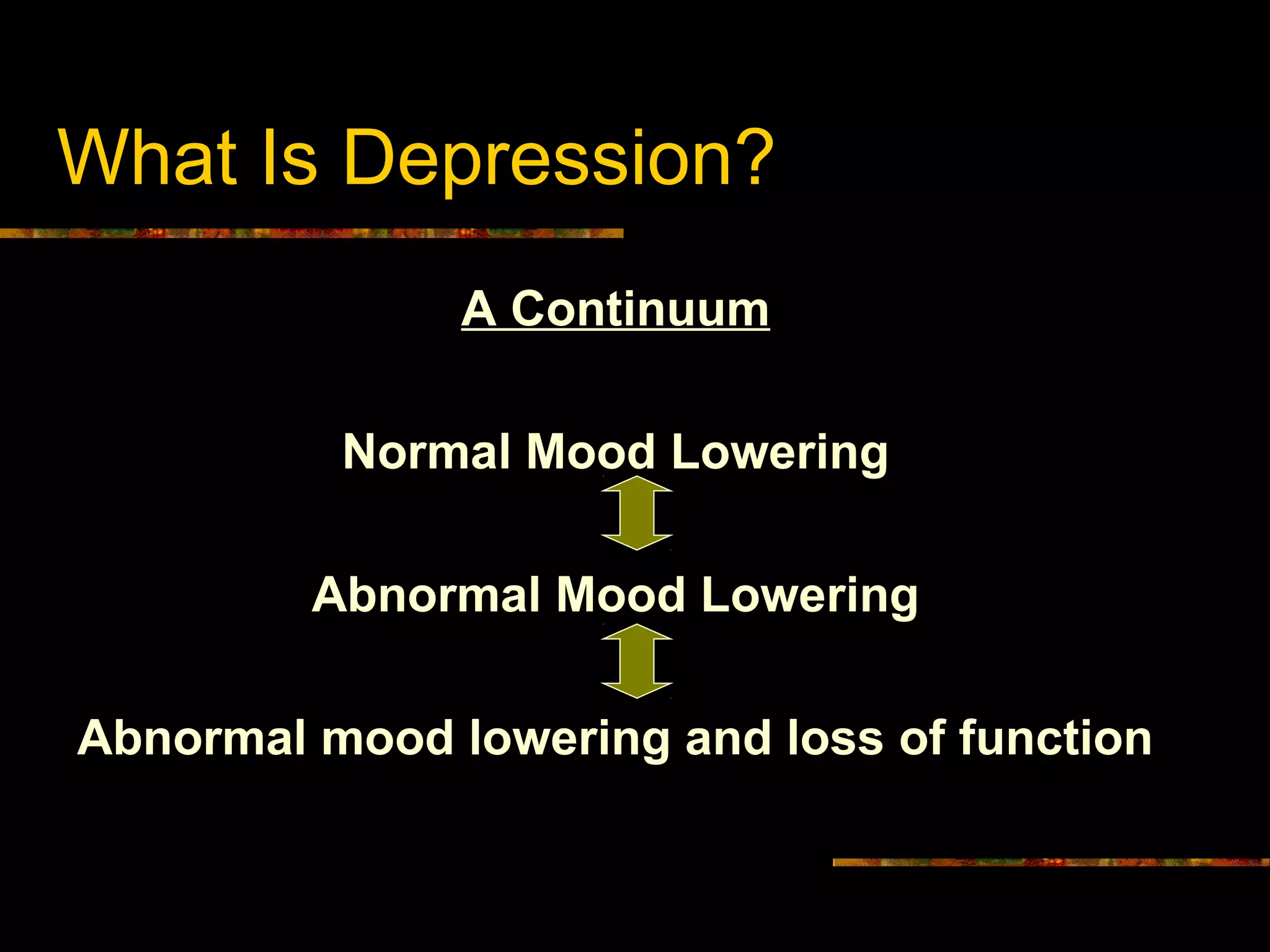
What Is Depression?
A Continuum
Normal Mood Lowering
Abnormal Mood Lowering
Abnormal mood lowering and loss of function
What Is Depression?
 Depressive disorder
 Pervasive
 Persistent
 Wide range of symptoms
What Is Depression?
 Range of symptoms
 Negative views
 Worthlessness
 Incapacity
 Guilt
 Sleep disturbance
 Diurnal mood variation
 Loss of energy
 Impaired concentration
What Is Depression?
 Impaired work ability
 Poor social functioning
 Psychomotor retardation
 Pessimism
 Better off dead
 Thoughts of suicide
 Suicide / action
 Fear / belief of bodily illness
Understandability
 No longer important.
 Do not alter
treatment
thresholds.
 Do not alter
treatment.
 Reactive /
endogenous =
confine to bin.
Vulnerabilities
 Losses
 Stressful life events
 Lack of social
support
 Physical illness
 Familial factors
 Genetic factors
What Is Depression? - Various Criteria.
Defeat Depression Campaign
 Depressed mood or loss of pleasure
for at least 2 weeks. Plus 4 or more of:
 Worthlessness or guilt
 Impaired concentration
 Loss of energy and fatigue
 Thoughts of suicide
 Loss or increase of appetite or weight
 Insomnia or hypersomnia
 Retardation or agitation
What Is Depression? - Various Criteria.
DSM – IV
 Duration > 2 weeks Depressed mood or Marked loss of
interest or pleasure in normal activities
 Plus 4 of:
i. Significant change in weight
ii. Significant change in sleep pattern
iii. Agitation or retardation
iv. Fatigue or loss of energy
v. Guilt / worthlessness
vi. Can’t concentrate or make decisions
vii. Thoughts of death or suicide
What Is Depression? - Various Criteria.
ICD – 10
 Patient has low mood:
1) How bad is it and how long has it been going on?
2) Have you lost interest in things?
3) Are you more tired than usual?
If the answer is yes to these, then:
ICD – 10 (Continued)
4) Have you lost confidence in yourself?
5) Do you feel guilty about things?
6) Concentration difficulties?
7) Sleeping problems?
8) Change in appetite or weight?
9) Do you feel that life is not worth living any
more?
ICD – 10 (Continued)
♦ Mild.
Two criteria from 1-3 and 2 others.
♦ Moderate.
Two criteria from 1-3 and 3-4 others or a yes
to question 5.
♦ Severe.
Most of the criteria in severe form especially
questions 5 & 9.
Variants
 Depressive episodes that
do not meet the criteria for
major depression.
 Lifelong mild fluctuating
depression (Dysthymia).
 Mixed states of above two.
 Manic depression –
bipolar disorder.
Incidence Of Depression :
2000 Patients
100 - major
100 - minor
200 – sub-
clinical
Depression. In 50% of patients it
may not be acknowledged.
Numbers
 10% of those diagnosed in primary care
are referred to psychiatrists.
 1 in 1000 are admitted to hospital.
 Lifetime incidence rates approach 33%.
 5% of consulters have major
depression.
 5% have milder depression.
 A further 10% have some depressive
features.
Numbers
 At least one patient per surgery will
have depressive symptoms of some
type.
 Commoner in younger people including
children than thought in the past.
 Men:women = 1:2.
 Common in the physically ill.
 50% recurrence rate.
 12% become chronically depressed.
Why Missed?
 50% are missed.
 10% subsequently
recognised.
 Of the 40% who remain
unrecognised:
 Half remit
spontaneously.
 Half remain depressed 6
months later.
Missed: Patient Factors
 Present somatic symptoms.
 Physical problems.
 Stigma.
 Beliefs about GP role and time to
listen.
 Longstanding depression.
 Less overt / typical.
 Less insight.
Missed: Doctor Factors
 More accurate doctors.
 Make more eye contact.
 Show less signs of hurry.
 Are good listeners.
 Ask questions with social and psychological
content.
 Less accurate doctors.
 Ask many closed questions.
 Ask questions derived from theory rather than
what the patient just said.
Assessment
 Severity
 Duration
 Social network
 Views of self, world
and future
 Suicidal thoughts
 Past history
 Factors affecting
symptoms
 Biological features
Assessment Skills
 Directive not closed questions
 Picking up on verbal clues
“clarification”
 Picking up on non-verbal clues and
using them
 Empathy
 Summarising
Treatment Contract
 Key skills
 Re-frame symptoms as
depression
 Link to life events
 Negotiate anti-
depressants if necessary
 Problem list and
priorities
 Set realistic time scale
 Agree regular review
Explanations
 Depressive illness is
clinically different
from the blues and
involves chemical
changes in the
brain.
 Depressive illness
has characteristic
symptoms and
explain them.
Explanations
 Depression benefits
from both drug and
non-drug
approaches.
 “Pills for symptoms.”
 “Talking for
problems.”
Explanations
 Anti-depressants
are not addictive or
habit forming.
 Anti-depressants
take 2-3 weeks to
begin to work and
need to be taken for
4-6 months after the
full benefit is
obtained to prevent
relapse.
Explanations
 Side effects occur
and are expected –
explain.
 Drugs enable talking
therapy to work
better.
 Regular review is
important and needs
to continue for at
least 6 months.
Explanations
 Talking therapy can help solve
problems that are soluble, cope with
the insoluble and examine other
problems that seem unrealistic to the
patient or therapist.
 Prevention of further trouble will be
considered when the treatment is
coming to an end.
References
 Defeat Depression Campaign. The
Royal College of Psychiatrists. 1994.
 Treating People with depression: a
practical guide for primary care. G
Wilkinson et al. Radcliffe 1998.
 Recognition and management of
depression in general practice:
consensus statement. BMJ
1992;305:1198-202.

Depression

  • 1.
    Depression Recognition and Management DrBruce Davies www.bradfordvts.co.uk
  • 2.
    What Is Depression? AContinuum Normal Mood Lowering Abnormal Mood Lowering Abnormal mood lowering and loss of function
  • 3.
    What Is Depression? Depressive disorder  Pervasive  Persistent  Wide range of symptoms
  • 4.
    What Is Depression? Range of symptoms  Negative views  Worthlessness  Incapacity  Guilt  Sleep disturbance  Diurnal mood variation  Loss of energy  Impaired concentration
  • 5.
    What Is Depression? Impaired work ability  Poor social functioning  Psychomotor retardation  Pessimism  Better off dead  Thoughts of suicide  Suicide / action  Fear / belief of bodily illness
  • 6.
    Understandability  No longerimportant.  Do not alter treatment thresholds.  Do not alter treatment.  Reactive / endogenous = confine to bin.
  • 7.
    Vulnerabilities  Losses  Stressfullife events  Lack of social support  Physical illness  Familial factors  Genetic factors
  • 8.
    What Is Depression?- Various Criteria. Defeat Depression Campaign  Depressed mood or loss of pleasure for at least 2 weeks. Plus 4 or more of:  Worthlessness or guilt  Impaired concentration  Loss of energy and fatigue  Thoughts of suicide  Loss or increase of appetite or weight  Insomnia or hypersomnia  Retardation or agitation
  • 9.
    What Is Depression?- Various Criteria. DSM – IV  Duration > 2 weeks Depressed mood or Marked loss of interest or pleasure in normal activities  Plus 4 of: i. Significant change in weight ii. Significant change in sleep pattern iii. Agitation or retardation iv. Fatigue or loss of energy v. Guilt / worthlessness vi. Can’t concentrate or make decisions vii. Thoughts of death or suicide
  • 10.
    What Is Depression?- Various Criteria. ICD – 10  Patient has low mood: 1) How bad is it and how long has it been going on? 2) Have you lost interest in things? 3) Are you more tired than usual? If the answer is yes to these, then:
  • 11.
    ICD – 10(Continued) 4) Have you lost confidence in yourself? 5) Do you feel guilty about things? 6) Concentration difficulties? 7) Sleeping problems? 8) Change in appetite or weight? 9) Do you feel that life is not worth living any more?
  • 12.
    ICD – 10(Continued) ♦ Mild. Two criteria from 1-3 and 2 others. ♦ Moderate. Two criteria from 1-3 and 3-4 others or a yes to question 5. ♦ Severe. Most of the criteria in severe form especially questions 5 & 9.
  • 13.
    Variants  Depressive episodesthat do not meet the criteria for major depression.  Lifelong mild fluctuating depression (Dysthymia).  Mixed states of above two.  Manic depression – bipolar disorder.
  • 14.
    Incidence Of Depression: 2000 Patients 100 - major 100 - minor 200 – sub- clinical Depression. In 50% of patients it may not be acknowledged.
  • 15.
    Numbers  10% ofthose diagnosed in primary care are referred to psychiatrists.  1 in 1000 are admitted to hospital.  Lifetime incidence rates approach 33%.  5% of consulters have major depression.  5% have milder depression.  A further 10% have some depressive features.
  • 16.
    Numbers  At leastone patient per surgery will have depressive symptoms of some type.  Commoner in younger people including children than thought in the past.  Men:women = 1:2.  Common in the physically ill.  50% recurrence rate.  12% become chronically depressed.
  • 17.
    Why Missed?  50%are missed.  10% subsequently recognised.  Of the 40% who remain unrecognised:  Half remit spontaneously.  Half remain depressed 6 months later.
  • 18.
    Missed: Patient Factors Present somatic symptoms.  Physical problems.  Stigma.  Beliefs about GP role and time to listen.  Longstanding depression.  Less overt / typical.  Less insight.
  • 19.
    Missed: Doctor Factors More accurate doctors.  Make more eye contact.  Show less signs of hurry.  Are good listeners.  Ask questions with social and psychological content.  Less accurate doctors.  Ask many closed questions.  Ask questions derived from theory rather than what the patient just said.
  • 20.
    Assessment  Severity  Duration Social network  Views of self, world and future  Suicidal thoughts  Past history  Factors affecting symptoms  Biological features
  • 21.
    Assessment Skills  Directivenot closed questions  Picking up on verbal clues “clarification”  Picking up on non-verbal clues and using them  Empathy  Summarising
  • 22.
    Treatment Contract  Keyskills  Re-frame symptoms as depression  Link to life events  Negotiate anti- depressants if necessary  Problem list and priorities  Set realistic time scale  Agree regular review
  • 23.
    Explanations  Depressive illnessis clinically different from the blues and involves chemical changes in the brain.  Depressive illness has characteristic symptoms and explain them.
  • 24.
    Explanations  Depression benefits fromboth drug and non-drug approaches.  “Pills for symptoms.”  “Talking for problems.”
  • 25.
    Explanations  Anti-depressants are notaddictive or habit forming.  Anti-depressants take 2-3 weeks to begin to work and need to be taken for 4-6 months after the full benefit is obtained to prevent relapse.
  • 26.
    Explanations  Side effectsoccur and are expected – explain.  Drugs enable talking therapy to work better.  Regular review is important and needs to continue for at least 6 months.
  • 27.
    Explanations  Talking therapycan help solve problems that are soluble, cope with the insoluble and examine other problems that seem unrealistic to the patient or therapist.  Prevention of further trouble will be considered when the treatment is coming to an end.
  • 28.
    References  Defeat DepressionCampaign. The Royal College of Psychiatrists. 1994.  Treating People with depression: a practical guide for primary care. G Wilkinson et al. Radcliffe 1998.  Recognition and management of depression in general practice: consensus statement. BMJ 1992;305:1198-202.