Depression

By: Rebecca Jones
Symptoms of Depression
• Difficulty concentrating, remembering details, and making
  decisions
• Fatigue and decreased energy
• Feeling of guilt, worthlessness, or helplessness
• Insomnia, early morning wakefulness, or excessive sleeping
• Irritability, restlessness
• Loss of interest in activities or hobbies once pleasurable,
  including sex
• Overeating or appetite loss
• Persistent aches and pains, headaches, cramps, or digestive
  problems that do not ease with treatment
• Persistent sad, anxious, or empty feeling
• Thoughts of suicide and/or suicide attempts
Warning Signs of Suicide with Depression

• A Sudden switch from being very happy to being very calm or
  appearing to be happy
• Always talking or thinking about death
• Clinical depression (deep sadness, loss of interest, trouble
  sleeping, and eating) that gets worse
• Having a death wish, tempting fate by taking risks that could
  lead to death, like driving thru red lights
• Losing interests in things that one used to care about
• Making comments about being hopeless, helpless, and worthless
• Putting affairs in order, tying up loose ends, changing a will
• Saying things like “it would be better if I wasn’t here” or “I
  want out”
• Talking about suicide (kills ones self)
• Visiting or calling people one cares about
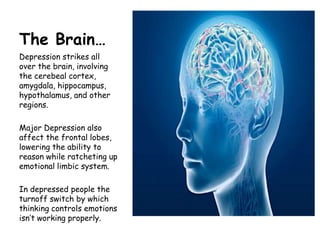
The Brain…
Depression strikes all
over the brain, involving
the cerebeal cortex,
amygdala, hippocampus,
hypothalamus, and other
regions.

Major Depression also
affect the frontal lobes,
lowering the ability to
reason while ratcheting up
emotional limbic system.

In depressed people the
turnoff switch by which
thinking controls emotions
isn’t working properly.
Depression can strike anyone!
Children as young as 5or 6 can experience
 symptoms that resemble depression in
 adults.
The onset of true depression increases
 sharply during the teenage years, then
 gradually rises to peak around age 40.
Average onset age is 30 with treatment
 beginning usually about 3 years later.
Hereditary

Heredity plays a role in the likelihood of
developing depression. Say if one twin
in a pair of identical twins is diagnosed
with clinical depression the other has a
70% chance of also having depression.
Gender and Depression
Women are more than twice as likely to
 become depressed as men.

Men are also more likely to hide
 depression from themselves and others
 by self medicating with alcohol or drugs
 or working excessive long hours.
Medications for depression

 Depression arises from
 imbalances of
 neurotransmitters.
 Many antidepressants
 increase the amount of
 the serotonin in the
 synapses.
 After 2 or 3 weeks the
 release of serotonin
 causes the receiving
 neuron to become more
 sensitive to its
 presence.
Sweeney, Michael S. BRAIN The Complete Mind.
National Geographic Washington, D.C. Print 2009

Mondimore, Francis Mark. Depression, the Mood Disease.
Baltimore, MD, USA: Johns Hopkins University Press, 2006.

Ainsworth, Patricia. Understanding Depression.
Jackson, MS, USA: University Press of Mississippi, 2000.

Paolucci, Susan L., MD; Paolucci, Stephen J., MD; Buckley, Sandra A..
Depression FAQs.
Hamilton, ON, CAN: B.C. Decker, 2007.

Depression

  • 1.
  • 2.
    Symptoms of Depression •Difficulty concentrating, remembering details, and making decisions • Fatigue and decreased energy • Feeling of guilt, worthlessness, or helplessness • Insomnia, early morning wakefulness, or excessive sleeping • Irritability, restlessness • Loss of interest in activities or hobbies once pleasurable, including sex • Overeating or appetite loss • Persistent aches and pains, headaches, cramps, or digestive problems that do not ease with treatment • Persistent sad, anxious, or empty feeling • Thoughts of suicide and/or suicide attempts
  • 3.
    Warning Signs ofSuicide with Depression • A Sudden switch from being very happy to being very calm or appearing to be happy • Always talking or thinking about death • Clinical depression (deep sadness, loss of interest, trouble sleeping, and eating) that gets worse • Having a death wish, tempting fate by taking risks that could lead to death, like driving thru red lights • Losing interests in things that one used to care about • Making comments about being hopeless, helpless, and worthless • Putting affairs in order, tying up loose ends, changing a will • Saying things like “it would be better if I wasn’t here” or “I want out” • Talking about suicide (kills ones self) • Visiting or calling people one cares about
  • 5.
    The Brain… Depression strikesall over the brain, involving the cerebeal cortex, amygdala, hippocampus, hypothalamus, and other regions. Major Depression also affect the frontal lobes, lowering the ability to reason while ratcheting up emotional limbic system. In depressed people the turnoff switch by which thinking controls emotions isn’t working properly.
  • 6.
    Depression can strikeanyone! Children as young as 5or 6 can experience symptoms that resemble depression in adults. The onset of true depression increases sharply during the teenage years, then gradually rises to peak around age 40. Average onset age is 30 with treatment beginning usually about 3 years later.
  • 7.
    Hereditary Heredity plays arole in the likelihood of developing depression. Say if one twin in a pair of identical twins is diagnosed with clinical depression the other has a 70% chance of also having depression.
  • 8.
    Gender and Depression Womenare more than twice as likely to become depressed as men. Men are also more likely to hide depression from themselves and others by self medicating with alcohol or drugs or working excessive long hours.
  • 9.
    Medications for depression Depression arises from imbalances of neurotransmitters. Many antidepressants increase the amount of the serotonin in the synapses. After 2 or 3 weeks the release of serotonin causes the receiving neuron to become more sensitive to its presence.
  • 10.
    Sweeney, Michael S.BRAIN The Complete Mind. National Geographic Washington, D.C. Print 2009 Mondimore, Francis Mark. Depression, the Mood Disease. Baltimore, MD, USA: Johns Hopkins University Press, 2006. Ainsworth, Patricia. Understanding Depression. Jackson, MS, USA: University Press of Mississippi, 2000. Paolucci, Susan L., MD; Paolucci, Stephen J., MD; Buckley, Sandra A.. Depression FAQs. Hamilton, ON, CAN: B.C. Decker, 2007.