Understanding
Depression
What is depression?
 Everyone occasionally feels blue or
sad, But these feelings are usually
short-lived and pass within a couple of
days, when you have to depression, it
interferes with daily life and causes pain
for both you and those who care about
you, depression is a common but
serious illness.
Definition (F-32)
 Depression is a common mental
disorder that presents with depressed
mood, loss of interest or pleasure,
feelings of guilt or low self-worth
disturbed sleep or appetite, low energy,
and poor concentration.
 Depression is the leading cause of
disability as measured and the 4th
leading contributor to the global burden
of disease (DALYs, Disability-Adjusted
Life Years) in 2000. By the year 2020,
depression is projected to reach 2nd
place of the ranking of DALYs
calculated for all ages, both sexes.
 Today, depression is already the 2nd
cause of DALYs in the age category 15-
44 years for both sexes combined.
Epidemiology
Epidemiology
 Depression is a wide spread mental
health problem affecting many people.
 The life time risk of depression in male
is 8-12% and in female it is 20-26%
 Depression occurs twice as frequently in
woman as in men.
 Onset is usually after 25-30 years and
peak between 40-60 years.
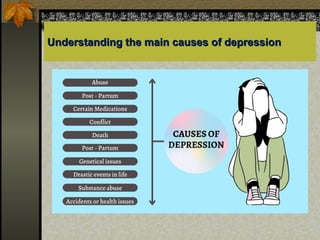
Understanding the main causes of depression
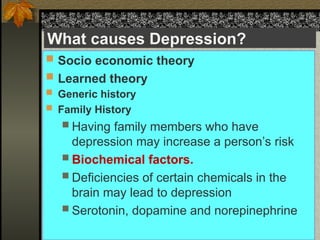
What causes Depression?
 Socio economic theory
 Learned theory
 Generic history
 Family History
 Having family members who have
depression may increase a person’s risk
 Biochemical factors.
 Deficiencies of certain chemicals in the
brain may lead to depression
 Serotonin, dopamine and norepinephrine
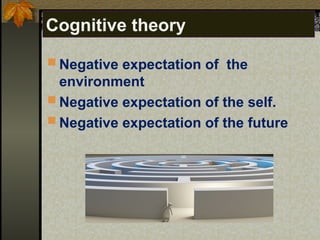
Cognitive theory
 Negative expectation of the
environment
 Negative expectation of the self.
 Negative expectation of the future
Psychological causes
 Loss of person
 Loss of love
 Failure in occupation
 Failure in exam
 Failure in business
 Disappointment
 Change in brain anatomy: loss of neurons
in the frontal lobes, cerebellum and basal ganglia has
been identified in depression
Major Life Changes
 Negative or particularly
stressful events can
trigger depression.
Examples include the
death of a loved one or a
job change.
 Major Illnesses such as
heart attack, stroke or
cancer may trigger
depression.
Certain medications used
alone or in combination can
cause side effects much like
the symptoms of depression.
Use of Alcohol or other Drugs
can lead to or worsen
depression.
Core Symptoms of Depression
 Vary from person to person
CORE SYMPTOMS
 2 key signs are loss of
interest in things you like to
do, and pervasive sadness
or loss and interest and
enjoyment.
 Fatiquablity
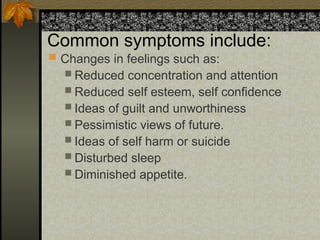
Common symptoms include:
 Changes in feelings such as:
 Reduced concentration and attention
 Reduced self esteem, self confidence
 Ideas of guilt and unworthiness
 Pessimistic views of future.
 Ideas of self harm or suicide
 Disturbed sleep
 Diminished appetite.
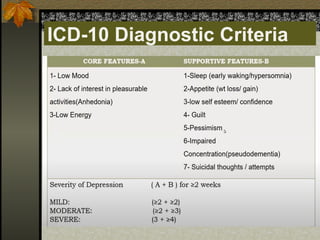
ICD-10 Diagnostic Criteria
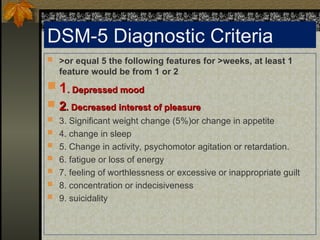
DSM-5 Diagnostic Criteria
 >or equal 5 the following features for >weeks, at least 1
feature would be from 1 or 2
 1. Depressed mood
. Depressed mood
 2
2. Decreased interest of pleasure
. Decreased interest of pleasure
 3. Significant weight change (5%)or change in appetite
 4. change in sleep
 5. Change in activity, psychomotor agitation or retardation.
 6. fatigue or loss of energy
 7. feeling of worthlessness or excessive or inappropriate guilt
 8. concentration or indecisiveness
 9. suicidality
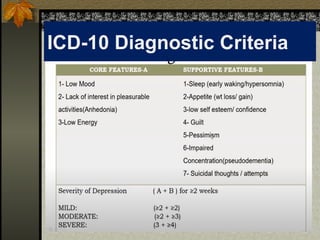
ICD-10 Diagnostic Criteria
Changes in behavior and
attitude
 These may include:
 General slowing down
 Neglect of responsibilities and appearance
 Poor memory
 Inability to concentrate
 Suicidal thoughts and feelings
 Difficulty making decisions
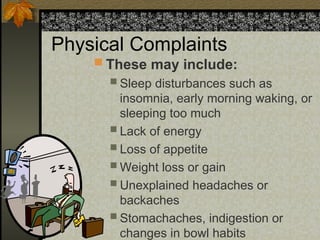
Physical Complaints
 These may include:
 Sleep disturbances such as
insomnia, early morning waking, or
sleeping too much
 Lack of energy
 Loss of appetite
 Weight loss or gain
 Unexplained headaches or
backaches
 Stomachaches, indigestion or
changes in bowl habits
Common Types of Depression
 Major Depression
 Atypical Depression
 Dysthymia
 Bipolar Disorder
 Seasonal Affective Disorder (SAD)
 premenstrual dysphonic
 postpartum depression
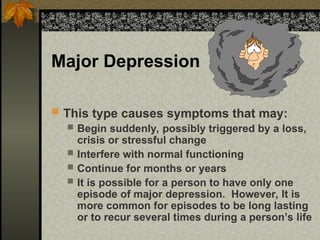
Major Depression
 This type causes symptoms that may:
 Begin suddenly, possibly triggered by a loss,
crisis or stressful change
 Interfere with normal functioning
 Continue for months or years
 It is possible for a person to have only one
episode of major depression. However, It is
more common for episodes to be long lasting
or to recur several times during a person’s life
Major depressive disorder
Diagnostic criteria
 According to the DSM-IV
 Five (or more) of the following
symptoms have to present for the same
two period.
 At least one of the first two symptoms
(depressed mood or loss of interest or
pleasure is included in these.
Diagnostic criteria
 Depressed mood for most of the day
every day
 Reported by the person or by others
 In children and adolescent, this can
irritable mood . .
Atypical Depression
 Mood reactivity plus > 2 of the followng
 Hyperplasia
 Hypersomnia
 Leaden paralysis (Heaviness)
 Interpersonal rejection sensitivity
 2-3 time common in women.
Dysthymia
People with this illness may be
consistently and mildly depressed
for years. They function fairly well
on a daily basis, but their
relationships and self esteem suffer
over time.
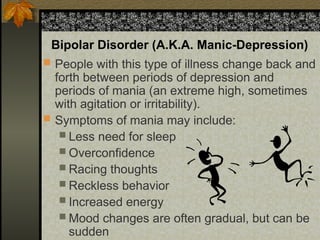
Bipolar Disorder (A.K.A. Manic-Depression)
 People with this type of illness change back and
forth between periods of depression and
periods of mania (an extreme high, sometimes
with agitation or irritability).
 Symptoms of mania may include:
 Less need for sleep
 Overconfidence
 Racing thoughts
 Reckless behavior
 Increased energy
 Mood changes are often gradual, but can be
sudden
Season Affective Disorder
 This is depression that coincides with
changes in the season. Most cases begin
in the fall or winter, when there is a
decrease in sunlight
(more common in regions
farther north)
 Less often, depression
can occur in late Spring
or summer
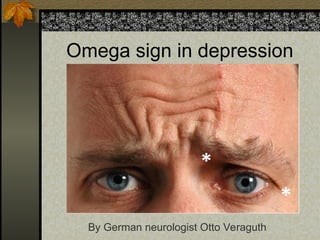
Omega sign in depression
By German neurologist Otto Veraguth
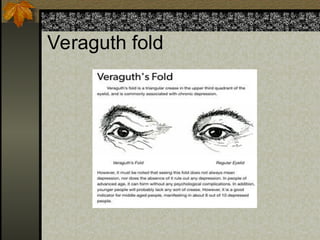
Veraguth fold
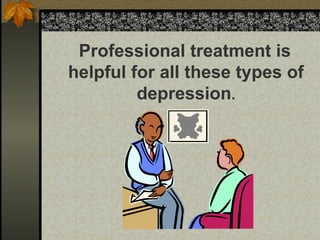
Professional treatment is
helpful for all these types of
depression.
Psychotherapy
 Counseling can help many depressed people
understand, accept and feel better about
themselves. People also learn more effective
ways of coping with life’s adversities and
difficulties. For example:
 Interpersonal therapy works to change how
people how to accept self and relate to others
that affects mood and self-worth.
 Cognitive therapy helps people change
negative thinking, behavior patterns and
attitudes that affect self esteem and overall
sense of well being.
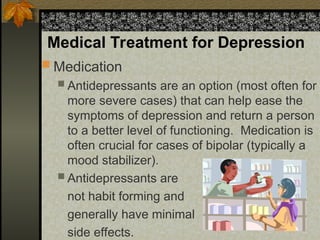
Medical Treatment for Depression
 Medication
 Antidepressants are an option (most often for
more severe cases) that can help ease the
symptoms of depression and return a person
to a better level of functioning. Medication is
often crucial for cases of bipolar (typically a
mood stabilizer).
 Antidepressants are
not habit forming and
generally have minimal
side effects.
If you or someone you know
has symptoms of
depression…
Take Action!
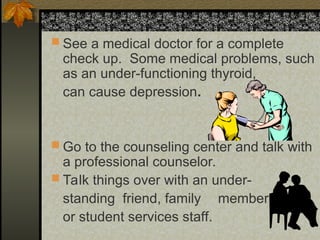
 See a medical doctor for a complete
check up. Some medical problems, such
as an under-functioning thyroid,
can cause depression.
 Go to the counseling center and talk with
a professional counselor.
 Talk things over with an under-
standing friend, family member
or student services staff.
 Don’t expect too much of yourself until
your energy and mood improve
 Take a break
 Get some exercise
 Avoid extra stress and big changes
Things to do
 Reduce or eliminate the use of alcohol
or drugs
 Exercise or engage in some form of
physical activity
 Eat a proper, well-balanced diet
 Establish a regular sleep
pattern
 Obtain an adequate and consistent amount of
sleep—not too much, nor too little
 Seek emotional support from family and
friends
 Focus on meaningful, positive aspects of your
life
 Pace yourself, modify your schedule, and set
small, realistic goals
 Remember, depression is
a temporary difficulty, not
a reflection of your whole
life or self worth.
Things to Avoid
 Don’t make long-term commitments or
important decisions unless necessary while you
are feeling down
 Don’t assume things are hopeless
 Don’t engage in “emotional reasoning” (i.e.:
because I feel awful, my life is terrible)
 Don’t assume responsibility for events which
are outside of your control
 Don’t avoid treatment-take some action to cope
 Don’t be critical of yourself; avoid critical others
Dealing with a depressed friend
 Be empathic and understanding
 Don’t try to “cheer up” a depressed person—it
can feel minimizing. Simply ask if there is
anything you can do to help—the answer will
often be “no,” but the support will be felt.
 Avoid critical or shaming statements
 Challenge expressions of hopelessness
 Empathize with feelings of sadness, grief,
anger and frustration (other feelings will come
in time)
 Don’t argue about how bad things are or
are not
 Don’t insist that depression or sadness
is not warranted for their situation
 Don’t react with anger even though your
efforts to help may be resisted or
rejected
Helping a depressed friend…
Helping a depressed
friend…
 Advocate for their recovery—
convey hope
 Emphasize that depression is very treatable
 Seek consultation (professional counselors
from the counseling center are always glad to
consult—by phone or in person).
 Encourage your friend to seek help; offer to
go with them to the counseling center
 Be supportive of counselor or other doctor
suggestions

Depression bynoem Dawood.ppthhhhhhhhhhhhhhhhh

  • 1.
  • 2.
    What is depression? Everyone occasionally feels blue or sad, But these feelings are usually short-lived and pass within a couple of days, when you have to depression, it interferes with daily life and causes pain for both you and those who care about you, depression is a common but serious illness.
  • 3.
    Definition (F-32)  Depressionis a common mental disorder that presents with depressed mood, loss of interest or pleasure, feelings of guilt or low self-worth disturbed sleep or appetite, low energy, and poor concentration.
  • 4.
     Depression isthe leading cause of disability as measured and the 4th leading contributor to the global burden of disease (DALYs, Disability-Adjusted Life Years) in 2000. By the year 2020, depression is projected to reach 2nd place of the ranking of DALYs calculated for all ages, both sexes.  Today, depression is already the 2nd cause of DALYs in the age category 15- 44 years for both sexes combined.
  • 5.
    Epidemiology Epidemiology  Depression isa wide spread mental health problem affecting many people.  The life time risk of depression in male is 8-12% and in female it is 20-26%  Depression occurs twice as frequently in woman as in men.  Onset is usually after 25-30 years and peak between 40-60 years.
  • 6.
    Understanding the maincauses of depression Understanding the main causes of depression
  • 7.
    What causes Depression? Socio economic theory  Learned theory  Generic history  Family History  Having family members who have depression may increase a person’s risk  Biochemical factors.  Deficiencies of certain chemicals in the brain may lead to depression  Serotonin, dopamine and norepinephrine
  • 8.
    Cognitive theory  Negativeexpectation of the environment  Negative expectation of the self.  Negative expectation of the future
  • 9.
    Psychological causes  Lossof person  Loss of love  Failure in occupation  Failure in exam  Failure in business  Disappointment  Change in brain anatomy: loss of neurons in the frontal lobes, cerebellum and basal ganglia has been identified in depression
  • 10.
    Major Life Changes Negative or particularly stressful events can trigger depression. Examples include the death of a loved one or a job change.  Major Illnesses such as heart attack, stroke or cancer may trigger depression.
  • 11.
    Certain medications used aloneor in combination can cause side effects much like the symptoms of depression. Use of Alcohol or other Drugs can lead to or worsen depression.
  • 12.
    Core Symptoms ofDepression  Vary from person to person CORE SYMPTOMS  2 key signs are loss of interest in things you like to do, and pervasive sadness or loss and interest and enjoyment.  Fatiquablity
  • 13.
    Common symptoms include: Changes in feelings such as:  Reduced concentration and attention  Reduced self esteem, self confidence  Ideas of guilt and unworthiness  Pessimistic views of future.  Ideas of self harm or suicide  Disturbed sleep  Diminished appetite.
  • 14.
  • 15.
    DSM-5 Diagnostic Criteria >or equal 5 the following features for >weeks, at least 1 feature would be from 1 or 2  1. Depressed mood . Depressed mood  2 2. Decreased interest of pleasure . Decreased interest of pleasure  3. Significant weight change (5%)or change in appetite  4. change in sleep  5. Change in activity, psychomotor agitation or retardation.  6. fatigue or loss of energy  7. feeling of worthlessness or excessive or inappropriate guilt  8. concentration or indecisiveness  9. suicidality
  • 16.
  • 17.
    Changes in behaviorand attitude  These may include:  General slowing down  Neglect of responsibilities and appearance  Poor memory  Inability to concentrate  Suicidal thoughts and feelings  Difficulty making decisions
  • 18.
    Physical Complaints  Thesemay include:  Sleep disturbances such as insomnia, early morning waking, or sleeping too much  Lack of energy  Loss of appetite  Weight loss or gain  Unexplained headaches or backaches  Stomachaches, indigestion or changes in bowl habits
  • 19.
    Common Types ofDepression  Major Depression  Atypical Depression  Dysthymia  Bipolar Disorder  Seasonal Affective Disorder (SAD)  premenstrual dysphonic  postpartum depression
  • 20.
    Major Depression  Thistype causes symptoms that may:  Begin suddenly, possibly triggered by a loss, crisis or stressful change  Interfere with normal functioning  Continue for months or years  It is possible for a person to have only one episode of major depression. However, It is more common for episodes to be long lasting or to recur several times during a person’s life
  • 21.
    Major depressive disorder Diagnosticcriteria  According to the DSM-IV  Five (or more) of the following symptoms have to present for the same two period.  At least one of the first two symptoms (depressed mood or loss of interest or pleasure is included in these.
  • 22.
    Diagnostic criteria  Depressedmood for most of the day every day  Reported by the person or by others  In children and adolescent, this can irritable mood . .
  • 23.
    Atypical Depression  Moodreactivity plus > 2 of the followng  Hyperplasia  Hypersomnia  Leaden paralysis (Heaviness)  Interpersonal rejection sensitivity  2-3 time common in women.
  • 24.
    Dysthymia People with thisillness may be consistently and mildly depressed for years. They function fairly well on a daily basis, but their relationships and self esteem suffer over time.
  • 25.
    Bipolar Disorder (A.K.A.Manic-Depression)  People with this type of illness change back and forth between periods of depression and periods of mania (an extreme high, sometimes with agitation or irritability).  Symptoms of mania may include:  Less need for sleep  Overconfidence  Racing thoughts  Reckless behavior  Increased energy  Mood changes are often gradual, but can be sudden
  • 26.
    Season Affective Disorder This is depression that coincides with changes in the season. Most cases begin in the fall or winter, when there is a decrease in sunlight (more common in regions farther north)  Less often, depression can occur in late Spring or summer
  • 27.
    Omega sign indepression By German neurologist Otto Veraguth
  • 28.
  • 29.
    Professional treatment is helpfulfor all these types of depression.
  • 30.
    Psychotherapy  Counseling canhelp many depressed people understand, accept and feel better about themselves. People also learn more effective ways of coping with life’s adversities and difficulties. For example:  Interpersonal therapy works to change how people how to accept self and relate to others that affects mood and self-worth.  Cognitive therapy helps people change negative thinking, behavior patterns and attitudes that affect self esteem and overall sense of well being.
  • 31.
    Medical Treatment forDepression  Medication  Antidepressants are an option (most often for more severe cases) that can help ease the symptoms of depression and return a person to a better level of functioning. Medication is often crucial for cases of bipolar (typically a mood stabilizer).  Antidepressants are not habit forming and generally have minimal side effects.
  • 32.
    If you orsomeone you know has symptoms of depression… Take Action!
  • 33.
     See amedical doctor for a complete check up. Some medical problems, such as an under-functioning thyroid, can cause depression.  Go to the counseling center and talk with a professional counselor.  Talk things over with an under- standing friend, family member or student services staff.
  • 34.
     Don’t expecttoo much of yourself until your energy and mood improve  Take a break  Get some exercise  Avoid extra stress and big changes
  • 35.
    Things to do Reduce or eliminate the use of alcohol or drugs  Exercise or engage in some form of physical activity  Eat a proper, well-balanced diet  Establish a regular sleep pattern
  • 36.
     Obtain anadequate and consistent amount of sleep—not too much, nor too little  Seek emotional support from family and friends  Focus on meaningful, positive aspects of your life  Pace yourself, modify your schedule, and set small, realistic goals  Remember, depression is a temporary difficulty, not a reflection of your whole life or self worth.
  • 37.
    Things to Avoid Don’t make long-term commitments or important decisions unless necessary while you are feeling down  Don’t assume things are hopeless  Don’t engage in “emotional reasoning” (i.e.: because I feel awful, my life is terrible)  Don’t assume responsibility for events which are outside of your control  Don’t avoid treatment-take some action to cope  Don’t be critical of yourself; avoid critical others
  • 38.
    Dealing with adepressed friend  Be empathic and understanding  Don’t try to “cheer up” a depressed person—it can feel minimizing. Simply ask if there is anything you can do to help—the answer will often be “no,” but the support will be felt.  Avoid critical or shaming statements  Challenge expressions of hopelessness  Empathize with feelings of sadness, grief, anger and frustration (other feelings will come in time)
  • 39.
     Don’t argueabout how bad things are or are not  Don’t insist that depression or sadness is not warranted for their situation  Don’t react with anger even though your efforts to help may be resisted or rejected Helping a depressed friend…
  • 40.
    Helping a depressed friend… Advocate for their recovery— convey hope  Emphasize that depression is very treatable  Seek consultation (professional counselors from the counseling center are always glad to consult—by phone or in person).  Encourage your friend to seek help; offer to go with them to the counseling center  Be supportive of counselor or other doctor suggestions