Alzheimer’s Disease &
       Memory
        By: Erica Gaspard
      ECE 275, Summer 2012
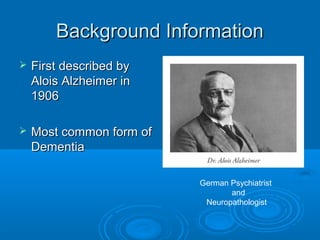
Background Information
   First described by
    Alois Alzheimer in
    1906

   Most common form of
    Dementia

                          German Psychiatrist
                                 and
                           Neuropathologist
Facts & Figures
   A progressive, degenerative, and fatal.
   Most often diagnosed in people 65 and older
     
       Approximate life expectancy is 7 years post diagnosis
      About 3% of diagnosed make it 14 or more years


   Early symptoms are often mistake for “age-related”
    concerns
   No cure for this disease
   One of the MOST costly diseases in today’s society!

   http://www.youtube.com/watch?v=In1IJocVor8
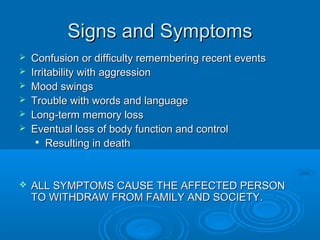
Signs and Symptoms
   Confusion or difficulty remembering recent events
   Irritability with aggression
   Mood swings
   Trouble with words and language
   Long-term memory loss
   Eventual loss of body function and control
     
         Resulting in death


   ALL SYMPTOMS CAUSE THE AFFECTED PERSON
    TO WITHDRAW FROM FAMILY AND SOCIETY.
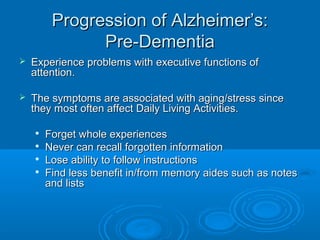
Progression of Alzheimer’s:
               Pre-Dementia
   Experience problems with executive functions of
    attention.

   The symptoms are associated with aging/stress since
    they most often affect Daily Living Activities.

       Forget whole experiences
       Never can recall forgotten information
       Lose ability to follow instructions
       Find less benefit in/from memory aides such as notes
        and lists
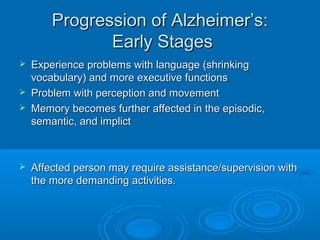
Progression of Alzheimer’s:
               Early Stages
   Experience problems with language (shrinking
    vocabulary) and more executive functions
   Problem with perception and movement
   Memory becomes further affected in the episodic,
    semantic, and implict


   Affected person may require assistance/supervision with
    the more demanding activities.
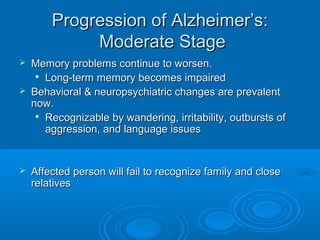
Progression of Alzheimer’s:
             Moderate Stage
   Memory problems continue to worsen.
      Long-term memory becomes impaired

   Behavioral & neuropsychiatric changes are prevalent
    now.
     
       Recognizable by wandering, irritability, outbursts of
       aggression, and language issues


   Affected person will fail to recognize family and close
    relatives
Progression of Alzheimer’s:
             Advanced Stage
   Language becomes single words or is gone completely.
   Affected person experiences extreme apathy and
    exhausted.
   Becomes completely bedridden due to complete loss of
    muscle mass and mobility.


   Affected person is COMPLETELY dependent on others
    for help.
Cause of Alzheimer’s Disease
   The presence of two specific anatomic abnormalities:
    
        Plaques: deposits of proteins called Beta-Amyloids
    
        Tangles: twisted fibers of Tau proteins


   Researchers believe a deterioration of cell bodies,
    dendrites, and axons takes place.
    
        Disrupts/blocks communication among nerve cells
         • Overall result = Gross atrophy of cells and surrounding regions.
Treatment
   Only known treatment currently is cholinergic drugs:
    
        an enzyme blocker that works by restoring the balance of natural
        substances (neurotransmitters) in the brain
         •   Tacrine
         •   Donepezil
         •   Rivastigmine
         •   Galantemine
EBSCO Article
   Since Alzheimer’s is characterized by memory loss, was
    speculated that different patterns of repetition would
    show this too.

   Found that an increasing amount of physical information
    was needed – bottom up processes.

   End result was that the longer the lag time between
    picture and answer, the more information was forgotten.
Bibliography
   “Alzheimer’s Disease Fact Sheet.” National Institutes of Health:
    National Institutes on Aging. 27 June 2012. 8 Aug. 2012.
    <http://www.nia.nih.gov/alzheimers/
    publication/alzheimers-disease-fact-sheet>

   “What is Alzheimer’s?.” Alzheimer’s Association. 8 Aug. 2012.
    <http://www.alz.org/alzheimers_disease_what_is_alzheimers.asp>

   Viggiano, M. Galli, G., Righi, S. Brancati, C. “Visual Recognition
    Memory in Alzheimer’s Disease: Repetition-Lag Effect.”
    Experimental Aging Research. 2008. EBSCO. 1 Aug. 2012.

Alzheimer s disease___memory

  • 1.
    Alzheimer’s Disease & Memory By: Erica Gaspard ECE 275, Summer 2012
  • 2.
    Background Information  First described by Alois Alzheimer in 1906  Most common form of Dementia German Psychiatrist and Neuropathologist
  • 3.
    Facts & Figures  A progressive, degenerative, and fatal.  Most often diagnosed in people 65 and older  Approximate life expectancy is 7 years post diagnosis  About 3% of diagnosed make it 14 or more years  Early symptoms are often mistake for “age-related” concerns  No cure for this disease  One of the MOST costly diseases in today’s society!  http://www.youtube.com/watch?v=In1IJocVor8
  • 4.
    Signs and Symptoms  Confusion or difficulty remembering recent events  Irritability with aggression  Mood swings  Trouble with words and language  Long-term memory loss  Eventual loss of body function and control  Resulting in death  ALL SYMPTOMS CAUSE THE AFFECTED PERSON TO WITHDRAW FROM FAMILY AND SOCIETY.
  • 5.
    Progression of Alzheimer’s: Pre-Dementia  Experience problems with executive functions of attention.  The symptoms are associated with aging/stress since they most often affect Daily Living Activities.  Forget whole experiences  Never can recall forgotten information  Lose ability to follow instructions  Find less benefit in/from memory aides such as notes and lists
  • 6.
    Progression of Alzheimer’s: Early Stages  Experience problems with language (shrinking vocabulary) and more executive functions  Problem with perception and movement  Memory becomes further affected in the episodic, semantic, and implict  Affected person may require assistance/supervision with the more demanding activities.
  • 7.
    Progression of Alzheimer’s: Moderate Stage  Memory problems continue to worsen.  Long-term memory becomes impaired  Behavioral & neuropsychiatric changes are prevalent now.  Recognizable by wandering, irritability, outbursts of aggression, and language issues  Affected person will fail to recognize family and close relatives
  • 8.
    Progression of Alzheimer’s: Advanced Stage  Language becomes single words or is gone completely.  Affected person experiences extreme apathy and exhausted.  Becomes completely bedridden due to complete loss of muscle mass and mobility.  Affected person is COMPLETELY dependent on others for help.
  • 9.
    Cause of Alzheimer’sDisease  The presence of two specific anatomic abnormalities:  Plaques: deposits of proteins called Beta-Amyloids  Tangles: twisted fibers of Tau proteins  Researchers believe a deterioration of cell bodies, dendrites, and axons takes place.  Disrupts/blocks communication among nerve cells • Overall result = Gross atrophy of cells and surrounding regions.
  • 10.
    Treatment  Only known treatment currently is cholinergic drugs:  an enzyme blocker that works by restoring the balance of natural substances (neurotransmitters) in the brain • Tacrine • Donepezil • Rivastigmine • Galantemine
  • 11.
    EBSCO Article  Since Alzheimer’s is characterized by memory loss, was speculated that different patterns of repetition would show this too.  Found that an increasing amount of physical information was needed – bottom up processes.  End result was that the longer the lag time between picture and answer, the more information was forgotten.
  • 12.
    Bibliography  “Alzheimer’s Disease Fact Sheet.” National Institutes of Health: National Institutes on Aging. 27 June 2012. 8 Aug. 2012. <http://www.nia.nih.gov/alzheimers/ publication/alzheimers-disease-fact-sheet>  “What is Alzheimer’s?.” Alzheimer’s Association. 8 Aug. 2012. <http://www.alz.org/alzheimers_disease_what_is_alzheimers.asp>  Viggiano, M. Galli, G., Righi, S. Brancati, C. “Visual Recognition Memory in Alzheimer’s Disease: Repetition-Lag Effect.” Experimental Aging Research. 2008. EBSCO. 1 Aug. 2012.