Review of DSM5 Mental Disorders for NCMHCE Study
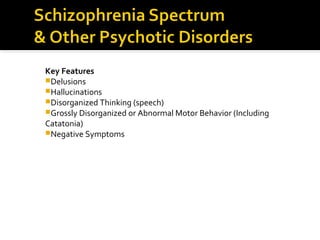
Key Features
Delusions
Hallucinations
Disorganized Thinking (speech)
Grossly Disorganized or Abnormal Motor Behavior (Including
Catatonia)
Negative Symptoms
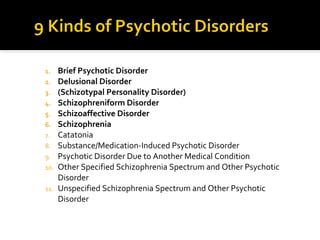
1. Brief Psychotic Disorder
2. Delusional Disorder
3. (Schizotypal Personality Disorder)
4. Schizophreniform Disorder
5. Schizoaffective Disorder
6. Schizophrenia
7. Catatonia
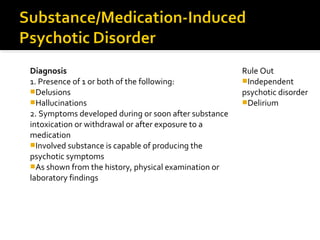
8. Substance/Medication-Induced Psychotic Disorder
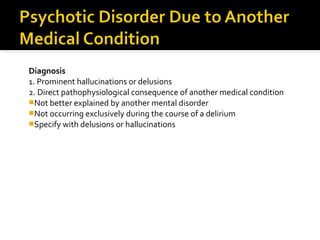
9. Psychotic Disorder Due to Another Medical Condition
10. Other Specified Schizophrenia Spectrum and Other Psychotic
Disorder
11. Unspecified Schizophrenia Spectrum and Other Psychotic
Disorder
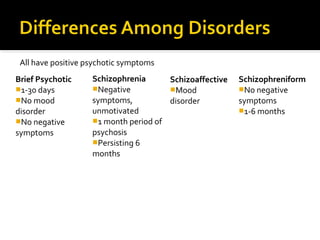
Brief Psychotic
1-30 days
No mood
disorder
No negative
symptoms
Schizophreniform
No negative
symptoms
1-6 months
Schizophrenia
Negative
symptoms,
unmotivated
1 month period of
psychosis
Persisting 6
months
Schizoaffective
Mood
disorder
All have positive psychotic symptoms
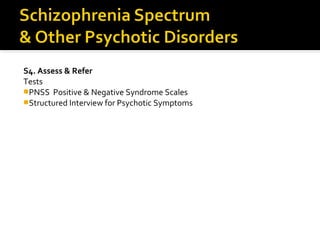
S4. Assess & Refer
Tests
PNSS Positive & Negative Syndrome Scales
Structured Interview for Psychotic Symptoms
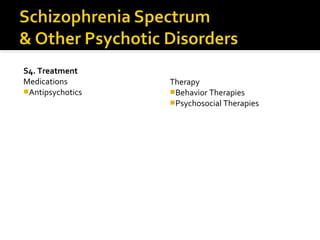
S4. Treatment
Medications
Antipsychotics
Therapy
Behavior Therapies
Psychosocial Therapies
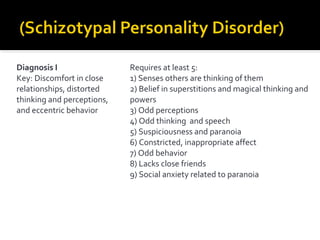
Diagnosis I
Key: Discomfort in close
relationships, distorted
thinking and perceptions,
and eccentric behavior
Requires at least 5:
1) Senses others are thinking of them
2) Belief in superstitions and magical thinking and
powers
3) Odd perceptions
4) Odd thinking and speech
5) Suspiciousness and paranoia
6) Constricted, inappropriate affect
7) Odd behavior
8) Lacks close friends
9) Social anxiety related to paranoia
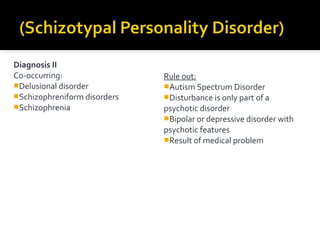
Diagnosis II
Co-occurring:
Delusional disorder
Schizophreniform disorders
Schizophrenia
Rule out:
Autism Spectrum Disorder
Disturbance is only part of a
psychotic disorder
Bipolar or depressive disorder with
psychotic features
Result of medical problem
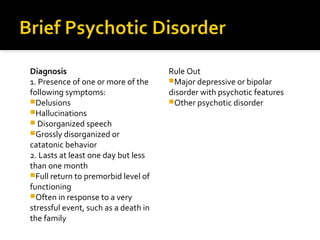
Diagnosis
1. Presence of one or more of the
following symptoms:
Delusions
Hallucinations
 Disorganized speech
Grossly disorganized or
catatonic behavior
2. Lasts at least one day but less
than one month
Full return to premorbid level of
functioning
Often in response to a very
stressful event, such as a death in
the family
Rule Out
Major depressive or bipolar
disorder with psychotic features
Other psychotic disorder
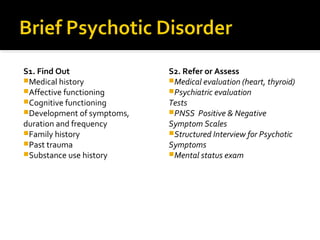
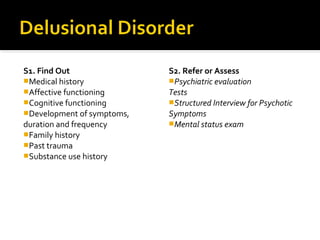
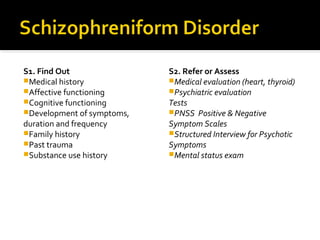
S1. Find Out
Medical history
Affective functioning
Cognitive functioning
Development of symptoms,
duration and frequency
Family history
Past trauma
Substance use history
S2. Refer or Assess
Medical evaluation (heart, thyroid)
Psychiatric evaluation
Tests
PNSS Positive & Negative
Symptom Scales
Structured Interview for Psychotic
Symptoms
Mental status exam
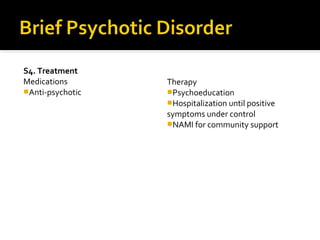
S4. Treatment
Medications
Anti-psychotic
Therapy
Psychoeducation
Hospitalization until positive
symptoms under control
NAMI for community support
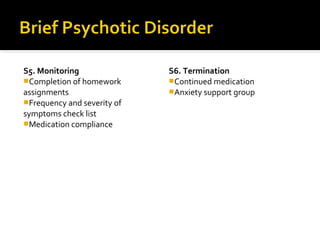
S5. Monitoring
Completion of homework
assignments
Frequency and severity of
symptoms check list
Medication compliance
S6. Termination
Continued medication
Anxiety support group
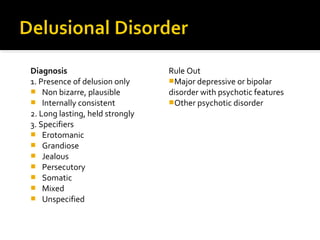
Diagnosis
1. Presence of delusion only
 Non bizarre, plausible
 Internally consistent
2. Long lasting, held strongly
3. Specifiers
 Erotomanic
 Grandiose
 Jealous
 Persecutory
 Somatic
 Mixed
 Unspecified
Rule Out
Major depressive or bipolar
disorder with psychotic features
Other psychotic disorder
S1. Find Out
Medical history
Affective functioning
Cognitive functioning
Development of symptoms,
duration and frequency
Family history
Past trauma
Substance use history
S2. Refer or Assess
Psychiatric evaluation
Tests
Structured Interview for Psychotic
Symptoms
Mental status exam
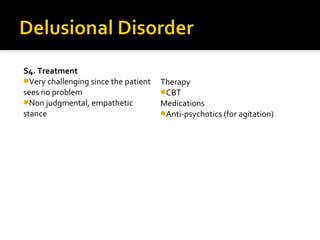
S4. Treatment
Very challenging since the patient
sees no problem
Non judgmental, empathetic
stance
Therapy
CBT
Medications
Anti-psychotics (for agitation)
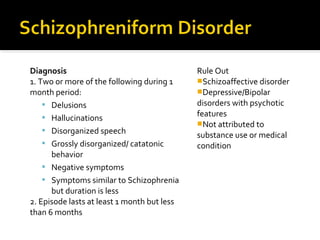
Diagnosis
1. Two or more of the following during 1
month period:
 Delusions
 Hallucinations
 Disorganized speech
 Grossly disorganized/ catatonic
behavior
 Negative symptoms
 Symptoms similar to Schizophrenia
but duration is less
2. Episode lasts at least 1 month but less
than 6 months
Rule Out
Schizoaffective disorder
Depressive/Bipolar
disorders with psychotic
features
Not attributed to
substance use or medical
condition
S1. Find Out
Medical history
Affective functioning
Cognitive functioning
Development of symptoms,
duration and frequency
Family history
Past trauma
Substance use history
S2. Refer or Assess
Medical evaluation (heart, thyroid)
Psychiatric evaluation
Tests
PNSS Positive & Negative
Symptom Scales
Structured Interview for Psychotic
Symptoms
Mental status exam
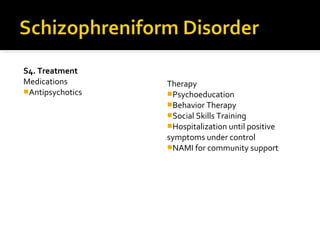
S4. Treatment
Medications
Antipsychotics
Therapy
Psychoeducation
Behavior Therapy
Social Skills Training
Hospitalization until positive
symptoms under control
NAMI for community support
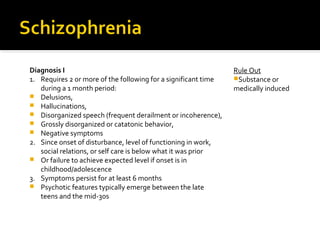
Diagnosis I
1. Requires 2 or more of the following for a significant time
during a 1 month period:
 Delusions,
 Hallucinations,
 Disorganized speech (frequent derailment or incoherence),
 Grossly disorganized or catatonic behavior,
 Negative symptoms
2. Since onset of disturbance, level of functioning in work,
social relations, or self care is below what it was prior
 Or failure to achieve expected level if onset is in
childhood/adolescence
3. Symptoms persist for at least 6 months
 Psychotic features typically emerge between the late
teens and the mid-30s
Rule Out
Substance or
medically induced
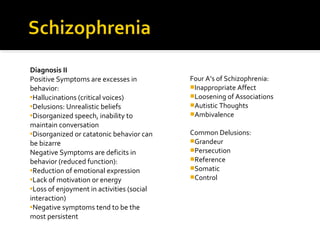
Diagnosis II
Positive Symptoms are excesses in
behavior:
Hallucinations (critical voices)
Delusions: Unrealistic beliefs
Disorganized speech, inability to
maintain conversation
Disorganized or catatonic behavior can
be bizarre
Negative Symptoms are deficits in
behavior (reduced function):
Reduction of emotional expression
Lack of motivation or energy
Loss of enjoyment in activities (social
interaction)
Negative symptoms tend to be the
most persistent
Four A’s of Schizophrenia:
Inappropriate Affect
Loosening of Associations
Autistic Thoughts
Ambivalence
Common Delusions:
Grandeur
Persecution
Reference
Somatic
Control
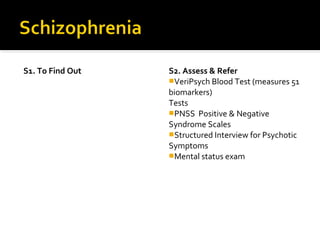
S1. To Find Out S2. Assess & Refer
VeriPsych Blood Test (measures 51
biomarkers)
Tests
PNSS Positive & Negative
Syndrome Scales
Structured Interview for Psychotic
Symptoms
Mental status exam
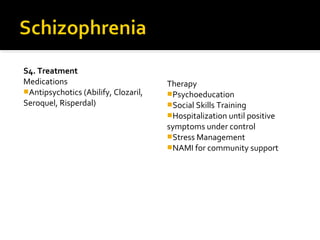
S4. Treatment
Medications
Antipsychotics (Abilify, Clozaril,
Seroquel, Risperdal)
Therapy
Psychoeducation
Social Skills Training
Hospitalization until positive
symptoms under control
Stress Management
NAMI for community support
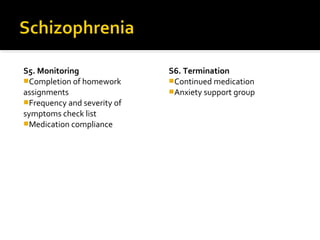
S5. Monitoring
Completion of homework
assignments
Frequency and severity of
symptoms check list
Medication compliance
S6. Termination
Continued medication
Anxiety support group
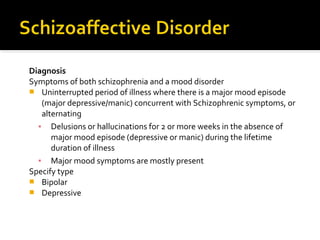
Diagnosis
Symptoms of both schizophrenia and a mood disorder
 Uninterrupted period of illness where there is a major mood episode
(major depressive/manic) concurrent with Schizophrenic symptoms, or
alternating
▪ Delusions or hallucinations for 2 or more weeks in the absence of
major mood episode (depressive or manic) during the lifetime
duration of illness
▪ Major mood symptoms are mostly present
Specify type
 Bipolar
 Depressive
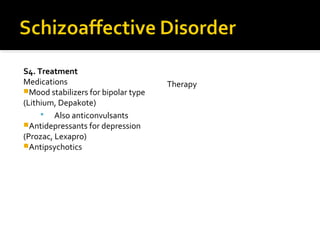
S4. Treatment
Medications
Mood stabilizers for bipolar type
(Lithium, Depakote)
 Also anticonvulsants
Antidepressants for depression
(Prozac, Lexapro)
Antipsychotics
Therapy
Diagnosis
1. Presence of 1 or both of the following:
Delusions
Hallucinations
2. Symptoms developed during or soon after substance
intoxication or withdrawal or after exposure to a
medication
Involved substance is capable of producing the
psychotic symptoms
As shown from the history, physical examination or
laboratory findings
Rule Out
Independent
psychotic disorder
Delirium
Diagnosis
1. Prominent hallucinations or delusions
2. Direct pathophysiological consequence of another medical condition
Not better explained by another mental disorder
Not occurring exclusively during the course of a delirium
Specify with delusions or hallucinations
S4. Treatment
Resolve medical conditions
Catatonia Associated with Another Mental Disorder
Catatonia Disorder due to Another Medical Condition
Unspecified Catatonia

Schizophrenia Spectrum & Other Psychotic Disorders for NCMHCE Study

  • 1.
    Review of DSM5Mental Disorders for NCMHCE Study
  • 2.
    Key Features Delusions Hallucinations Disorganized Thinking(speech) Grossly Disorganized or Abnormal Motor Behavior (Including Catatonia) Negative Symptoms
  • 3.
    1. Brief PsychoticDisorder 2. Delusional Disorder 3. (Schizotypal Personality Disorder) 4. Schizophreniform Disorder 5. Schizoaffective Disorder 6. Schizophrenia 7. Catatonia 8. Substance/Medication-Induced Psychotic Disorder 9. Psychotic Disorder Due to Another Medical Condition 10. Other Specified Schizophrenia Spectrum and Other Psychotic Disorder 11. Unspecified Schizophrenia Spectrum and Other Psychotic Disorder
  • 4.
    Brief Psychotic 1-30 days Nomood disorder No negative symptoms Schizophreniform No negative symptoms 1-6 months Schizophrenia Negative symptoms, unmotivated 1 month period of psychosis Persisting 6 months Schizoaffective Mood disorder All have positive psychotic symptoms
  • 5.
    S4. Assess &Refer Tests PNSS Positive & Negative Syndrome Scales Structured Interview for Psychotic Symptoms
  • 6.
  • 8.
    Diagnosis I Key: Discomfortin close relationships, distorted thinking and perceptions, and eccentric behavior Requires at least 5: 1) Senses others are thinking of them 2) Belief in superstitions and magical thinking and powers 3) Odd perceptions 4) Odd thinking and speech 5) Suspiciousness and paranoia 6) Constricted, inappropriate affect 7) Odd behavior 8) Lacks close friends 9) Social anxiety related to paranoia
  • 9.
    Diagnosis II Co-occurring: Delusional disorder Schizophreniformdisorders Schizophrenia Rule out: Autism Spectrum Disorder Disturbance is only part of a psychotic disorder Bipolar or depressive disorder with psychotic features Result of medical problem
  • 11.
    Diagnosis 1. Presence ofone or more of the following symptoms: Delusions Hallucinations  Disorganized speech Grossly disorganized or catatonic behavior 2. Lasts at least one day but less than one month Full return to premorbid level of functioning Often in response to a very stressful event, such as a death in the family Rule Out Major depressive or bipolar disorder with psychotic features Other psychotic disorder
  • 12.
    S1. Find Out Medicalhistory Affective functioning Cognitive functioning Development of symptoms, duration and frequency Family history Past trauma Substance use history S2. Refer or Assess Medical evaluation (heart, thyroid) Psychiatric evaluation Tests PNSS Positive & Negative Symptom Scales Structured Interview for Psychotic Symptoms Mental status exam
  • 13.
  • 14.
    S5. Monitoring Completion ofhomework assignments Frequency and severity of symptoms check list Medication compliance S6. Termination Continued medication Anxiety support group
  • 16.
    Diagnosis 1. Presence ofdelusion only  Non bizarre, plausible  Internally consistent 2. Long lasting, held strongly 3. Specifiers  Erotomanic  Grandiose  Jealous  Persecutory  Somatic  Mixed  Unspecified Rule Out Major depressive or bipolar disorder with psychotic features Other psychotic disorder
  • 17.
    S1. Find Out Medicalhistory Affective functioning Cognitive functioning Development of symptoms, duration and frequency Family history Past trauma Substance use history S2. Refer or Assess Psychiatric evaluation Tests Structured Interview for Psychotic Symptoms Mental status exam
  • 18.
    S4. Treatment Very challengingsince the patient sees no problem Non judgmental, empathetic stance Therapy CBT Medications Anti-psychotics (for agitation)
  • 20.
    Diagnosis 1. Two ormore of the following during 1 month period:  Delusions  Hallucinations  Disorganized speech  Grossly disorganized/ catatonic behavior  Negative symptoms  Symptoms similar to Schizophrenia but duration is less 2. Episode lasts at least 1 month but less than 6 months Rule Out Schizoaffective disorder Depressive/Bipolar disorders with psychotic features Not attributed to substance use or medical condition
  • 21.
    S1. Find Out Medicalhistory Affective functioning Cognitive functioning Development of symptoms, duration and frequency Family history Past trauma Substance use history S2. Refer or Assess Medical evaluation (heart, thyroid) Psychiatric evaluation Tests PNSS Positive & Negative Symptom Scales Structured Interview for Psychotic Symptoms Mental status exam
  • 22.
    S4. Treatment Medications Antipsychotics Therapy Psychoeducation Behavior Therapy SocialSkills Training Hospitalization until positive symptoms under control NAMI for community support
  • 24.
    Diagnosis I 1. Requires2 or more of the following for a significant time during a 1 month period:  Delusions,  Hallucinations,  Disorganized speech (frequent derailment or incoherence),  Grossly disorganized or catatonic behavior,  Negative symptoms 2. Since onset of disturbance, level of functioning in work, social relations, or self care is below what it was prior  Or failure to achieve expected level if onset is in childhood/adolescence 3. Symptoms persist for at least 6 months  Psychotic features typically emerge between the late teens and the mid-30s Rule Out Substance or medically induced
  • 25.
    Diagnosis II Positive Symptomsare excesses in behavior: Hallucinations (critical voices) Delusions: Unrealistic beliefs Disorganized speech, inability to maintain conversation Disorganized or catatonic behavior can be bizarre Negative Symptoms are deficits in behavior (reduced function): Reduction of emotional expression Lack of motivation or energy Loss of enjoyment in activities (social interaction) Negative symptoms tend to be the most persistent Four A’s of Schizophrenia: Inappropriate Affect Loosening of Associations Autistic Thoughts Ambivalence Common Delusions: Grandeur Persecution Reference Somatic Control
  • 26.
    S1. To FindOut S2. Assess & Refer VeriPsych Blood Test (measures 51 biomarkers) Tests PNSS Positive & Negative Syndrome Scales Structured Interview for Psychotic Symptoms Mental status exam
  • 27.
    S4. Treatment Medications Antipsychotics (Abilify,Clozaril, Seroquel, Risperdal) Therapy Psychoeducation Social Skills Training Hospitalization until positive symptoms under control Stress Management NAMI for community support
  • 28.
    S5. Monitoring Completion ofhomework assignments Frequency and severity of symptoms check list Medication compliance S6. Termination Continued medication Anxiety support group
  • 30.
    Diagnosis Symptoms of bothschizophrenia and a mood disorder  Uninterrupted period of illness where there is a major mood episode (major depressive/manic) concurrent with Schizophrenic symptoms, or alternating ▪ Delusions or hallucinations for 2 or more weeks in the absence of major mood episode (depressive or manic) during the lifetime duration of illness ▪ Major mood symptoms are mostly present Specify type  Bipolar  Depressive
  • 31.
    S4. Treatment Medications Mood stabilizersfor bipolar type (Lithium, Depakote)  Also anticonvulsants Antidepressants for depression (Prozac, Lexapro) Antipsychotics Therapy
  • 33.
    Diagnosis 1. Presence of1 or both of the following: Delusions Hallucinations 2. Symptoms developed during or soon after substance intoxication or withdrawal or after exposure to a medication Involved substance is capable of producing the psychotic symptoms As shown from the history, physical examination or laboratory findings Rule Out Independent psychotic disorder Delirium
  • 35.
    Diagnosis 1. Prominent hallucinationsor delusions 2. Direct pathophysiological consequence of another medical condition Not better explained by another mental disorder Not occurring exclusively during the course of a delirium Specify with delusions or hallucinations
  • 36.
  • 38.
    Catatonia Associated withAnother Mental Disorder Catatonia Disorder due to Another Medical Condition Unspecified Catatonia