DEPRESSION 
Presentation Created by Lucia Merino, LCSW 
September 2014
WHAT IS DEPRESSION? 
Clinical depression goes by many names -- 
depression, "the blues," biological depression, 
major depression. But it all refers to the same 
thing: feeling sad and depressed for weeks 
or months on end (not just a passing blue 
mood). This feeling is most often 
accompanied by feelings of hopelessness, a 
lack of energy (or feeling "weighed down"), 
and taking little or no pleasure in things that 
gave you joy in the past. A person who's 
depressed just "can't get moving" and feels 
completely unmotivated to do just about 
anything. Even simple things -- like getting 
dressed in the morning or eating -- become 
large obstacles in daily life.
WHAT CAUSES DEPRESSION? 
The cause of depression is not fully 
known. A number of factors may be 
involved, such as chemical imbalances in 
the brain or family history. Sometimes 
depression can be linked to stressful 
events, such as the death of a loved one, 
a divorce or job loss. Certain medicines, 
overuse of drugs and alcohol, and 
chronic diseases can also lead to 
depression. Depression isn’t caused by 
personal weakness, lack of willpower, or 
a ‘bad attitude’.
WHAT CAUSES DEPRESSION (2) 
Sorry, there is no easy answer to what causes 
depression. 
The answer to what causes depression, in most 
cases, involves a combination of factors that are 
biological, genetic, psychological and 
environmental in nature. 
An affected individual cannot regulate 
depression without deliberately altering the 
intensity of one of those four factors, often by 
counseling and medication in conjunction with 
lifestyle changes.
A COMBINATION OF FACTORS 
Biological Factors Genetic Factors
A COMBINATION OF FACTORS 
Psychological Factors Environmental Factors
UNDERNEATH THE SURFACE OF A 
DEPRESSION, ANGER MAY BE HIDING 
• Although someone suffering from depression appears sad and withdrawn, 
that person is actually dealing with deep-seated anger in an unhealthy way. 
Depressed people are frequently frustrated, irritable and snappish, but do 
not realize why they are reacting this way simply because they do not or 
cannot acknowledge the anger they feel. 
• As adults, we repress negative emotions for fear of embarrassment or 
reprisal, and may tend to show only positive emotions to gain acceptance 
by others. What may cause depression is the result of anger continually 
building and not being released either verbally or by taking action. As a 
result, depression overwhelms the bewildered individual as a form of coping 
mechanism. Indirect causes of depression that produce a chronic feeling of 
hostility in an individual may also compel that person to seek unhealthy 
release methods, such as drug, alcohol or sexual addiction. 
• http://www.what-is-depression.org/what-causes-depression/# 
sthash.LL8s0YeF.dpuf
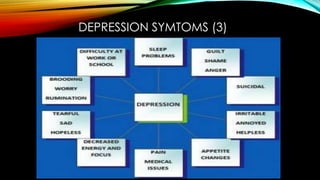
DEPRESSION SYMPTOMS
DEPRESSION SYMPTOMS (2)
DEPRESSION SYMTOMS (3)
DEPRESSION (4)
DEPRESSION OR PERIMENOPAUSE?
DEPRESSION IN MEN AND WOMEN
LET’S STOP TO DISCUSS SUICIDE AND 
DEPRESSION
LET’S DON’T FORGET 
DEPRESSION KILLS
HOW IS DEPRESSION TREATED?
DIFFERENT WAYS TO TREAT DEPRESSION 
Psychotropic Medication: Antidepressants 
Psychotherapies: psychoeducation, family systems, CBT, 
interpersonal, psychodynamic, solution-focused, analysis 
transactional, art therapy, self-help, support groups, etc. 
Complementary and Alternative Medicine: Omega-3 Fish 
Oil, Vitamins, etc. 
Holistic Approaches: Acupuncture, Exercise, Journaling, 
Artistic Expression ,Meditation, Reiki, etc. 
ECT: Electro Convulsive Therapy 
rTMS: Transcranial Magnetic Stimulation
PHARMACOLOGICAL TREATMENT: 
ANTIDEPRESSANT MEDICATION
HOW DO ANTIDEPRESSANTS WORK? 
• It often takes two to four weeks for antidepressants to start 
having an effect, and six to 12 weeks for antidepressants to 
have their full effect. In some cases, people may have to try 
various doses and different antidepressants before finding the 
one or the combination that is most effective. Friends and 
relatives will sometimes notice an improvement on 
medication before the depressed person will notice any 
changes. Antidepressants are not habit forming; however 
they should not be stopped abruptly as withdrawal symptoms 
(muscle aches, stomach upset, headaches) may occur.
MEDICATIONS OFTEN USED TO TREAT DEPRESSION 
• Selective serotonin reuptake inhibitors (SSRIs) act 
specifically on the neurotransmitter serotonin. They are the 
most common agents prescribed for depression worldwide. 
These agents block the reuptake of serotonin from the 
synapse to the nerve, which increases the level of serotonin. 
SSRIs include fluoxetine (Prozac), sertraline (Zoloft), 
paroxetine (Paxil), citalopram (Celexa) and escitalopram 
(Lexapro). Common side effects include sexual dysfunction 
and gastrointestinal problems.
SELECTIVE SEROTONIN REUPTAKE INHIBITORS
SEROTONIN-NOREPINEPHRINE REUPTAKE INHIBITORS 
• Serotonin and norepinephrine reuptake inhibitors (SNRIs) are 
the second most popular antidepressants worldwide. These 
agents block the reuptake of both serotonin and 
norepinephrine from the synapse into the nerve, which 
increases the amounts of these chemicals. SNRIs include 
venlafazine (Effexor), desvenlafazine (Pristiq) and duloxetine 
(Cymbalta).
NOREPINEPHRINE-DOPAMINE REUPTAKE INHIBITOR 
• Bupropion (Wellbutrin) is a popular antidepressant 
medication classified as a norepinephrine-dopamine 
reuptake inhibitor (NDRI). It acts by blocking the reuptake of 
dopamine and norepinephrine and increases these 
neurotransmitters in the brain. It also helps with smoking 
cessation strategies. Buproprion generally causes fewer side 
effects than most other antidepressants (particularly 
nausea, sexual side effects, weight gain, and fatigue or 
sleepiness).
OTHER ANTIDEPRESSANTS 
• Mirtazapine (Remeron) works differently from the compounds 
discussed above. Mirtazapine targets specific serotonin and 
norepinephrine receptors in the brain, thus indirectly increasing the 
activity or several brain circuits. Mirtazapine is used less often than 
other, newer antidepressants (SSRIs, SNRIs, buroprion) because it is 
associated with more weight gain, sedation and sleepiness. However, 
it appears to be less likely to result in insomnia, sexual side effects and 
nausea than the SSRIs and SNRIs. Other side effects include 
headaches, dry mouth and constipation. Remeron is not 
recommended for those with hepatic or renal dysfunction, a history of 
mania or seizure disorder.
OLDER ANTIDEPRESSANTS 
• Tricyclic antidepressants (TCAs) are older agents seldom used today as first-line 
treatment. They work similarly to the SNRIs, but have other properties that 
often result in higher rates of side effects, as compared to almost all other 
antidepressants. They are sometimes used in cases where other 
antidepressants have not worked. TCAs include amitriptyline (Elavil), 
desipramine (Norpramin), doxepin (sinequan), imipramine (Tofranil), 
nortriptyline (Pamelor, Aventyl) and protriptyline (Vivactil). TCAs (and 
duloxetine) may be helpful with chronic pain as well. TCAs generally have 
more side effects than all other antidepressants, including headaches, 
sleepiness and drowsiness, significant weight gain, nervousness, dry mouth, 
constipation, bladder problems, sexual problems, blurred vision, dizziness and 
skin rash.
MORE AND MORE ANTIDEPRESSANTS… 
• Monoamine oxidase inhibitors (MAOIs) are less commonly used today. MAOIs work 
by inactivating enzymes in the brain, which catabolize (breakdown) serotonin, 
norephinephrine and dopamine from the synapse, thus increasing the levels of these 
chemicals in the brain. They can never be used in combination with SSRI 
antidepressants. MAOIs can sometimes be effective for people who do not respond 
to other medications or have atypical (abnormal) depression with marked anxiety, 
excessive sleeping, irritability, hypochondria or phobic characteristics. They have 
important food and medication interactions, which requires strict adherence to a 
particular diet. MAOIs include phenelzine (Nardil), isocarboxazid (Marplan), 
tranylcypromine sulfate (Parnate) and selegiline patch (Emsam). Selegiline (Emsam) 
is a patch approved by the FDA in 2006. This delivery system reduces the risk of the 
dietary concerns noted above. 
• The FDA periodically approves medication. For a current list, visit www.fda.gov
SUMMARY OF THE MAJOR ANTIDEPRESSANTS 
BEING PRESCRIBED 
• Selective serotonin reuptake inhibitors (SSRIs) –Prozac, Zoloft, Celexa, Lexapro. 
• Serotonin and norepinephrine reuptake inhibitors (SNRIs) –Effexor, Pristq, Cymbalta 
• Norepinephrine-dopamine reuptake inhibitor (NDRI) –Bupropion 
• Miratzapine –Remeron 
• Tricyclic antidepressants (TCAs) -Elavil, Norpramin, sinequan, Tofranil, Pamelor, 
Aventyl, Vivactil. 
• Monoamine oxidase inhibitors (MAOIs) -Nardil, Marplan, Parnate, Emsam. 
The FDA periodically approves medication. For a current list, visit www.fda.gov
A LITTLE BIT OF HUMOR…
PSYCHOTHERAPY APPROACHES 
Psychoeducation Talk Therapy
PSYCHOTHERAPY APPROACHES (2) 
Cognitive Behavioral (CBT) Interpersonal Psychotherapy
PSYCHOTHERAPY APPROACHES (3) 
Psychodynamic Therapy Group Therapy
PSYCHOTHERAPY APPROACHES (4) 
Family Oriented Self-help
SUMMARY OF MOST USED 
PSYHOTHERAPY APPROACHES 
Psychoeducation 
Psychotherapy 
Talk Therapy 
Psychodynamic 
CBT 
Interpersonal 
Self-Help 
Group Support 
Family Oriented
HUMOR IS ALSO THERAPEUTIC 
Brings endorphins up High level coping mechanism
OTHER TREATMENTS FOR DEPRESSION
TREATING DEPRESSION 
Alternative Medicine Holistic Approaches
SOME STATISTICS
WHEN ALL ELSE FAILS… 
Electro Convulsive Therapy Transcranial Magnetic Stimulation
WARNING ON ALCOHOL AND DRUGS
THE GOAL IS TO HAVE A LIFE…
AND THE TRUTH IS THAT …
THANKS TO THE FOLLOWING WEBSITES 
https://healthy.kaiserpermanente.org 
http://www.mayoclinic.org 
http://www.managingdepression.us 
http://www.dsm5.org 
http://psychcentral.com 
http://www.what-is-depression.org 
http://www.nami.org 
http://www.allaboutdepression.com 
http://www.acuquest.com 
http://cure-depression.com
HAD FUN CREATING THIS 
PRESENTATION –FUNNY MOMENTS
HAHAHAHAHAHAHAHA!
THANK YOU FOR YOUR PARTICIPATION IN THIS 
GROUP –YOU MAKE ALL THE DIFFERENCE!
SUPPORT GROUP
SEE YOU NEXT WEEK!

Depression

  • 1.
    DEPRESSION Presentation Createdby Lucia Merino, LCSW September 2014
  • 2.
    WHAT IS DEPRESSION? Clinical depression goes by many names -- depression, "the blues," biological depression, major depression. But it all refers to the same thing: feeling sad and depressed for weeks or months on end (not just a passing blue mood). This feeling is most often accompanied by feelings of hopelessness, a lack of energy (or feeling "weighed down"), and taking little or no pleasure in things that gave you joy in the past. A person who's depressed just "can't get moving" and feels completely unmotivated to do just about anything. Even simple things -- like getting dressed in the morning or eating -- become large obstacles in daily life.
  • 3.
    WHAT CAUSES DEPRESSION? The cause of depression is not fully known. A number of factors may be involved, such as chemical imbalances in the brain or family history. Sometimes depression can be linked to stressful events, such as the death of a loved one, a divorce or job loss. Certain medicines, overuse of drugs and alcohol, and chronic diseases can also lead to depression. Depression isn’t caused by personal weakness, lack of willpower, or a ‘bad attitude’.
  • 4.
    WHAT CAUSES DEPRESSION(2) Sorry, there is no easy answer to what causes depression. The answer to what causes depression, in most cases, involves a combination of factors that are biological, genetic, psychological and environmental in nature. An affected individual cannot regulate depression without deliberately altering the intensity of one of those four factors, often by counseling and medication in conjunction with lifestyle changes.
  • 5.
    A COMBINATION OFFACTORS Biological Factors Genetic Factors
  • 6.
    A COMBINATION OFFACTORS Psychological Factors Environmental Factors
  • 7.
    UNDERNEATH THE SURFACEOF A DEPRESSION, ANGER MAY BE HIDING • Although someone suffering from depression appears sad and withdrawn, that person is actually dealing with deep-seated anger in an unhealthy way. Depressed people are frequently frustrated, irritable and snappish, but do not realize why they are reacting this way simply because they do not or cannot acknowledge the anger they feel. • As adults, we repress negative emotions for fear of embarrassment or reprisal, and may tend to show only positive emotions to gain acceptance by others. What may cause depression is the result of anger continually building and not being released either verbally or by taking action. As a result, depression overwhelms the bewildered individual as a form of coping mechanism. Indirect causes of depression that produce a chronic feeling of hostility in an individual may also compel that person to seek unhealthy release methods, such as drug, alcohol or sexual addiction. • http://www.what-is-depression.org/what-causes-depression/# sthash.LL8s0YeF.dpuf
  • 8.
  • 9.
  • 10.
  • 11.
  • 12.
  • 13.
  • 14.
    LET’S STOP TODISCUSS SUICIDE AND DEPRESSION
  • 15.
    LET’S DON’T FORGET DEPRESSION KILLS
  • 16.
  • 17.
    DIFFERENT WAYS TOTREAT DEPRESSION Psychotropic Medication: Antidepressants Psychotherapies: psychoeducation, family systems, CBT, interpersonal, psychodynamic, solution-focused, analysis transactional, art therapy, self-help, support groups, etc. Complementary and Alternative Medicine: Omega-3 Fish Oil, Vitamins, etc. Holistic Approaches: Acupuncture, Exercise, Journaling, Artistic Expression ,Meditation, Reiki, etc. ECT: Electro Convulsive Therapy rTMS: Transcranial Magnetic Stimulation
  • 18.
  • 19.
    HOW DO ANTIDEPRESSANTSWORK? • It often takes two to four weeks for antidepressants to start having an effect, and six to 12 weeks for antidepressants to have their full effect. In some cases, people may have to try various doses and different antidepressants before finding the one or the combination that is most effective. Friends and relatives will sometimes notice an improvement on medication before the depressed person will notice any changes. Antidepressants are not habit forming; however they should not be stopped abruptly as withdrawal symptoms (muscle aches, stomach upset, headaches) may occur.
  • 20.
    MEDICATIONS OFTEN USEDTO TREAT DEPRESSION • Selective serotonin reuptake inhibitors (SSRIs) act specifically on the neurotransmitter serotonin. They are the most common agents prescribed for depression worldwide. These agents block the reuptake of serotonin from the synapse to the nerve, which increases the level of serotonin. SSRIs include fluoxetine (Prozac), sertraline (Zoloft), paroxetine (Paxil), citalopram (Celexa) and escitalopram (Lexapro). Common side effects include sexual dysfunction and gastrointestinal problems.
  • 21.
  • 22.
    SEROTONIN-NOREPINEPHRINE REUPTAKE INHIBITORS • Serotonin and norepinephrine reuptake inhibitors (SNRIs) are the second most popular antidepressants worldwide. These agents block the reuptake of both serotonin and norepinephrine from the synapse into the nerve, which increases the amounts of these chemicals. SNRIs include venlafazine (Effexor), desvenlafazine (Pristiq) and duloxetine (Cymbalta).
  • 23.
    NOREPINEPHRINE-DOPAMINE REUPTAKE INHIBITOR • Bupropion (Wellbutrin) is a popular antidepressant medication classified as a norepinephrine-dopamine reuptake inhibitor (NDRI). It acts by blocking the reuptake of dopamine and norepinephrine and increases these neurotransmitters in the brain. It also helps with smoking cessation strategies. Buproprion generally causes fewer side effects than most other antidepressants (particularly nausea, sexual side effects, weight gain, and fatigue or sleepiness).
  • 24.
    OTHER ANTIDEPRESSANTS •Mirtazapine (Remeron) works differently from the compounds discussed above. Mirtazapine targets specific serotonin and norepinephrine receptors in the brain, thus indirectly increasing the activity or several brain circuits. Mirtazapine is used less often than other, newer antidepressants (SSRIs, SNRIs, buroprion) because it is associated with more weight gain, sedation and sleepiness. However, it appears to be less likely to result in insomnia, sexual side effects and nausea than the SSRIs and SNRIs. Other side effects include headaches, dry mouth and constipation. Remeron is not recommended for those with hepatic or renal dysfunction, a history of mania or seizure disorder.
  • 25.
    OLDER ANTIDEPRESSANTS •Tricyclic antidepressants (TCAs) are older agents seldom used today as first-line treatment. They work similarly to the SNRIs, but have other properties that often result in higher rates of side effects, as compared to almost all other antidepressants. They are sometimes used in cases where other antidepressants have not worked. TCAs include amitriptyline (Elavil), desipramine (Norpramin), doxepin (sinequan), imipramine (Tofranil), nortriptyline (Pamelor, Aventyl) and protriptyline (Vivactil). TCAs (and duloxetine) may be helpful with chronic pain as well. TCAs generally have more side effects than all other antidepressants, including headaches, sleepiness and drowsiness, significant weight gain, nervousness, dry mouth, constipation, bladder problems, sexual problems, blurred vision, dizziness and skin rash.
  • 26.
    MORE AND MOREANTIDEPRESSANTS… • Monoamine oxidase inhibitors (MAOIs) are less commonly used today. MAOIs work by inactivating enzymes in the brain, which catabolize (breakdown) serotonin, norephinephrine and dopamine from the synapse, thus increasing the levels of these chemicals in the brain. They can never be used in combination with SSRI antidepressants. MAOIs can sometimes be effective for people who do not respond to other medications or have atypical (abnormal) depression with marked anxiety, excessive sleeping, irritability, hypochondria or phobic characteristics. They have important food and medication interactions, which requires strict adherence to a particular diet. MAOIs include phenelzine (Nardil), isocarboxazid (Marplan), tranylcypromine sulfate (Parnate) and selegiline patch (Emsam). Selegiline (Emsam) is a patch approved by the FDA in 2006. This delivery system reduces the risk of the dietary concerns noted above. • The FDA periodically approves medication. For a current list, visit www.fda.gov
  • 27.
    SUMMARY OF THEMAJOR ANTIDEPRESSANTS BEING PRESCRIBED • Selective serotonin reuptake inhibitors (SSRIs) –Prozac, Zoloft, Celexa, Lexapro. • Serotonin and norepinephrine reuptake inhibitors (SNRIs) –Effexor, Pristq, Cymbalta • Norepinephrine-dopamine reuptake inhibitor (NDRI) –Bupropion • Miratzapine –Remeron • Tricyclic antidepressants (TCAs) -Elavil, Norpramin, sinequan, Tofranil, Pamelor, Aventyl, Vivactil. • Monoamine oxidase inhibitors (MAOIs) -Nardil, Marplan, Parnate, Emsam. The FDA periodically approves medication. For a current list, visit www.fda.gov
  • 28.
    A LITTLE BITOF HUMOR…
  • 29.
  • 30.
    PSYCHOTHERAPY APPROACHES (2) Cognitive Behavioral (CBT) Interpersonal Psychotherapy
  • 31.
    PSYCHOTHERAPY APPROACHES (3) Psychodynamic Therapy Group Therapy
  • 32.
    PSYCHOTHERAPY APPROACHES (4) Family Oriented Self-help
  • 33.
    SUMMARY OF MOSTUSED PSYHOTHERAPY APPROACHES Psychoeducation Psychotherapy Talk Therapy Psychodynamic CBT Interpersonal Self-Help Group Support Family Oriented
  • 34.
    HUMOR IS ALSOTHERAPEUTIC Brings endorphins up High level coping mechanism
  • 35.
  • 36.
    TREATING DEPRESSION AlternativeMedicine Holistic Approaches
  • 37.
  • 38.
    WHEN ALL ELSEFAILS… Electro Convulsive Therapy Transcranial Magnetic Stimulation
  • 39.
  • 40.
    THE GOAL ISTO HAVE A LIFE…
  • 41.
    AND THE TRUTHIS THAT …
  • 42.
    THANKS TO THEFOLLOWING WEBSITES https://healthy.kaiserpermanente.org http://www.mayoclinic.org http://www.managingdepression.us http://www.dsm5.org http://psychcentral.com http://www.what-is-depression.org http://www.nami.org http://www.allaboutdepression.com http://www.acuquest.com http://cure-depression.com
  • 43.
    HAD FUN CREATINGTHIS PRESENTATION –FUNNY MOMENTS
  • 44.
  • 45.
    THANK YOU FORYOUR PARTICIPATION IN THIS GROUP –YOU MAKE ALL THE DIFFERENCE!
  • 46.
  • 47.

Editor's Notes

  • #32 Psychodynamic therapy is often more available than CBT and IPT in many communities, but researchers in depression recommend it less often due to a relative lack of data indicating that it works for this condition. In fact, one study found that psychodynamic psychotherapy was no more effective than a placebo for depression. Self-help and support groups for people and families dealing with mental illnesses are becoming more widely available. In this venue, people rely on their lived experience to share frustrations and successes, referrals to qualified specialists and community resources and information about what works best when trying to recover. They also share friendships and hope for themselves, their loved ones and others in the group. NAMI sponsors two support groups. NAMI Connection Recovery Support Group is a weekly recovery support group for people living with mental illness, and NAMI Family Support Groups for family, friends and caregivers.