Autism,
Aspergers, and
the Brain
Adrienne Dorrah
Definition
         Autism and Aspergers are developmental disorders on a
          larger spectrum called Autism Spectrum Disorders (ASDs).
         Autism – usually have significant language delays, social
          and communication challenges, unusual behaviors and
          interests; may have intellectual disability
         Aspergers – may have social challenges and unusual
          behaviors and interests; typically do not have language
          problems or intellectual disability
         http://www.cdc.gov/NCBDDD/autism/videos/whatisautism.
          html - this is a link to a short video that explains the signs
          and symptoms related to ASDs.


Source: (Center for Disease Control, 2012)
General Information
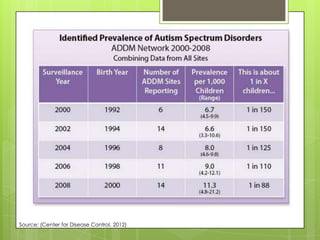
       1   in 88 children have been identified with
           an autism spectrum disorder
        Typically           diagnosed between the ages of
           2 and 4
        Because    of the late diagnosis, brain
           development in autism is largely
           unstudied during the first 2 years of life –
           the “crucial period”


Source: (Center for Disease Control, 2012)
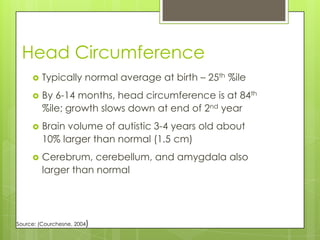
Head Circumference
        Typically normal average at birth – 25th %ile
        By 6-14 months, head circumference is at 84th
         %ile; growth slows down at end of 2nd year
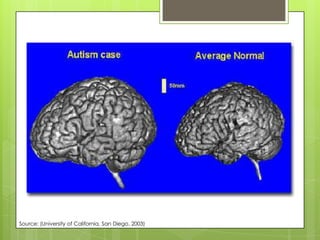
        Brain volume of autistic 3-4 years old about
         10% larger than normal (1.5 cm)
        Cerebrum, cerebellum, and amygdala also
         larger than normal


Source: (Courchesne, 2004)
Source: (University of California, San Diego, 2003)
Gray Matter & White Matter
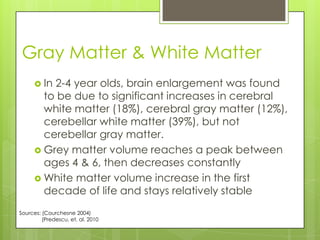
       In2-4 year olds, brain enlargement was found
        to be due to significant increases in cerebral
        white matter (18%), cerebral gray matter (12%),
        cerebellar white matter (39%), but not
        cerebellar gray matter.
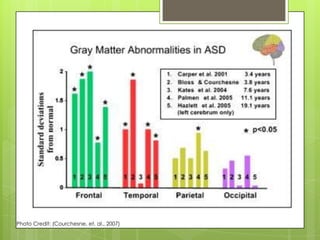
       Grey matter volume reaches a peak between
        ages 4 & 6, then decreases constantly
       White matter volume increase in the first
        decade of life and stays relatively stable
Sources: (Courchesne 2004)
         (Predescu, et. al. 2010
Photo Credit: (Courchesne, et. al., 2007)
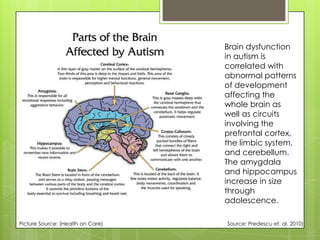
Brain dysfunction
                                   in autism is
                                   correlated with
                                   abnormal patterns
                                   of development
                                   affecting the
                                   whole brain as
                                   well as circuits
                                   involving the
                                   prefrontal cortex,
                                   the limbic system,
                                   and cerebellum.
                                   The amygdala
                                   and hippocampus
                                   increase in size
                                   through
                                   adolescence.

Picture Source: (Health on Care)   Source: Predescu et. al. 2010)
Affected Parts of the Brain
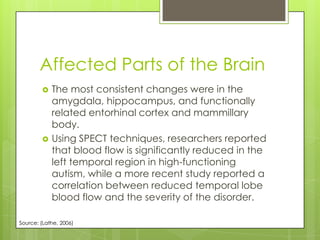
           The most consistent changes were in the
            amygdala, hippocampus, and functionally
            related entorhinal cortex and mammillary
            body.
           Using SPECT techniques, researchers reported
            that blood flow is significantly reduced in the
            left temporal region in high-functioning
            autism, while a more recent study reported a
            correlation between reduced temporal lobe
            blood flow and the severity of the disorder.

Source: (Lathe, 2006)
Boys vs. Girls
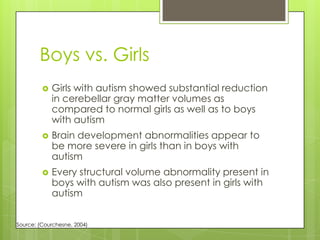
            Girls with autism showed substantial reduction
             in cerebellar gray matter volumes as
             compared to normal girls as well as to boys
             with autism
            Brain development abnormalities appear to
             be more severe in girls than in boys with
             autism
            Every structural volume abnormality present in
             boys with autism was also present in girls with
             autism


Source: (Courchesne, 2004)
Reference List
   Center for Disease Control. (29, March 2012). Data and statistics. Retrieved
    from http://www.cdc.gov/ncbddd/autism/data.html/
This site gave statistical information and data related to Autism. It also talks about
diagnosis and economic costs of autism. A basic chart with data about the
prevalence of ASDs was extracted from this site.
   Center for Disease Control. (29, March 2012). Facts about asds. Retrieved from
    http://www.cdc.gov/ncbddd/autism/facts.html
This website gave general information about Autism Spectrum Disorders. It
discusses the different types of ASDs, signs and symptoms, treatments, and risk
factors, among other information.
   Courchesne, E. (2004). Brain development in autism: Early overgrowth
    followed by premature arrest of growth. Mental Retardation & Developmental
    Disabilities Research Reviews, 10(2), 106-111.
*This article discusses brain development and growth in autism. Circumference of
the head, rate of growth, growth at different ages, and regional differences are
all discussed.
References Cont’d
   Courchesne, E., K. Pierce, C. M. Schumann, E. Redcay, J. A. Buckwalter, D. P.
    Kennedy, and J. Morgan. "Mapping Early Brain Development in Autism."
    Neuron. 56.2 (2007): 399-413. Web. 13 Aug. 2012.

*This article talks about findings during the first few years of life and argues that
early brain overgrowth is a key factor in the onset of autism. The article also
includes graphs that map out data related to overgrowth in the brain.

   Health on Care. (n.d.). Autism – causes, symptoms and treatment. Retrieved
    from http://www.healthoncare.com/autism-causes-symptoms-and-
    treatment.html

This website gave a brief overview of what autism is and the causes and
symptoms of autism. The site has a picture of the brain that shows which parts of
the brain which are affected by autism. This photo was extracted for my
presentation.
References Cont’d
   Lathe, Richard. Autism, Brain and Environment. London: Jessica Kingsley Publishers,
    2006.
*This is a book about autism that discusses how autism affects the brain and the
abnormalities and dysfunction associated with the disorder. The book also discusses how
the environment has an effect on the onset of autism.
   Predescu, E., Sipos, P., Sipos, R., Iftene, F., & Balázsi, R. (2010). BRAIN VOLUMES IN
    AUTISM AND DEVELOPMENTAL DELAY -- A MRI STUDY. Journal Of Cognitive &
    Behavioral Psychotherapies, 10(1), 25-38.
This article compared children with ASD and children with developmental delay. It
compared total brain volume of both sets of children as well as volume of gray matter
and white matter between the groups of children.
   University of California, San Diego. (2003). Ucsd researchers find brain
    overgrowth during first year of life in autism. Retrieved from
    http://health.ucsd.edu/news/2003/07_15_courchesne.html
This website contained an article talking about brain growth in children with autism
during their first year of life. The website contained a photo comparing the size of an
average brain with the size of a brain with autism. This photo was extracted for my
presentation.

Adrienne dorrah -_autism___aspergers

  • 1.
  • 2.
    Definition  Autism and Aspergers are developmental disorders on a larger spectrum called Autism Spectrum Disorders (ASDs).  Autism – usually have significant language delays, social and communication challenges, unusual behaviors and interests; may have intellectual disability  Aspergers – may have social challenges and unusual behaviors and interests; typically do not have language problems or intellectual disability  http://www.cdc.gov/NCBDDD/autism/videos/whatisautism. html - this is a link to a short video that explains the signs and symptoms related to ASDs. Source: (Center for Disease Control, 2012)
  • 3.
    General Information 1 in 88 children have been identified with an autism spectrum disorder  Typically diagnosed between the ages of 2 and 4  Because of the late diagnosis, brain development in autism is largely unstudied during the first 2 years of life – the “crucial period” Source: (Center for Disease Control, 2012)
  • 4.
    Source: (Center forDisease Control, 2012)
  • 5.
    Head Circumference  Typically normal average at birth – 25th %ile  By 6-14 months, head circumference is at 84th %ile; growth slows down at end of 2nd year  Brain volume of autistic 3-4 years old about 10% larger than normal (1.5 cm)  Cerebrum, cerebellum, and amygdala also larger than normal Source: (Courchesne, 2004)
  • 6.
    Source: (University ofCalifornia, San Diego, 2003)
  • 7.
    Gray Matter &White Matter  In2-4 year olds, brain enlargement was found to be due to significant increases in cerebral white matter (18%), cerebral gray matter (12%), cerebellar white matter (39%), but not cerebellar gray matter.  Grey matter volume reaches a peak between ages 4 & 6, then decreases constantly  White matter volume increase in the first decade of life and stays relatively stable Sources: (Courchesne 2004) (Predescu, et. al. 2010
  • 8.
  • 9.
    Brain dysfunction in autism is correlated with abnormal patterns of development affecting the whole brain as well as circuits involving the prefrontal cortex, the limbic system, and cerebellum. The amygdala and hippocampus increase in size through adolescence. Picture Source: (Health on Care) Source: Predescu et. al. 2010)
  • 10.
    Affected Parts ofthe Brain  The most consistent changes were in the amygdala, hippocampus, and functionally related entorhinal cortex and mammillary body.  Using SPECT techniques, researchers reported that blood flow is significantly reduced in the left temporal region in high-functioning autism, while a more recent study reported a correlation between reduced temporal lobe blood flow and the severity of the disorder. Source: (Lathe, 2006)
  • 11.
    Boys vs. Girls  Girls with autism showed substantial reduction in cerebellar gray matter volumes as compared to normal girls as well as to boys with autism  Brain development abnormalities appear to be more severe in girls than in boys with autism  Every structural volume abnormality present in boys with autism was also present in girls with autism Source: (Courchesne, 2004)
  • 12.
    Reference List  Center for Disease Control. (29, March 2012). Data and statistics. Retrieved from http://www.cdc.gov/ncbddd/autism/data.html/ This site gave statistical information and data related to Autism. It also talks about diagnosis and economic costs of autism. A basic chart with data about the prevalence of ASDs was extracted from this site.  Center for Disease Control. (29, March 2012). Facts about asds. Retrieved from http://www.cdc.gov/ncbddd/autism/facts.html This website gave general information about Autism Spectrum Disorders. It discusses the different types of ASDs, signs and symptoms, treatments, and risk factors, among other information.  Courchesne, E. (2004). Brain development in autism: Early overgrowth followed by premature arrest of growth. Mental Retardation & Developmental Disabilities Research Reviews, 10(2), 106-111. *This article discusses brain development and growth in autism. Circumference of the head, rate of growth, growth at different ages, and regional differences are all discussed.
  • 13.
    References Cont’d  Courchesne, E., K. Pierce, C. M. Schumann, E. Redcay, J. A. Buckwalter, D. P. Kennedy, and J. Morgan. "Mapping Early Brain Development in Autism." Neuron. 56.2 (2007): 399-413. Web. 13 Aug. 2012. *This article talks about findings during the first few years of life and argues that early brain overgrowth is a key factor in the onset of autism. The article also includes graphs that map out data related to overgrowth in the brain.  Health on Care. (n.d.). Autism – causes, symptoms and treatment. Retrieved from http://www.healthoncare.com/autism-causes-symptoms-and- treatment.html This website gave a brief overview of what autism is and the causes and symptoms of autism. The site has a picture of the brain that shows which parts of the brain which are affected by autism. This photo was extracted for my presentation.
  • 14.
    References Cont’d  Lathe, Richard. Autism, Brain and Environment. London: Jessica Kingsley Publishers, 2006. *This is a book about autism that discusses how autism affects the brain and the abnormalities and dysfunction associated with the disorder. The book also discusses how the environment has an effect on the onset of autism.  Predescu, E., Sipos, P., Sipos, R., Iftene, F., & Balázsi, R. (2010). BRAIN VOLUMES IN AUTISM AND DEVELOPMENTAL DELAY -- A MRI STUDY. Journal Of Cognitive & Behavioral Psychotherapies, 10(1), 25-38. This article compared children with ASD and children with developmental delay. It compared total brain volume of both sets of children as well as volume of gray matter and white matter between the groups of children.  University of California, San Diego. (2003). Ucsd researchers find brain overgrowth during first year of life in autism. Retrieved from http://health.ucsd.edu/news/2003/07_15_courchesne.html This website contained an article talking about brain growth in children with autism during their first year of life. The website contained a photo comparing the size of an average brain with the size of a brain with autism. This photo was extracted for my presentation.