INSTITUTE OF HEALTH TECHNOLOGY, DHAKA
Department of Laboratory Medicine
BSc in Health Technology (Laboratory)- 1st Year
MYCOLOGY
Lecture No. 04 (Cutaneous Mycoses)
By
Sk. MIZANUR RAHMAN
Lecturer, Mycology
MS in Biotechnology & Genetic Engineering (UODA)
MS in Microbiology (SUB)
Cutaneous Mycoses
oDermatophytosis - "ringworm" disease of the nails,

hair, and/or stratum corneum of the skin caused by
fungi called dermatophytes.
oDermatomycosis - more general name for any skin
disease caused by a fungus.
Cutaneous mycoses
• Infection of the skin, hair or nails caused by a
group of keratinophilic fungi, called
dermatophytes
• DERMATOPHYTOSIS (=Tinea = Ringworm)
extend deeper into the epidermis, as well as invasive hair and
nail diseases.
DERMATOPHYTES
• Digest keratin by their keratinases
• Resistant to cycloheximide
• Classified into three groups depending
on their usual habitat
Cutaneous mycoses
• Keratophilic – use keratin as subject to live
( parasites)
• Keratinases- invade only keratinized layers
DERMATOPHYTOSIS
Classification
Three Groups/Types:
• Clinical
• Etiological
• Ecological
Clinical Dermatophytosis
Clinical Classification & Manifestations
• Infection is named according to the
anatomic location involved:
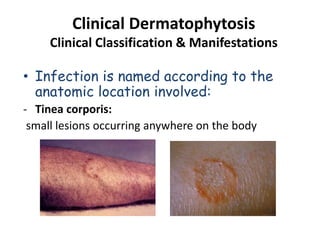
- Tinea corporis:
small lesions occurring anywhere on the body
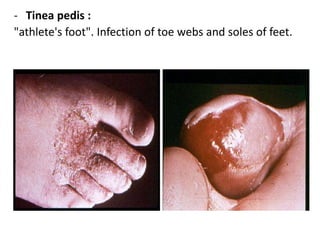
- Tinea pedis :
"athlete's foot". Infection of toe webs and soles of feet.
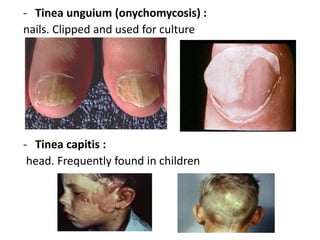
- Tinea unguium (onychomycosis) :
nails. Clipped and used for culture
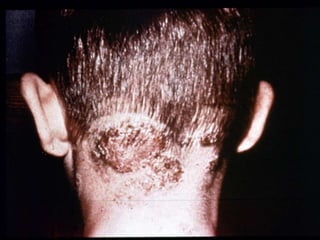
- Tinea capitis :
head. Frequently found in children
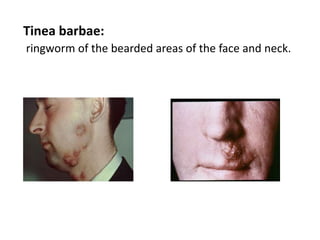
Tinea barbae:
ringworm of the bearded areas of the face and neck.
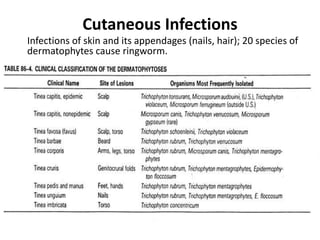
Cutaneous Infections
Infections of skin and its appendages (nails, hair); 20 species of
dermatophytes cause ringworm.
Etiology of Dermatophytes
Etiology (3 Genera)
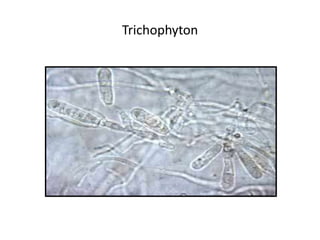
• Trichophyton
• Microsporum
• Epidermophyton
• Trichophyton - infections on skin, hair, and
nails.
• Microsporum - infections on skin and hair (not
the cause of TINEA UNGUIUM)
• Epidermophyton - infections on skin and nails
(not the cause of TINEA CAPITIS)
Etiology (3 Genera)
Trichophyton (19 species)
• Hair
• Skin
• Nails
Trichophyton
• For Trichophyton species - infections on hair follow one of
the 4 patterns.
– Ectothrix - more or less parallel rows of arthrospores
produced on surface of hair.
• 1. Small-spored ectothrix (arthrospores are < 5 mm
in diameter) - caused by T. mentagrophytes or T.
rubrum (rare). Spores are about the same size as
those produced by Aspergillus.
• 2. Large-spored ectothrix (arthrospores are 5- 10
mm in diameter) - caused by T. verrucosum.
– Endothrix - growth inside hair shaft only!
• 3. "Black-dot" endothrix (hair stubs filled with
arthrospores) - caused by T. tonsurans or T.
violaceum.
• 4. "Favus hair" endothrix (honeycomb pattern
of damage seen on surface of hair shaft) - caused by
T. schoenleinii.
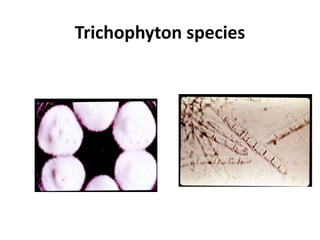
Trichophyton species
Trichophyton rubrum
Causes a chronic infection in patients with a
cell-mediated immune defect.
• Skin
• Hair
Microsporum (13 species)
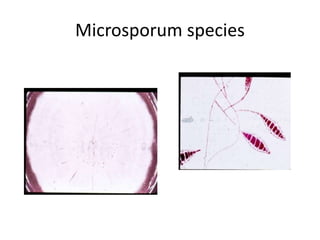
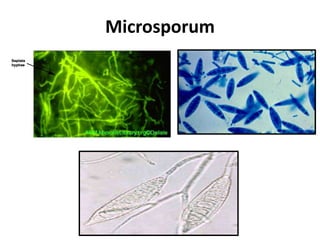
Microsporum species
Thick wall, spindle shape,
multicellular
Microsporum canis
Most common etiologic agent of
tinea
• Skin
• Nails
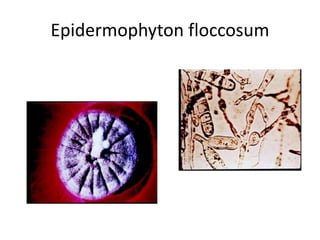
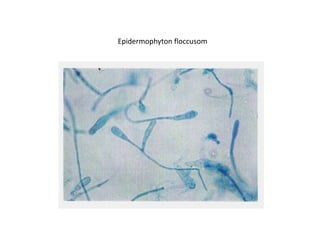
Epidermophyton floccosum
Bifurcated hyphae with multiple,
smooth, club shaped macroconidia (2-
4 cells)
Ecology of Dermatophytes
To determine the source of infection
• Anthropophilic
• Zoophilic
• Geophilic
Anthropophilic
• Associated with humans only. Person -to-
person transmission through contaminated
objects (comb, hat, etc.)
• e.g., M. audounii, T. tonsurans
Zoophilic
• Associated with animals. Direct transmission
to humans by close contact with animals.
• e.g., M. canis, T. verrucosum
Geophilic
• Usually found in soil (soil saprophytes).
Transmitted to humans by direct exposure.
•e.g., M. gypseum, T. ajelloi.
DERMATOPHYTOSIS
Diagnosis
I. Clinical
Appearance
Wood’s lamp (UV, 365 nm)
II. Lab
A. Direct microscopic examination
(10-25% KOH)
DERMATOPHYTOSIS
Diagnosis
B. Culture
• Mycobiotic agar
• Sabouraud dextrose agar
• Selective media – containing cycloheximide
and chlorampenicolincubate at 25 C.
• Identification based on the conidia
Diagnosis
• Diagnosis is based upon:
1. Anatomical site infected
2. Type of lesion
3. Examination with a Woods lamp (366 A°)
4. Examination of KOH-treated skin
scales from the infected area
5. Culture of the organism (not too
important)
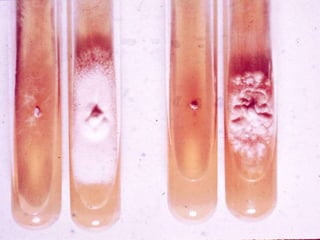
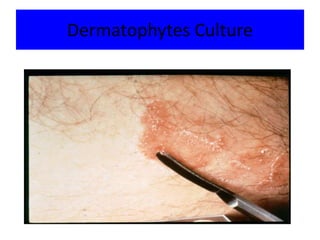
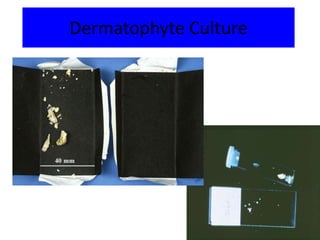
Dermatophytes Culture
Dermatophyte Culture
Black collection card
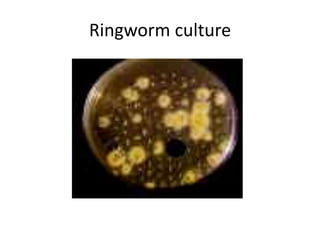
Ringworm culture
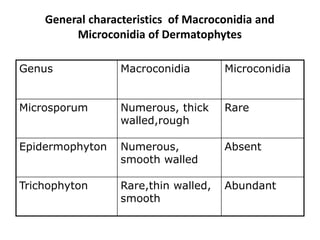
General characteristics of Macroconidia and
Microconidia of Dermatophytes
Genus Macroconidia Microconidia
Microsporum Numerous, thick
walled,rough
Rare
Epidermophyton Numerous,
smooth walled
Absent
Trichophyton Rare,thin walled,
smooth
Abundant
Microsporum
Trichophyton
Epidermophyton floccusom
Cutaneous mycoses.ppt

Cutaneous mycoses.ppt