INSTITUTE OF PULIC HEALTH, DHAKA
Department of Laboratory Medicine
BSc in Health Technology (Laboratory)- 1st Year
HELMINTHOLOGY
Lecture No. 03(Ancylostoma duodenale)
By
Sk. MIZANUR RAHMAN
Assistant Bacteriologist, MBL, IPH
MS in Biotechnology & Genetic Engineering (UODA)
MS in Microbiology (SU)
MPH in Epidemiology (SUB)
Introduction
• Hookworms are the voracious blood feeders
of the nematode world.
• Two principal species that infect around 900

million people on earth are:
• Necator americanus known as the american
killer also known the new world hookworm.
• Ancylostoma duodenale known as the old
world hookworm.
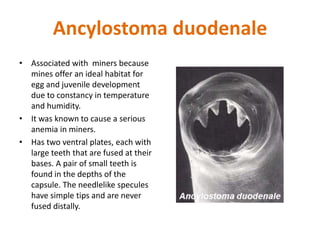
Ancylostoma duodenale
• Associated with miners because
mines offer an ideal habitat for
egg and juvenile development
due to constancy in temperature
and humidity.
• It was known to cause a serious
anemia in miners.
• Has two ventral plates, each with
large teeth that are fused at their
bases. A pair of small teeth is
found in the depths of the
capsule. The needlelike specules
have simple tips and are never
fused distally.
Definitive host
• Human • No Intermediate host
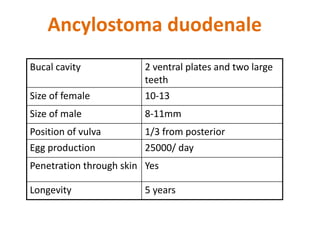
Bucal cavity 2 ventral plates and two large
teeth
Size of female 10-13
Size of male 8-11mm
Position of vulva 1/3 from posterior
Egg production 25000/ day
Penetration through skin Yes
Longevity 5 years
Ancylostoma duodenale
Geographic distribution
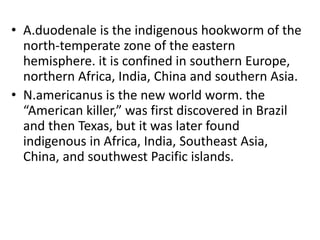
• A.duodenale is the indigenous hookworm of the
north-temperate zone of the eastern
hemisphere. it is confined in southern Europe,
northern Africa, India, China and southern Asia.
• N.americanus is the new world worm. the
“American killer,” was first discovered in Brazil
and then Texas, but it was later found
indigenous in Africa, India, Southeast Asia,
China, and southwest Pacific islands.
Morphology
• Adult
– Cylindrical with the head bent sharply backwards
– Males are smaller than the females and possess a
bursa at their posterior end
Morphology: Adults
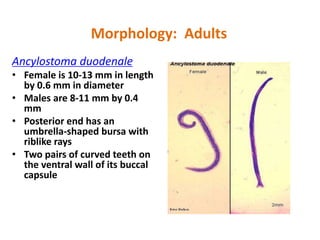
Ancylostoma duodenale
• Female is 10-13 mm in length
by 0.6 mm in diameter
• Males are 8-11 mm by 0.4
mm
• Posterior end has an
umbrella-shaped bursa with
riblike rays
• Two pairs of curved teeth on
the ventral wall of its buccal
capsule
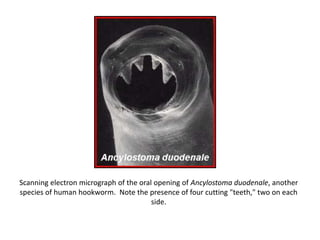
Scanning electron micrograph of the oral opening of Ancylostoma duodenale, another
species of human hookworm. Note the presence of four cutting "teeth," two on each
side.
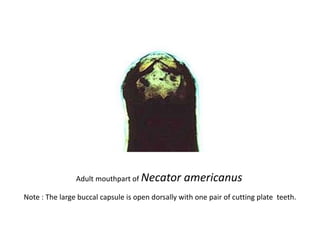
Adult mouthpart of Necator americanus
Note : The large buccal capsule is open dorsally with one pair of cutting plate teeth.
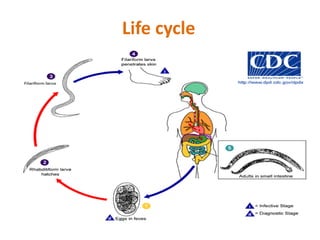
Life cycle
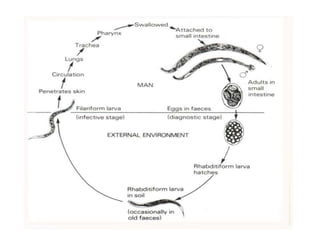
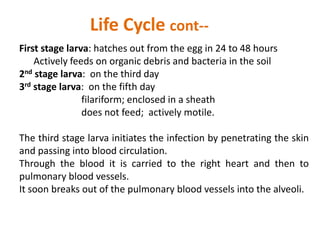
First stage larva: hatches out from the egg in 24 to 48 hours
Actively feeds on organic debris and bacteria in the soil
2nd stage larva: on the third day
3rd stage larva: on the fifth day
filariform; enclosed in a sheath
does not feed; actively motile.
The third stage larva initiates the infection by penetrating the skin
and passing into blood circulation.
Through the blood it is carried to the right heart and then to
pulmonary blood vessels.
It soon breaks out of the pulmonary blood vessels into the alveoli.
Life Cycle cont--
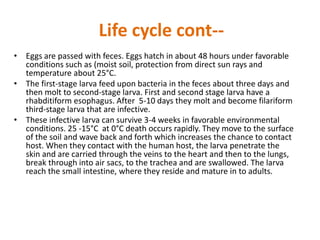
Life cycle cont--
• Eggs are passed with feces. Eggs hatch in about 48 hours under favorable
conditions such as (moist soil, protection from direct sun rays and
temperature about 25°C.
• The first-stage larva feed upon bacteria in the feces about three days and
then molt to second-stage larva. First and second stage larva have a
rhabditiform esophagus. After 5-10 days they molt and become filariform
third-stage larva that are infective.
• These infective larva can survive 3-4 weeks in favorable environmental
conditions. 25 -15°C at 0°C death occurs rapidly. They move to the surface
of the soil and wave back and forth which increases the chance to contact
host. When they contact with the human host, the larva penetrate the
skin and are carried through the veins to the heart and then to the lungs,
break through into air sacs, to the trachea and are swallowed. The larva
reach the small intestine, where they reside and mature in to adults.
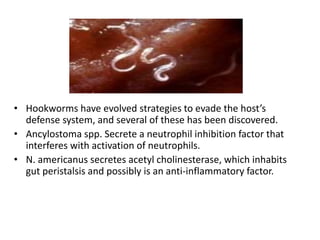
• Hookworms have evolved strategies to evade the host’s
defense system, and several of these has been discovered.
• Ancylostoma spp. Secrete a neutrophil inhibition factor that
interferes with activation of neutrophils.
• N. americanus secretes acetyl cholinesterase, which inhabits
gut peristalsis and possibly is an anti-inflammatory factor.
Pathogenesis cont--
1. Hookworm larvae dermatitis:
Penetration of the skin by the filariform larvae may
be asymptomatic in previously uninfected
individuals.
However, those experiencing repeated infections
develop itching, known as "ground itch" or "dew
itch".
Pathogenesis cont--
2. Migration of pre-adult cause temporary
pulmonary inflammation:
In heavily infected individuals
(i.e., 500-1000 worms), there can be
symptoms of pneumonia during the migratory
phase in the developmental cycle of these
worms
Pathogenesis cont--
3. Abdominal pains, diarrhea, loss of appetite…
4. Anemia
– Especially in young children
– Hypoproteinemic because of some loss of serum proteins
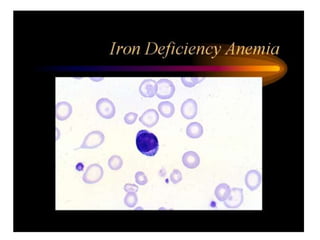
– Iron-deficiency
– Why the small worms can cause anemia?
• The pump-like action when worms suck blood
• The worms secrete an anticoagulant, which facilitates bleeding
• The worms usually change the sites when suck blood
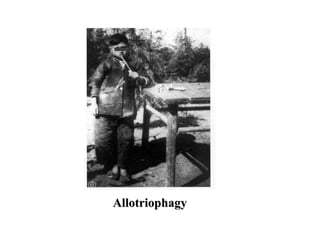
5. Allotriophagy (Geophagy): due to the iron-deficiency
6. Ancylostomiasis in infant
Pathogenesis cont--
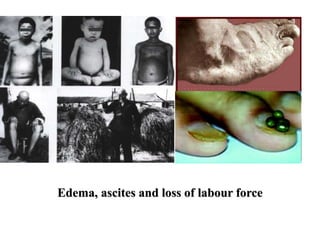
Edema, ascites and loss of labour force
Allotriophagy
Symptoms/Clinical Aspects
• Itching of skin as a result of penetration by the larvae.
• Congestion in lungs in heavy infections.
• Anemia due to loss of blood, particularly if diet is deficient.
• Diarrhea
• Persons with chronic hookworm disease are debilitated.
• Chronic heavy hookworm infection can damage the growth
and development of children.
• Hookworm infection has been known to be fatal, particularly
in infants.
Ground itch: The stage of skin penetration
Intense itching and dermatitis at the site of entry;
between the toes
Pneumonitis and bronchitis
The larval migration through the lungs
This is less severe than the Loeffler's syndrome seen during
the migration of Ascaris larvae.
The final stage of development and attachment to the intestine
is often asymptomatic.
Heavy infections: induce microcytic hypochromic anaemia
The blood loss is from sucking by the worm and also from
continuing haemorrhage at the site of attachment.
Symptoms/Clinical Aspects cont…..
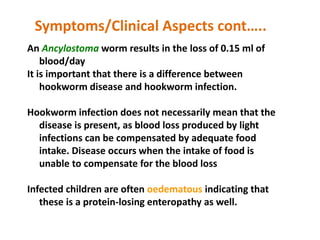
An Ancylostoma worm results in the loss of 0.15 ml of
blood/day
It is important that there is a difference between
hookworm disease and hookworm infection.
Hookworm infection does not necessarily mean that the
disease is present, as blood loss produced by light
infections can be compensated by adequate food
intake. Disease occurs when the intake of food is
unable to compensate for the blood loss
Infected children are often oedematous indicating that
these is a protein-losing enteropathy as well.
Symptoms/Clinical Aspects cont…..
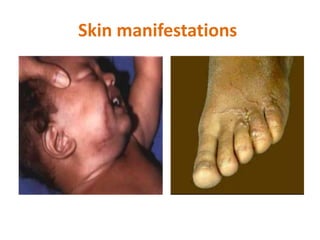
Skin manifestations
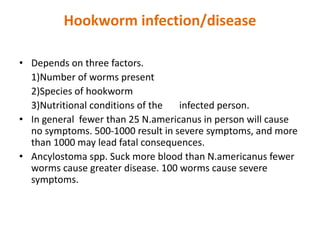
Hookworm infection/disease
• Depends on three factors.
1)Number of worms present
2)Species of hookworm
3)Nutritional conditions of the infected person.
• In general fewer than 25 N.americanus in person will cause
no symptoms. 500-1000 result in severe symptoms, and more
than 1000 may lead fatal consequences.
• Ancylostoma spp. Suck more blood than N.americanus fewer
worms cause greater disease. 100 worms cause severe
symptoms.
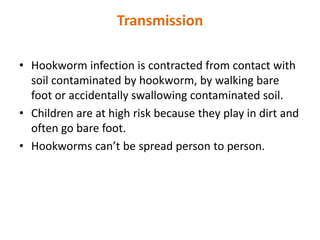
Transmission
• Hookworm infection is contracted from contact with
soil contaminated by hookworm, by walking bare
foot or accidentally swallowing contaminated soil.
• Children are at high risk because they play in dirt and
often go bare foot.
• Hookworms can’t be spread person to person.
Laboratory diagnosis
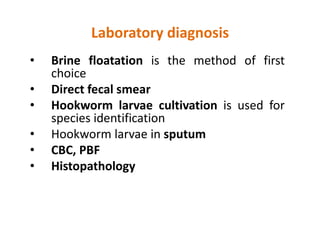
• Brine floatation is the method of first
choice
• Direct fecal smear
• Hookworm larvae cultivation is used for
species identification
• Hookworm larvae in sputum
• CBC, PBF
• Histopathology
Laboratory Diagnosis
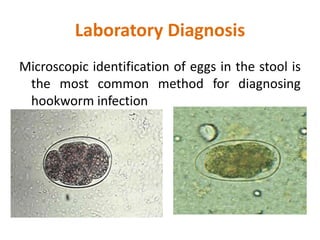
Microscopic identification of eggs in the stool is
the most common method for diagnosing
hookworm infection
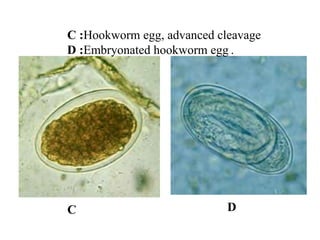
C :Hookworm egg, advanced cleavage
D :Embryonated hookworm egg .
C D
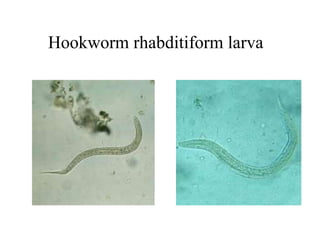
Hookworm rhabditiform larva
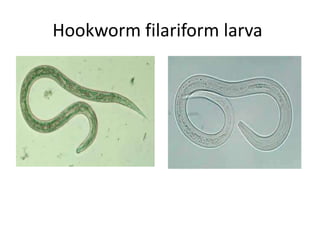
Hookworm filariform larva
HG
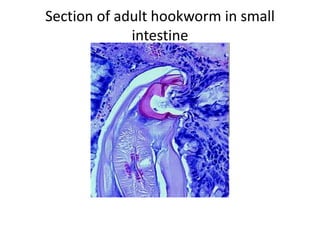
Section of adult hookworm in small
intestine
Prevention
• Proper sanitation practices.
• Appropriate fecal disposal.
• Do not walk barefoot or contact with bare
hands in areas where hookworms is common
or there are likely to be feces in the soil or
sand.
Thank you for attention!

Ancylostoma duodenale

  • 1.
    INSTITUTE OF PULICHEALTH, DHAKA Department of Laboratory Medicine BSc in Health Technology (Laboratory)- 1st Year HELMINTHOLOGY Lecture No. 03(Ancylostoma duodenale) By Sk. MIZANUR RAHMAN Assistant Bacteriologist, MBL, IPH MS in Biotechnology & Genetic Engineering (UODA) MS in Microbiology (SU) MPH in Epidemiology (SUB)
  • 2.
    Introduction • Hookworms arethe voracious blood feeders of the nematode world. • Two principal species that infect around 900 million people on earth are: • Necator americanus known as the american killer also known the new world hookworm. • Ancylostoma duodenale known as the old world hookworm.
  • 3.
    Ancylostoma duodenale • Associatedwith miners because mines offer an ideal habitat for egg and juvenile development due to constancy in temperature and humidity. • It was known to cause a serious anemia in miners. • Has two ventral plates, each with large teeth that are fused at their bases. A pair of small teeth is found in the depths of the capsule. The needlelike specules have simple tips and are never fused distally.
  • 4.
    Definitive host • Human• No Intermediate host
  • 5.
    Bucal cavity 2ventral plates and two large teeth Size of female 10-13 Size of male 8-11mm Position of vulva 1/3 from posterior Egg production 25000/ day Penetration through skin Yes Longevity 5 years Ancylostoma duodenale
  • 6.
  • 7.
    • A.duodenale isthe indigenous hookworm of the north-temperate zone of the eastern hemisphere. it is confined in southern Europe, northern Africa, India, China and southern Asia. • N.americanus is the new world worm. the “American killer,” was first discovered in Brazil and then Texas, but it was later found indigenous in Africa, India, Southeast Asia, China, and southwest Pacific islands.
  • 8.
    Morphology • Adult – Cylindricalwith the head bent sharply backwards – Males are smaller than the females and possess a bursa at their posterior end
  • 9.
    Morphology: Adults Ancylostoma duodenale •Female is 10-13 mm in length by 0.6 mm in diameter • Males are 8-11 mm by 0.4 mm • Posterior end has an umbrella-shaped bursa with riblike rays • Two pairs of curved teeth on the ventral wall of its buccal capsule
  • 10.
    Scanning electron micrographof the oral opening of Ancylostoma duodenale, another species of human hookworm. Note the presence of four cutting "teeth," two on each side.
  • 11.
    Adult mouthpart ofNecator americanus Note : The large buccal capsule is open dorsally with one pair of cutting plate teeth.
  • 12.
  • 14.
    First stage larva:hatches out from the egg in 24 to 48 hours Actively feeds on organic debris and bacteria in the soil 2nd stage larva: on the third day 3rd stage larva: on the fifth day filariform; enclosed in a sheath does not feed; actively motile. The third stage larva initiates the infection by penetrating the skin and passing into blood circulation. Through the blood it is carried to the right heart and then to pulmonary blood vessels. It soon breaks out of the pulmonary blood vessels into the alveoli. Life Cycle cont--
  • 15.
    Life cycle cont-- •Eggs are passed with feces. Eggs hatch in about 48 hours under favorable conditions such as (moist soil, protection from direct sun rays and temperature about 25°C. • The first-stage larva feed upon bacteria in the feces about three days and then molt to second-stage larva. First and second stage larva have a rhabditiform esophagus. After 5-10 days they molt and become filariform third-stage larva that are infective. • These infective larva can survive 3-4 weeks in favorable environmental conditions. 25 -15°C at 0°C death occurs rapidly. They move to the surface of the soil and wave back and forth which increases the chance to contact host. When they contact with the human host, the larva penetrate the skin and are carried through the veins to the heart and then to the lungs, break through into air sacs, to the trachea and are swallowed. The larva reach the small intestine, where they reside and mature in to adults.
  • 16.
    • Hookworms haveevolved strategies to evade the host’s defense system, and several of these has been discovered. • Ancylostoma spp. Secrete a neutrophil inhibition factor that interferes with activation of neutrophils. • N. americanus secretes acetyl cholinesterase, which inhabits gut peristalsis and possibly is an anti-inflammatory factor.
  • 17.
    Pathogenesis cont-- 1. Hookwormlarvae dermatitis: Penetration of the skin by the filariform larvae may be asymptomatic in previously uninfected individuals. However, those experiencing repeated infections develop itching, known as "ground itch" or "dew itch".
  • 18.
    Pathogenesis cont-- 2. Migrationof pre-adult cause temporary pulmonary inflammation: In heavily infected individuals (i.e., 500-1000 worms), there can be symptoms of pneumonia during the migratory phase in the developmental cycle of these worms
  • 19.
    Pathogenesis cont-- 3. Abdominalpains, diarrhea, loss of appetite… 4. Anemia – Especially in young children – Hypoproteinemic because of some loss of serum proteins – Iron-deficiency
  • 20.
    – Why thesmall worms can cause anemia? • The pump-like action when worms suck blood • The worms secrete an anticoagulant, which facilitates bleeding • The worms usually change the sites when suck blood 5. Allotriophagy (Geophagy): due to the iron-deficiency 6. Ancylostomiasis in infant Pathogenesis cont--
  • 21.
    Edema, ascites andloss of labour force
  • 22.
  • 23.
    Symptoms/Clinical Aspects • Itchingof skin as a result of penetration by the larvae. • Congestion in lungs in heavy infections. • Anemia due to loss of blood, particularly if diet is deficient. • Diarrhea • Persons with chronic hookworm disease are debilitated. • Chronic heavy hookworm infection can damage the growth and development of children. • Hookworm infection has been known to be fatal, particularly in infants.
  • 24.
    Ground itch: Thestage of skin penetration Intense itching and dermatitis at the site of entry; between the toes Pneumonitis and bronchitis The larval migration through the lungs This is less severe than the Loeffler's syndrome seen during the migration of Ascaris larvae. The final stage of development and attachment to the intestine is often asymptomatic. Heavy infections: induce microcytic hypochromic anaemia The blood loss is from sucking by the worm and also from continuing haemorrhage at the site of attachment. Symptoms/Clinical Aspects cont…..
  • 25.
    An Ancylostoma wormresults in the loss of 0.15 ml of blood/day It is important that there is a difference between hookworm disease and hookworm infection. Hookworm infection does not necessarily mean that the disease is present, as blood loss produced by light infections can be compensated by adequate food intake. Disease occurs when the intake of food is unable to compensate for the blood loss Infected children are often oedematous indicating that these is a protein-losing enteropathy as well. Symptoms/Clinical Aspects cont…..
  • 26.
  • 27.
    Hookworm infection/disease • Dependson three factors. 1)Number of worms present 2)Species of hookworm 3)Nutritional conditions of the infected person. • In general fewer than 25 N.americanus in person will cause no symptoms. 500-1000 result in severe symptoms, and more than 1000 may lead fatal consequences. • Ancylostoma spp. Suck more blood than N.americanus fewer worms cause greater disease. 100 worms cause severe symptoms.
  • 28.
    Transmission • Hookworm infectionis contracted from contact with soil contaminated by hookworm, by walking bare foot or accidentally swallowing contaminated soil. • Children are at high risk because they play in dirt and often go bare foot. • Hookworms can’t be spread person to person.
  • 29.
    Laboratory diagnosis • Brinefloatation is the method of first choice • Direct fecal smear • Hookworm larvae cultivation is used for species identification • Hookworm larvae in sputum • CBC, PBF • Histopathology
  • 30.
    Laboratory Diagnosis Microscopic identificationof eggs in the stool is the most common method for diagnosing hookworm infection
  • 31.
    C :Hookworm egg,advanced cleavage D :Embryonated hookworm egg . C D
  • 32.
  • 33.
  • 35.
    Section of adulthookworm in small intestine
  • 36.
    Prevention • Proper sanitationpractices. • Appropriate fecal disposal. • Do not walk barefoot or contact with bare hands in areas where hookworms is common or there are likely to be feces in the soil or sand.
  • 37.
    Thank you forattention!