INSTITUTE OF HEALTH TECHNOLOGY, DHAKA
Department of Laboratory Medicine
BSc in Health Technology (Laboratory)- 1st Year
MYCOLOGY
Lecture No. 06 (Deep Mycoses - Histoplasmosis)
By
Sk. MIZANUR RAHMAN
Lecturer, Mycology
MS in Biotechnology & Genetic Engineering (UODA)
MS in Microbiology (SU)
Outline of Histoplasmosis
• Characteristics
• Pathogenesis
• Histoplasmosis
–Pulmonary
–Disseminated
• Lab Diagnosis
2
Histoplasmosis
Characteristics
• Member of the phylum Ascomycota
• Worldwide distribution
• Naturally found in fecal-contaminated soils
• Birds and bats appear to be reservoirs
• Etiologic agent of histoplasmosis
Characteristics (cont.)
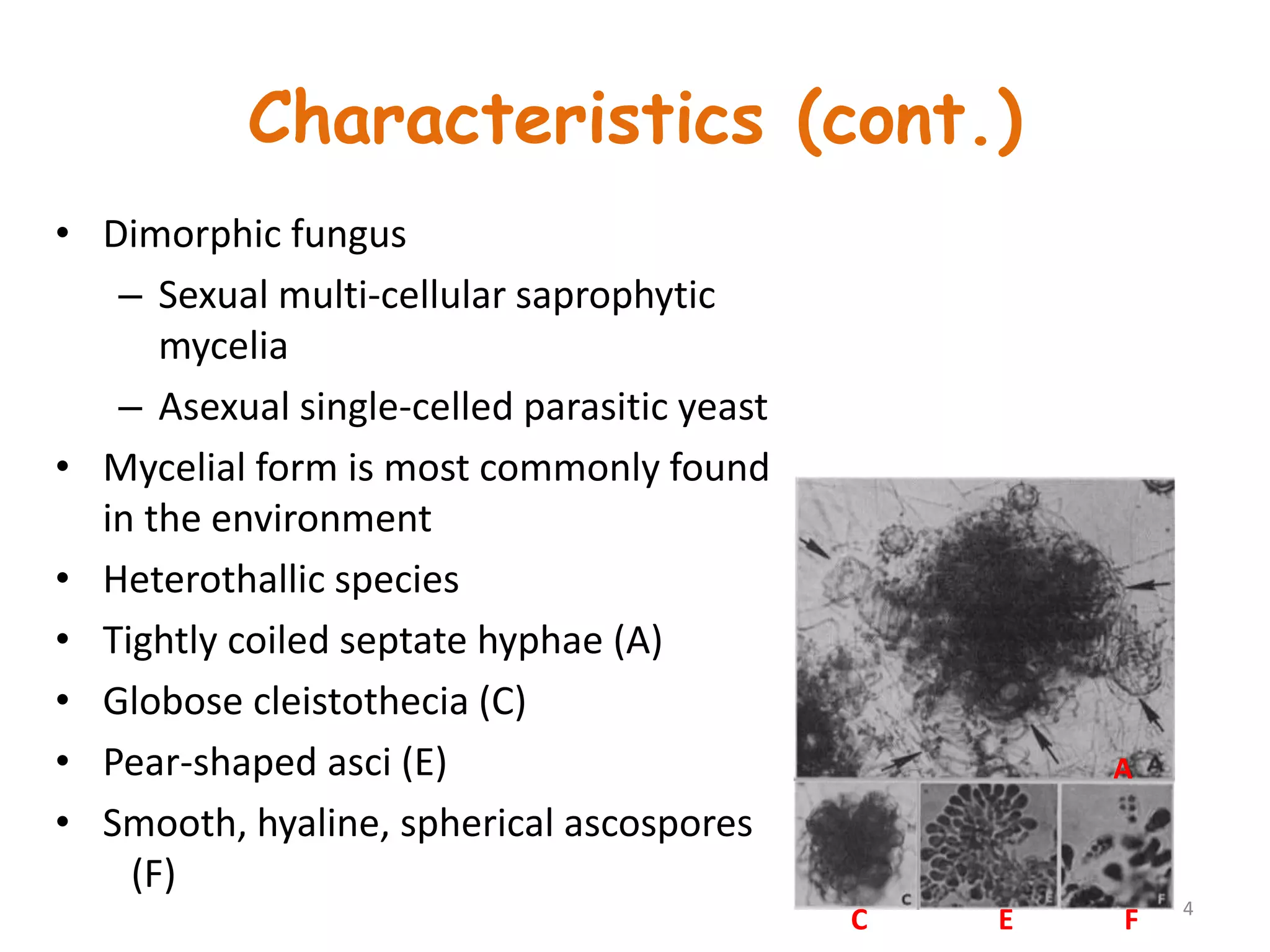
• Dimorphic fungus
– Sexual multi-cellular saprophytic
mycelia
– Asexual single-celled parasitic yeast
• Mycelial form is most commonly found
in the environment
• Heterothallic species
• Tightly coiled septate hyphae (A)
• Globose cleistothecia (C)
• Pear-shaped asci (E)
• Smooth, hyaline, spherical ascospores
(F)
A
C E F 4
Characteristics (cont.)
• Yeast form is the infectious agent in humans
• Form asexual macro- and microconidia
– Also borne by hyphae in the mycelial form (B)
• Conidia germinate via non/polar budding
• Yeast cells have white, thin-walled, oval bodies (A)
A B
5
Histoplasmosis-Types
• 2 major forms of histoplasmosis
– Pulmonary and disseminated
• Pulmonary histoplasmosis occurs when
microconidia or mycelial fragments are inhaled
– Form lesions in the hilar and/or mediastinal nodes
– Many types of pulmonary histoplasmosis
• Asymptomatic pulmonary histoplasmosis
• Acute pulmonary histoplasmosis
• Mediastinal granuloma
• Fibrosing mediastinitis
• Chronic cavitary pulmonary histoplasmosis
6
Disseminated Histoplasmosis
• Disseminated histoplasmosis
– Occurs primarily in immunocompromised individuals
– In healthy individuals, H. capsulatum is similar to
tuberculosis
• While the infection is usually resolved, the fungus is still present
• Constantly kept in check by T lymphocytes
– In immunocompromised individuals, H. capsulatum is able
to spread from the lungs into other organs
– Patients display fever, malaise, and occasionally petechiae
or skin lesions (cutaneous histoplasmosis)
– Tests often reveal mucous membrane ulcerations,
simultaneous enlargement of the liver and spleen, and
enlarged lymph nodes
7
Disseminated Histoplasmosis (cont.)
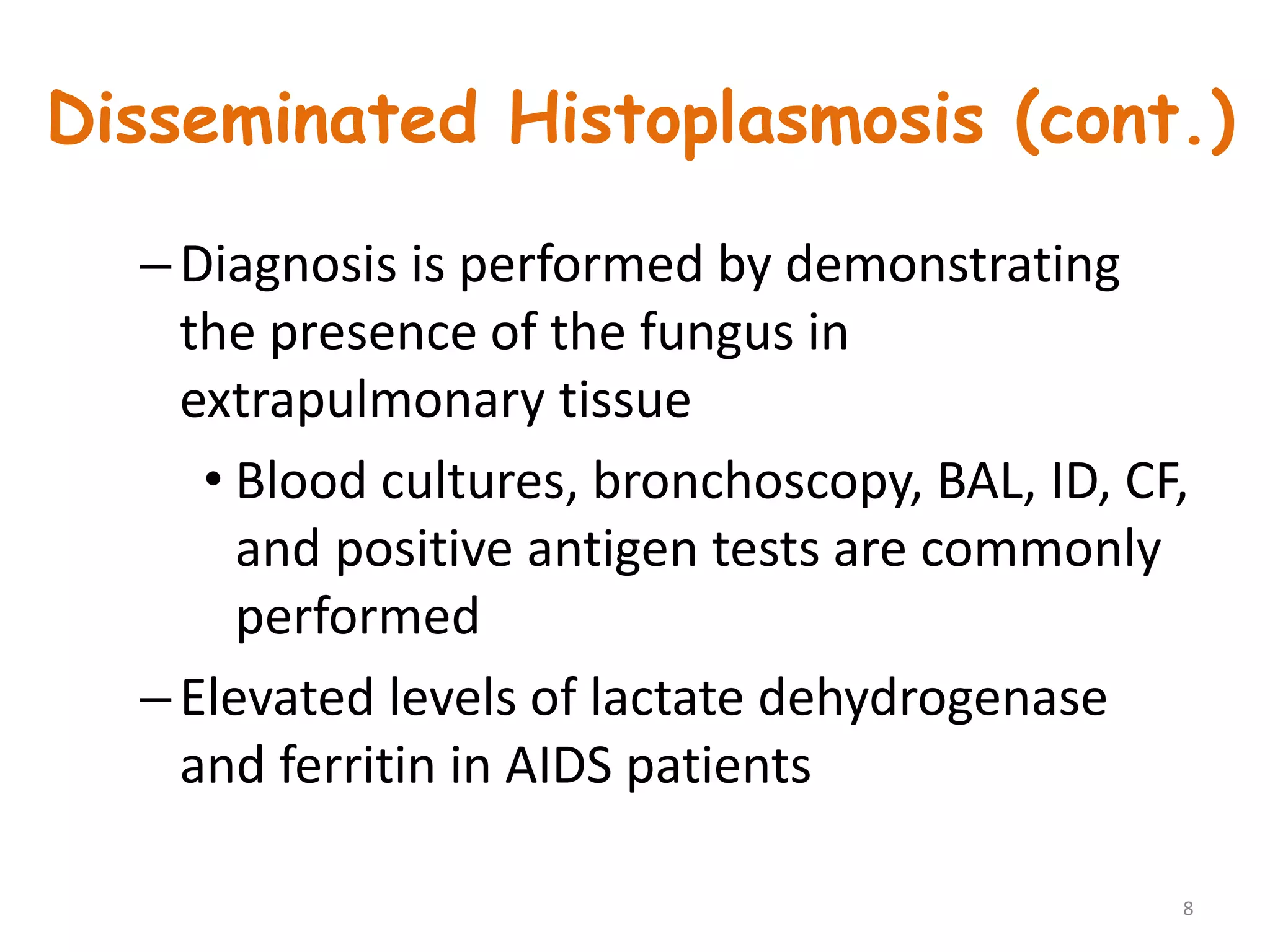
–Diagnosis is performed by demonstrating
the presence of the fungus in
extrapulmonary tissue
• Blood cultures, bronchoscopy, BAL, ID, CF,
and positive antigen tests are commonly
performed
–Elevated levels of lactate dehydrogenase
and ferritin in AIDS patients
8
HISTOPLASMOSIS
Pathogenesis
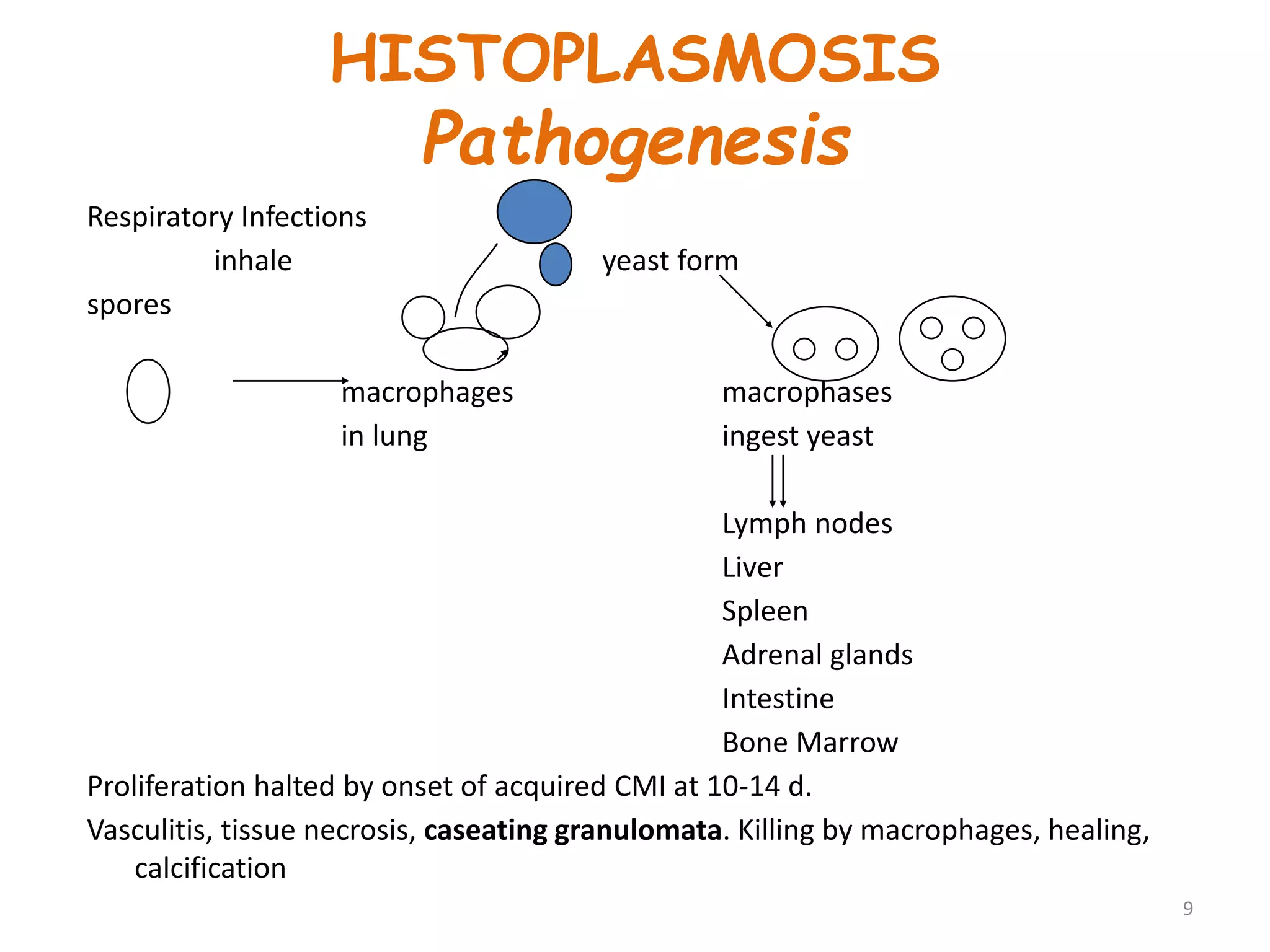
Respiratory Infections
inhale yeast form
spores
macrophages macrophases
in lung ingest yeast
Lymph nodes
Liver
Spleen
Adrenal glands
Intestine
Bone Marrow
Proliferation halted by onset of acquired CMI at 10-14 d.
Vasculitis, tissue necrosis, caseating granulomata. Killing by macrophages, healing,
calcification
9
Histoplasmosis
Clinical
• Chronic pulmonary histoplasmosis (1/100,000)
– pre-existing structural lung defect, i.e. COPD, emphysema
– chronic pneumonia or infection in cavities, increased
sputum
– reactivation or reinfection
– apical infection, may be cavitary
• Mediastinal granulomatosis and fibrosis
– fibrosis, traction, occlusion of mediastinal structure
• Histoplasmoma
– Fibrocaseous nodule
– Concentric caseation and calcification
• Presumed ocular histoplasmosis syndrome
– choroiditis - active or inactive
• may result in visual loss due to macular involvement
10
Histoplasmosis
11
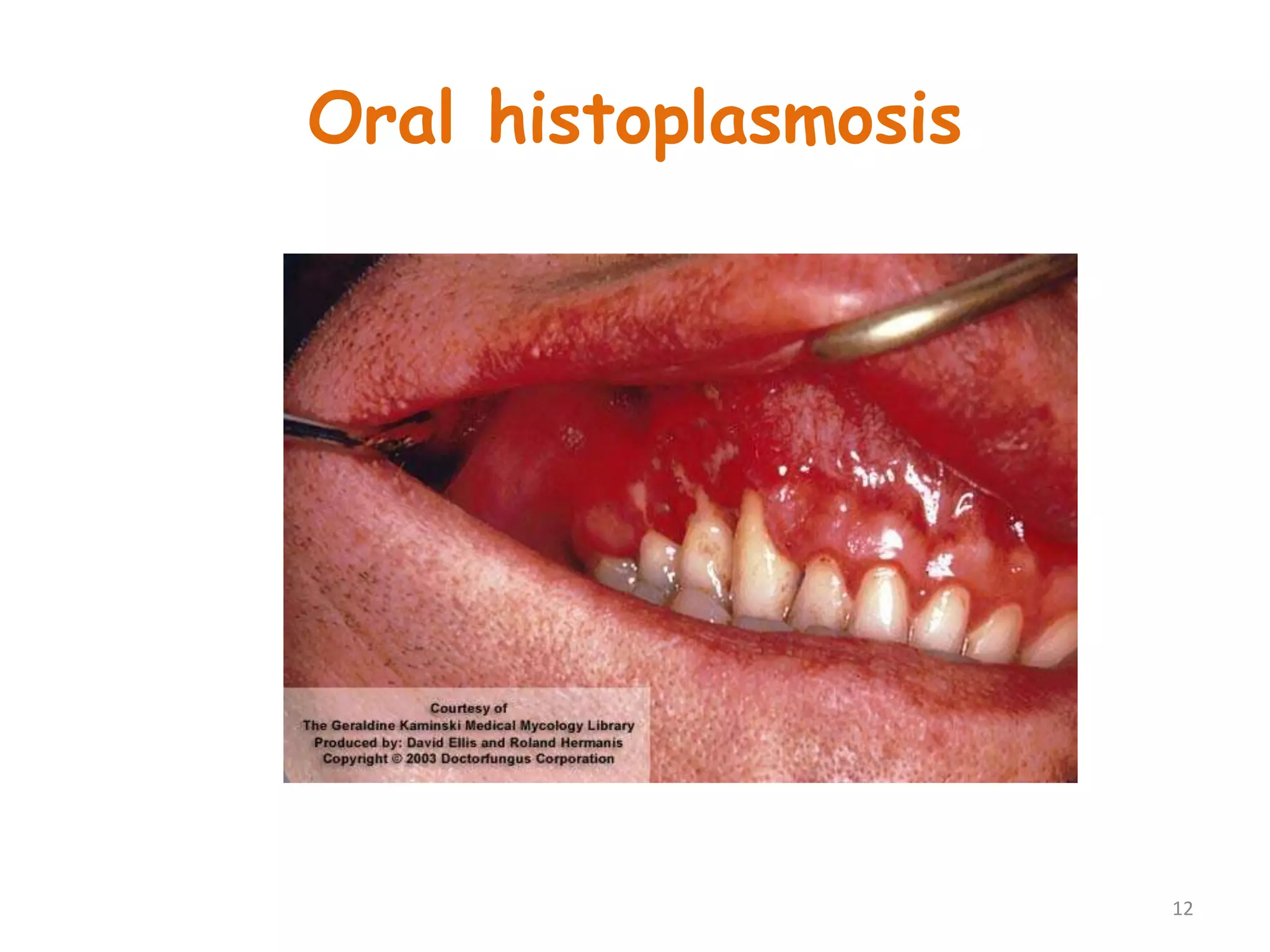
Oral histoplasmosis
12
Histoplasmosis
Chronic fibrocavitary histoplasmosis Histoplasmoma
13
Histoplasmosis
Laboratory Diagnosis
1. Obtain appropriate specimens
sputum bone marrow
blood lesion scrapings
urine biopsy specimens
2. Direct Examination
• Tissue Specimens
– stains for fungi - PAS, GMS, Giemsa
– routine histology - H & E
- small yeast (2-4 ) intracellular in macrophages
- granulomas - non-caseating
- caseating
• Sputum - KOH or calcofluor
14
Laboratory Diagnosis Cont----
• Direct detection methods
– Giemsa or Wright’s stains
– Calcofluor white stain, histological stains
– Look for small intracellular yeast cells
15
Calcofluor stain x400
Narrow-neck bud
16
Haematoxylin and Eosin (H&E) Stain
17
Grocott's methenamine silver
(GMS) from a lung biopsy
18
Histoplasmosis (diagnosis cont.)
3. Culture
Sabouraud’s agar
White - brown mould
Typical microscopic morphology
Slow growth 2-8 weeks
Rapid ID confirmation
Exo-antigen
Molecular probe
Traditional ID confirmation
Conversion mould to yeast
Animal inoculation
19
Macroscopic morphology
Sabouraud’s dextrose agar
Mould at RT
20
Culture of Histoplasma capsulatum
on Sabouraud's dextrose agar
21
Culture of Histoplasma capsulatum
on Sabouraud's dextrose agar
22
Mold - Histoplasma capsulatum
• Colony morphology
Click icon
for audio
23
Mold - Histoplasma capsulatum
• Microscopic morphology
Click icon
for audio
24
Hyphal to yeast conversion at 37ºC
Yeast-like colonies Yeast cells
25
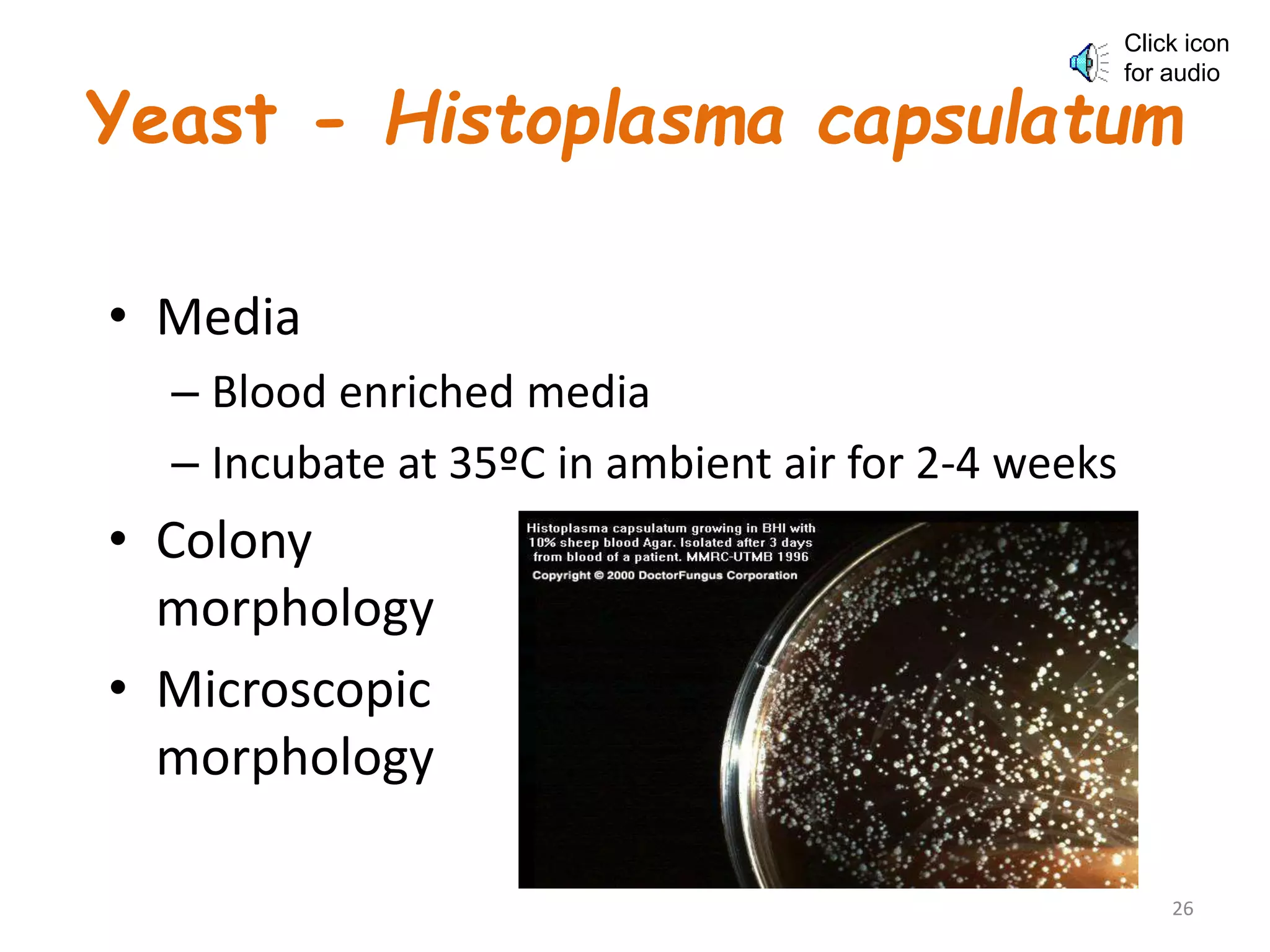
Yeast - Histoplasma capsulatum
• Media
– Blood enriched media
– Incubate at 35ºC in ambient air for 2-4 weeks
• Colony
morphology
• Microscopic
morphology
Click icon
for audio
26
27
Diagnosis (cont.)
• 4. Serology
– Sensitivity and specificity vary according to stage and
form of disease
• Lowest for early acute pulmonary and disseminated
(sensitivity 5-15% at 3 weeks)
• Highest for chronic pulmonary and disseminated (sensitivity
70-90% at 6 weeks)
– Complement fixation test (CFT)
• Yeast (more sensitive) and mycelial (histoplasmin) phase
antigens required
• ≥1:32 or 4-fold rise suggests recent infection
• X-reactions with B. dermatitidis and C. immitis
28
Diagnosis (cont.)
• Immunodiffusion
– More specific, less sensitive
– M bands
• Prior exposure
• Acute and chronic diseases
• X-reactions occur with other fungi
– H bands
• Diagnostic of acute disease
• Revert to negative in 6 months
• Acute or chronic
• Little cross-reaction with other fungi
• Appear later than CFT Abs
• ELISA/RIA
– Increased sensitivity (90% active pulmonary histo)
– Decreased specificity compared to CFT 29
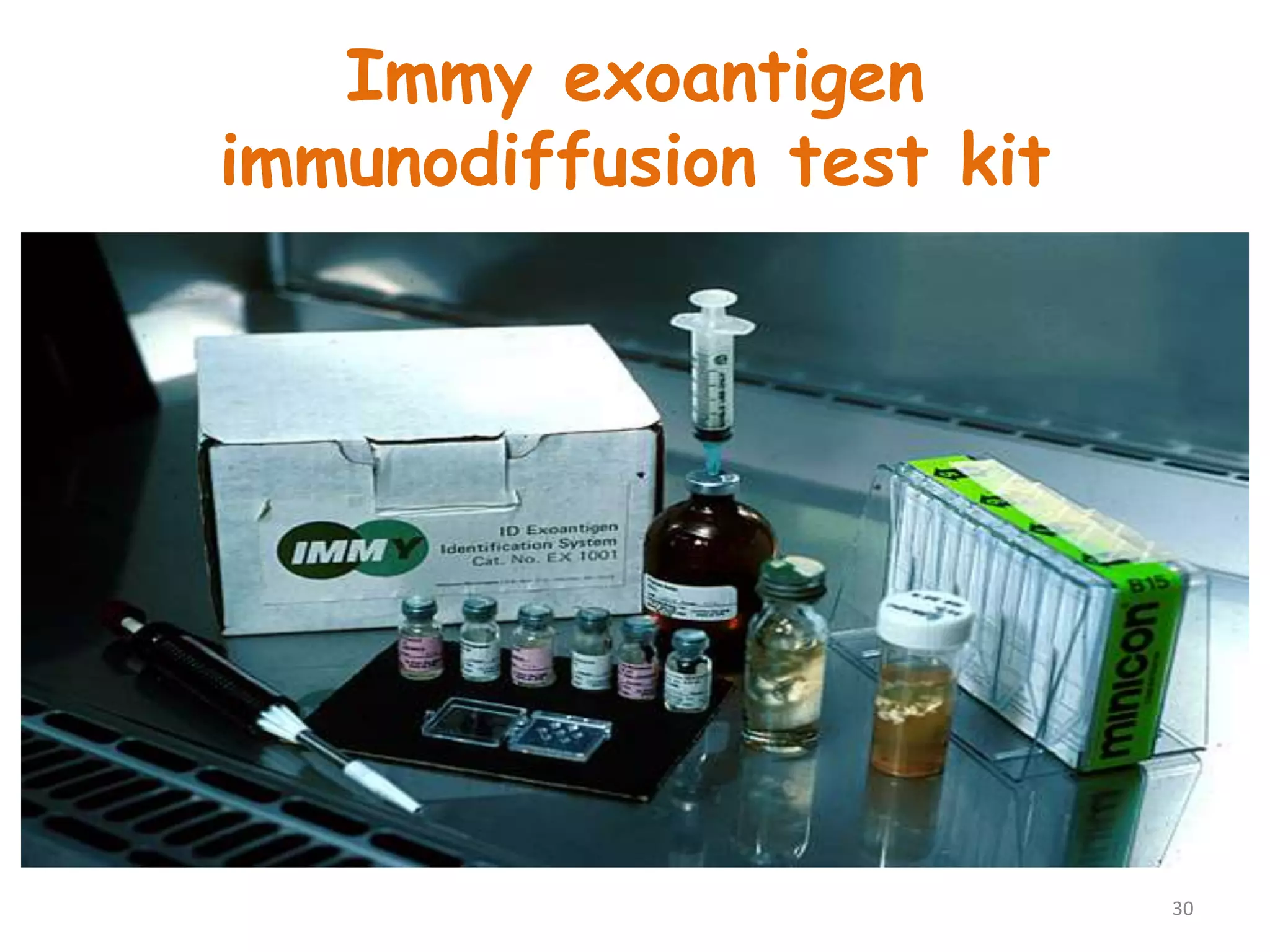
Immy exoantigen
immunodiffusion test kit
30
Exoantigen immunodiffusion plate
31
Diagnosis (cont.)
• Ag detection
– Urine
– Most useful in patients with large fungal burden
• Acute pulmonary histo (80% sensitive)
• Progressive disseminated histo (90% sens)
– Less useful with lower fungal burdens
• Chronic pulmonary (15% sensitive)
• Subacute pulmonary (30% sensitive)
– Serum sensitivity is lower
– Cross-reactions with B. dermatitidis and recipients of
anti-thymocyte globulin
– Joe Wheat, MiraVista Diagnostics, Indianapolis
32
Histoplasmosis

Histoplasmosis

  • 1.
    INSTITUTE OF HEALTHTECHNOLOGY, DHAKA Department of Laboratory Medicine BSc in Health Technology (Laboratory)- 1st Year MYCOLOGY Lecture No. 06 (Deep Mycoses - Histoplasmosis) By Sk. MIZANUR RAHMAN Lecturer, Mycology MS in Biotechnology & Genetic Engineering (UODA) MS in Microbiology (SU)
  • 2.
    Outline of Histoplasmosis •Characteristics • Pathogenesis • Histoplasmosis –Pulmonary –Disseminated • Lab Diagnosis 2
  • 3.
    Histoplasmosis Characteristics • Member ofthe phylum Ascomycota • Worldwide distribution • Naturally found in fecal-contaminated soils • Birds and bats appear to be reservoirs • Etiologic agent of histoplasmosis
  • 4.
    Characteristics (cont.) • Dimorphicfungus – Sexual multi-cellular saprophytic mycelia – Asexual single-celled parasitic yeast • Mycelial form is most commonly found in the environment • Heterothallic species • Tightly coiled septate hyphae (A) • Globose cleistothecia (C) • Pear-shaped asci (E) • Smooth, hyaline, spherical ascospores (F) A C E F 4
  • 5.
    Characteristics (cont.) • Yeastform is the infectious agent in humans • Form asexual macro- and microconidia – Also borne by hyphae in the mycelial form (B) • Conidia germinate via non/polar budding • Yeast cells have white, thin-walled, oval bodies (A) A B 5
  • 6.
    Histoplasmosis-Types • 2 majorforms of histoplasmosis – Pulmonary and disseminated • Pulmonary histoplasmosis occurs when microconidia or mycelial fragments are inhaled – Form lesions in the hilar and/or mediastinal nodes – Many types of pulmonary histoplasmosis • Asymptomatic pulmonary histoplasmosis • Acute pulmonary histoplasmosis • Mediastinal granuloma • Fibrosing mediastinitis • Chronic cavitary pulmonary histoplasmosis 6
  • 7.
    Disseminated Histoplasmosis • Disseminatedhistoplasmosis – Occurs primarily in immunocompromised individuals – In healthy individuals, H. capsulatum is similar to tuberculosis • While the infection is usually resolved, the fungus is still present • Constantly kept in check by T lymphocytes – In immunocompromised individuals, H. capsulatum is able to spread from the lungs into other organs – Patients display fever, malaise, and occasionally petechiae or skin lesions (cutaneous histoplasmosis) – Tests often reveal mucous membrane ulcerations, simultaneous enlargement of the liver and spleen, and enlarged lymph nodes 7
  • 8.
    Disseminated Histoplasmosis (cont.) –Diagnosisis performed by demonstrating the presence of the fungus in extrapulmonary tissue • Blood cultures, bronchoscopy, BAL, ID, CF, and positive antigen tests are commonly performed –Elevated levels of lactate dehydrogenase and ferritin in AIDS patients 8
  • 9.
    HISTOPLASMOSIS Pathogenesis Respiratory Infections inhale yeastform spores macrophages macrophases in lung ingest yeast Lymph nodes Liver Spleen Adrenal glands Intestine Bone Marrow Proliferation halted by onset of acquired CMI at 10-14 d. Vasculitis, tissue necrosis, caseating granulomata. Killing by macrophages, healing, calcification 9
  • 10.
    Histoplasmosis Clinical • Chronic pulmonaryhistoplasmosis (1/100,000) – pre-existing structural lung defect, i.e. COPD, emphysema – chronic pneumonia or infection in cavities, increased sputum – reactivation or reinfection – apical infection, may be cavitary • Mediastinal granulomatosis and fibrosis – fibrosis, traction, occlusion of mediastinal structure • Histoplasmoma – Fibrocaseous nodule – Concentric caseation and calcification • Presumed ocular histoplasmosis syndrome – choroiditis - active or inactive • may result in visual loss due to macular involvement 10
  • 11.
  • 12.
  • 13.
  • 14.
    Histoplasmosis Laboratory Diagnosis 1. Obtainappropriate specimens sputum bone marrow blood lesion scrapings urine biopsy specimens 2. Direct Examination • Tissue Specimens – stains for fungi - PAS, GMS, Giemsa – routine histology - H & E - small yeast (2-4 ) intracellular in macrophages - granulomas - non-caseating - caseating • Sputum - KOH or calcofluor 14
  • 15.
    Laboratory Diagnosis Cont---- •Direct detection methods – Giemsa or Wright’s stains – Calcofluor white stain, histological stains – Look for small intracellular yeast cells 15
  • 16.
  • 17.
    Haematoxylin and Eosin(H&E) Stain 17
  • 18.
  • 19.
    Histoplasmosis (diagnosis cont.) 3.Culture Sabouraud’s agar White - brown mould Typical microscopic morphology Slow growth 2-8 weeks Rapid ID confirmation Exo-antigen Molecular probe Traditional ID confirmation Conversion mould to yeast Animal inoculation 19
  • 20.
  • 21.
    Culture of Histoplasmacapsulatum on Sabouraud's dextrose agar 21
  • 22.
    Culture of Histoplasmacapsulatum on Sabouraud's dextrose agar 22
  • 23.
    Mold - Histoplasmacapsulatum • Colony morphology Click icon for audio 23
  • 24.
    Mold - Histoplasmacapsulatum • Microscopic morphology Click icon for audio 24
  • 25.
    Hyphal to yeastconversion at 37ºC Yeast-like colonies Yeast cells 25
  • 26.
    Yeast - Histoplasmacapsulatum • Media – Blood enriched media – Incubate at 35ºC in ambient air for 2-4 weeks • Colony morphology • Microscopic morphology Click icon for audio 26
  • 27.
  • 28.
    Diagnosis (cont.) • 4.Serology – Sensitivity and specificity vary according to stage and form of disease • Lowest for early acute pulmonary and disseminated (sensitivity 5-15% at 3 weeks) • Highest for chronic pulmonary and disseminated (sensitivity 70-90% at 6 weeks) – Complement fixation test (CFT) • Yeast (more sensitive) and mycelial (histoplasmin) phase antigens required • ≥1:32 or 4-fold rise suggests recent infection • X-reactions with B. dermatitidis and C. immitis 28
  • 29.
    Diagnosis (cont.) • Immunodiffusion –More specific, less sensitive – M bands • Prior exposure • Acute and chronic diseases • X-reactions occur with other fungi – H bands • Diagnostic of acute disease • Revert to negative in 6 months • Acute or chronic • Little cross-reaction with other fungi • Appear later than CFT Abs • ELISA/RIA – Increased sensitivity (90% active pulmonary histo) – Decreased specificity compared to CFT 29
  • 30.
  • 31.
  • 32.
    Diagnosis (cont.) • Agdetection – Urine – Most useful in patients with large fungal burden • Acute pulmonary histo (80% sensitive) • Progressive disseminated histo (90% sens) – Less useful with lower fungal burdens • Chronic pulmonary (15% sensitive) • Subacute pulmonary (30% sensitive) – Serum sensitivity is lower – Cross-reactions with B. dermatitidis and recipients of anti-thymocyte globulin – Joe Wheat, MiraVista Diagnostics, Indianapolis 32