INSTITUTE OF HEALTH TECHNOLOGY, DHAKA
Department of Laboratory Medicine
BSc in Health Technology (Laboratory)- 1st
Year
INSTITUTE OF HEALTH TECHNOLOGY, DHAKA
Department of Laboratory Medicine
BSc in Health Technology (Laboratory)- 1st
Year
MYCOLOGY
Lecture No. 01(Introduction)
ByBy
Sk. MIZANUR RAHMAN
Lecturer, Mycology
MS in Biotechnology & Genetic Engineering (UODA)
MS in Microbiology (SUB)
Sk. MIZANUR RAHMAN
Lecturer, Mycology
MS in Biotechnology & Genetic Engineering (UODA)
MS in Microbiology (SUB)
The Fungi
Learning outcomes- Students should be able to:
• Establish familiarity with the scientific terminology
peculiar to mycology
• Describe the dimorphic nature of the pathogenic fungi
used in making a clinical diagnosis.
• Emphasize the eukaryotic nature of the fungi.
• To explore the nature of the pathogenesis of fungal
infections.
• To gain familiarity with the classification of medically-
important fungi.
• To develop an understanding of the nature and mode of
action of anti-fungal agents
Recommended Textbooks
Theory
• Medical Mycology and Human Mycoses ES Beneke and AL
Rogers Star Publishing Company 1996 Belmont CA
Laboratory
• Identifying Filamentous Fungi: A Clinical Laboratory
Handbook St-Germain G and Summerbell R Rogers Star
Publishing Company 1996 Belmont CA
Additional Reading
• - Introductory Mycology Alexopoulos CJ Mims CW
Blackwell M Fourth Edition John Wiley &Sons Inc 1996 New
York NY
• - Medical Mycology KJ Kwon-Chung and JE Bennett Lea
&Febiger 1992 Philadelphia PA
• - Medical Microbiology A Laboratory Manual: Section II WG
Wu Third Edition Star Publishing Company 1995 Belmont CA
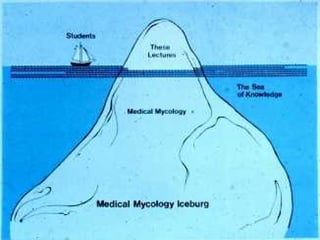
Medical Mycology Iceberg
What is a Fungus ?
• Eukaryotic – a true nucleus
• Do not contain chlorophyll
• Have cell walls
• Produce filamentous structures
• Produce spores
Species of Fungi
• 100,000 – 200,000 species
• About 300 pathogenic for man
Fungal Morphology and Structure
Eukaryotic organisms, distinguished by a rigid
cell wall composed of chitin and glucan, and a
cell membrane in which ergosterol is
substituted for cholesterol as the major sterol
component.
Fungal taxonomy relies heavily on
morphology and mode of spore production
Fungi may be unicellular or multicellular.
The simplest grouping based on morphology
divides fungi into either yeast or mold forms.
Features of Fungi and its value in our
life:
The fungi are a ubiquitous and diverse organisms, that degrade
organic matter.
Fungi have heterotrophic life; they could survive in nature as:
Saprophytic: live on dead or decaying matter
Symbiotic: live together and have mutual advantage
Commensal: one benefits and other neither benefits nor
harmed.
Parasitic: live on or within a host, they get benefit and harm the
other.
Fungi mainly infect immunocompromised or hospitalized patients
with serious underlying diseases.
The incidence of specific invasive mycoses continues to increase
with time
The list of opportunistic fungal pathogens likewise increases each
year “It seems there are no non-pathogenic fungi anymore ! “
This increase in fungal infections can be attributed to the ever-
growing number of immunocompromised patients.
Characteristics of fungi
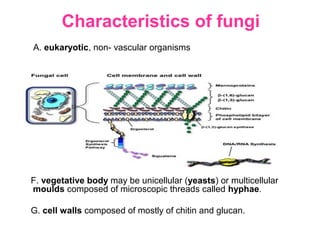
A. eukaryotic, non- vascular organisms
B. reproduce by means of spores (conidia), usually wind-
disseminated
C. both sexual (meiotic) and asexual (mitotic) spores may be
produced, depending on the species and conditions
D. typically not motile, although a few (e.g. Chytrids) have a motile
phase.
E. like plants, may have a stable haploid & diploid states
F. vegetative body may be unicellular (yeasts) or multicellular
moulds composed of microscopic threads called hyphae.
G. cell walls composed of mostly of chitin and glucan.
More Characteristics of Fungi
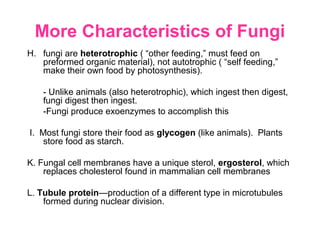
H. fungi are heterotrophic ( “other feeding,” must feed on
preformed organic material), not autotrophic ( “self feeding,”
make their own food by photosynthesis).
- Unlike animals (also heterotrophic), which ingest then digest,
fungi digest then ingest.
-Fungi produce exoenzymes to accomplish this
I. Most fungi store their food as glycogen (like animals). Plants
store food as starch.
K. Fungal cell membranes have a unique sterol, ergosterol, which
replaces cholesterol found in mammalian cell membranes
L. Tubule protein—production of a different type in microtubules
formed during nuclear division.
Structure
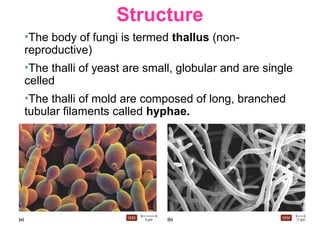
•The body of fungi is termed thallus (non-
reproductive)
•The thalli of yeast are small, globular and are single
celled
•The thalli of mold are composed of long, branched
tubular filaments called hyphae.
Structure
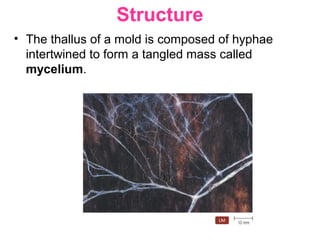
• The thallus of a mold is composed of hyphae
intertwined to form a tangled mass called
mycelium.
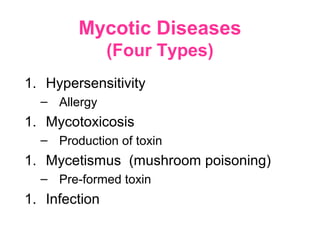
Mycotic Diseases
(Four Types)
1. Hypersensitivity
– Allergy
1. Mycotoxicosis
– Production of toxin
1. Mycetismus (mushroom poisoning)
– Pre-formed toxin
1. Infection
The Clinician Must Distinguish Between:
• COLONIZATION
• FUNGEMIA
• INFECTION
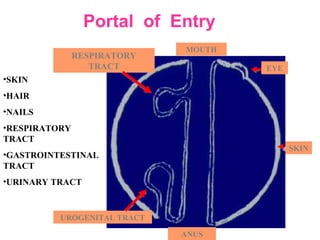
EYE
SKIN
UROGENITAL TRACT
ANUS
MOUTH
RESPIRATORY
TRACT
Portal of Entry
•SKIN
•HAIR
•NAILS
•RESPIRATORY
TRACT
•GASTROINTESTINAL
TRACT
•URINARY TRACT
EYE
SKIN
UROGENITAL TRACT
ANUS
MOUTH
RESPIRATORY
TRACT
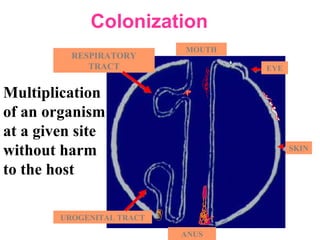
Colonization
Multiplication
of an organism
at a given site
without harm
to the host
EYE
SKIN
UROGENITAL TRACT
ANUS
MOUTH
RESPIRATORY
TRACT
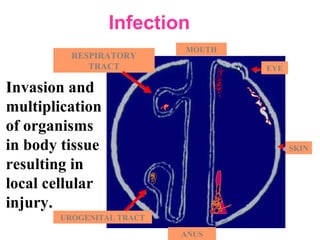
Infection
Invasion and
multiplication
of organisms
in body tissue
resulting in
local cellular
injury..
Classification of fungi
They are classified by several methods:
1- Morphological classification
2- Systematic classification
3- Clinical classification
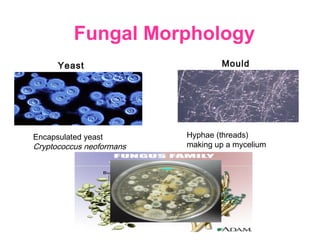
Fungal Morphology
Yeast
Hyphae (threads)
making up a mycelium
Mould
Encapsulated yeast
Cryptococcus neoformans
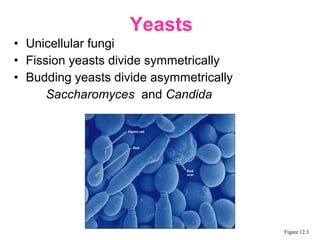
• Unicellular fungi
• Fission yeasts divide symmetrically
• Budding yeasts divide asymmetrically
Saccharomyces and Candida
Yeasts
Figure 12.3
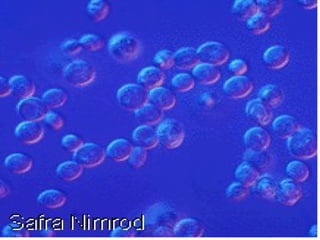
Yeast Reproduction
• FISSION
• “even” reproduction, nucleus divides forming
two identical cells, like bacteria
• BUDDING
• “uneven” reproduction, parent cell’s nucleus
divides and migrates to form a bud and then
breaks away
Molds
• Multicellular, tubular structures (hyphae)
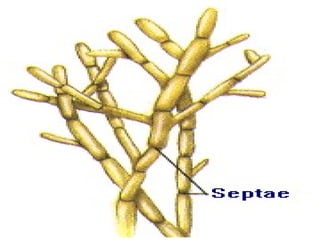
• Hyphae can be septate (regular crosswalls) or
nonseptate (coenocytic) depending on the
species (grow by apical extension)
– Vegetative hyphae grow on or in media (absorb
nutrients); form seen in tissue, few distinguishing
features
– Aerial hyphae contain structures for production of
spores (asexual propagules); usually only seen in
culture
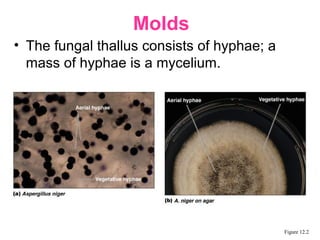
• The fungal thallus consists of hyphae; a
mass of hyphae is a mycelium.
Molds
Figure 12.2
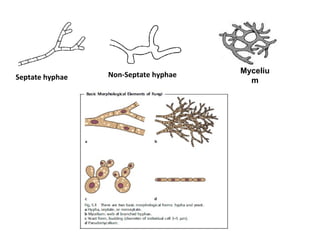
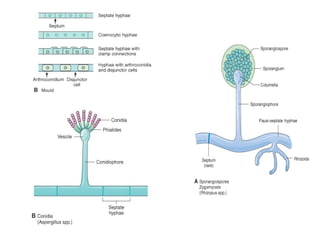
Moulds are multicellular organisms consisting of threadlike
tubular structures called Hyphae that elongate by apical
extension.
Hyphae are either:
Coenocytic: hollow and multinucleate
Septate: divided by partitions or cross-walls
Hyphae form together to produce a mat-like structure
called a Mycelium.
Vegetative hyphae, grow on or under surface of culture
medium,
Aerial Hyphae: project above surface of medium
Aerial H. produce Conidia (asexual reproductive elements)
Conidia can easily airborne and disseminate the fungus.
Many medical fungi are termed dimorphic because they exist
in yeast and mould forms.
Septate hyphae Non-Septate hyphae Myceliu
m
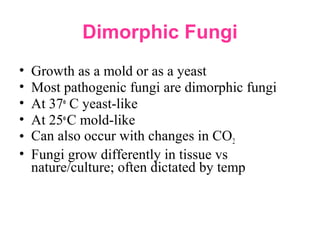
Dimorphic Fungi
• Growth as a mold or as a yeast
• Most pathogenic fungi are dimorphic fungi
• At 37o
C yeast-like
• At 25o
C mold-like
• Can also occur with changes in CO2
• Fungi grow differently in tissue vs
nature/culture; often dictated by temp
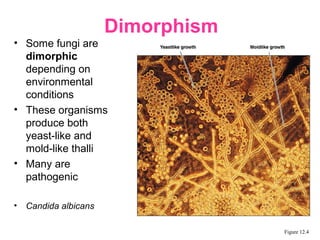
• Some fungi are
dimorphic
depending on
environmental
conditions
• These organisms
produce both
yeast-like and
mold-like thalli
• Many are
pathogenic
• Candida albicans
Dimorphism
Figure 12.4
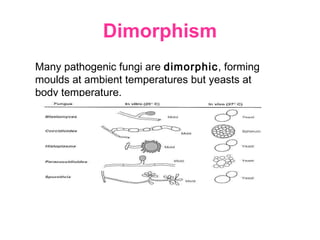
Dimorphism
Many pathogenic fungi are dimorphic, forming
moulds at ambient temperatures but yeasts at
body temperature.
Clinical Classification of
Mycoses
•Cutaneous
•Subcutaneous
•Systemic
•Opportunistic
Cutaneous Mycoses
Skin, hair and nails
Rarely invade deeper tissue
Dermatophytes
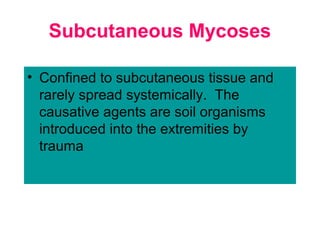
Subcutaneous Mycoses
• Confined to subcutaneous tissue and
rarely spread systemically. The
causative agents are soil organisms
introduced into the extremities by
trauma
Systemic Mycoses
• Involve skin and deep viscera
• May become widely disseminated
• Predilection for specific organs
Opportunistic Fungi
Ubiquitous saprophytes and occasional
pathogens that invade the tissues of
those patients who have:
• Predisposing diseases:
Diabetes, cancer, leukemia, etc.
• Predisposing conditions:
Agammaglobulinemia, steroid or antibiotic
therapy.
• Systemic mycoses Deep within body
• Subcutaneous mycoses Beneath the skin
• Cutaneous mycoses Affect hair, skin, nails
• Superficial mycoses Localized, e.g., hair
shafts
• Opportunistic mycoses Caused by normal
microbiota or
fungi
Fungal Diseases (mycoses)
DIAGNOSIS
Diagnosis
1. Wet Mount
2. Skin test
3. Serology
4. Fluorescent antibody
5. Biopsy and
histopathology
6. Culture
7. DNA probes
Diagnosis
1. Wet Mount
2. Skin test
3. Serology
4. Fluorescent antibody
5. Biopsy and
histopathology
6. Culture
7. DNA probes
Direct Microscopic
Observation
• 10 % KOH
• Gentle Heat
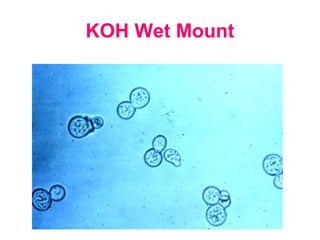
KOH Wet Mount
Diagnosis
1. Wet Mount
2. Skin test
3. Serology
4. Fluorescent antibody
5. Biopsy and
histopathology
6. Culture
7. DNA probes
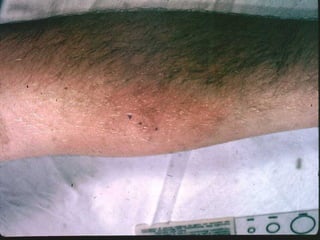
Skin Testing
(DERMAL HYPERSENSTIVITY)
Use is limited to :
– Determine cellular defense mechanisms
– Epidemiologic studies
Diagnosis
1. Wet Mount
2. Skin test
3. Serology
4. Fluorescent antibody
5. Biopsy and
histopathology
6. Culture
7. DNA probes
FUNGI ARE POOR
ANTIGENS
Fungal Serology Antibodies
• Latex Agglutination IgM
• Immunodiffusion IgG
• EIA IgG & IgM
• Complement Fixation IgG
Most serological tests for fungi
measure antibody. Newer tests
to measure antigen are now
being developed
ANTIGEN DETECTION PRESENTLY
AVAILABLE
 Cryptococcosis
 Histoplasmosis
 Aspergillosis
Diagnosis
1. Wet Mount
2. Skin test
3. Serology
4. Fluorescent antibody
5. Biopsy and
histopathology
6. Culture
7. DNA probes
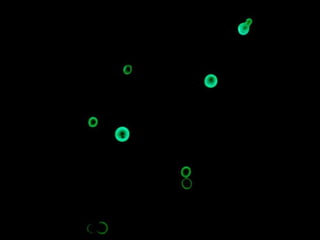
DIRECT FLUORESCENT
ANTIBODY
CAN BE APPLIED TO
1. HISTOLOGIC SECTIONS
2. CULTURE
• Viable organisms
• Non-viable organisms
Diagnosis
1. Wet Mount
2. Skin test
3. Serology
4. Fluorescent antibody
5. Biopsy and
histopathology
6. Culture
7. DNA probe
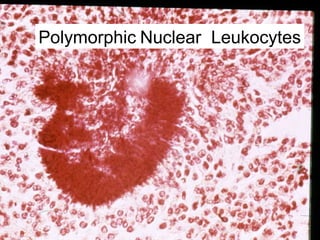
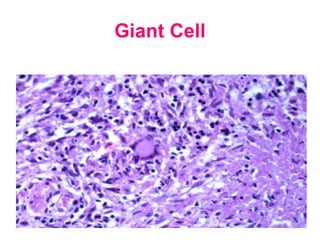
Inflamatory Reaction
• Normal host
–Pyogenic
–Granulomatous
• Immunodeficient host
–Necrosis
Polymorphic Nuclear Leukocytes
Giant Cell
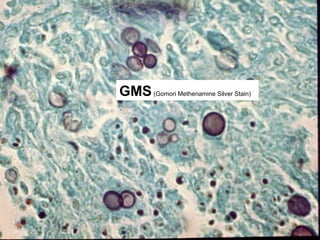
GMS(Gomori Methenamine Silver Stain)
Diagnosis
1. Wet Mount
2. Skin test
3. Serology
4. Fluorescent antibody
5. Biopsy and
histopathology
6. Culture
7. DNA probes
Isolation Media
SABOURAUD DEXTROSE AGAR
(pH ~ 5.6)
•Plain
•With antibiotics
•With cycloheximide
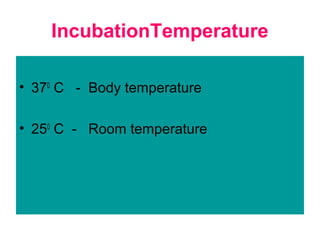
IncubationTemperature
• 370
C - Body temperature
• 250
C - Room temperature
Diagnosis
1. Wet Mount
2. Skin test
3. Serology
4. Fluorescent antibody
5. Biopsy and
histopathology
6. Culture
7. DNA probes
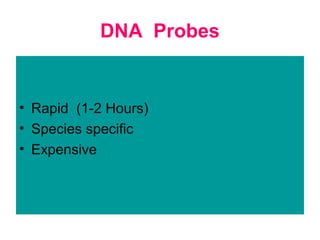
DNA Probes
• Rapid (1-2 Hours)
• Species specific
• Expensive
Introduction mycology

Introduction mycology

  • 1.
    INSTITUTE OF HEALTHTECHNOLOGY, DHAKA Department of Laboratory Medicine BSc in Health Technology (Laboratory)- 1st Year INSTITUTE OF HEALTH TECHNOLOGY, DHAKA Department of Laboratory Medicine BSc in Health Technology (Laboratory)- 1st Year MYCOLOGY Lecture No. 01(Introduction) ByBy Sk. MIZANUR RAHMAN Lecturer, Mycology MS in Biotechnology & Genetic Engineering (UODA) MS in Microbiology (SUB) Sk. MIZANUR RAHMAN Lecturer, Mycology MS in Biotechnology & Genetic Engineering (UODA) MS in Microbiology (SUB)
  • 2.
    The Fungi Learning outcomes-Students should be able to: • Establish familiarity with the scientific terminology peculiar to mycology • Describe the dimorphic nature of the pathogenic fungi used in making a clinical diagnosis. • Emphasize the eukaryotic nature of the fungi. • To explore the nature of the pathogenesis of fungal infections. • To gain familiarity with the classification of medically- important fungi. • To develop an understanding of the nature and mode of action of anti-fungal agents
  • 3.
    Recommended Textbooks Theory • MedicalMycology and Human Mycoses ES Beneke and AL Rogers Star Publishing Company 1996 Belmont CA Laboratory • Identifying Filamentous Fungi: A Clinical Laboratory Handbook St-Germain G and Summerbell R Rogers Star Publishing Company 1996 Belmont CA Additional Reading • - Introductory Mycology Alexopoulos CJ Mims CW Blackwell M Fourth Edition John Wiley &Sons Inc 1996 New York NY • - Medical Mycology KJ Kwon-Chung and JE Bennett Lea &Febiger 1992 Philadelphia PA • - Medical Microbiology A Laboratory Manual: Section II WG Wu Third Edition Star Publishing Company 1995 Belmont CA
  • 4.
  • 7.
    What is aFungus ? • Eukaryotic – a true nucleus • Do not contain chlorophyll • Have cell walls • Produce filamentous structures • Produce spores
  • 8.
    Species of Fungi •100,000 – 200,000 species • About 300 pathogenic for man
  • 9.
    Fungal Morphology andStructure Eukaryotic organisms, distinguished by a rigid cell wall composed of chitin and glucan, and a cell membrane in which ergosterol is substituted for cholesterol as the major sterol component. Fungal taxonomy relies heavily on morphology and mode of spore production Fungi may be unicellular or multicellular. The simplest grouping based on morphology divides fungi into either yeast or mold forms.
  • 10.
    Features of Fungiand its value in our life: The fungi are a ubiquitous and diverse organisms, that degrade organic matter. Fungi have heterotrophic life; they could survive in nature as: Saprophytic: live on dead or decaying matter Symbiotic: live together and have mutual advantage Commensal: one benefits and other neither benefits nor harmed. Parasitic: live on or within a host, they get benefit and harm the other. Fungi mainly infect immunocompromised or hospitalized patients with serious underlying diseases. The incidence of specific invasive mycoses continues to increase with time The list of opportunistic fungal pathogens likewise increases each year “It seems there are no non-pathogenic fungi anymore ! “ This increase in fungal infections can be attributed to the ever- growing number of immunocompromised patients.
  • 11.
    Characteristics of fungi A.eukaryotic, non- vascular organisms B. reproduce by means of spores (conidia), usually wind- disseminated C. both sexual (meiotic) and asexual (mitotic) spores may be produced, depending on the species and conditions D. typically not motile, although a few (e.g. Chytrids) have a motile phase. E. like plants, may have a stable haploid & diploid states F. vegetative body may be unicellular (yeasts) or multicellular moulds composed of microscopic threads called hyphae. G. cell walls composed of mostly of chitin and glucan.
  • 12.
    More Characteristics ofFungi H. fungi are heterotrophic ( “other feeding,” must feed on preformed organic material), not autotrophic ( “self feeding,” make their own food by photosynthesis). - Unlike animals (also heterotrophic), which ingest then digest, fungi digest then ingest. -Fungi produce exoenzymes to accomplish this I. Most fungi store their food as glycogen (like animals). Plants store food as starch. K. Fungal cell membranes have a unique sterol, ergosterol, which replaces cholesterol found in mammalian cell membranes L. Tubule protein—production of a different type in microtubules formed during nuclear division.
  • 13.
    Structure •The body offungi is termed thallus (non- reproductive) •The thalli of yeast are small, globular and are single celled •The thalli of mold are composed of long, branched tubular filaments called hyphae.
  • 14.
    Structure • The thallusof a mold is composed of hyphae intertwined to form a tangled mass called mycelium.
  • 15.
    Mycotic Diseases (Four Types) 1.Hypersensitivity – Allergy 1. Mycotoxicosis – Production of toxin 1. Mycetismus (mushroom poisoning) – Pre-formed toxin 1. Infection
  • 16.
    The Clinician MustDistinguish Between: • COLONIZATION • FUNGEMIA • INFECTION
  • 17.
    EYE SKIN UROGENITAL TRACT ANUS MOUTH RESPIRATORY TRACT Portal ofEntry •SKIN •HAIR •NAILS •RESPIRATORY TRACT •GASTROINTESTINAL TRACT •URINARY TRACT
  • 18.
  • 19.
  • 20.
    Classification of fungi Theyare classified by several methods: 1- Morphological classification 2- Systematic classification 3- Clinical classification
  • 21.
    Fungal Morphology Yeast Hyphae (threads) makingup a mycelium Mould Encapsulated yeast Cryptococcus neoformans
  • 22.
    • Unicellular fungi •Fission yeasts divide symmetrically • Budding yeasts divide asymmetrically Saccharomyces and Candida Yeasts Figure 12.3
  • 23.
    Yeast Reproduction • FISSION •“even” reproduction, nucleus divides forming two identical cells, like bacteria • BUDDING • “uneven” reproduction, parent cell’s nucleus divides and migrates to form a bud and then breaks away
  • 25.
    Molds • Multicellular, tubularstructures (hyphae) • Hyphae can be septate (regular crosswalls) or nonseptate (coenocytic) depending on the species (grow by apical extension) – Vegetative hyphae grow on or in media (absorb nutrients); form seen in tissue, few distinguishing features – Aerial hyphae contain structures for production of spores (asexual propagules); usually only seen in culture
  • 26.
    • The fungalthallus consists of hyphae; a mass of hyphae is a mycelium. Molds Figure 12.2
  • 27.
    Moulds are multicellularorganisms consisting of threadlike tubular structures called Hyphae that elongate by apical extension. Hyphae are either: Coenocytic: hollow and multinucleate Septate: divided by partitions or cross-walls Hyphae form together to produce a mat-like structure called a Mycelium. Vegetative hyphae, grow on or under surface of culture medium, Aerial Hyphae: project above surface of medium Aerial H. produce Conidia (asexual reproductive elements) Conidia can easily airborne and disseminate the fungus. Many medical fungi are termed dimorphic because they exist in yeast and mould forms.
  • 28.
  • 31.
    Dimorphic Fungi • Growthas a mold or as a yeast • Most pathogenic fungi are dimorphic fungi • At 37o C yeast-like • At 25o C mold-like • Can also occur with changes in CO2 • Fungi grow differently in tissue vs nature/culture; often dictated by temp
  • 32.
    • Some fungiare dimorphic depending on environmental conditions • These organisms produce both yeast-like and mold-like thalli • Many are pathogenic • Candida albicans Dimorphism Figure 12.4
  • 33.
    Dimorphism Many pathogenic fungiare dimorphic, forming moulds at ambient temperatures but yeasts at body temperature.
  • 34.
  • 35.
    Cutaneous Mycoses Skin, hairand nails Rarely invade deeper tissue Dermatophytes
  • 36.
    Subcutaneous Mycoses • Confinedto subcutaneous tissue and rarely spread systemically. The causative agents are soil organisms introduced into the extremities by trauma
  • 37.
    Systemic Mycoses • Involveskin and deep viscera • May become widely disseminated • Predilection for specific organs
  • 38.
    Opportunistic Fungi Ubiquitous saprophytesand occasional pathogens that invade the tissues of those patients who have: • Predisposing diseases: Diabetes, cancer, leukemia, etc. • Predisposing conditions: Agammaglobulinemia, steroid or antibiotic therapy.
  • 39.
    • Systemic mycosesDeep within body • Subcutaneous mycoses Beneath the skin • Cutaneous mycoses Affect hair, skin, nails • Superficial mycoses Localized, e.g., hair shafts • Opportunistic mycoses Caused by normal microbiota or fungi Fungal Diseases (mycoses)
  • 40.
  • 41.
    Diagnosis 1. Wet Mount 2.Skin test 3. Serology 4. Fluorescent antibody 5. Biopsy and histopathology 6. Culture 7. DNA probes
  • 42.
    Diagnosis 1. Wet Mount 2.Skin test 3. Serology 4. Fluorescent antibody 5. Biopsy and histopathology 6. Culture 7. DNA probes
  • 43.
  • 45.
  • 46.
    Diagnosis 1. Wet Mount 2.Skin test 3. Serology 4. Fluorescent antibody 5. Biopsy and histopathology 6. Culture 7. DNA probes
  • 47.
    Skin Testing (DERMAL HYPERSENSTIVITY) Useis limited to : – Determine cellular defense mechanisms – Epidemiologic studies
  • 49.
    Diagnosis 1. Wet Mount 2.Skin test 3. Serology 4. Fluorescent antibody 5. Biopsy and histopathology 6. Culture 7. DNA probes
  • 50.
  • 51.
    Fungal Serology Antibodies •Latex Agglutination IgM • Immunodiffusion IgG • EIA IgG & IgM • Complement Fixation IgG
  • 53.
    Most serological testsfor fungi measure antibody. Newer tests to measure antigen are now being developed ANTIGEN DETECTION PRESENTLY AVAILABLE  Cryptococcosis  Histoplasmosis  Aspergillosis
  • 54.
    Diagnosis 1. Wet Mount 2.Skin test 3. Serology 4. Fluorescent antibody 5. Biopsy and histopathology 6. Culture 7. DNA probes
  • 55.
    DIRECT FLUORESCENT ANTIBODY CAN BEAPPLIED TO 1. HISTOLOGIC SECTIONS 2. CULTURE • Viable organisms • Non-viable organisms
  • 57.
    Diagnosis 1. Wet Mount 2.Skin test 3. Serology 4. Fluorescent antibody 5. Biopsy and histopathology 6. Culture 7. DNA probe
  • 58.
    Inflamatory Reaction • Normalhost –Pyogenic –Granulomatous • Immunodeficient host –Necrosis
  • 59.
  • 60.
  • 61.
  • 62.
    Diagnosis 1. Wet Mount 2.Skin test 3. Serology 4. Fluorescent antibody 5. Biopsy and histopathology 6. Culture 7. DNA probes
  • 63.
    Isolation Media SABOURAUD DEXTROSEAGAR (pH ~ 5.6) •Plain •With antibiotics •With cycloheximide
  • 64.
    IncubationTemperature • 370 C -Body temperature • 250 C - Room temperature
  • 65.
    Diagnosis 1. Wet Mount 2.Skin test 3. Serology 4. Fluorescent antibody 5. Biopsy and histopathology 6. Culture 7. DNA probes
  • 66.
    DNA Probes • Rapid(1-2 Hours) • Species specific • Expensive

Editor's Notes

  • #25 Bread Yeast Bread yeast, or baker’s yeast, actually a type of sac fungi, reproduces by a process called budding. Bread yeast causes bread to rise by releasing carbon dioxide, which gets trapped in the dough. The Egyptians were the first to discover that allowing dough to ferment produced gases that made bread lighter. Safra Nimrod/Phototake NYC MichaelA. McClure PHD/Phototake NYC
  • #33 Yeasts grow typically in moist environments where there is a plentiful supply of simple, soluble nutrients such as sugars and amino acids. For this reason they are common on leaf and fruit surfaces, on roots and in various types of food. With few exceptions, they are unable to degrade polymers, such as starch and cellulose which are used by many hyphal fungi.