Downloaded 491 times
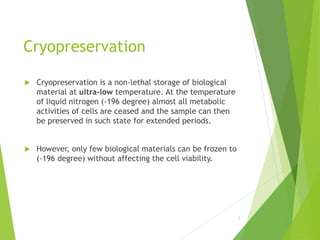


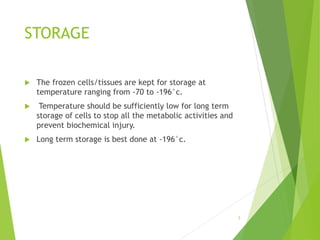




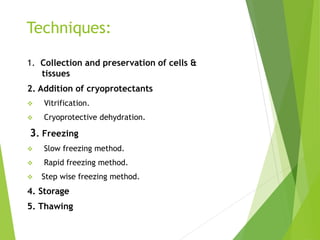


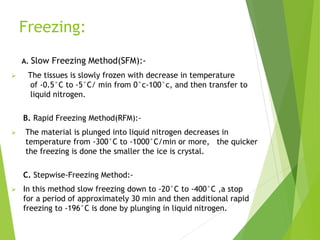


Cryopreservation involves storing biological material at ultra-low temperatures, usually in liquid nitrogen. This allows long-term preservation by stopping almost all metabolic activity in cells. Materials are frozen using slow freezing, rapid freezing, or stepwise freezing methods. They are then stored long-term at temperatures near -196°C. When needed, samples are thawed quickly in a warm water bath before use or analysis. Cryopreservation has many applications for preserving cells, tissues, blood, embryos and more.


