CRYOPRESERVATION
Department of Pharmacology
Why preservation is important ?
• Until two decades ago the genetic resources were getting depleted
owing to the continous depredation by man.
• It was imperative therefore that many of the elite, economically
important and
• endangered species are preserved to make them available when
needed.
• The conventional methods of storage failed to prevent losses
caused due to various reasons.
• A new methodology had to be devised for long term preservation of
material.
There are various methods of storage :
1. Cryopreservation - generally involves storage in liquid nitrogen.
2. Cold storage - it involves storage in low and non freezing temperature.
3. Low pressure – it involves partially reducing the atmospheric pressure of
surrounding.
4. Low oxygen storage - it involves reducing the oxygen level but
maintaining the pressure.
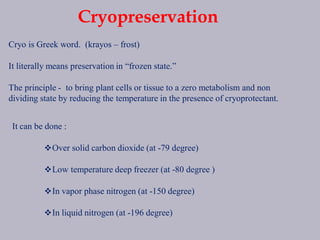
Cryo is Greek word. (krayos – frost)
It literally means preservation in “frozen state.”
The principle - to bring plant cells or tissue to a zero metabolism and non
dividing state by reducing the temperature in the presence of cryoprotectant.
It can be done :
Over solid carbon dioxide (at -79 degree)
Low temperature deep freezer (at -80 degree )
In vapor phase nitrogen (at -150 degree)
In liquid nitrogen (at -196 degree)
Cryopreservation
Major advantages
1. Once the material is sucessfully conserved to particular temperature it can be
preserved indefinately.
2. Once in storage no chance of new contamination of fungus or bacteria.
3. Minimal space required.
4. Minimal labour required.
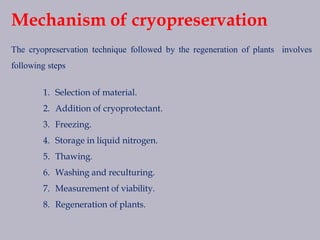
Mechanism of cryopreservation
The cryopreservation technique followed by the regeneration of plants involves
following steps
1. Selection of material.
2. Addition of cryoprotectant.
3. Freezing.
4. Storage in liquid nitrogen.
5. Thawing.
6. Washing and reculturing.
7. Measurement of viability.
8. Regeneration of plants.
1.Selection of plant material
• Selection of proper plant material is important.
• Two important factors depend on it such as
• nature and
• density.
• Any tissue can be selected for this purpose. e.g. meristem, embryo, ovules,
seeds etc..
• The density should be high.
2. Addition of cryoprotectant
• They are chemical which prevent cryodestruction.
• These are sucrose, alcohols, glycols, some amino acid (proline), DMSO
(dimethyl sulfoxide).
• Generally two cryoprotectant should be used together instead of
single one as they are more effective.
3. Freezing
• The sensitivity of cells to low temperature depends on the plant species.
• There are four different types of methods
• Slow freezing method - the tissue or plant material is slowly
frozen at slow cooling rate. The advantage is the plant cells are
partially dehydrated and survive better.
• Rapid freezing method - it involves plunging the vials in liquid
nitrogen. The temperature decreases from -300 to -1000 degree rapidly.
• Rapid freezing method - this is combination of both slow and rapid
freezing method.
• The process is carried out in step wise like manner.
• Dry freezing method - in this method dehydrated cells and seeds
are stored.
4. Storage
• The maintenance of the frozen cells or material at specific
temperature is very important.
• In general the temperature is kept -70 to -196 degree.
• Prolong storage is done at temperature of -196 degree in liquid
nitrogen.
• To prevent damage, continous supply of nitrogen is done.
5. Thawing
• Usually carried out by plunging the vials into warm water bath with
vigorous swirling.
• As thawing occurs the vials are transferred to another bath at 0 degree.
6. Washing and reculturing
• The preserved material is washed few times to remove the
cryoprotectant.
• This material is then recultured in a fresh medium.
7. Measurement of viability
There is possibility of death of cells due to storage stress.
Thus viability can be found at any stage.
It is calculated by formula :
No of cells growing / no of cells thawed * 100
8. Plant regeneration
The viable seeds are cultured on non specific growth medium.
Suitable environmental conditions are maintained.
Applications
• It is ideal method for long term conservation of material.
• Disease free plants can be conserved and propagated.
Recalcitrant seeds can be maintained for long time.
• Endangered species can be maintained.
• Pollens can be maintained to increase longitivity.
• Rare germplasm and other genetic manipulations can be stored.
Thank you

Cryo preservation

  • 1.
  • 2.
    Why preservation isimportant ? • Until two decades ago the genetic resources were getting depleted owing to the continous depredation by man. • It was imperative therefore that many of the elite, economically important and • endangered species are preserved to make them available when needed. • The conventional methods of storage failed to prevent losses caused due to various reasons. • A new methodology had to be devised for long term preservation of material.
  • 3.
    There are variousmethods of storage : 1. Cryopreservation - generally involves storage in liquid nitrogen. 2. Cold storage - it involves storage in low and non freezing temperature. 3. Low pressure – it involves partially reducing the atmospheric pressure of surrounding. 4. Low oxygen storage - it involves reducing the oxygen level but maintaining the pressure.
  • 4.
    Cryo is Greekword. (krayos – frost) It literally means preservation in “frozen state.” The principle - to bring plant cells or tissue to a zero metabolism and non dividing state by reducing the temperature in the presence of cryoprotectant. It can be done : Over solid carbon dioxide (at -79 degree) Low temperature deep freezer (at -80 degree ) In vapor phase nitrogen (at -150 degree) In liquid nitrogen (at -196 degree) Cryopreservation
  • 5.
    Major advantages 1. Oncethe material is sucessfully conserved to particular temperature it can be preserved indefinately. 2. Once in storage no chance of new contamination of fungus or bacteria. 3. Minimal space required. 4. Minimal labour required.
  • 6.
    Mechanism of cryopreservation Thecryopreservation technique followed by the regeneration of plants involves following steps 1. Selection of material. 2. Addition of cryoprotectant. 3. Freezing. 4. Storage in liquid nitrogen. 5. Thawing. 6. Washing and reculturing. 7. Measurement of viability. 8. Regeneration of plants.
  • 7.
    1.Selection of plantmaterial • Selection of proper plant material is important. • Two important factors depend on it such as • nature and • density. • Any tissue can be selected for this purpose. e.g. meristem, embryo, ovules, seeds etc.. • The density should be high.
  • 8.
    2. Addition ofcryoprotectant • They are chemical which prevent cryodestruction. • These are sucrose, alcohols, glycols, some amino acid (proline), DMSO (dimethyl sulfoxide). • Generally two cryoprotectant should be used together instead of single one as they are more effective.
  • 9.
    3. Freezing • Thesensitivity of cells to low temperature depends on the plant species. • There are four different types of methods • Slow freezing method - the tissue or plant material is slowly frozen at slow cooling rate. The advantage is the plant cells are partially dehydrated and survive better. • Rapid freezing method - it involves plunging the vials in liquid nitrogen. The temperature decreases from -300 to -1000 degree rapidly. • Rapid freezing method - this is combination of both slow and rapid freezing method. • The process is carried out in step wise like manner. • Dry freezing method - in this method dehydrated cells and seeds are stored.
  • 10.
    4. Storage • Themaintenance of the frozen cells or material at specific temperature is very important. • In general the temperature is kept -70 to -196 degree. • Prolong storage is done at temperature of -196 degree in liquid nitrogen. • To prevent damage, continous supply of nitrogen is done.
  • 11.
    5. Thawing • Usuallycarried out by plunging the vials into warm water bath with vigorous swirling. • As thawing occurs the vials are transferred to another bath at 0 degree. 6. Washing and reculturing • The preserved material is washed few times to remove the cryoprotectant. • This material is then recultured in a fresh medium.
  • 12.
    7. Measurement ofviability There is possibility of death of cells due to storage stress. Thus viability can be found at any stage. It is calculated by formula : No of cells growing / no of cells thawed * 100 8. Plant regeneration The viable seeds are cultured on non specific growth medium. Suitable environmental conditions are maintained.
  • 13.
    Applications • It isideal method for long term conservation of material. • Disease free plants can be conserved and propagated. Recalcitrant seeds can be maintained for long time. • Endangered species can be maintained. • Pollens can be maintained to increase longitivity. • Rare germplasm and other genetic manipulations can be stored.
  • 16.