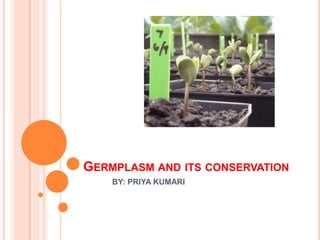
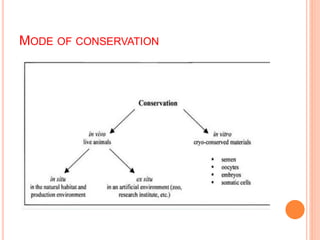
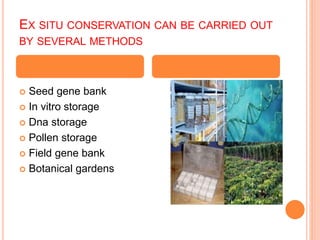
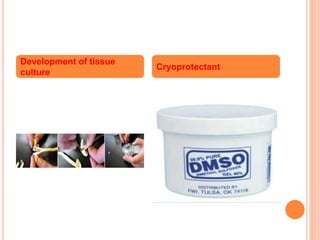
This document discusses germplasm and its conservation. It begins by defining germplasm as a collection of genetic resources for an organism, such as a seed bank or gene bank, that contains the genetic information for a species. Germplasm conservation is important to preserve genetic diversity and provide plant breeders resources to develop new crop varieties. Methods of conservation include in situ conservation of plants in their natural habitat and ex situ conservation of seeds, tissues, cells or DNA stored outside the natural habitat. Cryopreservation in liquid nitrogen at -196°C is an effective long-term storage method that stops cellular metabolism. The document outlines the cryopreservation process and applications for conserving plant species and genetic variations.















![IN-VITRO GERMPLASM CONSERVATION [Autosaved].pptx](https://cdn.slidesharecdn.com/ss_thumbnails/in-vitrogermplasmconservationautosaved-240521121521-a688ece6-thumbnail.jpg?width=640&height=640&fit=bounds)


![Human Reproduction [ Reproductive System ] Notes @irfanullah_mehar Irfanullah...](https://cdn.slidesharecdn.com/ss_thumbnails/humanreproductionreproductivesystemnotesirfanullahmeharirfanullahmeharjanantantra-260111172350-56e85778-thumbnail.jpg?width=640&height=640&fit=bounds)


