HERBICIDE RESISTANCE
Weeds are unwanted & useless plants that grow
along with the crop plants .
Weeds compete with the crops for light & nutrients,
besides harboring various pathogens .
So it is estimated that the worlds crop yield is
reduced by 10 – 15 % due to the presence of weeds.
To tackle the problem of weeds , modern
agriculture has developed a wide range of weed
killers ( herbicides ) .
Herbicides are broad spectrum as they can kill wide
range of weeds.
An ideal herbicide is to posses the following
characters : -
1. Capable of killing weeds with out affecting crop
plants
2. Not toxic to animals & microorganisms
3. Rapidly trans located with in the target plant
4. Rapidly degraded in the soil
Commercially available herbicides is that they can
not discriminate weeds from the crop plants .
For this reason , crops are also affected by
herbicides hence the need to develop herbicide
resistance plants
Glyphosate
It is a broad spectrum herbicide , effective against
76 of worlds worst 78 weeds .
Less toxic to animals , is rapidly degraded & short
life span .
The american company (Monsanto) market it as
round up .
Mechanism of Glyphosphate action :-
Capable of killing the plants in low conc .
Rapidly transported to growing tissues .
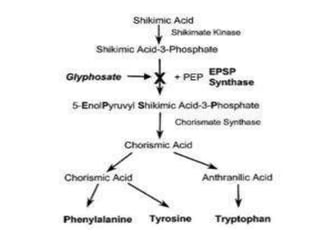
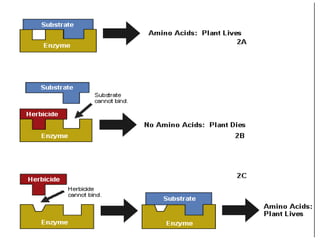
It is competitive inhibitor of EPSPS (a key enzyme
shikimic acid path way
Shikimic acid pathway results in the formation of
aa, phenols , metabolites .
Glyphosate binds with EPSPS & blocks metabolism
(sa) .
Thus biosynthesis of aa & other products are
inhibited .
So cell division & plant growth are blocked .
S pathway doesn't occur in animals .
So it is not toxic to animals
ADVANTAGES OF USING HERBICIDES
• Broad spectrum of weeds controlled
• Reduced crop injury
• Reduced herbicide carryover
• New mode of action for resistance management
• Crop management flexibility and simplicity
• Use of herbicides that are more environmentally
friendly
Disadvantages of herbicides
• Mammalian toxicity
• Eco toxicity
• Weeds become super weeds
• Reduced crop yield
• Creates soil and air pollution
Strategies for engineering herbicide resistance
A no. of biological manipulations involved in
genetic eng are in use to develop herbicide resistance
plant
1. over expression of EPSPS gene
2. use of mutant EPSPS gene
3. detoxification of herbicide by a foreign gene
Glyphosphate resistance in
crop plants :-
1.Over expression of EPSPS gene :-
An over expression gene of
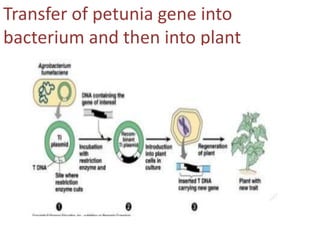
EPSPS was detected in petunia . Gene
from petunia was isolated & introduced in
to other plants . The transgenic plants can
tolerate glyphosphate 2 -4 times higher
than that required to kill wild type weed
plants
Transfer of petunia gene into
bacterium and then into plant
2.Use of mutant EPSPS :-
 EPSPS mutant gene resistant to glyphosphate was
found in s. typhimurium it was found that single base
substitution ( C to T ) change in aa from proline to
serine. This enzyme can not bind to glyphosphate
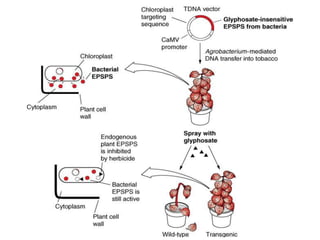
 using agrobacterium as vector mutant EPSPS was
introduced in to tobacco plants but this is failed . It was
later known that s . Pathway occurs in chloroplast,
mutant EPSPS was produced in cytoplasm . This gene is
not capable of transported to chloroplast .
 Later years mutant EPSPS gene was tagged
with chloroplast specific transit EPSPS enzyme that
freely enter chloroplast & confer resistance against
herbicide
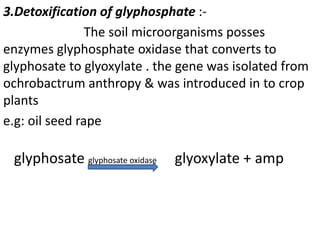
3.Detoxification of glyphosphate :-
The soil microorganisms posses
enzymes glyphosphate oxidase that converts to
glyphosate to glyoxylate . the gene was isolated from
ochrobactrum anthropy & was introduced in to crop
plants
e.g: oil seed rape
glyphosate glyphosate oxidase glyoxylate + amp
Use of combine strategy :-
High resistance is acquired when
the above 3 strategies combine together by this
approach mutant , detoxification ,over
expression genes were employed in the same
organism thus provides resistance
Herbicide resistance

Herbicide resistance

  • 1.
  • 2.
    Weeds are unwanted& useless plants that grow along with the crop plants . Weeds compete with the crops for light & nutrients, besides harboring various pathogens . So it is estimated that the worlds crop yield is reduced by 10 – 15 % due to the presence of weeds. To tackle the problem of weeds , modern agriculture has developed a wide range of weed killers ( herbicides ) . Herbicides are broad spectrum as they can kill wide range of weeds.
  • 3.
    An ideal herbicideis to posses the following characters : - 1. Capable of killing weeds with out affecting crop plants 2. Not toxic to animals & microorganisms 3. Rapidly trans located with in the target plant 4. Rapidly degraded in the soil Commercially available herbicides is that they can not discriminate weeds from the crop plants . For this reason , crops are also affected by herbicides hence the need to develop herbicide resistance plants
  • 4.
    Glyphosate It is abroad spectrum herbicide , effective against 76 of worlds worst 78 weeds . Less toxic to animals , is rapidly degraded & short life span . The american company (Monsanto) market it as round up . Mechanism of Glyphosphate action :- Capable of killing the plants in low conc . Rapidly transported to growing tissues . It is competitive inhibitor of EPSPS (a key enzyme shikimic acid path way
  • 7.
    Shikimic acid pathwayresults in the formation of aa, phenols , metabolites . Glyphosate binds with EPSPS & blocks metabolism (sa) . Thus biosynthesis of aa & other products are inhibited . So cell division & plant growth are blocked . S pathway doesn't occur in animals . So it is not toxic to animals
  • 8.
    ADVANTAGES OF USINGHERBICIDES • Broad spectrum of weeds controlled • Reduced crop injury • Reduced herbicide carryover • New mode of action for resistance management • Crop management flexibility and simplicity • Use of herbicides that are more environmentally friendly
  • 9.
    Disadvantages of herbicides •Mammalian toxicity • Eco toxicity • Weeds become super weeds • Reduced crop yield • Creates soil and air pollution
  • 10.
    Strategies for engineeringherbicide resistance A no. of biological manipulations involved in genetic eng are in use to develop herbicide resistance plant 1. over expression of EPSPS gene 2. use of mutant EPSPS gene 3. detoxification of herbicide by a foreign gene
  • 11.
    Glyphosphate resistance in cropplants :- 1.Over expression of EPSPS gene :- An over expression gene of EPSPS was detected in petunia . Gene from petunia was isolated & introduced in to other plants . The transgenic plants can tolerate glyphosphate 2 -4 times higher than that required to kill wild type weed plants
  • 12.
    Transfer of petuniagene into bacterium and then into plant
  • 13.
    2.Use of mutantEPSPS :-  EPSPS mutant gene resistant to glyphosphate was found in s. typhimurium it was found that single base substitution ( C to T ) change in aa from proline to serine. This enzyme can not bind to glyphosphate  using agrobacterium as vector mutant EPSPS was introduced in to tobacco plants but this is failed . It was later known that s . Pathway occurs in chloroplast, mutant EPSPS was produced in cytoplasm . This gene is not capable of transported to chloroplast .  Later years mutant EPSPS gene was tagged with chloroplast specific transit EPSPS enzyme that freely enter chloroplast & confer resistance against herbicide
  • 15.
    3.Detoxification of glyphosphate:- The soil microorganisms posses enzymes glyphosphate oxidase that converts to glyphosate to glyoxylate . the gene was isolated from ochrobactrum anthropy & was introduced in to crop plants e.g: oil seed rape glyphosate glyphosate oxidase glyoxylate + amp
  • 16.
    Use of combinestrategy :- High resistance is acquired when the above 3 strategies combine together by this approach mutant , detoxification ,over expression genes were employed in the same organism thus provides resistance