BY-: Suresh Yadav
I.D.No. – PALM 6005
1
 Cryo is Greek word. (krayos – frost)
 It literally means preservation in “frozen state.”
 It is a process where tissues, organelles, cells, extracellular
matrix, organs or any other biological constructs susceptible to
damage caused by unregulated chemical kinetics are preserved by
cooling to very low temp -196 degree Celsius using liquid nitrogen.
Cryopreservation-
2
What is germplasm conservation?
Plant germplasm is the genetic sources material used by the
plant breeders to develop new cultivars.
They may include:
 Seeds
Other plant propagules are:
 Leaf
 Stem
 Pollen
 Cultured cells
Which can be grown into mature plant?
Germplasm provide the raw material( genes) which the
breeder used to develop commercial crop varieties.
3
Why preservation is
important ?
Until two decades ago the genetic resources were getting depleted owing to the
continous depredation by man.
It was imperative therefore that many of the elite, economically important and
endangered species are preserved to make them available when needed.
The conventional methods of storage failed to prevent losses caused due to
various reasons.
A new methodology had to be devised for long term preservation of material.
4
Germplasm
 A germplasm is a collection of genetic resources for
an organism.
 For plants, the germplasm may be stored as a seed
collection (even a large seed bank).
 For trees, in a nursery.
 Animal as well as plant genetics may be stored in a
gene bank or cryobank.
5
Cryopreservation
 Cryopreservation is a non-lethal storage of biological
material at ultra-low temperature. At the temperature
of liquid nitrogen (-196 degree) almost all metabolic
activities of cells are ceased and the sample can then
be preserved in such state for extended peroids.
 However, only few biological materials can be frozen to
(-196 degree) without affecting the cell viability.
6
HISTORY
 Theoreticians of cryopreservation was James Lovelock
(born 1919).
 Osmotic stress
 Salt concentration
 Christopher Polge, carried out cryopreservation of
first fowl sperm.
 Later, in 1950s they tried it on humans where
pregnancy was obtained after insemination of frozen
sperm.
7
 However, the rapid immersion of the samples in liquid
nitrogen did not produce the necessary viability to
make them usable after thawing.
 Importance of controlled or slow cooling to obtain
maximum survival on thawing of the living cells.
 Cryoprotectants were introduced.
8
INTRODUCTION
 In recent years with tremendous increase in
population:
 Forest
 Land resources
 Population of medicinal plants
 Aromatic plants species
9
The conventional methods of germplasm
preservation are prone to possible catastrophic
losses because of:
1. Attack by pest and pathogens
2. Climate disorder
3. Natural disasters
4. Political and economic causes
10
The conservation of germplasm can be done
by two methods.
1. In-situ preservation: preservation of the
germplasm in their natural environment by
establishing biospheres, national parks etc.
2. Ex-situ preservation: in the form of seed or in vitro
cultures.
11
Ex-situ has following disadvantages
 Some plants do not produce fertile seeds.
 Loss of seed viability
 Seed destruction by pests, etc.
 Poor germination rate.
 This is only useful for seed propagating plants.
 It’s a costly process.
12
Advantages
 Small areas can store large amount of material.
 Protection from environmental methods.
13
 Liquid nitrogen is most widely used material for
cryopresevation.
 Dry ice can also be used.
 Why Liquid nitrogen ?
Chemically inert
 Relatively low cost
 Non toxic
Non flammable
Readily available
14
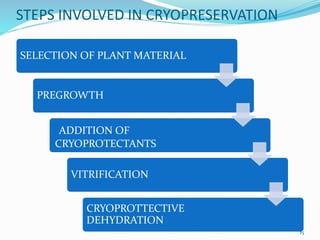
STEPS INVOLVED IN CRYOPRESERVATION
SELECTION OF PLANT MATERIAL
PREGROWTH
ADDITION OF
CRYOPROTECTANTS
VITRIFICATION
CRYOPROTTECTIVE
DEHYDRATION
15
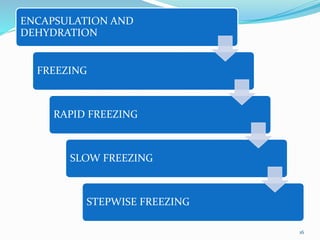
ENCAPSULATION AND
DEHYDRATION
FREEZING
RAPID FREEZING
SLOW FREEZING
STEPWISE FREEZING
16
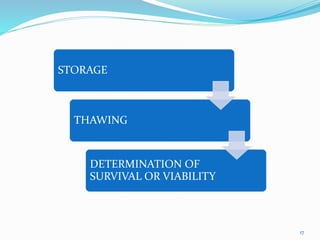
STORAGE
THAWING
DETERMINATION OF
SURVIVAL OR VIABILITY
17
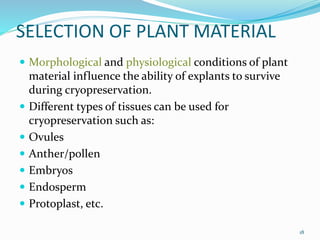
SELECTION OF PLANT MATERIAL
 Morphological and physiological conditions of plant
material influence the ability of explants to survive
during cryopreservation.
 Different types of tissues can be used for
cryopreservation such as:
 Ovules
 Anther/pollen
 Embryos
 Endosperm
 Protoplast, etc.
18
 FACTORS:
o Tissue must be selected from healthy plants.
o Small
o Young
o Rich in cytoplasm
o Meristematic cells can survive better than the larger
o Highly vacuolated cells.
19
o Callus derived from tropical plant is more resistant to
freezing damage.
o A rapidly growing stage of callus shortly after 1 or 2
weeks of subculture is best for cryopreservation.
o Old cells at the top of callus and blackened area should
be avoided.
o cultured cells are not ideal for freezing. Instead,
organized structures such as shoots apices, embryos or
young plantlets are preferred.
20
o Water content of cell or tissue used for
cryopreservation should be low freezable water,
tissues can withstand extremely low temperatures.
21
PREGROWTH
 Pregrowth treatment protect the plant tissues against
exposure to liquid nitrogen.
 Pregrowth involves the application of additives known
to enhance plant stress tolerance.
E.g.
 abscisic acid
 praline
 trehalose
22
 Partial tissue dehydration can be achieved by the
application of osmotically active compounds.
 The addition of low concentration of DMSO (1-5%)
during pre-growth often improves shoot tip recovery,
 E.g.
 C. roseus cells are precultured in medium containing
1M sorbitol before freezing. (Chen et al., 1984)
 Digitalis cells were precultured on 6% Mannitol
medium for 3 days before freezing. (Seitz et al., 1983)
 Nicotiana sylvestris with 6% sorbitol for 2-5 days
before freezing. (Maddox et al., 1983)
23
ADDITION OF A CRYOPROTECTANT
 A cryoprotectant is a substance that is used to
protect biological tissue from freezing damage
(damage due to ice formation).
 They acts like antifreeze
 They lower freezing temperature
 Increase viscosity and
 Prevents damage to the cells.
24
 There are two potential sources of cell damage
during cryopreservation.
1. Formation of large ice crystals inside the cell.
2. Intracellular concentration of solutes increase to
toxic levels before or during freezing as a result of
dehydration.
25
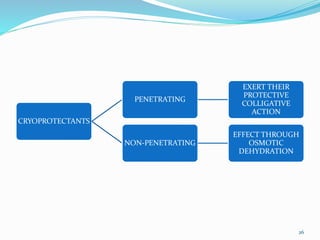
CRYOPROTECTANTS
PENETRATING
EXERT THEIR
PROTECTIVE
COLLIGATIVE
ACTION
NON-PENETRATING
EFFECT THROUGH
OSMOTIC
DEHYDRATION
26
VITRIFICATION
 The term “vitrification” refers to any process
resulting in “glass formation”, the transformation from
a liquid to a solid in the absence of crystallization.
 According to this definition, cells that are properly
slow frozen become “vitrified”.
 A process where ice formation cannot take place
because the aqueous solution is too concentrated to
permit ice crystal nucleation. Instead, water solidifies
into an amorphous ‘glassy’ state.
27
CRYOPROTECTIVE DEHYDRATION
 Dehydration can be achieved by growth in presence
of high concentration of osmotically active compounds
like
 sugars
 polyols and/or
 In a sterile flow cabinet
 over silica gel.
28
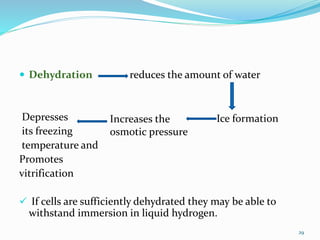
 Dehydration reduces the amount of water
Depresses
its freezing
temperature and
Promotes
vitrification
 If cells are sufficiently dehydrated they may be able to
withstand immersion in liquid hydrogen.
Ice formationIncreases the
osmotic pressure
29
ENCAPSULATION AND DEHYDRATION
 This involves the encapsulation of tissues in calcium
alginate beads.
 Which are pre-grown in liquid culture media
containing high concentration of sucrose.
 After these treatments the tissues are able to withstand
exposure to liquid nitrogen without application of
chemical cryoprotectants.

30
FREEZING: RAPID FREEZING
 The plant material is placed in vials and plunged into
liquid nitrogen and decrease of -300 to -10000c or
more occurs.
 The quicker the freezing is done , the smaller the
intracellular ice crystals are.
 Dry ice can also be used in a similar manner.
31
 This method is technically simple and easy to handle.
 Rapid freezing has been employed for
cryopreservation of shoot tips of potato , strawberry ,
brassica species
32
SLOW FREEZING
 Tissue is slowly frozen with decrease in temperature
from -0.1 to 10°c/min.
 Slow cooling permits the flow of water from the cells
to the outside , thereby promoting extracellular ice
formation instead of lethal intracellular freezing.
 This method has been successfully employed for
cryopreservation of meristems of peas , potato ,
cassava , strawberry etc.
33
 In a normal ice making process, the surface of the cube
freezes up much faster than the interior.
 Which “cramps” the interior, clouding it.
 By using very hot (and pure) water inside an insulated
environment, you are assuring yourself a very slow
freezing that allows the interior to cool down at a rate
far closer to that of the exterior, and that lack of
“cramping” is what produces such clear ice.
34
STEPWISE FREEZING
 In this method slow freezing down to -20 to 40c.
 A stop for a period of approximately 30 min and then
additional rapid freezing to -196c is done by plunging
in liquid nitrogen.
 Slow freezing permits protective dehydration of the
cells and rapid freezing prevents the growing of big ice
crystals.
 The Stepwise freezing gives excellent results in
strawberry and with suspension cultures.
35
STORAGE
 Storage of frozen material at correct temperature is as
important as freezing.
 The frozen cells/tissues are kept for storage at
temperature ranging from -70 to -196°c.
 Temperature should be sufficiently low for long term
storage of cells to stop all the metabolic activities and
prevent biochemical injury.
 Long term storage is best done at -196°c. …

36
THAWING
 It is done by putting ampoule containing the sample in
a warm water bath (35 to 40°c).
 Frozen tips of the sample in tubes or ampoules are
plunged into the warm water with a vigorous swirling
action just to the point of ice disappearance.
 It is important for the survival of the tissue that the
tubes should not be left in the warm water bath after
ice melts .

37
 just a point of thawing quickly transfer the tubes to a
water bath maintained at room temperature and
continue the swirling action for 15 sec to cool the warm
walls of the tube.
 Tissue which has been frozen by
encapsulation/dehydration is frequently thawed at
ambient temperature.
38
DETERMINATION OF SURVIVAL/VIABILITY
 Regrowth of the plants from stored tissues or cells is
the only test of survival of plant materials.
 Various viability tests include Fluorescien diacetate
(FDA) staining , growth measurement by cell number ,
dry and fresh weight.
 Important staining methods are:
Triphenyl Tetrazolium Chloride (TTC)
 Evan’s blue staining.
39
TRIPHENYL TETRAZOLIUM CHLORIDE (TTC)
ASSAY
 Cell survival is measured by amount of red formazan
product formed due to reduction of TTC assay which is
measured spectrometrically.
 Only the viable cells which contain the enzyme
mitochondrial dehydrogenase which reduces TTC to
red formazan will be stained and dead cells will not
take up the dye.
40
EVAN’S BLUE STAINING
 One drop of 0.1% solution of Evan’s blue is added to
cell suspension on a microscope slide and observed
under light microscope.
 Only non viable cells (dead cells) stain with Evan’s
blue. % of viable cells = Number of fluorescent cells ×
1oo total no of cells(viable + non-viable).
 Individual cell viability assayed with Evan's blue dye
and fluorescein diacetate.
41
MEASUREMENT OF GROWTH OF CELL
CULTURES
 Fresh and dry weight measurements
 Increase in cell number
 Packed cell volume (PCV)
 Molecular protein and DNA
 Mitotic index
 Medium component calibration
 Conductivity of medium
 Cellular protien
42
APPLICATIONS OF CRYOPRESERVATION:
CONSERVATION OF GENETIC MATERIAL
 Cryopreservation provides an opportunity for
conservation of endangered medicinal plants.
 Cryopreservation has been used successfully to store a
range of tissue types , including meristems ,
anthers/pollens and embryos.
43
FREEZE STORAGE OF CELL CULTURES
 A cell line to be maintained has to be subcultured and
transferred periodically and repeatedly over an
extended period of time.
 cryopreservation is an ideal approach to suppress cell
division to avoid the need for periodical subculturing
44
MAINTAINENCE OF DISEASE FREE
STOCK
 Pathogen free stocks of rare plant material could be
frozen and propagated when needed.
 Cold acclimatization and frost resistance
 A cryopreserved tissue culture would provide a
suitable material for selection of cold resistant mutant
cell lines , which could later differentiate into frost
resistance plants.

45
SEED BANK
 A seed bank stores seeds as a source for planting in
case seed reserves elsewhere are destroyed.
 It is a type of gene bank.
 The seeds stored may be food crops, or those of rare
species to protect biodiversity.
 The reasons for storing seeds may be varied.
46
 Seeds are dried to a moisture content of less than 5%.
 The seeds are then stored in freezers at -18°C or below.
 Because seed (DNA) degrades with time, the seeds
need to be periodically replanted and fresh seeds
collected for another round of long-term storage.
47
GENE BANK
 Gene banks are a type of bio repository which
preserve genetic material.
 In plants, this could be by freezing cuts from the plant,
or stocking the seeds.
 In animals, this is the freezing of sperm and eggs
in zoological freezers until further need..
48
 In an effort to conserve agricultural biodiversity, gene
banks are used to store and conserve the plant genetic
resources of major crop plants and their crop wild
relatives.
 There are many gene banks all over the world, with the
Svalbard Global Seed Vault being probably the most
famous one.

49
Major advantages are :
1. Once the material is sucessfully conserved to particular temperature it can
be preserved indefinately.
2. Once in storage no chance of new contamination of fungus or bacteria.
3. Minimal space required.
4. Minimal labour required.
Application
It is ideal method for long term conservation of material.
Disease free plants can be conserved and propagated.
Recalcitrant seeds can be maintained for long time.
Endangered species can be maintained.
Pollens can be maintained to increase longitivity.
Rare germplasm and other genetic manipulations can be stored.
 National Seed Storage Laboratory (NSSL) (Fort
Collins, Colorado, USA): 2,100 accessions of apple
(dormant buds) .
 National Clonal Germplasm Repository (NCGR) of
Corvallis (USA): 104 accessions of pear (shoot tips).
 International Potato Centre (CIP) (Lima, Peru) : 345
potato accessions.
 Tissue Culture BC Research Inc .(Vancouver, BC,
Canada) : 5000 accessions representing 14 conifer
species.
52
Limitation of germplasm
The expensive equipment needed to provide
controlled and varible rates of cooling/warming
temperatures can however be a limitation in the
application of in vitro technology for large scale
germplasm conservation.
Formation of ice crystal inside the cell should be
prevented as they cause injury to the cell.
Sometimes certain solutes from the cell leak out
during freezing.
Cryoprotectant also effect the viability of cells.

Cryopreservation

  • 1.
  • 2.
     Cryo isGreek word. (krayos – frost)  It literally means preservation in “frozen state.”  It is a process where tissues, organelles, cells, extracellular matrix, organs or any other biological constructs susceptible to damage caused by unregulated chemical kinetics are preserved by cooling to very low temp -196 degree Celsius using liquid nitrogen. Cryopreservation- 2
  • 3.
    What is germplasmconservation? Plant germplasm is the genetic sources material used by the plant breeders to develop new cultivars. They may include:  Seeds Other plant propagules are:  Leaf  Stem  Pollen  Cultured cells Which can be grown into mature plant? Germplasm provide the raw material( genes) which the breeder used to develop commercial crop varieties. 3
  • 4.
    Why preservation is important? Until two decades ago the genetic resources were getting depleted owing to the continous depredation by man. It was imperative therefore that many of the elite, economically important and endangered species are preserved to make them available when needed. The conventional methods of storage failed to prevent losses caused due to various reasons. A new methodology had to be devised for long term preservation of material. 4
  • 5.
    Germplasm  A germplasmis a collection of genetic resources for an organism.  For plants, the germplasm may be stored as a seed collection (even a large seed bank).  For trees, in a nursery.  Animal as well as plant genetics may be stored in a gene bank or cryobank. 5
  • 6.
    Cryopreservation  Cryopreservation isa non-lethal storage of biological material at ultra-low temperature. At the temperature of liquid nitrogen (-196 degree) almost all metabolic activities of cells are ceased and the sample can then be preserved in such state for extended peroids.  However, only few biological materials can be frozen to (-196 degree) without affecting the cell viability. 6
  • 7.
    HISTORY  Theoreticians ofcryopreservation was James Lovelock (born 1919).  Osmotic stress  Salt concentration  Christopher Polge, carried out cryopreservation of first fowl sperm.  Later, in 1950s they tried it on humans where pregnancy was obtained after insemination of frozen sperm. 7
  • 8.
     However, therapid immersion of the samples in liquid nitrogen did not produce the necessary viability to make them usable after thawing.  Importance of controlled or slow cooling to obtain maximum survival on thawing of the living cells.  Cryoprotectants were introduced. 8
  • 9.
    INTRODUCTION  In recentyears with tremendous increase in population:  Forest  Land resources  Population of medicinal plants  Aromatic plants species 9
  • 10.
    The conventional methodsof germplasm preservation are prone to possible catastrophic losses because of: 1. Attack by pest and pathogens 2. Climate disorder 3. Natural disasters 4. Political and economic causes 10
  • 11.
    The conservation ofgermplasm can be done by two methods. 1. In-situ preservation: preservation of the germplasm in their natural environment by establishing biospheres, national parks etc. 2. Ex-situ preservation: in the form of seed or in vitro cultures. 11
  • 12.
    Ex-situ has followingdisadvantages  Some plants do not produce fertile seeds.  Loss of seed viability  Seed destruction by pests, etc.  Poor germination rate.  This is only useful for seed propagating plants.  It’s a costly process. 12
  • 13.
    Advantages  Small areascan store large amount of material.  Protection from environmental methods. 13
  • 14.
     Liquid nitrogenis most widely used material for cryopresevation.  Dry ice can also be used.  Why Liquid nitrogen ? Chemically inert  Relatively low cost  Non toxic Non flammable Readily available 14
  • 15.
    STEPS INVOLVED INCRYOPRESERVATION SELECTION OF PLANT MATERIAL PREGROWTH ADDITION OF CRYOPROTECTANTS VITRIFICATION CRYOPROTTECTIVE DEHYDRATION 15
  • 16.
  • 17.
  • 18.
    SELECTION OF PLANTMATERIAL  Morphological and physiological conditions of plant material influence the ability of explants to survive during cryopreservation.  Different types of tissues can be used for cryopreservation such as:  Ovules  Anther/pollen  Embryos  Endosperm  Protoplast, etc. 18
  • 19.
     FACTORS: o Tissuemust be selected from healthy plants. o Small o Young o Rich in cytoplasm o Meristematic cells can survive better than the larger o Highly vacuolated cells. 19
  • 20.
    o Callus derivedfrom tropical plant is more resistant to freezing damage. o A rapidly growing stage of callus shortly after 1 or 2 weeks of subculture is best for cryopreservation. o Old cells at the top of callus and blackened area should be avoided. o cultured cells are not ideal for freezing. Instead, organized structures such as shoots apices, embryos or young plantlets are preferred. 20
  • 21.
    o Water contentof cell or tissue used for cryopreservation should be low freezable water, tissues can withstand extremely low temperatures. 21
  • 22.
    PREGROWTH  Pregrowth treatmentprotect the plant tissues against exposure to liquid nitrogen.  Pregrowth involves the application of additives known to enhance plant stress tolerance. E.g.  abscisic acid  praline  trehalose 22
  • 23.
     Partial tissuedehydration can be achieved by the application of osmotically active compounds.  The addition of low concentration of DMSO (1-5%) during pre-growth often improves shoot tip recovery,  E.g.  C. roseus cells are precultured in medium containing 1M sorbitol before freezing. (Chen et al., 1984)  Digitalis cells were precultured on 6% Mannitol medium for 3 days before freezing. (Seitz et al., 1983)  Nicotiana sylvestris with 6% sorbitol for 2-5 days before freezing. (Maddox et al., 1983) 23
  • 24.
    ADDITION OF ACRYOPROTECTANT  A cryoprotectant is a substance that is used to protect biological tissue from freezing damage (damage due to ice formation).  They acts like antifreeze  They lower freezing temperature  Increase viscosity and  Prevents damage to the cells. 24
  • 25.
     There aretwo potential sources of cell damage during cryopreservation. 1. Formation of large ice crystals inside the cell. 2. Intracellular concentration of solutes increase to toxic levels before or during freezing as a result of dehydration. 25
  • 26.
  • 27.
    VITRIFICATION  The term“vitrification” refers to any process resulting in “glass formation”, the transformation from a liquid to a solid in the absence of crystallization.  According to this definition, cells that are properly slow frozen become “vitrified”.  A process where ice formation cannot take place because the aqueous solution is too concentrated to permit ice crystal nucleation. Instead, water solidifies into an amorphous ‘glassy’ state. 27
  • 28.
    CRYOPROTECTIVE DEHYDRATION  Dehydrationcan be achieved by growth in presence of high concentration of osmotically active compounds like  sugars  polyols and/or  In a sterile flow cabinet  over silica gel. 28
  • 29.
     Dehydration reducesthe amount of water Depresses its freezing temperature and Promotes vitrification  If cells are sufficiently dehydrated they may be able to withstand immersion in liquid hydrogen. Ice formationIncreases the osmotic pressure 29
  • 30.
    ENCAPSULATION AND DEHYDRATION This involves the encapsulation of tissues in calcium alginate beads.  Which are pre-grown in liquid culture media containing high concentration of sucrose.  After these treatments the tissues are able to withstand exposure to liquid nitrogen without application of chemical cryoprotectants.  30
  • 31.
    FREEZING: RAPID FREEZING The plant material is placed in vials and plunged into liquid nitrogen and decrease of -300 to -10000c or more occurs.  The quicker the freezing is done , the smaller the intracellular ice crystals are.  Dry ice can also be used in a similar manner. 31
  • 32.
     This methodis technically simple and easy to handle.  Rapid freezing has been employed for cryopreservation of shoot tips of potato , strawberry , brassica species 32
  • 33.
    SLOW FREEZING  Tissueis slowly frozen with decrease in temperature from -0.1 to 10°c/min.  Slow cooling permits the flow of water from the cells to the outside , thereby promoting extracellular ice formation instead of lethal intracellular freezing.  This method has been successfully employed for cryopreservation of meristems of peas , potato , cassava , strawberry etc. 33
  • 34.
     In anormal ice making process, the surface of the cube freezes up much faster than the interior.  Which “cramps” the interior, clouding it.  By using very hot (and pure) water inside an insulated environment, you are assuring yourself a very slow freezing that allows the interior to cool down at a rate far closer to that of the exterior, and that lack of “cramping” is what produces such clear ice. 34
  • 35.
    STEPWISE FREEZING  Inthis method slow freezing down to -20 to 40c.  A stop for a period of approximately 30 min and then additional rapid freezing to -196c is done by plunging in liquid nitrogen.  Slow freezing permits protective dehydration of the cells and rapid freezing prevents the growing of big ice crystals.  The Stepwise freezing gives excellent results in strawberry and with suspension cultures. 35
  • 36.
    STORAGE  Storage offrozen material at correct temperature is as important as freezing.  The frozen cells/tissues are kept for storage at temperature ranging from -70 to -196°c.  Temperature should be sufficiently low for long term storage of cells to stop all the metabolic activities and prevent biochemical injury.  Long term storage is best done at -196°c. …  36
  • 37.
    THAWING  It isdone by putting ampoule containing the sample in a warm water bath (35 to 40°c).  Frozen tips of the sample in tubes or ampoules are plunged into the warm water with a vigorous swirling action just to the point of ice disappearance.  It is important for the survival of the tissue that the tubes should not be left in the warm water bath after ice melts .  37
  • 38.
     just apoint of thawing quickly transfer the tubes to a water bath maintained at room temperature and continue the swirling action for 15 sec to cool the warm walls of the tube.  Tissue which has been frozen by encapsulation/dehydration is frequently thawed at ambient temperature. 38
  • 39.
    DETERMINATION OF SURVIVAL/VIABILITY Regrowth of the plants from stored tissues or cells is the only test of survival of plant materials.  Various viability tests include Fluorescien diacetate (FDA) staining , growth measurement by cell number , dry and fresh weight.  Important staining methods are: Triphenyl Tetrazolium Chloride (TTC)  Evan’s blue staining. 39
  • 40.
    TRIPHENYL TETRAZOLIUM CHLORIDE(TTC) ASSAY  Cell survival is measured by amount of red formazan product formed due to reduction of TTC assay which is measured spectrometrically.  Only the viable cells which contain the enzyme mitochondrial dehydrogenase which reduces TTC to red formazan will be stained and dead cells will not take up the dye. 40
  • 41.
    EVAN’S BLUE STAINING One drop of 0.1% solution of Evan’s blue is added to cell suspension on a microscope slide and observed under light microscope.  Only non viable cells (dead cells) stain with Evan’s blue. % of viable cells = Number of fluorescent cells × 1oo total no of cells(viable + non-viable).  Individual cell viability assayed with Evan's blue dye and fluorescein diacetate. 41
  • 42.
    MEASUREMENT OF GROWTHOF CELL CULTURES  Fresh and dry weight measurements  Increase in cell number  Packed cell volume (PCV)  Molecular protein and DNA  Mitotic index  Medium component calibration  Conductivity of medium  Cellular protien 42
  • 43.
    APPLICATIONS OF CRYOPRESERVATION: CONSERVATIONOF GENETIC MATERIAL  Cryopreservation provides an opportunity for conservation of endangered medicinal plants.  Cryopreservation has been used successfully to store a range of tissue types , including meristems , anthers/pollens and embryos. 43
  • 44.
    FREEZE STORAGE OFCELL CULTURES  A cell line to be maintained has to be subcultured and transferred periodically and repeatedly over an extended period of time.  cryopreservation is an ideal approach to suppress cell division to avoid the need for periodical subculturing 44
  • 45.
    MAINTAINENCE OF DISEASEFREE STOCK  Pathogen free stocks of rare plant material could be frozen and propagated when needed.  Cold acclimatization and frost resistance  A cryopreserved tissue culture would provide a suitable material for selection of cold resistant mutant cell lines , which could later differentiate into frost resistance plants.  45
  • 46.
    SEED BANK  Aseed bank stores seeds as a source for planting in case seed reserves elsewhere are destroyed.  It is a type of gene bank.  The seeds stored may be food crops, or those of rare species to protect biodiversity.  The reasons for storing seeds may be varied. 46
  • 47.
     Seeds aredried to a moisture content of less than 5%.  The seeds are then stored in freezers at -18°C or below.  Because seed (DNA) degrades with time, the seeds need to be periodically replanted and fresh seeds collected for another round of long-term storage. 47
  • 48.
    GENE BANK  Genebanks are a type of bio repository which preserve genetic material.  In plants, this could be by freezing cuts from the plant, or stocking the seeds.  In animals, this is the freezing of sperm and eggs in zoological freezers until further need.. 48
  • 49.
     In aneffort to conserve agricultural biodiversity, gene banks are used to store and conserve the plant genetic resources of major crop plants and their crop wild relatives.  There are many gene banks all over the world, with the Svalbard Global Seed Vault being probably the most famous one.  49
  • 50.
    Major advantages are: 1. Once the material is sucessfully conserved to particular temperature it can be preserved indefinately. 2. Once in storage no chance of new contamination of fungus or bacteria. 3. Minimal space required. 4. Minimal labour required.
  • 51.
    Application It is idealmethod for long term conservation of material. Disease free plants can be conserved and propagated. Recalcitrant seeds can be maintained for long time. Endangered species can be maintained. Pollens can be maintained to increase longitivity. Rare germplasm and other genetic manipulations can be stored.
  • 52.
     National SeedStorage Laboratory (NSSL) (Fort Collins, Colorado, USA): 2,100 accessions of apple (dormant buds) .  National Clonal Germplasm Repository (NCGR) of Corvallis (USA): 104 accessions of pear (shoot tips).  International Potato Centre (CIP) (Lima, Peru) : 345 potato accessions.  Tissue Culture BC Research Inc .(Vancouver, BC, Canada) : 5000 accessions representing 14 conifer species. 52
  • 53.
    Limitation of germplasm Theexpensive equipment needed to provide controlled and varible rates of cooling/warming temperatures can however be a limitation in the application of in vitro technology for large scale germplasm conservation. Formation of ice crystal inside the cell should be prevented as they cause injury to the cell. Sometimes certain solutes from the cell leak out during freezing. Cryoprotectant also effect the viability of cells.