Downloaded 67 times








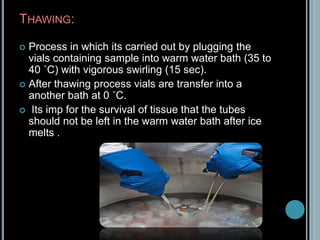






This document provides an overview of cryopreservation, which involves preserving biological material such as cells, tissues, organs, and embryos at ultra-low temperatures, typically in liquid nitrogen. It discusses the history, principles, mechanisms, and applications of cryopreservation. Key aspects covered include the use of cryoprotectants to prevent freezing damage to cells, various freezing and thawing methods, long-term storage in liquid nitrogen, and viability testing after thawing to regenerate plants or animals from preserved material. Cryopreservation has important applications in biobanking, conservation of endangered species, and preservation of disease-free agricultural crops.


