 Hybridization involving individuals from different species
belonging to the same genus or to different genera, is termed as
distant hybridization.
 Such crosses are known as distant crosses or wide crosses.
 This is because individuals used for hybridization in such cases
are taxonomically more distantly related than are different varieties
from the same species.
When individuals from two distinct species of the same genus are
crossed, it is known as interspecific hybridization.
When the individuals being crossed belong to species from two
different genera, it is referred to as intergeneric
hybridization.
Utilizing wild species is one method designed to
introduce additional germplasm into cultivated varieties.
The first recorded interspecific hybrid was made in 1717
between carnation and Sweet William by Thomas Fair
Child (Allard 1960).
Incorporation of desired genes into existing cultivated
varieties has become increasingly important.
Wide crosses are more successful in more closely related
species or genera than in less closely related species or
genera.
It is more successful in vegetative propagated species like
sugarcane and potato than in seed propagated species.
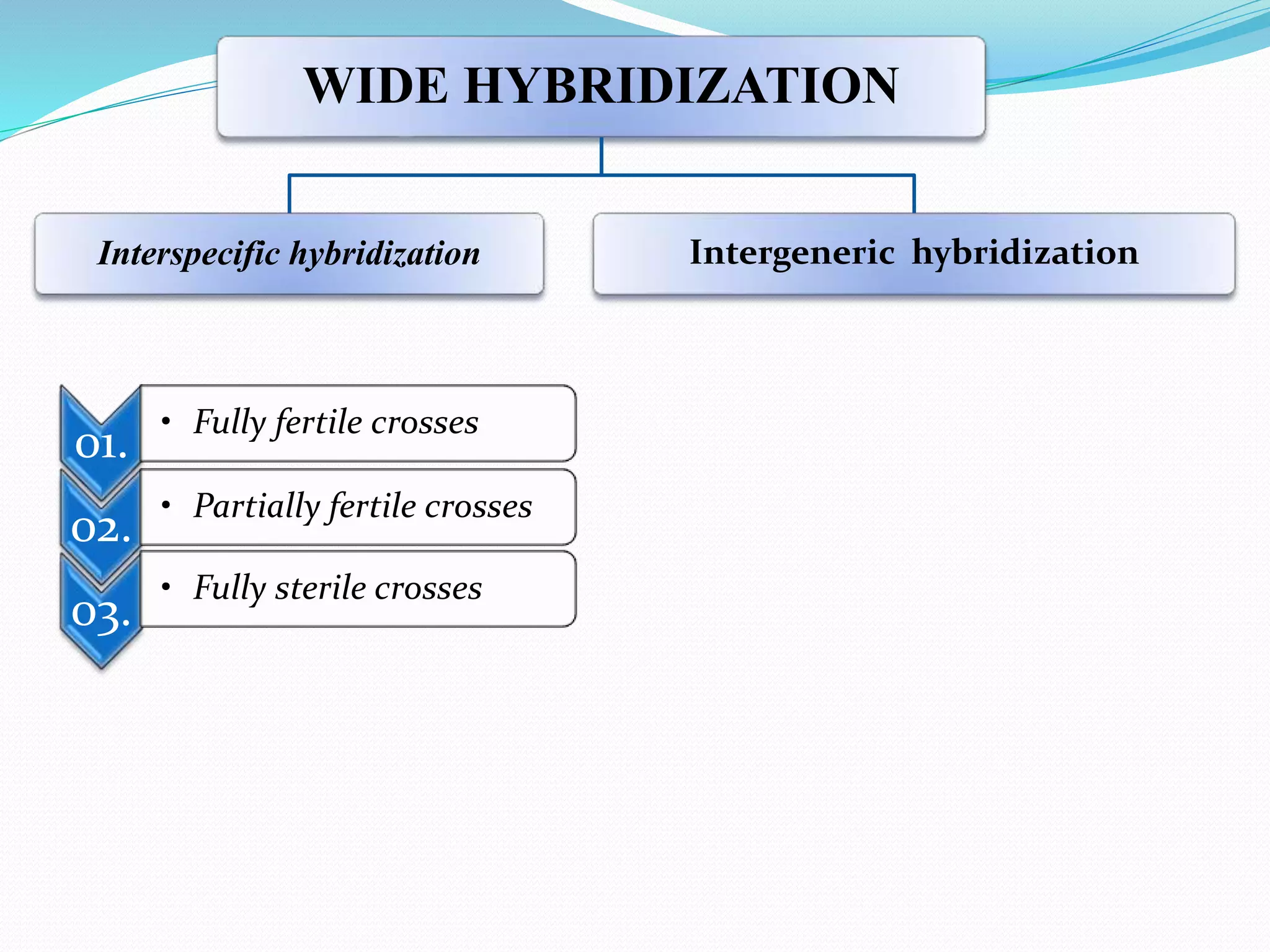
WIDE HYBRIDIZATION
Interspecific hybridization Intergeneric hybridization
01. • Fully fertile crosses
02. • Partially fertile crosses
03.
• Fully sterile crosses
INTERSPECIFIC HYBRIDIZATION
Interspecific hybridization gives rise to three types of crosses, viz. fully
fertile, partially fertile and fully sterile in different crop species.
1. Fully fertile crosses:- Interspecific crosses are fully fertile between those
species that have complete chromosomal homology. Chromosomes in such
hybrids have normal pairing at meiosis and as a result the F1 plants are fully
fertile. Ex. – Cotton = G. hirsutum (2n=52) X G. barbadense (2n=52).
2. Partially fertile crosses:- Interspecific crosses are partially fertile
between those species which differ in chromosome number but have some
chromosome in common. In such situations, the F1 plants are partially fertile.
Ex. – Wheat = T. aestivum (AA BB DD) (2n =42).
3. Fully sterile crosses:- Interspecific crosses are fully sterile between those
species which do not have chromosomal homology. In such species,
chromosome number may (or) may not be similar. The lack of chromosomal
homology does not permit pairing between the chromosomes of two species
during meiosis. Such hybrids can be made self fertile by doubling of
chromosomes through colchicine treatment.
Ex. – Vigna = V. radiata (2n=22) X V. mungo (2n=22).
INTERGENERIC HYBRIDIZATION
 The first intergeneric cross was made between radish (Raphanus
sativus) and cabbage (Brassica oleracea) by karpechenko in 1928 in
Russia.
 Rimpau around 1890 in Sweden crossed bread wheat ( T. aestivum
2n=42) and rye (Secale cereale 2n=14).
 The sterile F1 was doubled by colchicine treatment and triticale was
produced. This combines yield potential and grain quality of wheat and
hardiness of rye.
 Intergeneric crosses were also attempted in sugarcane and barley
crops.
 Tripsacum x diploid maize are being utilized in commercial crop
improvement programmes.
Barriers to distant hybridization
1) Failure of zygote formation:- In many cases, distant hybrids are not produced
because the zygote is not formed due to the failure of fertilization.
Fertilization often fails because of cross incompatibility. The failure of the
male and female gametes to unite to form zygote is known as cross
incompatibility. There are three main reasons for cross incompatibility.
Lack of pollen germination.
Insufficient growth of pollen tube to reach ovule.
Inability of male gamete to unite with egg cell.
Pollen tube may burst in the style of another species and thus fail to reach
the embryo sac.
2) Failure of zygote development:- In some wide crosses, fertilization occurs and zygote
formation also takes place. But the zygote failed to grow and its development is
blocked at various stages. This inability of a hybrid zygote to grow into a normal
embryo under the usual conditions of development is referred to as hybrid
inviability.
 Lethal genes.
Genotypic disharmony between the two parental genomes.
Chromosome elimination.
Incompatible cytoplasm.
Endosperm abortion.
3) Failure of hybrid seedling development:-
Some distant hybrids die during seedling development, or even
after initiation of flowering. This may be due to chlorosis, necrosis which may be due
complementary lethal genes etc. Interspecific and intergeneric F1 hybrids of wheat
show both chlorosis and necrosis, which is often lethal. Chlorosis refers to improper
chlorophyll development resulting in variable degrees of chlorophyll deficiency; in an
extreme case, very little chlorophyll may be produced. In wheat, hybrid chlorosis is
conditioned by two complementary genes Ch1 and Ch2. Gene Ch1 is found in
chromosome 2A of Triticum macha (6x), T. dicoccum (4x), T. dicoccoides (4x) and
T.durum (4x), while gene Ch2 is widely distributed in the varieties of T. astivum.
Therefore, when an accession carrying Ch1 of the above species is crossed with a T.
aestivum variety having Ch2, the F1 hybrid is chlorotic (hybrid chlorosis).
Techniques to overcome barriers
 Manipulation of ploidy.
1. Direct hybridization.
2. Doubling chromosome number of the species at lower ploidy level.
3. Doubling chromosome number at higher ploidy level.
4. Reducing the chromosome number of species at the higher ploidy level.
Introduction
 Haploids are plants (sporophytes) that contain a gametic chromosome number (n).
Blakeslee first described this phenomenon in Datura stramonium in 1922.
This was subsequently followed by similar reports in tobacco (Nicotiana tabacum),
wheat (Triticum aestivum) and several other species (Forster et al., 2007).
The potential of haploidy for plant breeding arose in 1964 with the achievement of
haploid embryo formation from in vitro culture of Datura anthers ( Guha and
Maheshwari, 1964, 1966).
Production of haploids and doubled haploids
 Haploids produced from diploid species (2n=2x), known as monoploids, contain only one
set of chromosomes in the sporophytic phase (2n=x).
 They are smaller and exhibit a lower plant vigour compared to donor plants and are sterile
due to the inability of their chromosomes to pair during meiosis.
 To propagate them through seed and to include them in breeding programs, their fertility
has to be restored with spontaneous or induced chromosome doubling.
The obtained DHs are homozygous at all loci and can represent a new variety (self-
pollinated crops) or parental inbred line for the production of hybrid varieties (cross-
pollinated crops).
Haploids and Doubled Haploids in Plant
The main factors affecting haploid induction and subsequent
regeneration of embryos are:-
- genotype of the donor plants,
- physiological condition of donor plants (i. e. growth at lower
temperature and high illumination),
- developmental stage of gametes, microspores and ovules,
- pre-treatment (i.e. cold treatment of inflorescences prior to culture,
hot treatment of cultured microspores),
- composition of the culture medium (including culture on
“starvation” medium low with carbohydrates and/or macro elements
followed by transfer to normal regeneration medium specific to the
species),
-physical factors during tissue culture (light, temperature).
a) Induction of maternal haploids
1. In situ induction of maternal haploids:-In situ induction of maternal
haploids can be initiated by pollination with pollen of the same species (e.g.,
maize), pollination with irradiated pollen, pollination with pollen of a wild
relative (e.g., barley, potato) or unrelated species (e.g., wheat).
2. Wide hybridization:- Wide crossing between species has been shown to be a
very effective method for haploid induction and has been used successfully
in several cultivated species.
3. In vitro induction of maternal haploids – gynogenesis:- In vitro induction
of maternal haploids, so-called gynogenesis, is another pathway to the
production of haploid embryos exclusively from a female gametophyte.
 It can be achieved with the in vitro culture of various un-pollinated flower
parts, such as ovules, placenta attached ovules, ovaries or whole flower
buds.
b) Induction of paternal haploids – androgenesis:-Androgenesis is the
process of induction and regeneration of haploids and double haploids
originating from male gametic cells.
 Androgenesis can be induced with in vitro culture of immature anthers, a
technically simple method consisting of surface sterilization of pre-treated
flower buds and subsequent excision of anthers under aseptic conditions.
Haploid techniques
a) Induction of maternal haploids
1. In situ induction of maternal haploids:-
 In situ induction of maternal haploids can be initiated by
pollination with pollen of the same species (e.g., maize), pollination
with irradiated pollen, pollination with pollen of a wild relative (e.g.,
barley, potato) or unrelated species (e.g., wheat).
 Pollination can be followed by fertilization of the egg cell and
development of a hybrid embryo, in which paternal chromosome
elimination occurs in early embryogenesis or fertilization of the egg
cell does not occur, and the development of the haploid embryo is
triggered by pollination of polar nuclei and the development of
endosperm.
2. Wide hybridization:-
 Wide crossing between species has been shown to be a very effective method
for haploid induction and has been used successfully in several cultivated
species.
 It exploits haploidy from the female gametic line and involves both inter-
specific and inter-generic pollinations.
 The fertilization of polar nuclei and production of functional endosperm can
trigger the parthenogenetic development of haploid embryos, which mature
normally and are propagated through seeds (e.g., potato).
 In other cases, fertilization of ovules is followed by paternal chromosome
elimination in hybrid embryos.
 The endosperms are absent or poorly developed, so embryo rescue and further
in vitro culture of embryos are needed (e.g., barley).
 The ‘bulbosum’ method was the first haploid induction method to produce
large numbers of haploids across most genotypes and quickly entered into
breeding programs.
3. In vitro induction of maternal haploids – gynogenesis:-
 In vitro induction of maternal haploids, so-called gynogenesis, is another
pathway to the production of haploid embryos exclusively from a female
gametophyte.
 It can be achieved with the in vitro culture of various un-pollinated
flower parts, such as ovules, placenta attached ovules, ovaries or whole flower
buds.
 Although gynogenetic regenerants show higher genetic stability and a
lower rate of albino plants compared to androgenetic ones, gynogenesis is
used mainly in plants in which other induction techniques, such as
androgenesis and the pollination methods above described, have failed.
 Gynogenic induction using un-pollinated flower parts has been
successful in several species, such as onion, sugar beet, cucumber, squash,
gerbera, sunflower, wheat, barley etc. (for a detailed list and protocols
overview, see Bohanec, 2009 and Chen et al., 2011) but its application in
breeding is mainly restricted to onion and sugar beet.
b) Induction of paternal haploids – Androgenesis:-
 Androgenesis is the process of induction and regeneration of haploids and
double haploids originating from male gametic cells.
 Due to its high effectiveness and applicability in numerous plant species, it
has outstanding potential for plant breeding and commercial exploitation of
double haploids.
 Its major drawbacks are high genotype dependency within species and the
recalcitrance of some important agricultural species, such as woody plants,
leguminous plants and the model plant Arabidopsis thaliana.
 The method relies on the ability of microspores and immature pollen grains
to convert their developmental pathway from gametophytic (leading to mature
pollen grain) to sporophytic, resulting in cell division at a haploid level
followed by formation of calluses or embryos.
 Androgenesis can be induced with in vitro culture of immature anthers, a
technically simple method consisting of surface sterilization of pre-treated
flower buds and subsequent excision of anthers under aseptic conditions. The
anthers are inoculated and cultured in vitro on solid, semi-solid or liquid
mediums or two-phase systems (liquid medium overlaying an agar-solidified
medium).
Androgenesis
Pollen culture Anther culture
Pollen culture
 Pollen culture (microspore culture) is a technique in which
haploid plants are obtained from isolated pollen grains while in
anther culture those are obtained from pollens, by placing anthers on
a suitable, synthetic culture medium.
Methods pollen culture :-
1. Nitsch’s culture technique.
2. Nurse culture technique.
3. Float culture technique.
4. Gradient centrifugation technique.
Method I:- Nitsch’s culture technique:
This method is described here for the culture of isolated pollen of tobacco. This
technique can be considered as the basic protocol for pollen culture and involves
the following procedure.
1. Selection of suitable unopened flower bud, sterilization, excision of anther
without filaments are the same as described previously in anther culture.
2. About 50 anthers are placed in small sterile beaker containing 20 ml of liquid
basal medium (MS or White or Nitsch and Nitsch).
3. Anthers are then pressed against the side of beaker with the sterile glass piston
of a syringes to squeeze out the pollens.
4. The homogenized anthers are then filtered through a nylon sieve to remove that
the anther tissue debris.
5. The filtrate or pollen suspension is then centrifuged at low speed ( 500-800
rpm/min) for five minutes. The supernant containing fine debris is discarded and
pallet of pollen is suspended in fresh liquid medium and washed twice by repeated
centrifugation and resuspension in fresh liquid medium.
6. Pollens are mixed finally with measured volume of liquid basal medium so
that it makes the density of 10 3-10 4 pollen/ml.
7. A 2.5 ml of pollen suspension is pipetted off and is spread in 5 cm
petridish. Pollens are best grown in liquid medium but, if necessary, they can
be grown by plating very soft agar added medium. Each dish is sealed with
cello tape to avoid dehydration.
8. Petri dishes are incubated at 27-30 0C under low intensity of white cool
light (500 lux,16 hrs).
9. Young embryoids can be observed after 30 days. The embryoids ultimately
give rise to haploid plantlets.
10. Haploid plantlets are then incubated at 27-30 0C in a 16 hrs day light
regime at about 2000 lux. Plantlets at maturity are transferred to soil as
described in anther culture.
Method I:- Nurse culture technique:-
This method is known as nurse culture technique. Sharp et.al. ( 1972) first
introduced this method. The steps are as under.
1. Selection of flower bud sterilization excision of anther, isolation of suitable
pollen is the same as described previously.
2. In this method, the intact anthers are placed horizontally on the top of solid or
semisolid basal medium within a conical flask.
3. A small filter paper disc is placed over the intact anther and about 10 pollen
grains in the suspension are then placed on the filter paper disc. Here the intact
anthers are considered as the nurse tissue. A control set is also prepared in exactly
the same way except that the pollen grain on the filter paper are directly kept on
solid medium. Sometimes, callus tissue derived from any part of the plant is used
as nurse tissue.
4. With this method, pollen grains the control set did not grown at all. The pollen
gains kept on nurse tissue grow and form a culture of green parenchymatous tissue
in two weeks, such tissue ultimately form the haploid callus tissue.
Anther culture is technique by which the developing anthers at a precise
and critical stage are excised aseptically from unopened flower bud and are cultured
on a nutrient medium where the microspore within the cultured anther develop into
callus tissue or embryoids that give rise to haploid plantlets either through
organogenesis or embryogenesis.
Protocol for Anther Culture
Tobacco is the ideal material for anther culture. So the basic protocol described
below should be applicable to anther culture in general with modifications. The
immature anthers containing uninucleate pollens at the time of first mitosis are the
most suitable material for the induction of haploids.
1. Collect the flower buds of Nicotiana tabacum at the onset of flowering. Select
the flower bud of 17-22 mm in length when the length of the sepals equals that of
the petals. Reject all flower buds which are beginning to open.
2. Transfer the selected flower buds to the laminar airflow. Each flower bud contains
five anther and these are normally surface sterile in closed buds. The flower buds
are surface sterilized by immersion in 70% ethanol for 10 seconds followed
immediately by 10 minutes in 20% sodium hypochlorite. They are washed three
times with sterile distilled water. Finally transfer the buds to sterile petridish.
Anther culture
3. To remove the anthers, slit the side of the bud with a sharp scalpel and remove
them, with a pair of forceps, place the five anthers with the filaments to another
petridish. The filaments are cut gently. Damaged anthers should be discarded as
they often form callus tissue the damaged parts other than the pollens.
4. Anthers are placed on agar solidified basal MS or White or Nitsch and Nitsch
medium.
5. The culture is kept initially in dark. After 3-4 weeks, the anthers normally
undergo pollen embryogenesis and haploid plantlets appear from the cultured
anther. In some cases, anther may undergo proliferation to form callus tissue
which can be induced to differentiate into haploid plants.
6. At this stage the cultures are incubated at 24-28 0C in a 14 hrs day light regime
at about 2000 lux.
7. Approximately 50mm tall plantlets are freed from agar by gently washing with
running tap water and then transferred to small pots containing autoclaved potting
compost. Cover each plant with glass beaker to prevent desiccation and maintain
in a well-lit-humid green house. After some week, remove the glass beaker and
transfer the plant to larger pots when the plants will mature and finally flower.
Advantages of Pollen Culture over Anther Culture
i) Overcrowding of pollen grains in anther is eliminated and isolated
pollen grains are equally exposed to nutrient medium.
ii) Unwanted growth of diploid cells of anther wall and other associated
tissue is eliminated.
iii) The stage of androgenesis can be observed starting from single cell.
iv) Various factors governing androgenesis can be better regulated.
v) Pollen is deal for uptake, transformation and mutagenic studies as
pollen can be uniformly exposed to chemicals and physical mutagens.
vi) Pollen may be directly transformed into an embryoid. So it is very
suitable for understanding biochemistry and physiology of androgenesis.
vii) Higher yield of haploid plants per anther could be expected in pollen
culture than the anther culture.
 Diploidization of haploid plants:-
Haploids plants derived from either anther culture or pollen culture are sterile.
These plants contain only one set of chromosomes.
By doubling their chromosomes number, the plants can be made fertile and
resultant plants will be homozygous diploid or isogenic diploid. These
homozygous diploid plants show the normal meiotic separation.
The fertile homozygous diploid plants are more important than the sterile
haploid plants and can be used as pure line lines in breeding programme.
Haploids plants can be diplodized by following methods.
i) Colchicine Treatment.
ii) Endomitosis.
iii) Fusion of Pollen Nuclei.
Production of Homozygous Diploid Plants
i) Colchicine Treatment:
Colchicine has been utilized widely as spindle inhibitor to induce chromosome
duplication and to produce polyploid plants. The young plantlets while still
enclosed within the anther are treated with 0.5% colchicine solution for 24-48
hrs. Treated plantlets are planted in the medium after through washing. In case of
mature haploid plantlets, 4% colchicine- lanoline pasts may be applied to the axil
of the leaves.
ii) Endomitosis:
Haploids cells are unstable in culture and have tendency to undergo
Endomitosis. i.e chromosome duplication without nuclear division. This
property can be used for obtaining homozygous diploid plants. In this process, a
small explant of stem from a haploid plant is cultured on auxin-cytokinin added
medium where the segment forms the callus tissue. During callus growth,
diploid homozygous cells are produced by endomitosis. Now large number of
isogenic diploid plants can be obtained by organogenesis.
iii) Fusion of Pollen Nuclei:
Homozygous diploid callus or embryoids may form by the spontaneous fusion of
two similar nuclei of the cultured pollen after first division. In Brassica, the
frequency of spontaneous nuclear fusion in microspore is high in culture.
Application of Haploids in Plant Breeding
1. Releasing New Varieties through F1 Double - haploid System.
2. Selection of Mutants Resistance to Diseases.
3. Developing Asexual Lines of Tree Perennial Species.
4. Transfer of Desired Alien Gene.
5. Establishment of Haploids and Diploid Cell Lines of Pollen Plant.
1.Releasing New Varieties through F1 Double –haploid System:-
Haploid breeding technique usually involve only one cycle of meiotic recombination.
However, many agronomic traits are polygenically controlled. One cycle of
recombination is usually insufficient for the improvement of such quantitative traits
since linkage between Polygenes will not release all potential variations available in
the cross. To overcome these disadvantages, the Chinese developed a method
combining anther culture with sexual hybridization among different genotypes of
anther derived plants. The anthers of the hybrid (F1) progeny are excellent breeding
material for raising pollen-derived homozygous plants (Double –haploids) in which
complementary parental characteristics are combined in one generation.
Double –haploids are also useful in studies related to inheritance of quantitative traits.
Using double –haploid technique new varieties have been developed in barley,
Brassica, rice, maize , rye, potato, pepper and asparagus.
2. Selection of Mutants Resistance to Diseases:
Mutants with resistance to disease is of prime importance in crop improvement. Haploids
provide a relatively easier system for the induction of mutations. Some examples of using
anther culture technique in mutant successfully are tobacco mutants resistant to black
shank disease and wheat lines resistant to scab. (Fusarium graminearum).
3. Developing Asexual Lines of Tree Perennial Species:
Chinese workers obtained pollen –derived rubber tree taller by sic meters which could
then be multiplied by asexual propagation to raise several clones. Another example of
pollen –haploids in plant improvement is popular.
4. Transfer of Desired Alien Gene:
Chromosomal instability in haploids makes them potential tools for introduction of alien
chromosomes on genes during wider crossing programmes. In rice , developing a
resistance to blast requires about 12 years by conventional breeding through back
crossing. Through hybridization and anther culture, this can be achieved in two years
(Examples: cv . Zhonghua No.8 and 9 released by the institute of crop Breeding and
cultivation in china.
5. Establishment of Haploids and Diploid Cell Lines of Pollen Plant:
The anther culture technique was used to establish both haploid and diploid somatic cell
lines of pollen plants in wheat and maize. Similarly, a haploid tobacco line resistant to
methionine sulfoxomide was selected which turned out to be identical in phenotype and
effect to the toxin produced by the pathogen Pseudomonas tabaci.
1. Haploids derived from anther and pollen culture are useful in cytogenic studies.
2. Recessive phenotypic characters can be identified easily by comparing
heterozygous diploid with haploid or homozygous diploid population.
3. Double haploid that are homozygous and fertile, are readily obtained, enabling
the selection of desirable gene combination.
4. Culture of isolated pollen provides a novel experimental system for the study of
factor controlling pollen embryogenesis of higher plants.
5. Study of meiotic behaviour of haploids valuable cubes to measure chromosome
duplication within a species for understanding of phylogentic relationship between
species. It also provides information for the interpretation of chromosome
homology.
6. Genetic analysis could be performed on haploid population to establish
inheritance patterns.
7. Use of haploids in production of monosomics, nullisomics and other aneuploids.
This approach has been used in tobacco for the isolation of nullisomics, trisomics.
Importance and Implications of Anther and Pollen Culture
Haploid production

Haploid production

  • 2.
     Hybridization involvingindividuals from different species belonging to the same genus or to different genera, is termed as distant hybridization.  Such crosses are known as distant crosses or wide crosses.  This is because individuals used for hybridization in such cases are taxonomically more distantly related than are different varieties from the same species. When individuals from two distinct species of the same genus are crossed, it is known as interspecific hybridization. When the individuals being crossed belong to species from two different genera, it is referred to as intergeneric hybridization.
  • 3.
    Utilizing wild speciesis one method designed to introduce additional germplasm into cultivated varieties. The first recorded interspecific hybrid was made in 1717 between carnation and Sweet William by Thomas Fair Child (Allard 1960). Incorporation of desired genes into existing cultivated varieties has become increasingly important. Wide crosses are more successful in more closely related species or genera than in less closely related species or genera. It is more successful in vegetative propagated species like sugarcane and potato than in seed propagated species.
  • 4.
    WIDE HYBRIDIZATION Interspecific hybridizationIntergeneric hybridization 01. • Fully fertile crosses 02. • Partially fertile crosses 03. • Fully sterile crosses
  • 5.
    INTERSPECIFIC HYBRIDIZATION Interspecific hybridizationgives rise to three types of crosses, viz. fully fertile, partially fertile and fully sterile in different crop species. 1. Fully fertile crosses:- Interspecific crosses are fully fertile between those species that have complete chromosomal homology. Chromosomes in such hybrids have normal pairing at meiosis and as a result the F1 plants are fully fertile. Ex. – Cotton = G. hirsutum (2n=52) X G. barbadense (2n=52). 2. Partially fertile crosses:- Interspecific crosses are partially fertile between those species which differ in chromosome number but have some chromosome in common. In such situations, the F1 plants are partially fertile. Ex. – Wheat = T. aestivum (AA BB DD) (2n =42). 3. Fully sterile crosses:- Interspecific crosses are fully sterile between those species which do not have chromosomal homology. In such species, chromosome number may (or) may not be similar. The lack of chromosomal homology does not permit pairing between the chromosomes of two species during meiosis. Such hybrids can be made self fertile by doubling of chromosomes through colchicine treatment. Ex. – Vigna = V. radiata (2n=22) X V. mungo (2n=22).
  • 6.
    INTERGENERIC HYBRIDIZATION  Thefirst intergeneric cross was made between radish (Raphanus sativus) and cabbage (Brassica oleracea) by karpechenko in 1928 in Russia.  Rimpau around 1890 in Sweden crossed bread wheat ( T. aestivum 2n=42) and rye (Secale cereale 2n=14).  The sterile F1 was doubled by colchicine treatment and triticale was produced. This combines yield potential and grain quality of wheat and hardiness of rye.  Intergeneric crosses were also attempted in sugarcane and barley crops.  Tripsacum x diploid maize are being utilized in commercial crop improvement programmes.
  • 7.
    Barriers to distanthybridization 1) Failure of zygote formation:- In many cases, distant hybrids are not produced because the zygote is not formed due to the failure of fertilization. Fertilization often fails because of cross incompatibility. The failure of the male and female gametes to unite to form zygote is known as cross incompatibility. There are three main reasons for cross incompatibility. Lack of pollen germination. Insufficient growth of pollen tube to reach ovule. Inability of male gamete to unite with egg cell. Pollen tube may burst in the style of another species and thus fail to reach the embryo sac. 2) Failure of zygote development:- In some wide crosses, fertilization occurs and zygote formation also takes place. But the zygote failed to grow and its development is blocked at various stages. This inability of a hybrid zygote to grow into a normal embryo under the usual conditions of development is referred to as hybrid inviability.  Lethal genes. Genotypic disharmony between the two parental genomes. Chromosome elimination. Incompatible cytoplasm. Endosperm abortion.
  • 8.
    3) Failure ofhybrid seedling development:- Some distant hybrids die during seedling development, or even after initiation of flowering. This may be due to chlorosis, necrosis which may be due complementary lethal genes etc. Interspecific and intergeneric F1 hybrids of wheat show both chlorosis and necrosis, which is often lethal. Chlorosis refers to improper chlorophyll development resulting in variable degrees of chlorophyll deficiency; in an extreme case, very little chlorophyll may be produced. In wheat, hybrid chlorosis is conditioned by two complementary genes Ch1 and Ch2. Gene Ch1 is found in chromosome 2A of Triticum macha (6x), T. dicoccum (4x), T. dicoccoides (4x) and T.durum (4x), while gene Ch2 is widely distributed in the varieties of T. astivum. Therefore, when an accession carrying Ch1 of the above species is crossed with a T. aestivum variety having Ch2, the F1 hybrid is chlorotic (hybrid chlorosis). Techniques to overcome barriers  Manipulation of ploidy. 1. Direct hybridization. 2. Doubling chromosome number of the species at lower ploidy level. 3. Doubling chromosome number at higher ploidy level. 4. Reducing the chromosome number of species at the higher ploidy level.
  • 9.
    Introduction  Haploids areplants (sporophytes) that contain a gametic chromosome number (n). Blakeslee first described this phenomenon in Datura stramonium in 1922. This was subsequently followed by similar reports in tobacco (Nicotiana tabacum), wheat (Triticum aestivum) and several other species (Forster et al., 2007). The potential of haploidy for plant breeding arose in 1964 with the achievement of haploid embryo formation from in vitro culture of Datura anthers ( Guha and Maheshwari, 1964, 1966). Production of haploids and doubled haploids  Haploids produced from diploid species (2n=2x), known as monoploids, contain only one set of chromosomes in the sporophytic phase (2n=x).  They are smaller and exhibit a lower plant vigour compared to donor plants and are sterile due to the inability of their chromosomes to pair during meiosis.  To propagate them through seed and to include them in breeding programs, their fertility has to be restored with spontaneous or induced chromosome doubling. The obtained DHs are homozygous at all loci and can represent a new variety (self- pollinated crops) or parental inbred line for the production of hybrid varieties (cross- pollinated crops). Haploids and Doubled Haploids in Plant
  • 10.
    The main factorsaffecting haploid induction and subsequent regeneration of embryos are:- - genotype of the donor plants, - physiological condition of donor plants (i. e. growth at lower temperature and high illumination), - developmental stage of gametes, microspores and ovules, - pre-treatment (i.e. cold treatment of inflorescences prior to culture, hot treatment of cultured microspores), - composition of the culture medium (including culture on “starvation” medium low with carbohydrates and/or macro elements followed by transfer to normal regeneration medium specific to the species), -physical factors during tissue culture (light, temperature).
  • 11.
    a) Induction ofmaternal haploids 1. In situ induction of maternal haploids:-In situ induction of maternal haploids can be initiated by pollination with pollen of the same species (e.g., maize), pollination with irradiated pollen, pollination with pollen of a wild relative (e.g., barley, potato) or unrelated species (e.g., wheat). 2. Wide hybridization:- Wide crossing between species has been shown to be a very effective method for haploid induction and has been used successfully in several cultivated species. 3. In vitro induction of maternal haploids – gynogenesis:- In vitro induction of maternal haploids, so-called gynogenesis, is another pathway to the production of haploid embryos exclusively from a female gametophyte.  It can be achieved with the in vitro culture of various un-pollinated flower parts, such as ovules, placenta attached ovules, ovaries or whole flower buds. b) Induction of paternal haploids – androgenesis:-Androgenesis is the process of induction and regeneration of haploids and double haploids originating from male gametic cells.  Androgenesis can be induced with in vitro culture of immature anthers, a technically simple method consisting of surface sterilization of pre-treated flower buds and subsequent excision of anthers under aseptic conditions. Haploid techniques
  • 12.
    a) Induction ofmaternal haploids 1. In situ induction of maternal haploids:-  In situ induction of maternal haploids can be initiated by pollination with pollen of the same species (e.g., maize), pollination with irradiated pollen, pollination with pollen of a wild relative (e.g., barley, potato) or unrelated species (e.g., wheat).  Pollination can be followed by fertilization of the egg cell and development of a hybrid embryo, in which paternal chromosome elimination occurs in early embryogenesis or fertilization of the egg cell does not occur, and the development of the haploid embryo is triggered by pollination of polar nuclei and the development of endosperm.
  • 13.
    2. Wide hybridization:- Wide crossing between species has been shown to be a very effective method for haploid induction and has been used successfully in several cultivated species.  It exploits haploidy from the female gametic line and involves both inter- specific and inter-generic pollinations.  The fertilization of polar nuclei and production of functional endosperm can trigger the parthenogenetic development of haploid embryos, which mature normally and are propagated through seeds (e.g., potato).  In other cases, fertilization of ovules is followed by paternal chromosome elimination in hybrid embryos.  The endosperms are absent or poorly developed, so embryo rescue and further in vitro culture of embryos are needed (e.g., barley).  The ‘bulbosum’ method was the first haploid induction method to produce large numbers of haploids across most genotypes and quickly entered into breeding programs.
  • 15.
    3. In vitroinduction of maternal haploids – gynogenesis:-  In vitro induction of maternal haploids, so-called gynogenesis, is another pathway to the production of haploid embryos exclusively from a female gametophyte.  It can be achieved with the in vitro culture of various un-pollinated flower parts, such as ovules, placenta attached ovules, ovaries or whole flower buds.  Although gynogenetic regenerants show higher genetic stability and a lower rate of albino plants compared to androgenetic ones, gynogenesis is used mainly in plants in which other induction techniques, such as androgenesis and the pollination methods above described, have failed.  Gynogenic induction using un-pollinated flower parts has been successful in several species, such as onion, sugar beet, cucumber, squash, gerbera, sunflower, wheat, barley etc. (for a detailed list and protocols overview, see Bohanec, 2009 and Chen et al., 2011) but its application in breeding is mainly restricted to onion and sugar beet.
  • 16.
    b) Induction ofpaternal haploids – Androgenesis:-  Androgenesis is the process of induction and regeneration of haploids and double haploids originating from male gametic cells.  Due to its high effectiveness and applicability in numerous plant species, it has outstanding potential for plant breeding and commercial exploitation of double haploids.  Its major drawbacks are high genotype dependency within species and the recalcitrance of some important agricultural species, such as woody plants, leguminous plants and the model plant Arabidopsis thaliana.  The method relies on the ability of microspores and immature pollen grains to convert their developmental pathway from gametophytic (leading to mature pollen grain) to sporophytic, resulting in cell division at a haploid level followed by formation of calluses or embryos.  Androgenesis can be induced with in vitro culture of immature anthers, a technically simple method consisting of surface sterilization of pre-treated flower buds and subsequent excision of anthers under aseptic conditions. The anthers are inoculated and cultured in vitro on solid, semi-solid or liquid mediums or two-phase systems (liquid medium overlaying an agar-solidified medium).
  • 18.
  • 19.
    Pollen culture  Pollenculture (microspore culture) is a technique in which haploid plants are obtained from isolated pollen grains while in anther culture those are obtained from pollens, by placing anthers on a suitable, synthetic culture medium. Methods pollen culture :- 1. Nitsch’s culture technique. 2. Nurse culture technique. 3. Float culture technique. 4. Gradient centrifugation technique.
  • 20.
    Method I:- Nitsch’sculture technique: This method is described here for the culture of isolated pollen of tobacco. This technique can be considered as the basic protocol for pollen culture and involves the following procedure. 1. Selection of suitable unopened flower bud, sterilization, excision of anther without filaments are the same as described previously in anther culture. 2. About 50 anthers are placed in small sterile beaker containing 20 ml of liquid basal medium (MS or White or Nitsch and Nitsch). 3. Anthers are then pressed against the side of beaker with the sterile glass piston of a syringes to squeeze out the pollens. 4. The homogenized anthers are then filtered through a nylon sieve to remove that the anther tissue debris. 5. The filtrate or pollen suspension is then centrifuged at low speed ( 500-800 rpm/min) for five minutes. The supernant containing fine debris is discarded and pallet of pollen is suspended in fresh liquid medium and washed twice by repeated centrifugation and resuspension in fresh liquid medium.
  • 21.
    6. Pollens aremixed finally with measured volume of liquid basal medium so that it makes the density of 10 3-10 4 pollen/ml. 7. A 2.5 ml of pollen suspension is pipetted off and is spread in 5 cm petridish. Pollens are best grown in liquid medium but, if necessary, they can be grown by plating very soft agar added medium. Each dish is sealed with cello tape to avoid dehydration. 8. Petri dishes are incubated at 27-30 0C under low intensity of white cool light (500 lux,16 hrs). 9. Young embryoids can be observed after 30 days. The embryoids ultimately give rise to haploid plantlets. 10. Haploid plantlets are then incubated at 27-30 0C in a 16 hrs day light regime at about 2000 lux. Plantlets at maturity are transferred to soil as described in anther culture.
  • 22.
    Method I:- Nurseculture technique:- This method is known as nurse culture technique. Sharp et.al. ( 1972) first introduced this method. The steps are as under. 1. Selection of flower bud sterilization excision of anther, isolation of suitable pollen is the same as described previously. 2. In this method, the intact anthers are placed horizontally on the top of solid or semisolid basal medium within a conical flask. 3. A small filter paper disc is placed over the intact anther and about 10 pollen grains in the suspension are then placed on the filter paper disc. Here the intact anthers are considered as the nurse tissue. A control set is also prepared in exactly the same way except that the pollen grain on the filter paper are directly kept on solid medium. Sometimes, callus tissue derived from any part of the plant is used as nurse tissue. 4. With this method, pollen grains the control set did not grown at all. The pollen gains kept on nurse tissue grow and form a culture of green parenchymatous tissue in two weeks, such tissue ultimately form the haploid callus tissue.
  • 23.
    Anther culture istechnique by which the developing anthers at a precise and critical stage are excised aseptically from unopened flower bud and are cultured on a nutrient medium where the microspore within the cultured anther develop into callus tissue or embryoids that give rise to haploid plantlets either through organogenesis or embryogenesis. Protocol for Anther Culture Tobacco is the ideal material for anther culture. So the basic protocol described below should be applicable to anther culture in general with modifications. The immature anthers containing uninucleate pollens at the time of first mitosis are the most suitable material for the induction of haploids. 1. Collect the flower buds of Nicotiana tabacum at the onset of flowering. Select the flower bud of 17-22 mm in length when the length of the sepals equals that of the petals. Reject all flower buds which are beginning to open. 2. Transfer the selected flower buds to the laminar airflow. Each flower bud contains five anther and these are normally surface sterile in closed buds. The flower buds are surface sterilized by immersion in 70% ethanol for 10 seconds followed immediately by 10 minutes in 20% sodium hypochlorite. They are washed three times with sterile distilled water. Finally transfer the buds to sterile petridish. Anther culture
  • 24.
    3. To removethe anthers, slit the side of the bud with a sharp scalpel and remove them, with a pair of forceps, place the five anthers with the filaments to another petridish. The filaments are cut gently. Damaged anthers should be discarded as they often form callus tissue the damaged parts other than the pollens. 4. Anthers are placed on agar solidified basal MS or White or Nitsch and Nitsch medium. 5. The culture is kept initially in dark. After 3-4 weeks, the anthers normally undergo pollen embryogenesis and haploid plantlets appear from the cultured anther. In some cases, anther may undergo proliferation to form callus tissue which can be induced to differentiate into haploid plants. 6. At this stage the cultures are incubated at 24-28 0C in a 14 hrs day light regime at about 2000 lux. 7. Approximately 50mm tall plantlets are freed from agar by gently washing with running tap water and then transferred to small pots containing autoclaved potting compost. Cover each plant with glass beaker to prevent desiccation and maintain in a well-lit-humid green house. After some week, remove the glass beaker and transfer the plant to larger pots when the plants will mature and finally flower.
  • 25.
    Advantages of PollenCulture over Anther Culture i) Overcrowding of pollen grains in anther is eliminated and isolated pollen grains are equally exposed to nutrient medium. ii) Unwanted growth of diploid cells of anther wall and other associated tissue is eliminated. iii) The stage of androgenesis can be observed starting from single cell. iv) Various factors governing androgenesis can be better regulated. v) Pollen is deal for uptake, transformation and mutagenic studies as pollen can be uniformly exposed to chemicals and physical mutagens. vi) Pollen may be directly transformed into an embryoid. So it is very suitable for understanding biochemistry and physiology of androgenesis. vii) Higher yield of haploid plants per anther could be expected in pollen culture than the anther culture.
  • 26.
     Diploidization ofhaploid plants:- Haploids plants derived from either anther culture or pollen culture are sterile. These plants contain only one set of chromosomes. By doubling their chromosomes number, the plants can be made fertile and resultant plants will be homozygous diploid or isogenic diploid. These homozygous diploid plants show the normal meiotic separation. The fertile homozygous diploid plants are more important than the sterile haploid plants and can be used as pure line lines in breeding programme. Haploids plants can be diplodized by following methods. i) Colchicine Treatment. ii) Endomitosis. iii) Fusion of Pollen Nuclei. Production of Homozygous Diploid Plants
  • 27.
    i) Colchicine Treatment: Colchicinehas been utilized widely as spindle inhibitor to induce chromosome duplication and to produce polyploid plants. The young plantlets while still enclosed within the anther are treated with 0.5% colchicine solution for 24-48 hrs. Treated plantlets are planted in the medium after through washing. In case of mature haploid plantlets, 4% colchicine- lanoline pasts may be applied to the axil of the leaves. ii) Endomitosis: Haploids cells are unstable in culture and have tendency to undergo Endomitosis. i.e chromosome duplication without nuclear division. This property can be used for obtaining homozygous diploid plants. In this process, a small explant of stem from a haploid plant is cultured on auxin-cytokinin added medium where the segment forms the callus tissue. During callus growth, diploid homozygous cells are produced by endomitosis. Now large number of isogenic diploid plants can be obtained by organogenesis. iii) Fusion of Pollen Nuclei: Homozygous diploid callus or embryoids may form by the spontaneous fusion of two similar nuclei of the cultured pollen after first division. In Brassica, the frequency of spontaneous nuclear fusion in microspore is high in culture.
  • 28.
    Application of Haploidsin Plant Breeding 1. Releasing New Varieties through F1 Double - haploid System. 2. Selection of Mutants Resistance to Diseases. 3. Developing Asexual Lines of Tree Perennial Species. 4. Transfer of Desired Alien Gene. 5. Establishment of Haploids and Diploid Cell Lines of Pollen Plant. 1.Releasing New Varieties through F1 Double –haploid System:- Haploid breeding technique usually involve only one cycle of meiotic recombination. However, many agronomic traits are polygenically controlled. One cycle of recombination is usually insufficient for the improvement of such quantitative traits since linkage between Polygenes will not release all potential variations available in the cross. To overcome these disadvantages, the Chinese developed a method combining anther culture with sexual hybridization among different genotypes of anther derived plants. The anthers of the hybrid (F1) progeny are excellent breeding material for raising pollen-derived homozygous plants (Double –haploids) in which complementary parental characteristics are combined in one generation. Double –haploids are also useful in studies related to inheritance of quantitative traits. Using double –haploid technique new varieties have been developed in barley, Brassica, rice, maize , rye, potato, pepper and asparagus.
  • 29.
    2. Selection ofMutants Resistance to Diseases: Mutants with resistance to disease is of prime importance in crop improvement. Haploids provide a relatively easier system for the induction of mutations. Some examples of using anther culture technique in mutant successfully are tobacco mutants resistant to black shank disease and wheat lines resistant to scab. (Fusarium graminearum). 3. Developing Asexual Lines of Tree Perennial Species: Chinese workers obtained pollen –derived rubber tree taller by sic meters which could then be multiplied by asexual propagation to raise several clones. Another example of pollen –haploids in plant improvement is popular. 4. Transfer of Desired Alien Gene: Chromosomal instability in haploids makes them potential tools for introduction of alien chromosomes on genes during wider crossing programmes. In rice , developing a resistance to blast requires about 12 years by conventional breeding through back crossing. Through hybridization and anther culture, this can be achieved in two years (Examples: cv . Zhonghua No.8 and 9 released by the institute of crop Breeding and cultivation in china. 5. Establishment of Haploids and Diploid Cell Lines of Pollen Plant: The anther culture technique was used to establish both haploid and diploid somatic cell lines of pollen plants in wheat and maize. Similarly, a haploid tobacco line resistant to methionine sulfoxomide was selected which turned out to be identical in phenotype and effect to the toxin produced by the pathogen Pseudomonas tabaci.
  • 30.
    1. Haploids derivedfrom anther and pollen culture are useful in cytogenic studies. 2. Recessive phenotypic characters can be identified easily by comparing heterozygous diploid with haploid or homozygous diploid population. 3. Double haploid that are homozygous and fertile, are readily obtained, enabling the selection of desirable gene combination. 4. Culture of isolated pollen provides a novel experimental system for the study of factor controlling pollen embryogenesis of higher plants. 5. Study of meiotic behaviour of haploids valuable cubes to measure chromosome duplication within a species for understanding of phylogentic relationship between species. It also provides information for the interpretation of chromosome homology. 6. Genetic analysis could be performed on haploid population to establish inheritance patterns. 7. Use of haploids in production of monosomics, nullisomics and other aneuploids. This approach has been used in tobacco for the isolation of nullisomics, trisomics. Importance and Implications of Anther and Pollen Culture