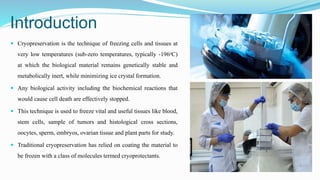
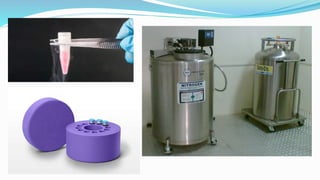
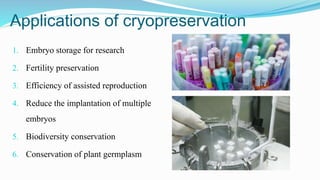
Cryopreservation is the technique of freezing cells and tissues at very low sub-zero temperatures to preserve them. This stops biological activity and keeps materials genetically stable. Cryopreservation relies on cryoprotectants, which protect cells from freezing damage by penetrating cells and replacing water. The main cryopreservation procedures are slow freezing and vitrification. Slow freezing uses gradual cooling and cryoprotectants allow water to leave cells, while vitrification rapidly freezes cells to glass transition. Cryopreservation has applications in fertility preservation, assisted reproduction research, and biodiversity conservation.