


Presented by:
Md. Ali Haidar
Reg. no.: AGRW2014000016
Faculty: Agriculture
Term: Summer 2017
Department of Genetics & Plant Breeding
EXIM Bank Agricultural University Bangladesh
Chapainawabganj
Welcome
6-Jul-17 1
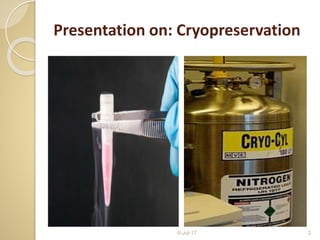
Presentation on: Cryopreservation
6-Jul-17 2
What is Cryopreservation ?
 Cryopreservation comes from the Greek word
“krayos” which means “frost”. Literally
cryopreservation is the preservation in
“frozen state”.
 In Other sense, Cryopreservation is the
technique of freezing cells and tissues at very
low temperatures (sub-zero temperatures,
typically -196oC) at which the biological
material remains genetically stable and
metabolically inert, while minimizing ice
crystal formation.
6-Jul-17 3
History
 Ernest John Christopher Polge, an English biologist, was
the first person to solve the mystery of how to preserve
living cells at very low temperatures in 1949.
 During early 1950s, James E. Lovelock suggested that
increasing salt concentrations in a cell as it dehydrates to
lose water to the external ice might cause damage to the
cell.
6-Jul-17 4
 In 1953, the research work of Jerome K.
Sherman led him to successfully freeze and
thaw human sperm.
 In 1983, Alan Trounson, was credited for
successfully achieving a pregnancy after
freezing early human embryos one to three
days after fertilization.
6-Jul-17 5
History
Applications of cryopreservation
 It is ideal method for long term conservation
of material.
 Disease free plants can be conserved and
propagated.
 Recalcitrant seeds can be maintained for long
time.
 Endangered species can be maintained.
 Pollens can be maintained to increase
longitivity.
 Rare germplasm and other genetic
manipulations can be stored.
6-Jul-17 6
Equipment Require for Cryopreservation:
 A reliable source of liquid nitrogen
 Safety equipment ( gloves, apron, face shield, pumps
for dispensing liquid nitrogen from a large storage
dewars, trolleys for the transport of dewars).
 Small (1-2 litre) liquid nitrogen resistant dewar(s).
 Dewar(s) for the routine storage of liquid nitrogen.
 Dewar(s) for the long term storage of spicemens.
 Cryovilas, straws, boxes, canes, racks.
 A refrigerent (-20 degree).
 A programmable feezer with dewar and pump.
 A water bath for thawing at 40 to 50 degree.
6-Jul-17 7
Why Liquid nitrogen is use?
 Chemically inert
 Relatively low cost
 Non toxic
 Non flammable
 Readily available
6-Jul-17 8
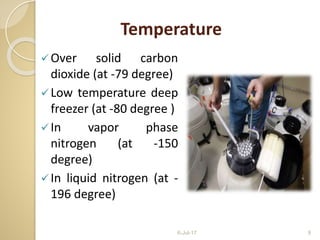
Temperature
Over solid carbon
dioxide (at -79 degree)
Low temperature deep
freezer (at -80 degree )
In vapor phase
nitrogen (at -150
degree)
In liquid nitrogen (at -
196 degree)
6-Jul-17 9
Steps involved in cryopreservation
 Selection of plant material
Morphological and physiological conditions of plant
material influence the ability of explants to survive
during cryopreservation. e.g. Ovules, pollen, Embryos,
Endosperm, Protoplast, etc.
 Pregrowth
Pregrowth treatment protect the plant tissues against
exposure to liquid nitrogen. e.g. abscisic acid, praline
etc.
 Addition of Cryoprotechtants
A cryoprotectant is a substance that is used to
protect biological tissue from freezing damage.
6-Jul-17 10
 Vitrification
The term “vitrification” refers to any process resulting in
“glass formation”, the transformation from a liquid to a
solid in the absence of crystallization.
 Cryprotective Dehydration
Dehydration can be achieved by growth in presence of
high concentration of osmotically active compounds like
sugars.
 Encapsulation and Dehydration
This involves the encapsulation of tissues in calcium
alginate beads. Which are pre-grown in liquid culture
media containing high concentration of sucrose.
6-Jul-17 11
Steps involved in cryopreservation
 Freezing
The plant material is placed in vials and plunged into liquid
nitrogen and decrease of -300 to -10000c or more occurs.
 Slow Freezing
Tissue is slowly frozen with decrease in temperature from -0.1 to
10°c/min. Slow cooling permits the flow of water from the cells to
the outside, thereby promoting extracellular ice formation
instead of lethal intracellular freezing.
 Stepwise Freezing
In this method slow freezing down to -20 to 40c. A stop for a
period of approximately 30 min and then additional rapid freezing
to -196c is done by plunging in liquid nitrogen.
6-Jul-17 12
Steps involved in cryopreservation
 Storage
Storage of frozen material at correct temperature is as
important as freezing. The frozen cells/tissues are kept for
storage at temperature ranging from -70 to -196°c.
 Thawing
It is done by putting ampoule containing the sample in a
warm water bath (35 to 40°c).
 Determination of Survival or viability
Regrowth of the plants from stored tissues or cells is the
only test of survival of plant materials. Various viability
tests include Fluorescien diacetate (FDA) staining, growth
measurement by cell number , dry and fresh weight.
6-Jul-17 13
Steps involved in cryopreservation
Risks involved in cryopreservation techniques
 Solution effects: As ice crystals grow in freezing water,
solutes are excluded, causing them to become
concentrated in the remaining liquid water. High
concentrations of some solutes can be very damaging.
 Extracellular ice formation: When tissues are cooled
slowly, water migrates out of cells and ice forms in the
extracellular space. Too much extracellular ice can cause
mechanical damage to the cell membrane due to crushing.
6-Jul-17 14
 Dehydration: Migration of water, causing
extracellular ice formation, can also cause cellular
dehydration. The associated stresses on the cell can
cause damage directly.
 Intracellular ice formation: While
some organisms and tissues can tolerate some
extracellular ice, any appreciable intracellular ice is
almost always fatal to cells.
6-Jul-17 15
Risks involved in cryopreservation techniques
Main methods to prevent risks
Slow programmable freezing
 The first step of the slow-freeze procedure is to expose the cell
to cryprotectant in a gradual step-wise fashion to slowly allow
equilibrium of the cell with the cryoprotectant while releasing
water. Once the cells have been cleared of the majority of
cellular water, they are placed in a container of some kind, such
as plastic or straw, a glass ampoule or a plastic vial.
 The volume of the liquid surrounding the cells for slow freezing
is typically less than a teaspoon and may only be a few drops.
The pre-labeled container is filled, sealed and put away in a
programmable freezer, which slowly decreases the temperature
of the container over a period of minutes or hours to very low
temperatures.
 When the container reaches temperatures between -30oC and -
85oC, the container holding the cells can be directly plunged
into liquid nitrogen to complete the cooling to -196oC.
6-Jul-17 16
Vitrification
 This procedure uses higher concentrations of
cryoprotectants coupled with an almost instantaneous
freezing rate achieved by plunging cells directly into liquid
nitrogen.
 Vitrification by passes the ice-crystal formation phase and
moves the water directly into a glass-like phase.
 For vitrification, the cells are usually placed on the tip of a
straw and excess cryoprotectant is removed, leaving just
enough so that the cell clings to the container by surface
tension, prior to plunging in liquid nitrogen.
 Because of the rapid freezing, the duration of exposure to
cryoprotectants is much less.
 Warming of the cell to return it to normal metabolic
functioning must also be incredibly rapid.
6-Jul-17 17
Main methods to prevent risks
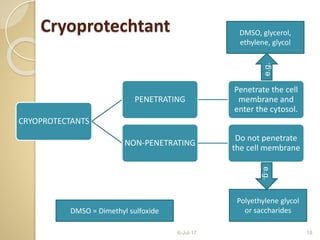
Cryoprotechtant
6-Jul-17 18
CRYOPROTECTANTS
PENETRATING
Penetrate the cell
membrane and
enter the cytosol.
NON-PENETRATING
Do not penetrate
the cell membrane
DMSO, glycerol,
ethylene, glycol
e.g.
Polyethylene glycol
or saccharides
e.g.
DMSO = Dimethyl sulfoxide
Freezable tissues
 Semen
 Blood
 Special cells for transfusion
 Stem cells
 Tissue
 Eggs (oocytes) in oocyte cryopreservation
 Embryos
 Ovarian tissue
 Plant seeds or shoots
6-Jul-17 19
Preservation of Microbiology Cultures
 Fungi
Fungi, notably zygomycetes, ascomycetes
and higher basidiomycetes, regardless of
sporulation, are able to be stored in liquid
nitrogen or deep-frozen. Crypreservation is a
hallmark method for fungi that do not
sporulate (otherwise other preservation
methods for spores can be used at lower
costs and ease), sporulate but have delicate
spores (large or freeze-dry sensitive), are
pathogenic (dangerous to keep metabolically
active fungus) or are to be used for genetic
stocks (ideally to have identical composition
as the original deposit).
6-Jul-17 20
 Bacteria
Many common cultural laboratory strains are
deep-frozen to preserve genetically and
phenotypically stable, long-term stocks. Sub-
culturing and prolonged refrigerated samples
may lead to loss of plasmid(s) or mutations.
From a fresh culture plate, one single colony of
interest is chosen and liquid culture is made.
From the liquid culture, the medium is directly
mixed with equal amount of glycerol; the colony
should be checked for any defects like
mutations. All antibiotics should be washed from
the culture before long-term storage.
6-Jul-17 21
Preservation of Microbiology Cultures
Conclusion
Today, by the help of progressing biotechnology, it is
more often that we apply cryopreservation. While,
there are still insufficient researches especially for the
oocytes, studies on the cryopreservation of
immunological memory lymphoid cells, aortic root
allografts and osteoblasts for bone banking, are going
on. An updated, but discursive subject is postmortem
human reproduction; and it currently has many ethical
and legal problems a waiting to be solved. Recently, it
can be seen that vitrification is more preferable than
slow cooling as it is cheaper and easier to handle.
Cryopreservation of cornea, umbilical cord and
hematopoietic cells and sperm banking procedures
are performed routinely.
6-Jul-17 22
6-Jul-17 23
Thanks
To
All

Cryopreservation Prepared by Md. Ali Haidar

  • 1.
    Presented by: Md. AliHaidar Reg. no.: AGRW2014000016 Faculty: Agriculture Term: Summer 2017 Department of Genetics & Plant Breeding EXIM Bank Agricultural University Bangladesh Chapainawabganj Welcome 6-Jul-17 1
  • 2.
  • 3.
    What is Cryopreservation?  Cryopreservation comes from the Greek word “krayos” which means “frost”. Literally cryopreservation is the preservation in “frozen state”.  In Other sense, Cryopreservation is the technique of freezing cells and tissues at very low temperatures (sub-zero temperatures, typically -196oC) at which the biological material remains genetically stable and metabolically inert, while minimizing ice crystal formation. 6-Jul-17 3
  • 4.
    History  Ernest JohnChristopher Polge, an English biologist, was the first person to solve the mystery of how to preserve living cells at very low temperatures in 1949.  During early 1950s, James E. Lovelock suggested that increasing salt concentrations in a cell as it dehydrates to lose water to the external ice might cause damage to the cell. 6-Jul-17 4
  • 5.
     In 1953,the research work of Jerome K. Sherman led him to successfully freeze and thaw human sperm.  In 1983, Alan Trounson, was credited for successfully achieving a pregnancy after freezing early human embryos one to three days after fertilization. 6-Jul-17 5 History
  • 6.
    Applications of cryopreservation It is ideal method for long term conservation of material.  Disease free plants can be conserved and propagated.  Recalcitrant seeds can be maintained for long time.  Endangered species can be maintained.  Pollens can be maintained to increase longitivity.  Rare germplasm and other genetic manipulations can be stored. 6-Jul-17 6
  • 7.
    Equipment Require forCryopreservation:  A reliable source of liquid nitrogen  Safety equipment ( gloves, apron, face shield, pumps for dispensing liquid nitrogen from a large storage dewars, trolleys for the transport of dewars).  Small (1-2 litre) liquid nitrogen resistant dewar(s).  Dewar(s) for the routine storage of liquid nitrogen.  Dewar(s) for the long term storage of spicemens.  Cryovilas, straws, boxes, canes, racks.  A refrigerent (-20 degree).  A programmable feezer with dewar and pump.  A water bath for thawing at 40 to 50 degree. 6-Jul-17 7
  • 8.
    Why Liquid nitrogenis use?  Chemically inert  Relatively low cost  Non toxic  Non flammable  Readily available 6-Jul-17 8
  • 9.
    Temperature Over solid carbon dioxide(at -79 degree) Low temperature deep freezer (at -80 degree ) In vapor phase nitrogen (at -150 degree) In liquid nitrogen (at - 196 degree) 6-Jul-17 9
  • 10.
    Steps involved incryopreservation  Selection of plant material Morphological and physiological conditions of plant material influence the ability of explants to survive during cryopreservation. e.g. Ovules, pollen, Embryos, Endosperm, Protoplast, etc.  Pregrowth Pregrowth treatment protect the plant tissues against exposure to liquid nitrogen. e.g. abscisic acid, praline etc.  Addition of Cryoprotechtants A cryoprotectant is a substance that is used to protect biological tissue from freezing damage. 6-Jul-17 10
  • 11.
     Vitrification The term“vitrification” refers to any process resulting in “glass formation”, the transformation from a liquid to a solid in the absence of crystallization.  Cryprotective Dehydration Dehydration can be achieved by growth in presence of high concentration of osmotically active compounds like sugars.  Encapsulation and Dehydration This involves the encapsulation of tissues in calcium alginate beads. Which are pre-grown in liquid culture media containing high concentration of sucrose. 6-Jul-17 11 Steps involved in cryopreservation
  • 12.
     Freezing The plantmaterial is placed in vials and plunged into liquid nitrogen and decrease of -300 to -10000c or more occurs.  Slow Freezing Tissue is slowly frozen with decrease in temperature from -0.1 to 10°c/min. Slow cooling permits the flow of water from the cells to the outside, thereby promoting extracellular ice formation instead of lethal intracellular freezing.  Stepwise Freezing In this method slow freezing down to -20 to 40c. A stop for a period of approximately 30 min and then additional rapid freezing to -196c is done by plunging in liquid nitrogen. 6-Jul-17 12 Steps involved in cryopreservation
  • 13.
     Storage Storage offrozen material at correct temperature is as important as freezing. The frozen cells/tissues are kept for storage at temperature ranging from -70 to -196°c.  Thawing It is done by putting ampoule containing the sample in a warm water bath (35 to 40°c).  Determination of Survival or viability Regrowth of the plants from stored tissues or cells is the only test of survival of plant materials. Various viability tests include Fluorescien diacetate (FDA) staining, growth measurement by cell number , dry and fresh weight. 6-Jul-17 13 Steps involved in cryopreservation
  • 14.
    Risks involved incryopreservation techniques  Solution effects: As ice crystals grow in freezing water, solutes are excluded, causing them to become concentrated in the remaining liquid water. High concentrations of some solutes can be very damaging.  Extracellular ice formation: When tissues are cooled slowly, water migrates out of cells and ice forms in the extracellular space. Too much extracellular ice can cause mechanical damage to the cell membrane due to crushing. 6-Jul-17 14
  • 15.
     Dehydration: Migrationof water, causing extracellular ice formation, can also cause cellular dehydration. The associated stresses on the cell can cause damage directly.  Intracellular ice formation: While some organisms and tissues can tolerate some extracellular ice, any appreciable intracellular ice is almost always fatal to cells. 6-Jul-17 15 Risks involved in cryopreservation techniques
  • 16.
    Main methods toprevent risks Slow programmable freezing  The first step of the slow-freeze procedure is to expose the cell to cryprotectant in a gradual step-wise fashion to slowly allow equilibrium of the cell with the cryoprotectant while releasing water. Once the cells have been cleared of the majority of cellular water, they are placed in a container of some kind, such as plastic or straw, a glass ampoule or a plastic vial.  The volume of the liquid surrounding the cells for slow freezing is typically less than a teaspoon and may only be a few drops. The pre-labeled container is filled, sealed and put away in a programmable freezer, which slowly decreases the temperature of the container over a period of minutes or hours to very low temperatures.  When the container reaches temperatures between -30oC and - 85oC, the container holding the cells can be directly plunged into liquid nitrogen to complete the cooling to -196oC. 6-Jul-17 16
  • 17.
    Vitrification  This procedureuses higher concentrations of cryoprotectants coupled with an almost instantaneous freezing rate achieved by plunging cells directly into liquid nitrogen.  Vitrification by passes the ice-crystal formation phase and moves the water directly into a glass-like phase.  For vitrification, the cells are usually placed on the tip of a straw and excess cryoprotectant is removed, leaving just enough so that the cell clings to the container by surface tension, prior to plunging in liquid nitrogen.  Because of the rapid freezing, the duration of exposure to cryoprotectants is much less.  Warming of the cell to return it to normal metabolic functioning must also be incredibly rapid. 6-Jul-17 17 Main methods to prevent risks
  • 18.
    Cryoprotechtant 6-Jul-17 18 CRYOPROTECTANTS PENETRATING Penetrate thecell membrane and enter the cytosol. NON-PENETRATING Do not penetrate the cell membrane DMSO, glycerol, ethylene, glycol e.g. Polyethylene glycol or saccharides e.g. DMSO = Dimethyl sulfoxide
  • 19.
    Freezable tissues  Semen Blood  Special cells for transfusion  Stem cells  Tissue  Eggs (oocytes) in oocyte cryopreservation  Embryos  Ovarian tissue  Plant seeds or shoots 6-Jul-17 19
  • 20.
    Preservation of MicrobiologyCultures  Fungi Fungi, notably zygomycetes, ascomycetes and higher basidiomycetes, regardless of sporulation, are able to be stored in liquid nitrogen or deep-frozen. Crypreservation is a hallmark method for fungi that do not sporulate (otherwise other preservation methods for spores can be used at lower costs and ease), sporulate but have delicate spores (large or freeze-dry sensitive), are pathogenic (dangerous to keep metabolically active fungus) or are to be used for genetic stocks (ideally to have identical composition as the original deposit). 6-Jul-17 20
  • 21.
     Bacteria Many commoncultural laboratory strains are deep-frozen to preserve genetically and phenotypically stable, long-term stocks. Sub- culturing and prolonged refrigerated samples may lead to loss of plasmid(s) or mutations. From a fresh culture plate, one single colony of interest is chosen and liquid culture is made. From the liquid culture, the medium is directly mixed with equal amount of glycerol; the colony should be checked for any defects like mutations. All antibiotics should be washed from the culture before long-term storage. 6-Jul-17 21 Preservation of Microbiology Cultures
  • 22.
    Conclusion Today, by thehelp of progressing biotechnology, it is more often that we apply cryopreservation. While, there are still insufficient researches especially for the oocytes, studies on the cryopreservation of immunological memory lymphoid cells, aortic root allografts and osteoblasts for bone banking, are going on. An updated, but discursive subject is postmortem human reproduction; and it currently has many ethical and legal problems a waiting to be solved. Recently, it can be seen that vitrification is more preferable than slow cooling as it is cheaper and easier to handle. Cryopreservation of cornea, umbilical cord and hematopoietic cells and sperm banking procedures are performed routinely. 6-Jul-17 22
  • 23.