CRYOPRESERVATION.
SUBMITTED TO,
DEPARTMENT OF ZOOLOGY.
ISABELLA THOBURN COLLEGE
INTRODUCTION.
 Cryopreservation is the process which refers to the “ preservation in the
frozen state”.
 It is derived from the Greek word ‘KRYOS’ meaning ‘FROST’.
 The term “cryopreservation” means storage at very low temperature
such as in deep freezers (-80°C) in vapour phase nitrogen (-150°C) or
in liquid nitrogen (-196°C).
 Cryopreservation refers to the storage of cells, tissues & organs at the
ultra- low temperature of liquid nitrogen.
 At such low temperatures, the stored material enters in a state of
“absolute quiescence” as all the physical & the biochemical reactions
are practically halted.
 Thus, cryopreservation is a long term storage techniques with very low
temperatures to preserve the structurally intact living cells & tissues
for extended period of time at a relatively low cost.
 The science pertaining this activity is known as “CRYOBIOLOGY”.
PRECULTURE.
A 3-4th day preculture on 2-4% proline either
alone or in combination with croprotectants
like DMSO improves the survival of
suspension cultures.
Sugars acting as osmotically effective agents,
although they don’t penetrate inside the cells.
Culture of cells / tissues/ organs in the presence of
amino acid like proline, sugars or at low temperatures
prior to freezing initiates in them physiological changes.
These changes facilitate dehydration & accumulation
of substances like proline, which protect the cells from
toxicity of high solute concentration.
Plantlets hardened by growing them at near freezing
temperature(for 1 week at 22°C).Cold hardened tissues
show water efflux, permits dehydration of cells.
Process of Preculture.
SOURCE: www.edu.com
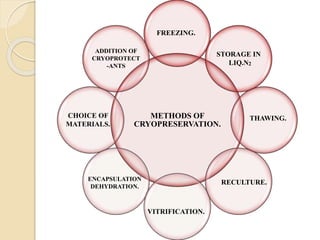
METHODS OF
CRYOPRESERVATION.
CHOICE OF
MATERIALS.
ADDITION OF
CRYOPROTECT
-ANTS
FREEZING.
STORAGE IN
LIQ.N2
THAWING.
RECULTURE.
VITRIFICATION.
ENCAPSULATION
DEHYDRATION.
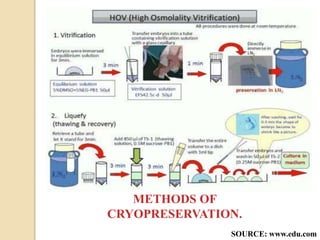
METHODS OF
CRYOPRESERVATION.
SOURCE: www.edu.com
SELECTION OF
MATERIAL.
 Material chosen for cryopreservation should be far as possible in
meristematic state.
 For selecting a material, a number of facts are taken into account:
1. The nature of cells.
2. The density of cells in the vials to be preserved.
• Cell cultures are generally preserved in lag or early exponential
phase of growth.
• Young, highly cytoplasmic & small cells which are non-
vacuolated & in small aggregates are good materials to be
selected for cryopreservation.
• In some species, it may be important to use highly embryonic cell
cultures since non- embryonic or poorly embryogenic cultures
show poor or no regrowth after thawing.
ADDITION OF
CRYOPROTECTANTS.
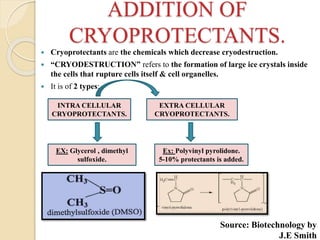
 Cryoprotectants are the chemicals which decrease cryodestruction.
 “CRYODESTRUCTION” refers to the formation of large ice crystals inside
the cells that rupture cells itself & cell organelles.
 It is of 2 types:
INTRA CELLULAR
CRYOPROTECTANTS.
EXTRA CELLULAR
CRYOPROTECTANTS.
EX: Glycerol , dimethyl
sulfoxide.
Ex: Polyvinyl pyrolidone.
5-10% protectants is added.
Source: Biotechnology by
J.E Smith
FREEZING.
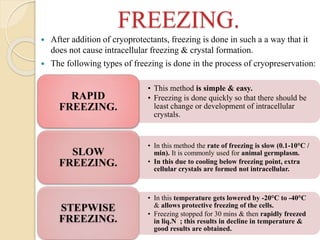
 After addition of cryoprotectants, freezing is done in such a a way that it
does not cause intracellular freezing & crystal formation.
 The following types of freezing is done in the process of cryopreservation:
• This method is simple & easy.
• Freezing is done quickly so that there should be
least change or development of intracellular
crystals.
RAPID
FREEZING.
• In this method the rate of freezing is slow (0.1-10°C /
min). It is commonly used for animal germplasm.
• In this due to cooling below freezing point, extra
cellular crystals are formed not intracellular.
SLOW
FREEZING.
• In this temperature gets lowered by -20°C to -40°C
& allows protective freezing of the cells.
• Freezing stopped for 30 mins & then rapidly freezed
in liq.N ; this results in decline in temperature &
good results are obtained.
STEPWISE
FREEZING.
Ampoules used
during freezing
FREEZERS.
FREEZING OF
CELLS.
Source: Animal biotechnology by Ian
Freshney
1. If the cells are not
stored at sufficiently low
temperature, an
additional injury to the
material be caused.
2. The storage
temperature be such that
it stops all the
metabolic activities &
prevents biochemical
activity; this can be
achieved with the help
of liq. N2 at 196°C.
STORAGE IN LIQUID
NITROGEN.
SOURCE:
www.edu.com
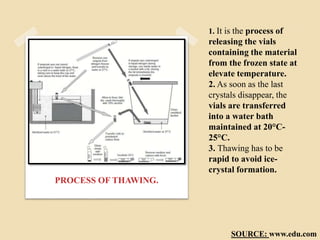
1. It is the process of
releasing the vials
containing the material
from the frozen state at
elevate temperature.
2. As soon as the last
crystals disappear, the
vials are transferred
into a water bath
maintained at 20°C-
25°C.
3. Thawing has to be
rapid to avoid ice-
crystal formation.
PROCESS OF THAWING.
SOURCE: www.edu.com
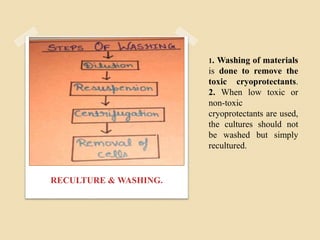
1. Washing of materials
is done to remove the
toxic cryoprotectants.
2. When low toxic or
non-toxic
cryoprotectants are used,
the cultures should not
be washed but simply
recultured.
RECULTURE & WASHING.
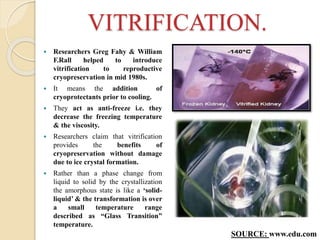
VITRIFICATION.
 Researchers Greg Fahy & William
F.Rall helped to introduce
vitrification to reproductive
cryopreservation in mid 1980s.
 It means the addition of
cryoprotectants prior to cooling.
 They act as anti-freeze i.e. they
decrease the freezing temperature
& the viscosity.
 Researchers claim that vitrification
provides the benefits of
cryopreservation without damage
due to ice crystal formation.
 Rather than a phase change from
liquid to solid by the crystallization
the amorphous state is like a ‘solid-
liquid’ & the transformation is over
a small temperature range
described as “Glass Transition”
temperature.
SOURCE: www.edu.com
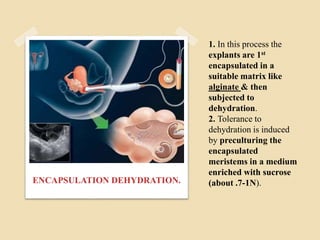
1. In this process the
explants are 1st
encapsulated in a
suitable matrix like
alginate & then
subjected to
dehydration.
2. Tolerance to
dehydration is induced
by preculturing the
encapsulated
meristems in a medium
enriched with sucrose
(about .7-1N).ENCAPSULATION DEHYDRATION.
CRYOPRESERAVTION OF
ANIMAL STOCK CELL.
 Development of animal cell line is expensive, time consuming &
labour intensive.
 It is essential to protect this considerable investment by preserving the cell
line so that it can be further used when required.
 Selection of cell line & standardization of culture: A cell line have
different properties; continuous cell line are clone; suitable clone is
selected & grown to get suitable bulk of cell required for freezing.
 Continuous cell line have several advantages over fertile cell line such
as:
1. They survive indefinitely.
2. They grow more rapidly.
3. They can clone more easily, but they may be less stable genetically.
4. Usually the finite cell line are diploid & stable but harder to clone.
They grow more slowly & eventually die or transfer.
CRYOPRESERAVTION OF
PLANT STOCK CELL.
 Due to gradual disappearance of economic & rare species the necessity for
storage of genetic resources increase.
 The conventional methods of storage fail to prevent from losses caused by:
1. Attack of pathogen & pest.
2. Climatic disorders.
3. Natural disorders.
4. Political & economic causes.
• The materials to be preserved are stored at low temperatures due to which
growth rate of cells retards ; consequently biological activities are conserved
for long time.
• 3 principal methods are:
1. Alteration of physiological condition of culture i.e. temperature of gas
composition in the vessels.
2. Changing the composition of basal medium .
EX: Using sub or supra optimal concentration of nutrients.
3. Supplementing the nutrients with growth retarders or osmoregulatory
compounds.
Several cell
banks have been
established to
secure storage &
distribution of
validated cell
line.
CRYO BANK.
APPLICATIONS OF
CRYOPRESERVATION.
 Suitable combinations of cryoprotectants & regimes of
cooling & rinsing allow successful cryopreservation of
biological materials such as: semen, embryos, oocytes,
ovarian tissues, testicular tissue, meristems etc.
 Some examples are given below:
1. EMBRYO CRYOPRESERVATION.
• It is used for embryo storage when in-vitro fertilization has
resulted in more embryo than is currently needed.
• Pregnancies have been reported from embryos stored for 16
yrs.
• The result has been uniformly positive with no increase of
birth defects or developmental abnormalities.
2. OVARIAN CRYOPRESERVATION.
• Ovarian tissue cryopreservation is of interest to
women who want to preserve their reproductive
function beyond the natural limit or whose
reproductive potential is threatened by
chemotherapy.
EX: In haematologic malignancies or breast
cancer.
• The procedure is to take a part of the ovary &
perform slow freezing before storing it in liquid
N2.
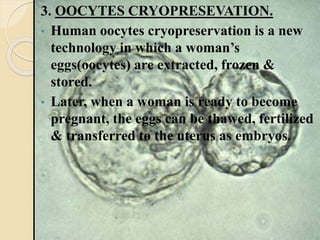
3. OOCYTES CRYOPRESEVATION.
• Human oocytes cryopreservation is a new
technology in which a woman’s
eggs(oocytes) are extracted, frozen &
stored.
• Later, when a woman is ready to become
pregnant, the eggs can be thawed, fertilized
& transferred to the uterus as embryos.
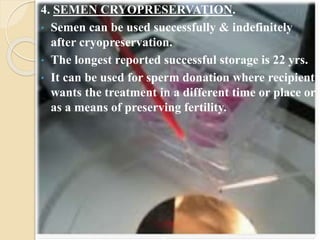
4. SEMEN CRYOPRESERVATION.
• Semen can be used successfully & indefinitely
after cryopreservation.
• The longest reported successful storage is 22 yrs.
• It can be used for sperm donation where recipient
wants the treatment in a different time or place or
as a means of preserving fertility.
5. TESTICULAR CRYOPRESERAVTION.
• Cryopreservation of immature testicular tissue is
a developing method to avail reproduction to
young male who need to have gonadotoxic
therapy.
• Health offsprings have been obtained after
transplantation of frozen testicular cell
suspension or tissue pieces.
SIGNIFICANCE OF
CRYOPRESERVATION.
 There are various advantages of this technique. These are as
follows:
1. Cryopreservation of gametes, embryos etc.
prevents genetic drift.
2. It safeguards genetic integrity of valuable stains.
3. It offers generation time & allows further
contribution of genetics.
4. It eases transportation of genetic stock.
5. It causes decrease of disease transmission.
THANK YOU…

Cryopreservation

  • 1.
    CRYOPRESERVATION. SUBMITTED TO, DEPARTMENT OFZOOLOGY. ISABELLA THOBURN COLLEGE
  • 2.
    INTRODUCTION.  Cryopreservation isthe process which refers to the “ preservation in the frozen state”.  It is derived from the Greek word ‘KRYOS’ meaning ‘FROST’.  The term “cryopreservation” means storage at very low temperature such as in deep freezers (-80°C) in vapour phase nitrogen (-150°C) or in liquid nitrogen (-196°C).  Cryopreservation refers to the storage of cells, tissues & organs at the ultra- low temperature of liquid nitrogen.  At such low temperatures, the stored material enters in a state of “absolute quiescence” as all the physical & the biochemical reactions are practically halted.  Thus, cryopreservation is a long term storage techniques with very low temperatures to preserve the structurally intact living cells & tissues for extended period of time at a relatively low cost.  The science pertaining this activity is known as “CRYOBIOLOGY”.
  • 3.
    PRECULTURE. A 3-4th daypreculture on 2-4% proline either alone or in combination with croprotectants like DMSO improves the survival of suspension cultures. Sugars acting as osmotically effective agents, although they don’t penetrate inside the cells. Culture of cells / tissues/ organs in the presence of amino acid like proline, sugars or at low temperatures prior to freezing initiates in them physiological changes. These changes facilitate dehydration & accumulation of substances like proline, which protect the cells from toxicity of high solute concentration. Plantlets hardened by growing them at near freezing temperature(for 1 week at 22°C).Cold hardened tissues show water efflux, permits dehydration of cells.
  • 4.
  • 5.
    METHODS OF CRYOPRESERVATION. CHOICE OF MATERIALS. ADDITIONOF CRYOPROTECT -ANTS FREEZING. STORAGE IN LIQ.N2 THAWING. RECULTURE. VITRIFICATION. ENCAPSULATION DEHYDRATION.
  • 6.
  • 7.
    SELECTION OF MATERIAL.  Materialchosen for cryopreservation should be far as possible in meristematic state.  For selecting a material, a number of facts are taken into account: 1. The nature of cells. 2. The density of cells in the vials to be preserved. • Cell cultures are generally preserved in lag or early exponential phase of growth. • Young, highly cytoplasmic & small cells which are non- vacuolated & in small aggregates are good materials to be selected for cryopreservation. • In some species, it may be important to use highly embryonic cell cultures since non- embryonic or poorly embryogenic cultures show poor or no regrowth after thawing.
  • 8.
    ADDITION OF CRYOPROTECTANTS.  Cryoprotectantsare the chemicals which decrease cryodestruction.  “CRYODESTRUCTION” refers to the formation of large ice crystals inside the cells that rupture cells itself & cell organelles.  It is of 2 types: INTRA CELLULAR CRYOPROTECTANTS. EXTRA CELLULAR CRYOPROTECTANTS. EX: Glycerol , dimethyl sulfoxide. Ex: Polyvinyl pyrolidone. 5-10% protectants is added. Source: Biotechnology by J.E Smith
  • 9.
    FREEZING.  After additionof cryoprotectants, freezing is done in such a a way that it does not cause intracellular freezing & crystal formation.  The following types of freezing is done in the process of cryopreservation: • This method is simple & easy. • Freezing is done quickly so that there should be least change or development of intracellular crystals. RAPID FREEZING. • In this method the rate of freezing is slow (0.1-10°C / min). It is commonly used for animal germplasm. • In this due to cooling below freezing point, extra cellular crystals are formed not intracellular. SLOW FREEZING. • In this temperature gets lowered by -20°C to -40°C & allows protective freezing of the cells. • Freezing stopped for 30 mins & then rapidly freezed in liq.N ; this results in decline in temperature & good results are obtained. STEPWISE FREEZING.
  • 10.
    Ampoules used during freezing FREEZERS. FREEZINGOF CELLS. Source: Animal biotechnology by Ian Freshney
  • 11.
    1. If thecells are not stored at sufficiently low temperature, an additional injury to the material be caused. 2. The storage temperature be such that it stops all the metabolic activities & prevents biochemical activity; this can be achieved with the help of liq. N2 at 196°C. STORAGE IN LIQUID NITROGEN. SOURCE: www.edu.com
  • 12.
    1. It isthe process of releasing the vials containing the material from the frozen state at elevate temperature. 2. As soon as the last crystals disappear, the vials are transferred into a water bath maintained at 20°C- 25°C. 3. Thawing has to be rapid to avoid ice- crystal formation. PROCESS OF THAWING. SOURCE: www.edu.com
  • 13.
    1. Washing ofmaterials is done to remove the toxic cryoprotectants. 2. When low toxic or non-toxic cryoprotectants are used, the cultures should not be washed but simply recultured. RECULTURE & WASHING.
  • 14.
    VITRIFICATION.  Researchers GregFahy & William F.Rall helped to introduce vitrification to reproductive cryopreservation in mid 1980s.  It means the addition of cryoprotectants prior to cooling.  They act as anti-freeze i.e. they decrease the freezing temperature & the viscosity.  Researchers claim that vitrification provides the benefits of cryopreservation without damage due to ice crystal formation.  Rather than a phase change from liquid to solid by the crystallization the amorphous state is like a ‘solid- liquid’ & the transformation is over a small temperature range described as “Glass Transition” temperature. SOURCE: www.edu.com
  • 15.
    1. In thisprocess the explants are 1st encapsulated in a suitable matrix like alginate & then subjected to dehydration. 2. Tolerance to dehydration is induced by preculturing the encapsulated meristems in a medium enriched with sucrose (about .7-1N).ENCAPSULATION DEHYDRATION.
  • 16.
    CRYOPRESERAVTION OF ANIMAL STOCKCELL.  Development of animal cell line is expensive, time consuming & labour intensive.  It is essential to protect this considerable investment by preserving the cell line so that it can be further used when required.  Selection of cell line & standardization of culture: A cell line have different properties; continuous cell line are clone; suitable clone is selected & grown to get suitable bulk of cell required for freezing.  Continuous cell line have several advantages over fertile cell line such as: 1. They survive indefinitely. 2. They grow more rapidly. 3. They can clone more easily, but they may be less stable genetically. 4. Usually the finite cell line are diploid & stable but harder to clone. They grow more slowly & eventually die or transfer.
  • 17.
    CRYOPRESERAVTION OF PLANT STOCKCELL.  Due to gradual disappearance of economic & rare species the necessity for storage of genetic resources increase.  The conventional methods of storage fail to prevent from losses caused by: 1. Attack of pathogen & pest. 2. Climatic disorders. 3. Natural disorders. 4. Political & economic causes. • The materials to be preserved are stored at low temperatures due to which growth rate of cells retards ; consequently biological activities are conserved for long time. • 3 principal methods are: 1. Alteration of physiological condition of culture i.e. temperature of gas composition in the vessels. 2. Changing the composition of basal medium . EX: Using sub or supra optimal concentration of nutrients. 3. Supplementing the nutrients with growth retarders or osmoregulatory compounds.
  • 19.
    Several cell banks havebeen established to secure storage & distribution of validated cell line. CRYO BANK.
  • 20.
    APPLICATIONS OF CRYOPRESERVATION.  Suitablecombinations of cryoprotectants & regimes of cooling & rinsing allow successful cryopreservation of biological materials such as: semen, embryos, oocytes, ovarian tissues, testicular tissue, meristems etc.  Some examples are given below: 1. EMBRYO CRYOPRESERVATION. • It is used for embryo storage when in-vitro fertilization has resulted in more embryo than is currently needed. • Pregnancies have been reported from embryos stored for 16 yrs. • The result has been uniformly positive with no increase of birth defects or developmental abnormalities.
  • 21.
    2. OVARIAN CRYOPRESERVATION. •Ovarian tissue cryopreservation is of interest to women who want to preserve their reproductive function beyond the natural limit or whose reproductive potential is threatened by chemotherapy. EX: In haematologic malignancies or breast cancer. • The procedure is to take a part of the ovary & perform slow freezing before storing it in liquid N2.
  • 22.
    3. OOCYTES CRYOPRESEVATION. •Human oocytes cryopreservation is a new technology in which a woman’s eggs(oocytes) are extracted, frozen & stored. • Later, when a woman is ready to become pregnant, the eggs can be thawed, fertilized & transferred to the uterus as embryos.
  • 23.
    4. SEMEN CRYOPRESERVATION. •Semen can be used successfully & indefinitely after cryopreservation. • The longest reported successful storage is 22 yrs. • It can be used for sperm donation where recipient wants the treatment in a different time or place or as a means of preserving fertility.
  • 24.
    5. TESTICULAR CRYOPRESERAVTION. •Cryopreservation of immature testicular tissue is a developing method to avail reproduction to young male who need to have gonadotoxic therapy. • Health offsprings have been obtained after transplantation of frozen testicular cell suspension or tissue pieces.
  • 25.
    SIGNIFICANCE OF CRYOPRESERVATION.  Thereare various advantages of this technique. These are as follows: 1. Cryopreservation of gametes, embryos etc. prevents genetic drift. 2. It safeguards genetic integrity of valuable stains. 3. It offers generation time & allows further contribution of genetics. 4. It eases transportation of genetic stock. 5. It causes decrease of disease transmission.
  • 26.