RESEARCH IN CONTINUING
EDUCATION
Dr. Virendra Singh Choudhary
INTRODUCTION
• Continuing nursing education is a
modern imperative, it must be
future oriented , geared to the
facing new situations and making
of new responses appropriate for
these situations.
CONTD…….
• New knowledge is emerging
rapidly in the physical,
biological, behavioural and
medical sciences, which
constitute the foundation of
nursing.
CONTD………
• Continuing nursing education
programs should be developed
by nurses and conducted
within nursing or in general
education system in
cooperation with the nurses.
DEFINITION
• “All the learning activities
that occurs after an
individual has completed his
basic education”
-Cooper
CONTD………
“ Education which builds on
previous education”
–Shannon
TYPES OF
CONTINUING
EDUCATION
•Correspondence
continuing education
•Liberal education
•Inservice education
FEATURES
• Unified approach
• Relationship with other systems
• Comprehensiveness
• Accessibility for all health
professionals
• Integration with the management
process
CONTD………
• Analysis of needs as a basis for
learning continuity
• Internally coordinated
• Relevance in planning
• Credibility and economics
NEED
• To ensure safe and effective
nursing care.
• Development of nurses will
occur by updating their
knowledge and skills to
prepare them for
specialization.
CONTD…….
• For career advancement
• To develop competent nurse
practitioners
• To meet the professional forces or
challenges.
• Nurses with research aptitudes and
preparation needed.
CONTD
• Clinical specialists are needed
for the direct patient care, for
teaching and consultative roles
to help the students and staff
nurses to reach higher levels of
competency.
CONTD…….
• Nurses in administrative positions
need to increase their understanding
of administrative process
• The demand for specialized nursing
service is increasing more rapidly
CONTD……..
• Planned programs are needed to
increase nurse’s competence as
practitioners.
• Need for additional preparation for
the positions nurses already holding
or to prepare themselves for other
positions.
CONTD……
• To provide and prepare
faculty who see continuing
nursing education as a
personal responsibility as
well as professional and
university responsibility.
FUNCTIONS
• To meet the health needs and public
expectations
• To develop the practicing abilities of
the nurse
• For recruitment purposes
• To recognize gaps in nurse’s
knowledge levels
CONTD……
• To test ability and skills and to
choose further advancement in
studies
• To improve the communication
between the participants, faculty,
community and health sector
• To shape or support university
educational policies and practices
CONTD……….
• To ensure the quality of education.

• To grant budget for extension
studies.
• To maintain academic standards.
• To meet educational requirements.
PHILOSOPHY
• Continuing nursing education
encompasses various aspects of life
and is not limited to professional
educational. Continuing nursing
education is concerned with the
development of the nurse as a
person, a practitioner and citizen.
CONTD……..
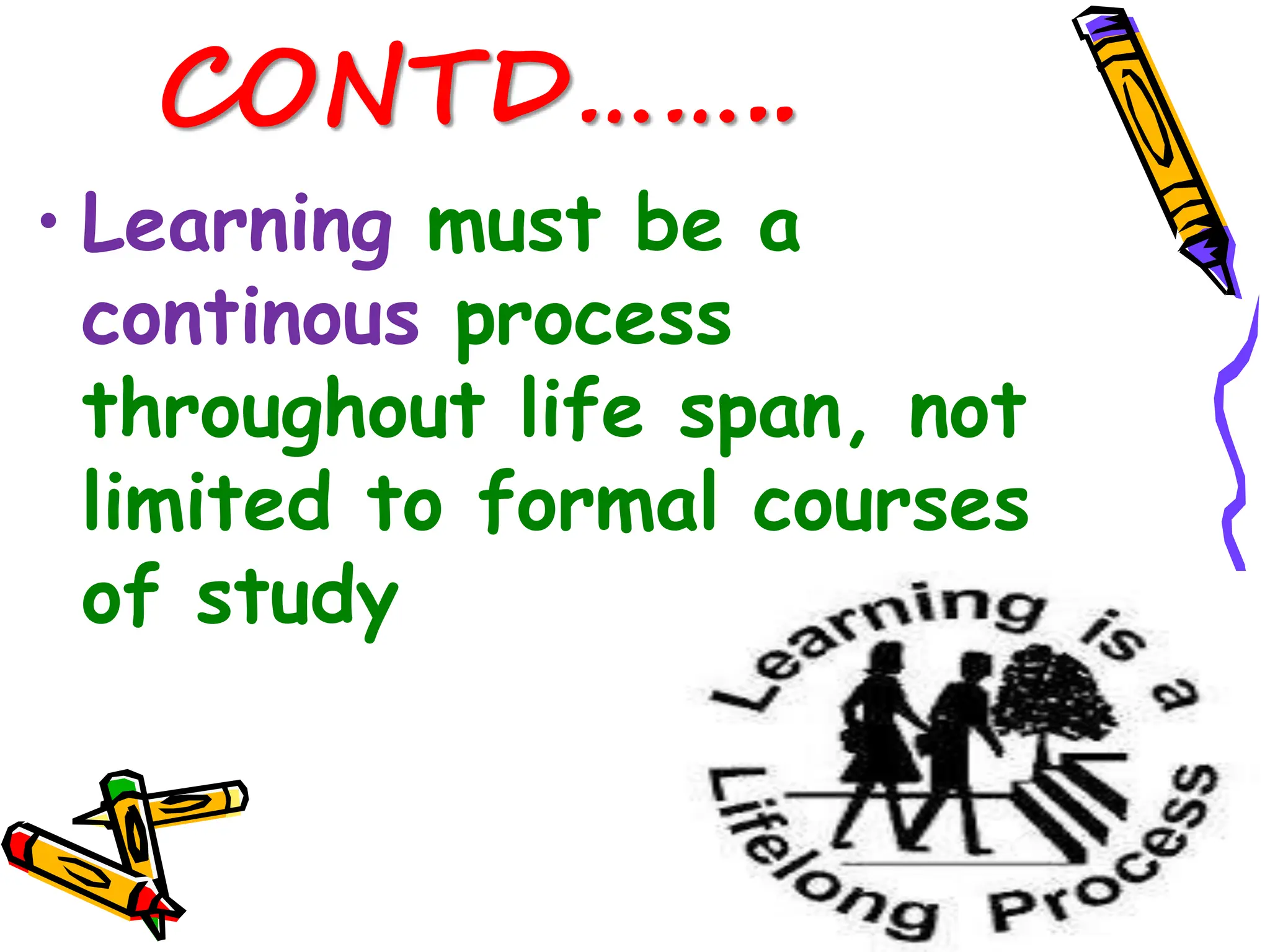
• Learning must be a
continous process
throughout life span, not
limited to formal courses
of study
CONTD…….
• Nursing is based on
knowledge of physical and
psychological functioning of
man within his environment
and expanding the knowledge
ELEMENTS
• Learner as a person, as a nurse and
as a citizen
• Teacher/ Nurse Educator
• Educational preparation
• Competnces and other characterstics
• The Faculty Administrator
• Motivation of the learner
CONTD………
• Involvement Of The Learner In The
Learning Process
• Organized learning experiences
• The needs of society.
• Universilization is necessary for
continuing nursing education
CONTD………
• The leisure
• Liberal Education
• Inter-professional in
Continuing Education
PRINCIPLES
• Provision of school and nursing
faculty involvement in planning
and teaching the continuing
nursing education courses.
• An adequate staff is essential
for planning, implementing and
evaluating a programme
• Responsibility of the director of
CNE.
• Staff services are required with
sufficient number.
• Appointment of advisory
committee.
• Continuing nursing education
program may be decentralized.
• Financial support is by either
university grants or self
supporting.
• Faculty may be assigned to
continuing education as a
regular part of the normal
teaching load.
PLANNING
PROCESS
RESEARCH IN
CONTINUING
EDUCATION
DEFINITION OF
NURSING RESEARCH
• Research is defined as
systemic and scientific
process to answer to a
question about facts. It is
an activity involved in seeking
answer to unanswered
questions
DEFINITION OF
RESEARCH IN
CONTINUING
EDUCATION
• Research in continuing nursing
education is defined as
application of scientific inquiry
to the phenomenon of concern to
the nursing. Research in
continuing education seeks to
find new knowledge that
eventually be applied in providing
nursing care to patients.
NEEDS AND
PURPOSES
• Develop, refine and extend the
scientific base of knowledge,
which is required for quality
nursing care, education and
administration.
• Enhance the body of
professional knowledge in CNE.
CONTD…….
• Provide foundation for
evidenced based practice
• Help in expansion of
knowledge, which is essential
for continued growth in
education.

CONTD……….
• Enhance the professional identity as
research is an essential component
of CNE
• Refine and eliminate the old
knowledge.
• Identify nursing care practices that
make a difference in the health care
status of individuals and are cost-
effective
IMPORTANCE AND
SIGNIFICANCE
• Development and utilization of
knowledge
• adopt a research based practice,
• CNE need to base specific nursing
actions and decisions on evidences
indicating that actions are clinically
appropriate, cost effective, and
result in positive patient outcome.
CONTD……..
• CNE for rapid advancement in medical
science and technology
• Research is essential for CNE to
understand the various dimensions of
the profession
• Research in CNE also helps to
eliminate nursing action that do not
achieve desired outcome for patients.
PLANNING FOR
IMPROVING
PRACTICE
• An initial needs assessments
can be accomplished using
strategies such as self
reflection, reading and
discussions with respected
peers.
• The next step is to choose a
learning activity.
CONTD……
• Reading materials can be useful if
they are evidence based. Secondary
sources such as this journal are
ideal because they only present high
quality research and provide a
commentary on each abstract by
clinician.

Barriers
• A gap often exists
between what is known
and what is practiced.
• Lack of resources
• Lack of motivation
• Lack of interest
RESEARCH
INPUT
SUMMARIZATION
RECAPTUALIZATION
BIBLIOGRAPHY
• Neeraja K.P , “ textbook of
communication and education
technology”, published by jaypee
brothers edition 2011 p 337-45
• Swansburg C. Russell “Nursing
Staff Development”, edition 1st,
jones and Bartlett publishers,
P-44-5
• http//www.wikipedia.com//continuing
education
• http//www.webcrawler.com//research in
education
• Sharma K Suresh, “textbook of
communication and education technology”,
published by Elsevier edition 2011 Pp
467-9
• Sharma K Suresh, “textbook of nursing
research and statistics.” Published by
Elsevier edition 2nd Pp 4-5
RESEARCH IN CONTINUING EDUCATIONresearch in CNE.ppt

RESEARCH IN CONTINUING EDUCATIONresearch in CNE.ppt

  • 1.
    RESEARCH IN CONTINUING EDUCATION Dr.Virendra Singh Choudhary
  • 2.
    INTRODUCTION • Continuing nursingeducation is a modern imperative, it must be future oriented , geared to the facing new situations and making of new responses appropriate for these situations.
  • 3.
    CONTD……. • New knowledgeis emerging rapidly in the physical, biological, behavioural and medical sciences, which constitute the foundation of nursing.
  • 4.
    CONTD……… • Continuing nursingeducation programs should be developed by nurses and conducted within nursing or in general education system in cooperation with the nurses.
  • 5.
  • 6.
    • “All thelearning activities that occurs after an individual has completed his basic education” -Cooper
  • 7.
    CONTD……… “ Education whichbuilds on previous education” –Shannon
  • 8.
  • 9.
  • 10.
  • 11.
    • Unified approach •Relationship with other systems • Comprehensiveness • Accessibility for all health professionals • Integration with the management process
  • 12.
    CONTD……… • Analysis ofneeds as a basis for learning continuity • Internally coordinated • Relevance in planning • Credibility and economics
  • 13.
  • 14.
    • To ensuresafe and effective nursing care. • Development of nurses will occur by updating their knowledge and skills to prepare them for specialization.
  • 15.
    CONTD……. • For careeradvancement • To develop competent nurse practitioners • To meet the professional forces or challenges. • Nurses with research aptitudes and preparation needed.
  • 16.
    CONTD • Clinical specialistsare needed for the direct patient care, for teaching and consultative roles to help the students and staff nurses to reach higher levels of competency.
  • 17.
    CONTD……. • Nurses inadministrative positions need to increase their understanding of administrative process • The demand for specialized nursing service is increasing more rapidly
  • 18.
    CONTD…….. • Planned programsare needed to increase nurse’s competence as practitioners. • Need for additional preparation for the positions nurses already holding or to prepare themselves for other positions.
  • 19.
    CONTD…… • To provideand prepare faculty who see continuing nursing education as a personal responsibility as well as professional and university responsibility.
  • 20.
  • 21.
    • To meetthe health needs and public expectations • To develop the practicing abilities of the nurse • For recruitment purposes • To recognize gaps in nurse’s knowledge levels
  • 22.
    CONTD…… • To testability and skills and to choose further advancement in studies • To improve the communication between the participants, faculty, community and health sector • To shape or support university educational policies and practices
  • 23.
    CONTD………. • To ensurethe quality of education. • To grant budget for extension studies. • To maintain academic standards. • To meet educational requirements.
  • 24.
  • 25.
    • Continuing nursingeducation encompasses various aspects of life and is not limited to professional educational. Continuing nursing education is concerned with the development of the nurse as a person, a practitioner and citizen.
  • 26.
    CONTD…….. • Learning mustbe a continous process throughout life span, not limited to formal courses of study
  • 27.
    CONTD……. • Nursing isbased on knowledge of physical and psychological functioning of man within his environment and expanding the knowledge
  • 28.
  • 29.
    • Learner asa person, as a nurse and as a citizen • Teacher/ Nurse Educator • Educational preparation • Competnces and other characterstics • The Faculty Administrator • Motivation of the learner
  • 30.
    CONTD……… • Involvement OfThe Learner In The Learning Process • Organized learning experiences • The needs of society. • Universilization is necessary for continuing nursing education
  • 31.
    CONTD……… • The leisure •Liberal Education • Inter-professional in Continuing Education
  • 32.
  • 33.
    • Provision ofschool and nursing faculty involvement in planning and teaching the continuing nursing education courses. • An adequate staff is essential for planning, implementing and evaluating a programme
  • 34.
    • Responsibility ofthe director of CNE. • Staff services are required with sufficient number. • Appointment of advisory committee. • Continuing nursing education program may be decentralized.
  • 35.
    • Financial supportis by either university grants or self supporting. • Faculty may be assigned to continuing education as a regular part of the normal teaching load.
  • 36.
  • 37.
  • 38.
  • 39.
    • Research isdefined as systemic and scientific process to answer to a question about facts. It is an activity involved in seeking answer to unanswered questions
  • 40.
  • 41.
    • Research incontinuing nursing education is defined as application of scientific inquiry to the phenomenon of concern to the nursing. Research in continuing education seeks to find new knowledge that eventually be applied in providing nursing care to patients.
  • 42.
  • 43.
    • Develop, refineand extend the scientific base of knowledge, which is required for quality nursing care, education and administration. • Enhance the body of professional knowledge in CNE.
  • 44.
    CONTD……. • Provide foundationfor evidenced based practice • Help in expansion of knowledge, which is essential for continued growth in education.
  • 45.
    CONTD………. • Enhance theprofessional identity as research is an essential component of CNE • Refine and eliminate the old knowledge. • Identify nursing care practices that make a difference in the health care status of individuals and are cost- effective
  • 46.
  • 47.
    • Development andutilization of knowledge • adopt a research based practice, • CNE need to base specific nursing actions and decisions on evidences indicating that actions are clinically appropriate, cost effective, and result in positive patient outcome.
  • 48.
    CONTD…….. • CNE forrapid advancement in medical science and technology • Research is essential for CNE to understand the various dimensions of the profession • Research in CNE also helps to eliminate nursing action that do not achieve desired outcome for patients.
  • 49.
  • 50.
    • An initialneeds assessments can be accomplished using strategies such as self reflection, reading and discussions with respected peers. • The next step is to choose a learning activity.
  • 51.
    CONTD…… • Reading materialscan be useful if they are evidence based. Secondary sources such as this journal are ideal because they only present high quality research and provide a commentary on each abstract by clinician.
  • 52.
  • 53.
    • A gapoften exists between what is known and what is practiced. • Lack of resources • Lack of motivation • Lack of interest
  • 54.
  • 55.
  • 56.
  • 57.
  • 58.
    • Neeraja K.P, “ textbook of communication and education technology”, published by jaypee brothers edition 2011 p 337-45 • Swansburg C. Russell “Nursing Staff Development”, edition 1st, jones and Bartlett publishers, P-44-5
  • 59.
    • http//www.wikipedia.com//continuing education • http//www.webcrawler.com//researchin education • Sharma K Suresh, “textbook of communication and education technology”, published by Elsevier edition 2011 Pp 467-9 • Sharma K Suresh, “textbook of nursing research and statistics.” Published by Elsevier edition 2nd Pp 4-5