




NURSING EDUCATION
PROGRAMS
By : SHALINI SOOD
MSc Nursing (Medical Surgical )
SR. NO CONTENTS
1. INTRODUCTION , DEFINITION , MEANING OF
NURSING
2. INTRODUCTION , DEFINITION , MEANING OF
EDUCATION
3. INTRODUCTION , DEFINITION , MEANING OF
NURSING AS A PROFESSION
4. NURSING EDUCATION PROGRAMS
• ANM
• FHW
• GNM
• BSc
• POST BASIC
• MSC
• PHD
• MPHIL
5. ROLE OF NURSING EDUCATION PROGRAMS
6. RECAPITUALIZATION
7. BIBLIOGRAPHY
NURSING
INTRODUCTION
 Diversity is the major characteristic of nursing education today.
 Influenced by a variety of factors such as social change , efforts
to achieve full professional status , women issues , historical
factors , public expectations , expectations of nurses themselves
, legislation , national studies and constant changes in the
healthcare systems many different types of nursing education
programs exist.
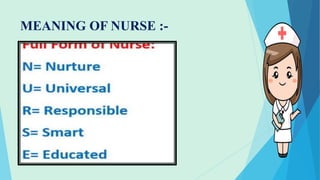
MEANING OF NURSE :-
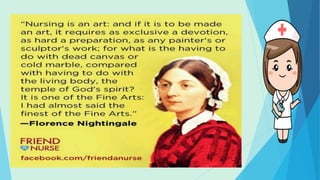
NURSING
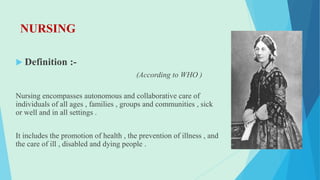
 Definition :-
(According to WHO )
Nursing encompasses autonomous and collaborative care of
individuals of all ages , families , groups and communities , sick
or well and in all settings .
It includes the promotion of health , the prevention of illness , and
the care of ill , disabled and dying people .
INTRODUCTION :-
 Education is usually understood as a course of study to
acquire a body of knowledge or skills undertaken to
enhance one's ability to do a particular job and be able
to earn more money.
 The more liberal introduction of education, where it is
understood as development and refinement of one's
personality, without necessarily an eye to economic
advantage .
EDUCATION
The word “educate” comes from the Latin word called
‘educere’ meaning to lead out or to bring out
True education is the development of
 Physical
 Mental
 Social
 Moral , the four dimensions of life
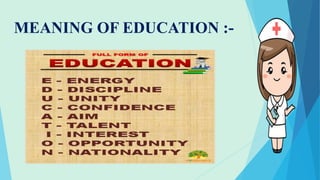
MEANING OF EDUCATION :-
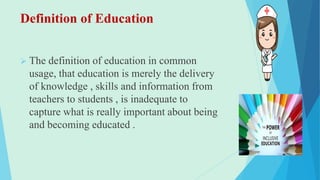
Definition of Education
 The definition of education in common
usage, that education is merely the delivery
of knowledge , skills and information from
teachers to students , is inadequate to
capture what is really important about being
and becoming educated .
NURSING AS A PROFESSION
INTRODUCTION
 It embodies many values inherent in those who pursue
nursing careers .
 When nurses are asked to identify their core values ,
they are consistent throughout the profession globally .
 Includes honesty , responsibility , pursuit of new
knowledge , belief in human dignity , equally of all
patients and the desire to prevent suffering .
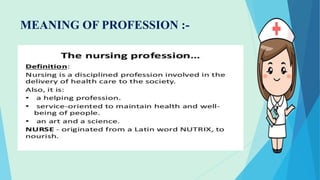
DEFINITION OF PROFESSION
A Nursing Profession is defines as
“ A vocation requiring advanced training and
usually involving mental rather than manual
work , as teaching , engineering , especially
medicine , law”.
MEANING OF PROFESSION :-
NURSING
EDUCATION
PROGRAMS
NURSING EDUCATION PROGRAMS :-
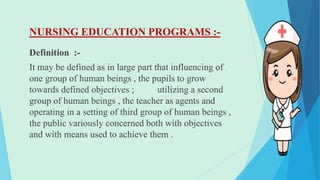
Definition :-
It may be defined as in large part that influencing of
one group of human beings , the pupils to grow
towards defined objectives ; utilizing a second
group of human beings , the teacher as agents and
operating in a setting of third group of human beings ,
the public variously concerned both with objectives
and with means used to achieve them .
NURSING EDUCATIONAL
PROGRAMS
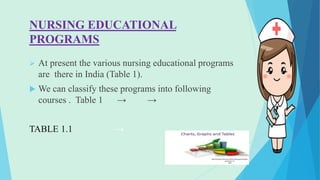
 At present the various nursing educational programs
are there in India (Table 1).
 We can classify these programs into following
courses . Table 1 → →
TABLE 1.1 →
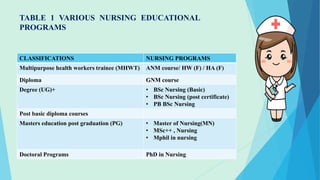
TABLE 1 VARIOUS NURSING EDUCATIONAL
PROGRAMS
CLASSIFICATIONS NURSING PROGRAMS
Multipurpose health workers trainee (MHWT) ANM course/ HW (F) / HA (F)
Diploma GNM course
Degree (UG)+ • BSc Nursing (Basic)
• BSc Nursing (post certificate)
• PB BSc Nursing
Post basic diploma courses
Masters education post graduation (PG) • Master of Nursing(MN)
• MSc++ , Nursing
• Mphil in nursing
Doctoral Programs PhD in Nursing
1. MULTIPURPOSE
HEALTH WORKER
1. ANM
2. Female Health Worker
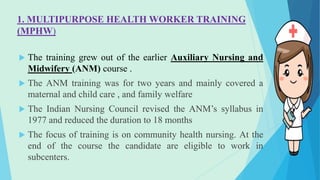
1. MULTIPURPOSE HEALTH WORKER TRAINING
(MPHW)
 The training grew out of the earlier Auxiliary Nursing and
Midwifery (ANM) course .
 The ANM training was for two years and mainly covered a
maternal and child care , and family welfare
 The Indian Nursing Council revised the ANM’s syllabus in
1977 and reduced the duration to 18 months
 The focus of training is on community health nursing. At the
end of the course the candidate are eligible to work in
subcenters.
OBJECTIVES OF ANM
 Prevention of diseases
 Rehabilitation
 Maintaining the good health of patients
SCOPE OF ANM
Community health worker
Home Nurse
Health visitor
Basic health worker
Rural health worker
ELIGIBILITY OF ANM
+2 pass in any field i.e :-
 Arts
 Medical
with minimum aggregate of 45% marks , followed by
entrance test .
 Age limit is 17 years .
 Only female students can apply for this course .
ROLE OF ANM :-
 To assist qualified nursing practitioners in
administering care to patients .
 Auxiliary nurses are often referred to as health
assistant's .
 They require no academic qualifications , and
the role can serve as a pathway into a career as
a registered nurse .
MULTIPURPOSE HEALTH WORKER
2. Female Health Supervisor training
 This course was initially meant as a health visitor
training course.
 It went through several modifications in course of
time and finally metamorphosed into the present
6 month promotional training .
 It is conducted in 21 centers in India .
OBJECTIVES OF FEMALE HEALTH
SUPERVISOR
Quality of services :-
 Adherence to norms
 Drugs , supplies
Supportive environment:-
 Emotional , motivational
 Problem solving
Communication and Information :-
 Collection on household
 Deliver educational messages
SCOPE OF FEMALE HEALTH
SUPERVISOR
 Scheduling work hours and shifts
 Coordinating job rotation
 Providing real time feedback
 Providing reports and activity
updates to management
ELIGIBILITY OF FEMALE
HEALTH WORKER :-
+2 pass in any field i.e :-
 Arts
 Medical with minimum aggregate of 45% marks ,
followed by entrance test .
 Age limit is 17 years .
 Only female students can apply for this course .
ROLE OF FEMALE HEALTH WORKER :-
 She will provide care to pregnant women especially registered
mothers through out the pregnancy.
 Distribute iron and folic acid tablets to pregnant and nursing
mothers, children and family planning adopters and Vitamin
‘A’ solution to children at twice a year from 6 months to 60
months of age.
 Spread the message of family planning to the couples.
Motivate them for family planning individuals and in groups.
 Test Urine for a albumin and sugar and hemoglobin test during
her home visits to the pregnant mothers.
2. DIPLOMA
GNM
(General Nursing Midwifery )
2. DIPLOMA
GENERAL NURSING AND MIDWIFERY COURSES
(GNM)
 The course is conducted in more than 1,000 centers in the
country.
 The latest revision of the GNM by the INC in 1988 had
reduced the duration of the course form 3.6 years to 3 years.
 Both arts and science students are eligible
 Focus – Care of the sick in the hospital
2. DIPLOMA
SCOPES OF GENERAL NURSING
AND MIDWIFERY COURSE :-
 Staff Nurse
 Home nurse
 Health visitor
 Community health worker
OBJECTIVES OF GNM
 Assess the nursing need of clients from birth to
death
 Plan and carry out appropriate action to meet
nursing needs
 Apply problem solving technique in nursing
practice
 Recognize the need of continuing education for
professional development
ELIGIBILITY OF GNM
 +2 passed with Physics , Chemistry , and Biology
 Age limit is 17 years with maximum 30 years
 This course is for both males and females .
 At least 40% of aggregate marks needed for
entrance.
ROLE OF GNM NURSE
 Assessment of various needs of the people from their birth to
death.
 They can put into effect their knowledge gained from the
humanities, biological and behavioral sciences in their
nursing career.
 GNM aspirants can work at Hospitals, Private clinics,
Schools, Private offices, Training institutes, and
Rehabilitation centers.
3. DEGREE
• 1. BSc Nursing (Basic)
• 2. BSc Nursing (Post certificate)
• 3. PB BSc Nursing
3. DEGREE
A(UNDER GRADUATE)
 There are 2 types of graduate nursing education in
India – one is of 4 year Basic Course for fresh
entrance and the second is condensed post basic
course for those who have undergone the GNM
course.
4 year Bachelor of Science in Nursing [BSc
(N) ]
Graduate nursing education started in India in the year of
1946 in Christian Medical College and Hospital (CMC),
Vellore and in the Rajkumari Amrit Kaur (RAK) College
of Nursing at Delhi University.
4 year BSc Nursing Contd…
• The course also include teachers initiative
programs.
• It lays the foundation for a holistic perspective to
health and caring.
SCOPES of BSc (Nursing)

 Provide an innovative and academically
challenging experience in order to meet the
technological revolution globally .
 Great career who go for higher studies .
OBJECTIVES OF BSC (N)

 Perform as competent professional nurses in a variety of
health care settings
 Exhibit a scientific attitude of independent enquiry into
nursing problems
 Function effectively as a member of inter disciplinary
health team and as a leader of nursing team .
ELIGIBILITY CRITERIA OF BSc :-
 The entry qualification is intermediate with
biological sciences, physics and chemistry .
 The course focuses on preparation of professional
nurses for working at the bedside and for taking up
leadership roles in public health nursing.
ROLE OF BSc (Nursing)
 Students can go for a job or go for higher studies
.
 Can join as Nursing advisors to the Indian
Government
 They can serve patients independently
 Provides necessary care when needed .
B.) POST BASIC BSc (N)
 A 2 year degree course in nursing is offered in
several universities in India.
 This course was specially designed to provide
higher educated opportunities for practicing
nurses.
C. BSc Nursing (IGNOU)
 Distance education in postbasic nursing has also been
started by Indira Gandhi National Open University
(IGNOU) in 1994 .
 This has provided an opening for diploma nurses all
over the country to undertake higher education.
 The IGNOU offers courses through its study centers
throughout the country .
4. POST BASIC DIPLOMA
COURSES
Post Basic Courses
4. POST BASIC DIPLOMA
COURSES
 These courses are designed for higher studies in chosen
specialities.
 Normally , the duration is 1 year.
 Candidates who had successfully completed there
GNM/BSc Nursing programs can apply.
 In some institutes its mandatory to complete 2 years of
work experience to attain eligibility in the course.
Post Basic Diploma courses contd…
The following are the post basic diploma courses, which
are taught in various institutes in India :-
 Diploma in Neuro Nursing
 Diploma in Cardiac Nursing
 Diploma in Psychiatric Nursing
 Diploma in Critical Care Nursing
 Diploma in Neonatal Nursing
 Diploma in Operation Theatre Technique
 Diploma of Nursing Education and Administration
SCOPE OF POST BASIC :-
Assume responsibilities as professional ,
competent nurses and midwives at basic level
in providing promotive , preventive and
curative
OBJECTIVES OF POST BASIC
 Assess the nursing need of clients from
birth to death
 Plan and carry out appropriate action to
meet nursing needs
 Apply problem solving technique in
nursing practice
 Recognize the need of continuing
education for professional development
ELIGIBILITY FOR POST BASIC :-
• The entry requirements is that they should
have completed the general nursing course
and Ⅻ.
• Two exams are conducted by the universities
one at the end of the 1st year and the other at
the end of the 2nd year .
ROLE OF POST BASIC :-
Its role is to prepare them to function
effectively as care givers/nurse
supervisors in the respective settings .
Provide efficient education to the
needy ones .
5. MASTER'S
PROGRAMME
MASTERS DEGREE
5. MASTERS EDUCATION (PG)
 Master of Science in Nursing MSc (N) course is
presently being offered in several universities in the
country.
 The 2 year course is designed to prepare clinical
and community health nursing specialists.
 The students are thought to conduct research in
nursing.
 A thesis is submitted by each student in partial
fulfilment of the requirements for the degree.
SCOPE OF MSC(N)
 Prepare graduates to assume responsibilities as :-
 Nurse specialist ,
 Consultants ,
 Educators ,
 Administration in a wide variety of professional
settings .
OBJECTIVES OF MSC (N)
 Utilize / Apply the concepts, theories and principles of
nursing science
 Demonstrate advance competence in practice of nursing
 Practice as nurse specialist
 Establish collaborative relationship with members of
other disciplines
ELIGIBILITY OF MSC (N) :-
 The entrance requirement is BSc (N) and 1 year
experience as a clinical nurse or instructor.
 Entrance test is mandatory in reputed institutions.
 University exams are conducted at the end of the
academic year or semesters.
ROLE OF MSc (N)
 It gives you a leadership or administrative role
.
 Masters degree gives you opportunity to
become a nurse trainer.
 Provide health care beneficiaries when needed .
 Provide adequate knowledge to the trainees .
6. DOCTORAL PROGRAM -
1. M. phil (Master of
Philosophy) and
2. Phd in Nursing (Doctor of
Philosophy)
6. Mphil and PhD Programs
 Till a few years ago nurses had to travel abroad
to study PhD course or seek admission in
allied disciplines .
 In the 80’s RAK (Rajkumari Amrit Kaur)
College of Nursing started an Mphil program
as a regular and part time course.
 Since then several universities started
registering candidates for PhD in nursing .
Mphil and PhD programs contd…
 Since then several universities started registering
candidates for PhD in nursing
 Prominent among these are MGR Medical University ,
Rajiv Gandhi University of Health Sciences, SNDT
University and Delhi University.
 The Manipal Academy of Higher Education (MAHE)
has started both Mphil and PhD program in nursing
through support from the WHO .
Nursing programs
 Mphil and PhD programs contd…
However, nurses keen to obtain doctorate degrees continue to
seek admission into universities and departments with related
disciplines such as community health, nutrition , social
sciences .
M. PHILAND PHD PROGRAMS
 The Jawaharlal Nehru University at New Delhi ,
the Padmavathi Mahila University , Triupathi , and
the Center for development Studies , Trivandrum
and the Centre for Economic and Social Sciences ,
Hyderabad are some of the universities and
institutes where nurses seek to obtain higher
education.
Objectives of PHd and M .Phil
It provides :-
 Treatment
 Education
 Support
Therapeutic management to promote
health within interpersonal relationships
Scope of Phd and Mphil
It enables students to integrate
 Knowledge
 Skills and
 Attitude in the areas of management , clinical
practice and generic areas of professional
nursing , and then apply them to practice
ELIGIBILITY OF PHD AND M.PHIL
Student should be of :-
Medical field (+2 Medical)
BSc (N)
1 year experience
MSC(N)
ROLE OF PHD AND M.PHIL
 The study is thesis based which provide
researchers to give helpful data related their
knowledge
 The researchers are self capable of doing
researches and conduct seminars for
enhancing the knowledge of the delegates
 They are the researchers who provide
scientific data related their study for best
outcomes .
ROLE OF NURSE IN NURSING EDUCATION
PROGRAMS
PRACTICE MAKES MAN PERFECT
 The Nursing officer plays an integral role in clinical
nursing education , helping to prepare undergraduate
nursing students for professional practice.
 The student- nurse relationship profoundly affects
learning.
 A positive experience in the clinical site can promote
learning .
ROLES OF NEP :-
 A positive experience in the clinical site can
promote learning .
 It focuses on educating health care people
about effective ways to deliver the health care
to patients .
 It educates nurses about examining the patient
and to deliver best services to patients .
 Its main role is to develop the nursing
profession .
SUMMERIZATION
SR. NO SUMMERIZATION
1. INTRODUCTION , DEFINITION , MEANING OF NURSING
2. INTRODUCTION , DEFINITION , MEANING OF EDUCATION
3. INTRODUCTION , DEFINITION , MEANING OF NURSING AS A
PROFESSION
4. NURSING EDUCATION PROGRAMS
• ANM
• FHW
• GNM
• BSc
• POST BASIC
• MSC
• PHD
• MPHIL
5. ROLE OF NURSING EDUCATION PROGRAMS
RECAPTUALIZATION
BIBLIOGRAPHY
 B.T Basanthappa textbook of Nursing Education.com
followed on 14-4-2020
 http://www.scribd.com/doc/20286451/Nursingeducationinin
diaANM-GNM-BSCandMSC#scribd followed on 15-4-2020
 http://en.Wikipedia.org/wiki/Nursing_in_india followed on
16-4-2020
 http://currentnursing.com followed on 14-4-2020
 D Elakkuvana Bhaskara Raj textbook of nursing
education,Jaypee publisher,1stedition, page no.12-15
followed on 13-4-2020
NURSING EDUCATION PROGRAMS PPT

NURSING EDUCATION PROGRAMS PPT

  • 2.
    NURSING EDUCATION PROGRAMS By :SHALINI SOOD MSc Nursing (Medical Surgical )
  • 3.
    SR. NO CONTENTS 1.INTRODUCTION , DEFINITION , MEANING OF NURSING 2. INTRODUCTION , DEFINITION , MEANING OF EDUCATION 3. INTRODUCTION , DEFINITION , MEANING OF NURSING AS A PROFESSION 4. NURSING EDUCATION PROGRAMS • ANM • FHW • GNM • BSc • POST BASIC • MSC • PHD • MPHIL 5. ROLE OF NURSING EDUCATION PROGRAMS 6. RECAPITUALIZATION 7. BIBLIOGRAPHY
  • 4.
  • 5.
    INTRODUCTION  Diversity isthe major characteristic of nursing education today.  Influenced by a variety of factors such as social change , efforts to achieve full professional status , women issues , historical factors , public expectations , expectations of nurses themselves , legislation , national studies and constant changes in the healthcare systems many different types of nursing education programs exist.
  • 6.
  • 7.
    NURSING  Definition :- (Accordingto WHO ) Nursing encompasses autonomous and collaborative care of individuals of all ages , families , groups and communities , sick or well and in all settings . It includes the promotion of health , the prevention of illness , and the care of ill , disabled and dying people .
  • 10.
    INTRODUCTION :-  Educationis usually understood as a course of study to acquire a body of knowledge or skills undertaken to enhance one's ability to do a particular job and be able to earn more money.  The more liberal introduction of education, where it is understood as development and refinement of one's personality, without necessarily an eye to economic advantage .
  • 11.
    EDUCATION The word “educate”comes from the Latin word called ‘educere’ meaning to lead out or to bring out True education is the development of  Physical  Mental  Social  Moral , the four dimensions of life
  • 12.
  • 13.
    Definition of Education The definition of education in common usage, that education is merely the delivery of knowledge , skills and information from teachers to students , is inadequate to capture what is really important about being and becoming educated .
  • 14.
    NURSING AS APROFESSION
  • 15.
    INTRODUCTION  It embodiesmany values inherent in those who pursue nursing careers .  When nurses are asked to identify their core values , they are consistent throughout the profession globally .  Includes honesty , responsibility , pursuit of new knowledge , belief in human dignity , equally of all patients and the desire to prevent suffering .
  • 16.
    DEFINITION OF PROFESSION ANursing Profession is defines as “ A vocation requiring advanced training and usually involving mental rather than manual work , as teaching , engineering , especially medicine , law”.
  • 17.
  • 18.
  • 19.
    NURSING EDUCATION PROGRAMS:- Definition :- It may be defined as in large part that influencing of one group of human beings , the pupils to grow towards defined objectives ; utilizing a second group of human beings , the teacher as agents and operating in a setting of third group of human beings , the public variously concerned both with objectives and with means used to achieve them .
  • 20.
    NURSING EDUCATIONAL PROGRAMS  Atpresent the various nursing educational programs are there in India (Table 1).  We can classify these programs into following courses . Table 1 → → TABLE 1.1 →
  • 21.
    TABLE 1 VARIOUSNURSING EDUCATIONAL PROGRAMS CLASSIFICATIONS NURSING PROGRAMS Multipurpose health workers trainee (MHWT) ANM course/ HW (F) / HA (F) Diploma GNM course Degree (UG)+ • BSc Nursing (Basic) • BSc Nursing (post certificate) • PB BSc Nursing Post basic diploma courses Masters education post graduation (PG) • Master of Nursing(MN) • MSc++ , Nursing • Mphil in nursing Doctoral Programs PhD in Nursing
  • 22.
    1. MULTIPURPOSE HEALTH WORKER 1.ANM 2. Female Health Worker
  • 23.
    1. MULTIPURPOSE HEALTHWORKER TRAINING (MPHW)  The training grew out of the earlier Auxiliary Nursing and Midwifery (ANM) course .  The ANM training was for two years and mainly covered a maternal and child care , and family welfare  The Indian Nursing Council revised the ANM’s syllabus in 1977 and reduced the duration to 18 months  The focus of training is on community health nursing. At the end of the course the candidate are eligible to work in subcenters.
  • 24.
    OBJECTIVES OF ANM Prevention of diseases  Rehabilitation  Maintaining the good health of patients
  • 25.
    SCOPE OF ANM Communityhealth worker Home Nurse Health visitor Basic health worker Rural health worker
  • 26.
    ELIGIBILITY OF ANM +2pass in any field i.e :-  Arts  Medical with minimum aggregate of 45% marks , followed by entrance test .  Age limit is 17 years .  Only female students can apply for this course .
  • 27.
    ROLE OF ANM:-  To assist qualified nursing practitioners in administering care to patients .  Auxiliary nurses are often referred to as health assistant's .  They require no academic qualifications , and the role can serve as a pathway into a career as a registered nurse .
  • 28.
    MULTIPURPOSE HEALTH WORKER 2.Female Health Supervisor training  This course was initially meant as a health visitor training course.  It went through several modifications in course of time and finally metamorphosed into the present 6 month promotional training .  It is conducted in 21 centers in India .
  • 29.
    OBJECTIVES OF FEMALEHEALTH SUPERVISOR Quality of services :-  Adherence to norms  Drugs , supplies Supportive environment:-  Emotional , motivational  Problem solving Communication and Information :-  Collection on household  Deliver educational messages
  • 30.
    SCOPE OF FEMALEHEALTH SUPERVISOR  Scheduling work hours and shifts  Coordinating job rotation  Providing real time feedback  Providing reports and activity updates to management
  • 31.
    ELIGIBILITY OF FEMALE HEALTHWORKER :- +2 pass in any field i.e :-  Arts  Medical with minimum aggregate of 45% marks , followed by entrance test .  Age limit is 17 years .  Only female students can apply for this course .
  • 32.
    ROLE OF FEMALEHEALTH WORKER :-  She will provide care to pregnant women especially registered mothers through out the pregnancy.  Distribute iron and folic acid tablets to pregnant and nursing mothers, children and family planning adopters and Vitamin ‘A’ solution to children at twice a year from 6 months to 60 months of age.  Spread the message of family planning to the couples. Motivate them for family planning individuals and in groups.  Test Urine for a albumin and sugar and hemoglobin test during her home visits to the pregnant mothers.
  • 33.
  • 34.
    2. DIPLOMA GENERAL NURSINGAND MIDWIFERY COURSES (GNM)  The course is conducted in more than 1,000 centers in the country.  The latest revision of the GNM by the INC in 1988 had reduced the duration of the course form 3.6 years to 3 years.  Both arts and science students are eligible  Focus – Care of the sick in the hospital
  • 35.
  • 36.
    SCOPES OF GENERALNURSING AND MIDWIFERY COURSE :-  Staff Nurse  Home nurse  Health visitor  Community health worker
  • 37.
    OBJECTIVES OF GNM Assess the nursing need of clients from birth to death  Plan and carry out appropriate action to meet nursing needs  Apply problem solving technique in nursing practice  Recognize the need of continuing education for professional development
  • 38.
    ELIGIBILITY OF GNM +2 passed with Physics , Chemistry , and Biology  Age limit is 17 years with maximum 30 years  This course is for both males and females .  At least 40% of aggregate marks needed for entrance.
  • 39.
    ROLE OF GNMNURSE  Assessment of various needs of the people from their birth to death.  They can put into effect their knowledge gained from the humanities, biological and behavioral sciences in their nursing career.  GNM aspirants can work at Hospitals, Private clinics, Schools, Private offices, Training institutes, and Rehabilitation centers.
  • 40.
    3. DEGREE • 1.BSc Nursing (Basic) • 2. BSc Nursing (Post certificate) • 3. PB BSc Nursing
  • 41.
    3. DEGREE A(UNDER GRADUATE) There are 2 types of graduate nursing education in India – one is of 4 year Basic Course for fresh entrance and the second is condensed post basic course for those who have undergone the GNM course.
  • 42.
    4 year Bachelorof Science in Nursing [BSc (N) ] Graduate nursing education started in India in the year of 1946 in Christian Medical College and Hospital (CMC), Vellore and in the Rajkumari Amrit Kaur (RAK) College of Nursing at Delhi University.
  • 43.
    4 year BScNursing Contd… • The course also include teachers initiative programs. • It lays the foundation for a holistic perspective to health and caring.
  • 44.
    SCOPES of BSc(Nursing)  Provide an innovative and academically challenging experience in order to meet the technological revolution globally .  Great career who go for higher studies .
  • 45.
    OBJECTIVES OF BSC(N)  Perform as competent professional nurses in a variety of health care settings  Exhibit a scientific attitude of independent enquiry into nursing problems  Function effectively as a member of inter disciplinary health team and as a leader of nursing team .
  • 46.
    ELIGIBILITY CRITERIA OFBSc :-  The entry qualification is intermediate with biological sciences, physics and chemistry .  The course focuses on preparation of professional nurses for working at the bedside and for taking up leadership roles in public health nursing.
  • 47.
    ROLE OF BSc(Nursing)  Students can go for a job or go for higher studies .  Can join as Nursing advisors to the Indian Government  They can serve patients independently  Provides necessary care when needed .
  • 48.
    B.) POST BASICBSc (N)  A 2 year degree course in nursing is offered in several universities in India.  This course was specially designed to provide higher educated opportunities for practicing nurses.
  • 49.
    C. BSc Nursing(IGNOU)  Distance education in postbasic nursing has also been started by Indira Gandhi National Open University (IGNOU) in 1994 .  This has provided an opening for diploma nurses all over the country to undertake higher education.  The IGNOU offers courses through its study centers throughout the country .
  • 50.
    4. POST BASICDIPLOMA COURSES Post Basic Courses
  • 51.
    4. POST BASICDIPLOMA COURSES  These courses are designed for higher studies in chosen specialities.  Normally , the duration is 1 year.  Candidates who had successfully completed there GNM/BSc Nursing programs can apply.  In some institutes its mandatory to complete 2 years of work experience to attain eligibility in the course.
  • 52.
    Post Basic Diplomacourses contd… The following are the post basic diploma courses, which are taught in various institutes in India :-  Diploma in Neuro Nursing  Diploma in Cardiac Nursing  Diploma in Psychiatric Nursing  Diploma in Critical Care Nursing  Diploma in Neonatal Nursing  Diploma in Operation Theatre Technique  Diploma of Nursing Education and Administration
  • 53.
    SCOPE OF POSTBASIC :- Assume responsibilities as professional , competent nurses and midwives at basic level in providing promotive , preventive and curative
  • 54.
    OBJECTIVES OF POSTBASIC  Assess the nursing need of clients from birth to death  Plan and carry out appropriate action to meet nursing needs  Apply problem solving technique in nursing practice  Recognize the need of continuing education for professional development
  • 55.
    ELIGIBILITY FOR POSTBASIC :- • The entry requirements is that they should have completed the general nursing course and Ⅻ. • Two exams are conducted by the universities one at the end of the 1st year and the other at the end of the 2nd year .
  • 56.
    ROLE OF POSTBASIC :- Its role is to prepare them to function effectively as care givers/nurse supervisors in the respective settings . Provide efficient education to the needy ones .
  • 57.
  • 58.
    5. MASTERS EDUCATION(PG)  Master of Science in Nursing MSc (N) course is presently being offered in several universities in the country.  The 2 year course is designed to prepare clinical and community health nursing specialists.  The students are thought to conduct research in nursing.  A thesis is submitted by each student in partial fulfilment of the requirements for the degree.
  • 59.
    SCOPE OF MSC(N) Prepare graduates to assume responsibilities as :-  Nurse specialist ,  Consultants ,  Educators ,  Administration in a wide variety of professional settings .
  • 60.
    OBJECTIVES OF MSC(N)  Utilize / Apply the concepts, theories and principles of nursing science  Demonstrate advance competence in practice of nursing  Practice as nurse specialist  Establish collaborative relationship with members of other disciplines
  • 61.
    ELIGIBILITY OF MSC(N) :-  The entrance requirement is BSc (N) and 1 year experience as a clinical nurse or instructor.  Entrance test is mandatory in reputed institutions.  University exams are conducted at the end of the academic year or semesters.
  • 62.
    ROLE OF MSc(N)  It gives you a leadership or administrative role .  Masters degree gives you opportunity to become a nurse trainer.  Provide health care beneficiaries when needed .  Provide adequate knowledge to the trainees .
  • 63.
    6. DOCTORAL PROGRAM- 1. M. phil (Master of Philosophy) and 2. Phd in Nursing (Doctor of Philosophy)
  • 64.
    6. Mphil andPhD Programs  Till a few years ago nurses had to travel abroad to study PhD course or seek admission in allied disciplines .  In the 80’s RAK (Rajkumari Amrit Kaur) College of Nursing started an Mphil program as a regular and part time course.  Since then several universities started registering candidates for PhD in nursing .
  • 65.
    Mphil and PhDprograms contd…  Since then several universities started registering candidates for PhD in nursing  Prominent among these are MGR Medical University , Rajiv Gandhi University of Health Sciences, SNDT University and Delhi University.  The Manipal Academy of Higher Education (MAHE) has started both Mphil and PhD program in nursing through support from the WHO .
  • 66.
    Nursing programs  Mphiland PhD programs contd… However, nurses keen to obtain doctorate degrees continue to seek admission into universities and departments with related disciplines such as community health, nutrition , social sciences .
  • 67.
    M. PHILAND PHDPROGRAMS  The Jawaharlal Nehru University at New Delhi , the Padmavathi Mahila University , Triupathi , and the Center for development Studies , Trivandrum and the Centre for Economic and Social Sciences , Hyderabad are some of the universities and institutes where nurses seek to obtain higher education.
  • 69.
    Objectives of PHdand M .Phil It provides :-  Treatment  Education  Support Therapeutic management to promote health within interpersonal relationships
  • 70.
    Scope of Phdand Mphil It enables students to integrate  Knowledge  Skills and  Attitude in the areas of management , clinical practice and generic areas of professional nursing , and then apply them to practice
  • 71.
    ELIGIBILITY OF PHDAND M.PHIL Student should be of :- Medical field (+2 Medical) BSc (N) 1 year experience MSC(N)
  • 72.
    ROLE OF PHDAND M.PHIL  The study is thesis based which provide researchers to give helpful data related their knowledge  The researchers are self capable of doing researches and conduct seminars for enhancing the knowledge of the delegates  They are the researchers who provide scientific data related their study for best outcomes .
  • 74.
    ROLE OF NURSEIN NURSING EDUCATION PROGRAMS PRACTICE MAKES MAN PERFECT  The Nursing officer plays an integral role in clinical nursing education , helping to prepare undergraduate nursing students for professional practice.  The student- nurse relationship profoundly affects learning.  A positive experience in the clinical site can promote learning .
  • 75.
    ROLES OF NEP:-  A positive experience in the clinical site can promote learning .  It focuses on educating health care people about effective ways to deliver the health care to patients .  It educates nurses about examining the patient and to deliver best services to patients .  Its main role is to develop the nursing profession .
  • 76.
    SUMMERIZATION SR. NO SUMMERIZATION 1.INTRODUCTION , DEFINITION , MEANING OF NURSING 2. INTRODUCTION , DEFINITION , MEANING OF EDUCATION 3. INTRODUCTION , DEFINITION , MEANING OF NURSING AS A PROFESSION 4. NURSING EDUCATION PROGRAMS • ANM • FHW • GNM • BSc • POST BASIC • MSC • PHD • MPHIL 5. ROLE OF NURSING EDUCATION PROGRAMS
  • 78.
  • 79.
    BIBLIOGRAPHY  B.T Basanthappatextbook of Nursing Education.com followed on 14-4-2020  http://www.scribd.com/doc/20286451/Nursingeducationinin diaANM-GNM-BSCandMSC#scribd followed on 15-4-2020  http://en.Wikipedia.org/wiki/Nursing_in_india followed on 16-4-2020  http://currentnursing.com followed on 14-4-2020  D Elakkuvana Bhaskara Raj textbook of nursing education,Jaypee publisher,1stedition, page no.12-15 followed on 13-4-2020