EVALUATION OF EDUCATIONAL
PROGRAMS IN NURSING
BY : Ms Arushi negi
MSc Nursing 1st year.
• Program Evaluation is the process of judging the
worth or value of an educational program.
• Purpose of program evaluation is to provide data
on which to base decisions about the educational
program and to provide evidence of educational
effectiveness in response to internal and external
demands .
• Evaluation is a systematic process by which the worth or
value of something ,in nursing education : teaching and
learning is judged.
• It is an ongoing process of collecting and describing data
which provide the basis for decision making specially
evaluative data can be used to prepare for accredition
visits ,account for budgetary expenditures examine the
planned and actual efforts of the programme within the
community and make changes accordingly.
• How elements of the program influence program
effectiveness?
• Extent of missing goals and outcomes of program
• Whether the program has been implemented as planned
• Efficient use of resources to improve program quality
• If program is effective in producing the desired outcome
• Continuous quality improvement
why ?
• Guide program evaluation activities in nursing
education programs
• Provide a framework to develop an evaluation plan
• With a planned, systematic evaluation, administrators,
faculty members, and others involved in the program
have information for quality improvement.
1. Accreditation Model
Accreditation is a means of ensuring that institutions of
higher education programs meet standards and of
indicating to the public that they offer a quality education
for students.
Accreditation involves internally reviewing and assessing
one’s own programs on a continuous basis to identify
areas requiring revision and participating in an external
review, including a site visit, to verify the standards are
met.
Nursing education programs must be approved by the state
board of nursing and by the regional accrediting body i.e
State Nursing Council and Indian Nursing Council.
• They set standards for nursing practice and education in
state.
• Nursing education programs cannot operate without
approval because they have responsibility in ensuring
safe nursing practice .
• Each state board has its own set of standards that nursing
education programs within the state need to meet for
approval.
Types of Accreditation
• There are two types of accreditation:
A) Institutional (at the university or college level)
B) Programmatic (at the program or discipline level)
• Saewert (2017) described eight models for program
evaluation: objective- based, goal-free, expert-oriented,
naturalistic, participative oriented,improvement-focused,
success case, and theory-driven.
• Eclectic approach-design own model by selecting
features from more than one.
• Decision oriented model- provide information to
decision makers for program improvement.
• Systems oriented model-these examine inputs into the
program as well as program resources
• Curriculum is the overall content i.e lessons and
academic content taught in aspecific course or program.
• Here the focus is on elements, central to the course of
studies taken by students.
• In evaluating the curriculum, the main areas to assess
are:Philosophy,conceptual framework,program
outcomes,curriculum design,courses,teaching–learning
strategies,assessment methods,resources and
partnerships etc.
• Course is a unit of teaching that typically lasts one
academic term. So all aspects of course design and
implementation is included in the evaluation.
To determine the extent to which:
• Course outcomes are appropriate and relate to the
program outcomes.
• Content is up-to-date and evidence based.
• Course is logically organized.
•Teaching methods and learning activities are relevant for
the course outcomes (or objectives).
•Assessment methods are related to the course outcomes.
•Assignments are appropriate and promote learning.
•Grading criteria are clear and adhered to.
•Students are satisfied with the course.
•Faculty are satisfied with the course.
• Whether they facilitated student learning and the extent
to which they engaged students actively.
• Faculty members should evaluate the effectiveness of
the teaching methods and each assignment
• Teaching methods should promote active involvement of
students and interactions with others, one-to-one and in
small groups.
• The research in nursing education suggests five qualities
of effective teaching in nursing: (a) knowledge, (b) clinical
competence, (c) teaching skill, (d) interpersonal
relationships with learners, and (e) personal
characteristics.
• Teaching effectiveness data are available from a variety of
sources that include students, peers, administrators, and
others involved in the educational experience such as
preceptors.
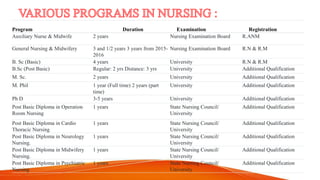
Programsing Programs Training dDurationDuration ExaminationExamination RRegistrationegistration
Auxiliary Nurse & Midwife 2 years Nursing Examination Board R.ANM
General Nursing & Midwifery 3 and 1/2 years 3 years from 2015-
2016
Nursing Examination Board R.N & R.M
B. Sc (Basic) 4 years University R.N & R.M
B.Sc (Post Basic) Regular: 2 yrs Distance: 3 yrs University Additional Qualification
M. Sc. 2 years University Additional Qualification
M. Phil 1 year (Full time) 2 years (part
time)
University Additional Qualification
Ph D 3-5 years University Additional Qualification
Post Basic Diploma in Operation
Room Nursing
1 years State Nursing Council/
University
Additional Qualification
Post Basic Diploma in Cardio
Thoracic Nursing
1 years State Nursing Council/
University
Additional Qualification
Post Basic Diploma in Neurology
Nursing.
1 years State Nursing Council/
University
Additional Qualification
Post Basic Diploma in Midwifery
Nursing.
1 years State Nursing Council/
University
Additional Qualification
Post Basic Diploma in Psychiatric
Nursing
1 years State Nursing Council/
University
Additional Qualification
Post Basic Diploma in Critical Care
Nursing
1 years State Nursing Council/
University
Additional Qualification
Post Basic Diploma in Emergency &
Disaster Nursing
1 years State Nursing Council/
University
Additional Qualification
Post Basic Diploma in Oncology
Nursing
1 years State Nursing Council/
University
Additional Qualification
Post Basic Diploma in Ortho and
Rehabilitation Nursing
1 years State Nursing Council/
University
Additional Qualification
Post Basic Diploma in Geriatric
Nursing
1 years State Nursing Council/
University
Additional Qualification
Post Basic Diploma in Neonatal
Nursing
1 years State Nursing Council/
University
Additional Qualification
Post Basic Diploma in Forensic
Nursing
1 years State Nursing Council/
University
Additional Qualification
Post Basic Diploma in Haematology
Nursing-Residency Programme
1 years State Nursing Council/
University
Additional Qualification
Post Basic Diploma in Burn &
Reconstructive Surgery Nursing –
Residency Programme
1 years State Nursing Council/
University
Additional Qualification
Nurse Practitioner in Critical Care 2 years University Additional Qualification
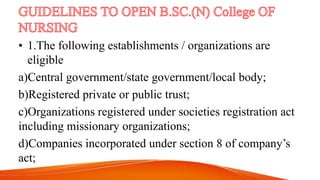
• 1.The following establishments / organizations are
eligible
a)Central government/state government/local body;
b)Registered private or public trust;
c)Organizations registered under societies registration act
including missionary organizations;
d)Companies incorporated under section 8 of company’s
act;
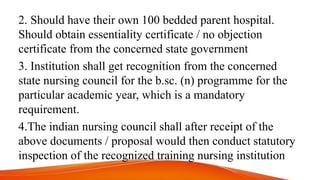
2. Should have their own 100 bedded parent hospital.
Should obtain essentiality certificate / no objection
certificate from the concerned state government
3. Institution shall get recognition from the concerned
state nursing council for the b.sc. (n) programme for the
particular academic year, which is a mandatory
requirement.
4.The indian nursing council shall after receipt of the
above documents / proposal would then conduct statutory
inspection of the recognized training nursing institution
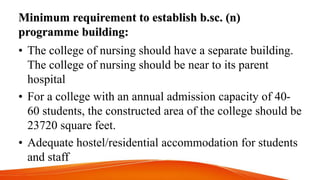
Minimum requirement to establish b.sc. (n)
programme building:
• The college of nursing should have a separate building.
The college of nursing should be near to its parent
hospital
• For a college with an annual admission capacity of 40-
60 students, the constructed area of the college should be
23720 square feet.
• Adequate hostel/residential accommodation for students
and staff
Teaching block
• Lecture hall 4 , nursing foundation lab ,chn , nutrition
,obg and paediatrics lab,pre-clinical science
lab,computer lab.
• Multipurpose hall,Common room,Staff room, Principal
room,Vice principal room
• Library ,A.v. Aids room ,One room for each head of
departments, Faculty room
• Provisions for toilets.
• Physical facilities
• Class rooms -at least four classrooms ,well ventilated
with proper lighting system ,built in black/green/white
boards.
• Also a desk/ dais/a big table and chair for teacher and
racks/cupboards for keeping teaching aids
• Departments- FON including nutrition , MSN,
CHN,OBG,PAED,MHN
• Laboratories
• Auditorium- accommodate at least double the
sanctioned/actual strength of students,
• Multipurpose hall
• Library- separate library for the college, accessible to
the teaching faculty and the students.
• Seating arrangements for 60 students,good lighting and
ventilation and space for stocking and displaying of
books and journals. The library should have at least
3000 books.
• Offices requirements- accommodate the entire office
staff with separate cabin.Should be adequately furnished
• Principal’s office- provision for visitor’s room
,telephone facility
• Office for vice-principal -provision for visitor’s
room,Independent telephone facility
• Office for faculty members -Separate toilet facility should be
provided for the teaching faculty with hand washing facility.
Separate chambers for heads of the department should be there.
• Common rooms a minimum of 3 common rooms should be
provided.
• Record room- separate record room with steel racks, built-in
shelves and racks, cupboards and filing cabinets for proper
storage of records
• Store room- accommodate the equipments and inventory
articles which are required in the laboratories of the college.
• Audio-visual aids room- safe storage for all the audio- visual
aids.
• Safe drinking water and adequate sanitary/toilet facilities
should be available for both men and women separately in the
college in each floor common toilets for teachers (separate for
male and female) i.e 4 toilets with wash basins
• Garage should accommodate a 60 seater vehicle.
Hostel block area
• Single room , double room ,Sanitary one latrine & one
bath room (for 5 students).
• Visitor room ,Reading room ,Store ,Recreation room
,Dining hall ,Kitchen & store.
Post, qualification & experience
• Principal cum professor - 15 years experience with
m.sc.(n) out of which 12 years should be teaching
experience with minimum of 5 years in collegiate
programme. Ph.d.(n) is desirable.
• Vice- principal cum professor - 12 years experience with
m.sc.(n) out of which 10 years should be teaching experience
with minimum of 5 years in collegiate programme.
• Professor- 10 years experience with m.sc.(n) out of which 7
years should be teaching experience.
• Associate professor - m.sc. (n) with 8 years experience
including 5 years teaching experience.
• Assistant professor- m.sc. (n) with 3 years teaching
experience
• Tutor-M.Sc.(n) or b.sc.(n)/p.b.b.sc.(n) with 1 year experience
1:10 teacher student ratio norms (teacher) tutor student
ratio
• Central government/state government/local body;
• Registered private or public trust;
• Organisations registered under societies registration act
including missionary organisations;
• Companies incorporated under section 8 of company’s act;
• No objection certificate and Statutory inspection
• Physical facilities
• Nursing teaching faculty
• Clinical facilities
• Central government/state government/local body OR Registered private
or public trust OR Organisations registered under societies registration
act including missionary organisations ORCompanies incorporated under
section 8 of company’s act
• Should have their own 100 bedded parent hospital.
• No objection certificate
• Recognition state nursing council for the gnm programme
• Statutory inspection
• Physical facilities, Adequate hostel/residential accommodation , Nursing
teaching faculty , Clinical facilities , Admission terms and conditions
• Central government/state government/local body OR
Registered private or public trust OR Organizations registered
under societies registration act including missionary
organizations OR Companies incorporated under section 8 of
company’s act OR institute already offering b.sc (n) programme
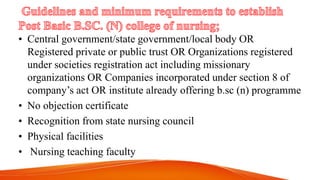
• No objection certificate
• Recognition from state nursing council
• Physical facilities
• Nursing teaching faculty
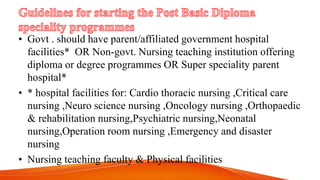
• Govt . should have parent/affiliated government hospital
facilities* OR Non-govt. Nursing teaching institution offering
diploma or degree programmes OR Super speciality parent
hospital*
• * hospital facilities for: Cardio thoracic nursing ,Critical care
nursing ,Neuro science nursing ,Oncology nursing ,Orthopaedic
& rehabilitation nursing,Psychiatric nursing,Neonatal
nursing,Operation room nursing ,Emergency and disaster
nursing
• Nursing teaching faculty & Physical facilities
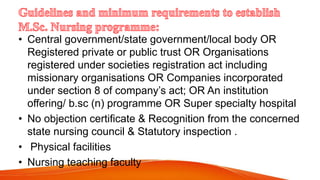
• Central government/state government/local body OR
Registered private or public trust OR Organisations
registered under societies registration act including
missionary organisations OR Companies incorporated
under section 8 of company’s act; OR An institution
offering/ b.sc (n) programme OR Super specialty hospital
• No objection certificate & Recognition from the concerned
state nursing council & Statutory inspection .
• Physical facilities
• Nursing teaching faculty
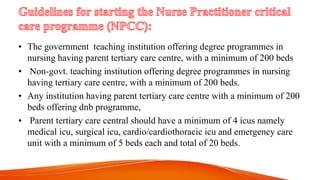
• The government teaching institution offering degree programmes in
nursing having parent tertiary care centre, with a minimum of 200 beds
• Non-govt. teaching institution offering degree programmes in nursing
having tertiary care centre, with a minimum of 200 beds.
• Any institution having parent tertiary care centre with a minimum of 200
beds offering dnb programme,
• Parent tertiary care central should have a minimum of 4 icus namely
medical icu, surgical icu, cardio/cardiothoracic icu and emergency care
unit with a minimum of 5 beds each and total of 20 beds.
• Evaluation of doctoral nursing programs – a review and a
strategy for follow up . June 2005 nurse education
today ,By Karin i kjellgren ,linköping university
,catharina welin, ella danielson ,University of gothenburg
• Available at -
https://www.researchgate.net/publication/7845889_evalu
ation_of_doctoral_nursing_programs_-
_a_review_and_a_strategy_for_follow_up
• The aims of the paper were to review the literature about evaluation of
higher education with focus on doctoral programs in nursing, and to
present a strategy to evaluate a doctoral nursing program.
• From the review it is concluded that more systematic evaluations are
necessary to guide the development of quality in nursing.
• Attention must be given to the curriculam, competence in the faculty, the
research activity and to the students' involvement in courses and
research.
• Therefore, a strategy for evaluation should be ongoing, flexible,
systematic and comprehensive. It should involve students, graduates,
employers and faculty members in evaluation, include process and
outcome data and give possibility for comparison to internal and external
standards.
• The strategy developed aims to facilitate ongoing and future
• This chapter presents an overview of program evalu-ation
models; discusses evaluation of selected program
components, including curriculum, outcomes, and
teaching; and explains how to develop an assessment plan
in a nursing education program.
• Evaluation is a systematic process by which the worth or value of
something ,in nursing education teaching and learning is judged
• It is an ongoing process of collecting and describing data which
provide the basis for decision making specially evaluative data
can be used to prepare for accredition visits ,account for budgetary
expenditures examine the planned and actual efforts of the
programme within the community and make changes accordingly.
• Oermann Marilyn and Gaberson Kathleen, Evaluation and
testing in nursing education , sixth edition, chapter nineteen ,
program evaluation, pg no 315 -335.
• Guidelines from Indian Nursing Council , avaialable at:
https://indiannursingcouncil.org/nursing-programs-guidelines
• Research avaialable at
https://www.researchgate.net/publication/7845889_evaluation_o
f_doctoral_nursing_programs_-
_a_review_and_a_strategy_for_follow_up
Ppt on evaluation of education programs in nursing

Ppt on evaluation of education programs in nursing

  • 1.
    EVALUATION OF EDUCATIONAL PROGRAMSIN NURSING BY : Ms Arushi negi MSc Nursing 1st year.
  • 2.
    • Program Evaluationis the process of judging the worth or value of an educational program. • Purpose of program evaluation is to provide data on which to base decisions about the educational program and to provide evidence of educational effectiveness in response to internal and external demands .
  • 3.
    • Evaluation isa systematic process by which the worth or value of something ,in nursing education : teaching and learning is judged. • It is an ongoing process of collecting and describing data which provide the basis for decision making specially evaluative data can be used to prepare for accredition visits ,account for budgetary expenditures examine the planned and actual efforts of the programme within the community and make changes accordingly.
  • 4.
    • How elementsof the program influence program effectiveness? • Extent of missing goals and outcomes of program • Whether the program has been implemented as planned • Efficient use of resources to improve program quality • If program is effective in producing the desired outcome • Continuous quality improvement
  • 5.
    why ? • Guideprogram evaluation activities in nursing education programs • Provide a framework to develop an evaluation plan • With a planned, systematic evaluation, administrators, faculty members, and others involved in the program have information for quality improvement.
  • 6.
    1. Accreditation Model Accreditationis a means of ensuring that institutions of higher education programs meet standards and of indicating to the public that they offer a quality education for students. Accreditation involves internally reviewing and assessing one’s own programs on a continuous basis to identify areas requiring revision and participating in an external review, including a site visit, to verify the standards are met.
  • 7.
    Nursing education programsmust be approved by the state board of nursing and by the regional accrediting body i.e State Nursing Council and Indian Nursing Council. • They set standards for nursing practice and education in state. • Nursing education programs cannot operate without approval because they have responsibility in ensuring safe nursing practice . • Each state board has its own set of standards that nursing education programs within the state need to meet for approval.
  • 8.
    Types of Accreditation •There are two types of accreditation: A) Institutional (at the university or college level) B) Programmatic (at the program or discipline level)
  • 9.
    • Saewert (2017)described eight models for program evaluation: objective- based, goal-free, expert-oriented, naturalistic, participative oriented,improvement-focused, success case, and theory-driven. • Eclectic approach-design own model by selecting features from more than one. • Decision oriented model- provide information to decision makers for program improvement. • Systems oriented model-these examine inputs into the program as well as program resources
  • 10.
    • Curriculum isthe overall content i.e lessons and academic content taught in aspecific course or program. • Here the focus is on elements, central to the course of studies taken by students. • In evaluating the curriculum, the main areas to assess are:Philosophy,conceptual framework,program outcomes,curriculum design,courses,teaching–learning strategies,assessment methods,resources and partnerships etc.
  • 11.
    • Course isa unit of teaching that typically lasts one academic term. So all aspects of course design and implementation is included in the evaluation. To determine the extent to which: • Course outcomes are appropriate and relate to the program outcomes. • Content is up-to-date and evidence based. • Course is logically organized.
  • 12.
    •Teaching methods andlearning activities are relevant for the course outcomes (or objectives). •Assessment methods are related to the course outcomes. •Assignments are appropriate and promote learning. •Grading criteria are clear and adhered to. •Students are satisfied with the course. •Faculty are satisfied with the course.
  • 13.
    • Whether theyfacilitated student learning and the extent to which they engaged students actively. • Faculty members should evaluate the effectiveness of the teaching methods and each assignment • Teaching methods should promote active involvement of students and interactions with others, one-to-one and in small groups.
  • 14.
    • The researchin nursing education suggests five qualities of effective teaching in nursing: (a) knowledge, (b) clinical competence, (c) teaching skill, (d) interpersonal relationships with learners, and (e) personal characteristics. • Teaching effectiveness data are available from a variety of sources that include students, peers, administrators, and others involved in the educational experience such as preceptors.
  • 15.
    Programsing Programs TrainingdDurationDuration ExaminationExamination RRegistrationegistration Auxiliary Nurse & Midwife 2 years Nursing Examination Board R.ANM General Nursing & Midwifery 3 and 1/2 years 3 years from 2015- 2016 Nursing Examination Board R.N & R.M B. Sc (Basic) 4 years University R.N & R.M B.Sc (Post Basic) Regular: 2 yrs Distance: 3 yrs University Additional Qualification M. Sc. 2 years University Additional Qualification M. Phil 1 year (Full time) 2 years (part time) University Additional Qualification Ph D 3-5 years University Additional Qualification Post Basic Diploma in Operation Room Nursing 1 years State Nursing Council/ University Additional Qualification Post Basic Diploma in Cardio Thoracic Nursing 1 years State Nursing Council/ University Additional Qualification Post Basic Diploma in Neurology Nursing. 1 years State Nursing Council/ University Additional Qualification Post Basic Diploma in Midwifery Nursing. 1 years State Nursing Council/ University Additional Qualification Post Basic Diploma in Psychiatric Nursing 1 years State Nursing Council/ University Additional Qualification
  • 16.
    Post Basic Diplomain Critical Care Nursing 1 years State Nursing Council/ University Additional Qualification Post Basic Diploma in Emergency & Disaster Nursing 1 years State Nursing Council/ University Additional Qualification Post Basic Diploma in Oncology Nursing 1 years State Nursing Council/ University Additional Qualification Post Basic Diploma in Ortho and Rehabilitation Nursing 1 years State Nursing Council/ University Additional Qualification Post Basic Diploma in Geriatric Nursing 1 years State Nursing Council/ University Additional Qualification Post Basic Diploma in Neonatal Nursing 1 years State Nursing Council/ University Additional Qualification Post Basic Diploma in Forensic Nursing 1 years State Nursing Council/ University Additional Qualification Post Basic Diploma in Haematology Nursing-Residency Programme 1 years State Nursing Council/ University Additional Qualification Post Basic Diploma in Burn & Reconstructive Surgery Nursing – Residency Programme 1 years State Nursing Council/ University Additional Qualification Nurse Practitioner in Critical Care 2 years University Additional Qualification
  • 17.
    • 1.The followingestablishments / organizations are eligible a)Central government/state government/local body; b)Registered private or public trust; c)Organizations registered under societies registration act including missionary organizations; d)Companies incorporated under section 8 of company’s act;
  • 18.
    2. Should havetheir own 100 bedded parent hospital. Should obtain essentiality certificate / no objection certificate from the concerned state government 3. Institution shall get recognition from the concerned state nursing council for the b.sc. (n) programme for the particular academic year, which is a mandatory requirement. 4.The indian nursing council shall after receipt of the above documents / proposal would then conduct statutory inspection of the recognized training nursing institution
  • 19.
    Minimum requirement toestablish b.sc. (n) programme building: • The college of nursing should have a separate building. The college of nursing should be near to its parent hospital • For a college with an annual admission capacity of 40- 60 students, the constructed area of the college should be 23720 square feet. • Adequate hostel/residential accommodation for students and staff
  • 20.
    Teaching block • Lecturehall 4 , nursing foundation lab ,chn , nutrition ,obg and paediatrics lab,pre-clinical science lab,computer lab. • Multipurpose hall,Common room,Staff room, Principal room,Vice principal room • Library ,A.v. Aids room ,One room for each head of departments, Faculty room • Provisions for toilets.
  • 21.
    • Physical facilities •Class rooms -at least four classrooms ,well ventilated with proper lighting system ,built in black/green/white boards. • Also a desk/ dais/a big table and chair for teacher and racks/cupboards for keeping teaching aids • Departments- FON including nutrition , MSN, CHN,OBG,PAED,MHN • Laboratories • Auditorium- accommodate at least double the sanctioned/actual strength of students,
  • 22.
    • Multipurpose hall •Library- separate library for the college, accessible to the teaching faculty and the students. • Seating arrangements for 60 students,good lighting and ventilation and space for stocking and displaying of books and journals. The library should have at least 3000 books. • Offices requirements- accommodate the entire office staff with separate cabin.Should be adequately furnished • Principal’s office- provision for visitor’s room ,telephone facility
  • 23.
    • Office forvice-principal -provision for visitor’s room,Independent telephone facility • Office for faculty members -Separate toilet facility should be provided for the teaching faculty with hand washing facility. Separate chambers for heads of the department should be there. • Common rooms a minimum of 3 common rooms should be provided. • Record room- separate record room with steel racks, built-in shelves and racks, cupboards and filing cabinets for proper storage of records • Store room- accommodate the equipments and inventory articles which are required in the laboratories of the college.
  • 24.
    • Audio-visual aidsroom- safe storage for all the audio- visual aids. • Safe drinking water and adequate sanitary/toilet facilities should be available for both men and women separately in the college in each floor common toilets for teachers (separate for male and female) i.e 4 toilets with wash basins • Garage should accommodate a 60 seater vehicle.
  • 25.
    Hostel block area •Single room , double room ,Sanitary one latrine & one bath room (for 5 students). • Visitor room ,Reading room ,Store ,Recreation room ,Dining hall ,Kitchen & store. Post, qualification & experience • Principal cum professor - 15 years experience with m.sc.(n) out of which 12 years should be teaching experience with minimum of 5 years in collegiate programme. Ph.d.(n) is desirable.
  • 26.
    • Vice- principalcum professor - 12 years experience with m.sc.(n) out of which 10 years should be teaching experience with minimum of 5 years in collegiate programme. • Professor- 10 years experience with m.sc.(n) out of which 7 years should be teaching experience. • Associate professor - m.sc. (n) with 8 years experience including 5 years teaching experience. • Assistant professor- m.sc. (n) with 3 years teaching experience • Tutor-M.Sc.(n) or b.sc.(n)/p.b.b.sc.(n) with 1 year experience 1:10 teacher student ratio norms (teacher) tutor student ratio
  • 27.
    • Central government/stategovernment/local body; • Registered private or public trust; • Organisations registered under societies registration act including missionary organisations; • Companies incorporated under section 8 of company’s act; • No objection certificate and Statutory inspection • Physical facilities • Nursing teaching faculty • Clinical facilities
  • 28.
    • Central government/stategovernment/local body OR Registered private or public trust OR Organisations registered under societies registration act including missionary organisations ORCompanies incorporated under section 8 of company’s act • Should have their own 100 bedded parent hospital. • No objection certificate • Recognition state nursing council for the gnm programme • Statutory inspection • Physical facilities, Adequate hostel/residential accommodation , Nursing teaching faculty , Clinical facilities , Admission terms and conditions
  • 29.
    • Central government/stategovernment/local body OR Registered private or public trust OR Organizations registered under societies registration act including missionary organizations OR Companies incorporated under section 8 of company’s act OR institute already offering b.sc (n) programme • No objection certificate • Recognition from state nursing council • Physical facilities • Nursing teaching faculty
  • 30.
    • Govt .should have parent/affiliated government hospital facilities* OR Non-govt. Nursing teaching institution offering diploma or degree programmes OR Super speciality parent hospital* • * hospital facilities for: Cardio thoracic nursing ,Critical care nursing ,Neuro science nursing ,Oncology nursing ,Orthopaedic & rehabilitation nursing,Psychiatric nursing,Neonatal nursing,Operation room nursing ,Emergency and disaster nursing • Nursing teaching faculty & Physical facilities
  • 31.
    • Central government/stategovernment/local body OR Registered private or public trust OR Organisations registered under societies registration act including missionary organisations OR Companies incorporated under section 8 of company’s act; OR An institution offering/ b.sc (n) programme OR Super specialty hospital • No objection certificate & Recognition from the concerned state nursing council & Statutory inspection . • Physical facilities • Nursing teaching faculty
  • 32.
    • The governmentteaching institution offering degree programmes in nursing having parent tertiary care centre, with a minimum of 200 beds • Non-govt. teaching institution offering degree programmes in nursing having tertiary care centre, with a minimum of 200 beds. • Any institution having parent tertiary care centre with a minimum of 200 beds offering dnb programme, • Parent tertiary care central should have a minimum of 4 icus namely medical icu, surgical icu, cardio/cardiothoracic icu and emergency care unit with a minimum of 5 beds each and total of 20 beds.
  • 33.
    • Evaluation ofdoctoral nursing programs – a review and a strategy for follow up . June 2005 nurse education today ,By Karin i kjellgren ,linköping university ,catharina welin, ella danielson ,University of gothenburg • Available at - https://www.researchgate.net/publication/7845889_evalu ation_of_doctoral_nursing_programs_- _a_review_and_a_strategy_for_follow_up
  • 34.
    • The aimsof the paper were to review the literature about evaluation of higher education with focus on doctoral programs in nursing, and to present a strategy to evaluate a doctoral nursing program. • From the review it is concluded that more systematic evaluations are necessary to guide the development of quality in nursing. • Attention must be given to the curriculam, competence in the faculty, the research activity and to the students' involvement in courses and research. • Therefore, a strategy for evaluation should be ongoing, flexible, systematic and comprehensive. It should involve students, graduates, employers and faculty members in evaluation, include process and outcome data and give possibility for comparison to internal and external standards. • The strategy developed aims to facilitate ongoing and future
  • 35.
    • This chapterpresents an overview of program evalu-ation models; discusses evaluation of selected program components, including curriculum, outcomes, and teaching; and explains how to develop an assessment plan in a nursing education program.
  • 36.
    • Evaluation isa systematic process by which the worth or value of something ,in nursing education teaching and learning is judged • It is an ongoing process of collecting and describing data which provide the basis for decision making specially evaluative data can be used to prepare for accredition visits ,account for budgetary expenditures examine the planned and actual efforts of the programme within the community and make changes accordingly.
  • 37.

    • Oermann Marilynand Gaberson Kathleen, Evaluation and testing in nursing education , sixth edition, chapter nineteen , program evaluation, pg no 315 -335. • Guidelines from Indian Nursing Council , avaialable at: https://indiannursingcouncil.org/nursing-programs-guidelines • Research avaialable at https://www.researchgate.net/publication/7845889_evaluation_o f_doctoral_nursing_programs_- _a_review_and_a_strategy_for_follow_up